The moment that changed John Wayne’s life lasts only a few seconds on screen. A rifle spins into his hand in John Ford’s 1939 film *Stagecoach*, the camera rushes toward him, and his face comes suddenly close, young and open. To audiences, it looked like the arrival of a new star. In truth, the man in the frame had already spent nearly a decade trying not to disappear.
He had already been given one enormous chance as a leading man in a costly epic, and when that chance failed to make him a star, Hollywood kept him working just close enough to the dream to make giving up impossible. Wayne later remembered that Ford wanted him for *Stagecoach* while almost nobody else did. He had been cheap enough to hire in low-budget westerns, and that very familiarity made producers doubt he could carry an important film. Ford held out.
On the set, Ford was hard on Wayne, sometimes brutally so, forcing him through repeated takes of simple business. Wayne remembered one scene in which he splashed water on his face and wiped it with a towel. Ford made him repeat the action until the rubbing left his face nearly raw. Actor Tim Holt finally objected and asked Ford to ease up.
The action itself was trivial; Ford was testing more than towel technique. Born Marion Robert Morrison on May 26, 1907, in Winterset, Iowa, Wayne did not arrive on screen fully formed. The name was given to him, the manner was learned, and the authority was practiced. He moved west with his family as a boy, settling in Southern California.
The nickname Duke came from an Airedale dog he was often seen with as a boy, and it stayed with him through school, college, studio labor, fame, and old age. At Glendale High School, he played football and developed the social confidence that later made him seem at ease with crews, soldiers, businessmen, politicians, and strangers. A football scholarship took him to the University of Southern California, where he studied with law in mind. The future did not point toward acting until a shoulder injury from a body-surfing accident damaged his football prospects and made the scholarship no longer secure.
Like other athletes and students, he had already found jobs around the studios, hauling props and appearing as an extra when a tall young man was needed. Once college receded, those temporary jobs mattered more. Wayne learned filmmaking from the edges, watching crews solve problems, directors shape action, and actors repeat scenes until they worked. His school was the lot, the location, and the long day.
John Ford was one of the directors he encountered in those years. Ford could be loyal and cruel, generous and humiliating, often within the same working relationship. The young propman was absorbing a grammar before he had the status to speak much of it. Director Raoul Walsh gave Wayne his first great opportunity for *The Big Trail*, released in 1930.
Walsh needed a leading man who could plausibly belong to a vast wagon-train spectacle, and Marion Morrison had the height and the look. The studio had another problem: the name. Marion Morrison did not strike executives as the right marquee identity for a western hero. A studio system that routinely reshaped names and biographies made the decision to replace it with John Wayne.
*The Big Trail* was ambitious, expensive, and technically impressive, but it was a commercial disappointment. Its large-format version could be shown in only a small number of specially equipped theaters, sharply limiting one of its main attractions. For a young actor, the result was devastating in a quiet Hollywood way. He had been elevated suddenly, then left without the kind of success that protects a new star.
What followed was years of work below the level he had briefly touched. Wayne made western after western for small companies and modest budgets. The schedules were fast, and the stories could be interchangeable. This period was not simply a waiting room; it was his apprenticeship.
Wayne learned where to put his hands, how to mount and dismount without calling attention to the effort, how to listen on camera, and how to let stillness make a line heavier. The walk that audiences would later call simply John Wayne was not a magical natural gait discovered by a camera. He watched other men, borrowed what seemed truthful, and reduced unnecessary motion. The voice changed too.
Over time, the rhythm slowed and the phrasing became more measured. He learned to leave air around a sentence, a method that suited westerns where a man who rushed to explain himself could seem weak. During these years, he also built a private life. He married Josephine Saenz in 1933, and they had four children: Michael, Toni, Patrick, and Melinda.
Patrick Wayne would later say that his father did not usually teach by delivering speeches but by example, being prepared, ready, and on time. That professionalism was one of the bridges between Marion Morrison and the figure audiences came to trust. By the late 1930s, however, professionalism had not solved the central problem. Wayne was known but not prestigious.
John Ford did. *Stagecoach*, an ensemble story about strangers traveling through dangerous country, brought them back together at exactly the right moment. The role of the Ringo Kid needed a special balance: an outlaw with a grievance who had to carry innocence, competence, and decency. *Stagecoach* succeeded.
More important, it changed the category in which audiences and producers placed Wayne. Ford’s landscapes gave his physical presence scale, but the performance worked because Wayne did not spend the whole film trying to be monumental. The public saw a star being born. Wayne knew the birth had taken almost ten years.
Success did not free him from the persona he had learned; it gave him better material with which to test it. In his strongest performances, the qualities audiences expected were placed under pressure. Confidence becomes stubbornness, loyalty becomes blindness, and courage shades into obsession. Howard Hawks understood that.
When they worked together on *Red River* in 1948, Wayne played Thomas Dunson, an older cattleman whose certainty hardens into tyranny. Hawks described his practical theory of screen acting in plain language: if an actor could make two good scenes and avoid irritating the audience for the rest of the picture, he could become a star. Wayne turned the idea into a running joke between them. *Red River* showed how much Wayne had learned.
The pauses that had once suggested calm now suggested a man unwilling to yield. The familiar stance became a threat. Ford knew the public image he had helped create, and in later films he sometimes worked against it. Their partnership became one of the great director-actor relationships in American cinema, but it was never simple.
The affection was real, and so was the friction. Wayne’s personal life was also changing. His marriage to Josephine ended in divorce. In 1946, he married Esperanza Baur, with whom he had two children, Aissa and Ethan.
Their marriage became turbulent, and their divorce was finalized on November 1, 1954. Later that same year, he married Pilar Pallete, with whom he had three more children, including Marisa. At his death, he and Pilar were still legally married, though they had been separated for years. The Second World War created a more difficult contradiction.
Many major Hollywood figures served in uniform or took military assignments. John Wayne did not. Early in the war, he had a family deferment, and the record of his later draft classification involves changes, studio interests, and competing explanations. What can be said plainly is that he did not enter the armed forces.
Admirers have pointed to his work entertaining and visiting service members. Critics have asked why a man who came to embody military courage on screen was not himself in uniform. The honest biography has to hold both facts without converting either into a slogan. His wartime movies strengthened the patriotic image, especially *Sands of Iwo Jima*, for which he received an Academy Award nomination.
Wayne’s move into producing grew from a practical knowledge of production. He understood schedules, financing, contracts, locations, and the daily mathematics of keeping a company moving. That business awareness helped explain why he could survive shifts that destroyed many earlier stars. He moved among companies, built his own production interests, and maintained relationships with directors who understood what he could do.
The romantic idea of John Wayne as instinct alone misses the professional culture around him. Film sets are collective workshops. Wayne knew that world from below the star line; he had carried props before people carried things for him. That early experience gave him an unusually concrete understanding of what a production day required, and crew loyalty became part of his reputation.
Television made adaptation more difficult for every movie star of his generation. Westerns filled the small screen, and theatrical westerns had to offer scale, distinction, or star power that television could not easily duplicate. Wayne’s name itself became part of the attraction. At the same time, television extended his familiarity.
Older films returned, allowing one generation’s current star to become another generation’s inherited star. His relationship with Ford helps explain some of his most enduring contradictions: confidence and loneliness, belonging and exclusion, violence and restraint. Ford could treat Wayne harshly because he believed there was more in him than easy heroics. Wayne endured because Ford had seen possibility before the industry did.
Their collaboration helped define a visual America that many viewers came to treat as memory. The film *The Quiet Man*, made with Ford and Maureen O’Hara, took Wayne away from the American West and placed him in Ireland. His character Shaun Thornton discovers that strength cannot solve every problem by simple command. The film gives Wayne comedy, embarrassment, tenderness, and romantic awkwardness.
O’Hara pushed back in their scenes, and their partnership worked because Wayne’s authority met an equal force of personality. Offscreen, O’Hara remained one of his close friends. Decades later, she defended his ability as an actor against the old complaint that he merely played himself. Her response was impatient, arguing that even if the personality was recognizable, that did not erase the acting.
She had watched the work up close. That question, was John Wayne really acting, followed him for much of his career. It rests on a narrow idea of performance. Transformation is one kind of acting; precision within a narrow register is another.
Wayne often worked by small shifts: how long he held a look, when he sat instead of stood, whether a line arrived with humor or warning. John Ford’s *The Searchers* turned those skills toward one of Wayne’s darkest important roles. Ethan Edwards is a former Confederate soldier returning to his brother’s Texas home. After violence destroys the family, Ethan spends years searching for his abducted niece.
His endurance is heroic in one sense, but his racism, rage, and capacity for violence poison that heroism. The power of Wayne’s performance comes from the audience’s prior trust. The film’s final image leaves Ethan outside a doorway while others enter the home. The man who has restored a family cannot comfortably join it.
*The Searchers* became one of the films through which later generations reassessed both Ford and Wayne. *Rio Bravo*, made with Hawks, offered a different model of strength. Wayne’s sheriff does not win because he is a solitary superman. He depends on an alcoholic deputy, an old man, a young gunfighter, and a woman who refuses to be pushed away.
Hawks had made the picture partly in response to what he disliked in *High Noon*. The best directors used the hat as a known object and changed what the man beneath it had to confront. Wayne also wanted more control. Acting had made him famous, but producing could shape the stories, budgets, and public meaning around him.
No project shows that more clearly than *The Alamo*. Wayne had been thinking about the story for years. He wanted a large historical epic about the siege and the men who died there, a story about duty, sacrifice, liberty, and the willingness to defend principle against overwhelming force. The project became an obsession of scale.
Scripts changed, financing was difficult, and Wayne took on directing as well as starring. He put his own assets at risk and told a reporter he had tied every last damn dime he had in the world into the picture. The finished film was not the cultural triumph he had imagined. It received attention and awards recognition, but the cost and expectations were enormous, and as a business venture it put strain on him and his company.
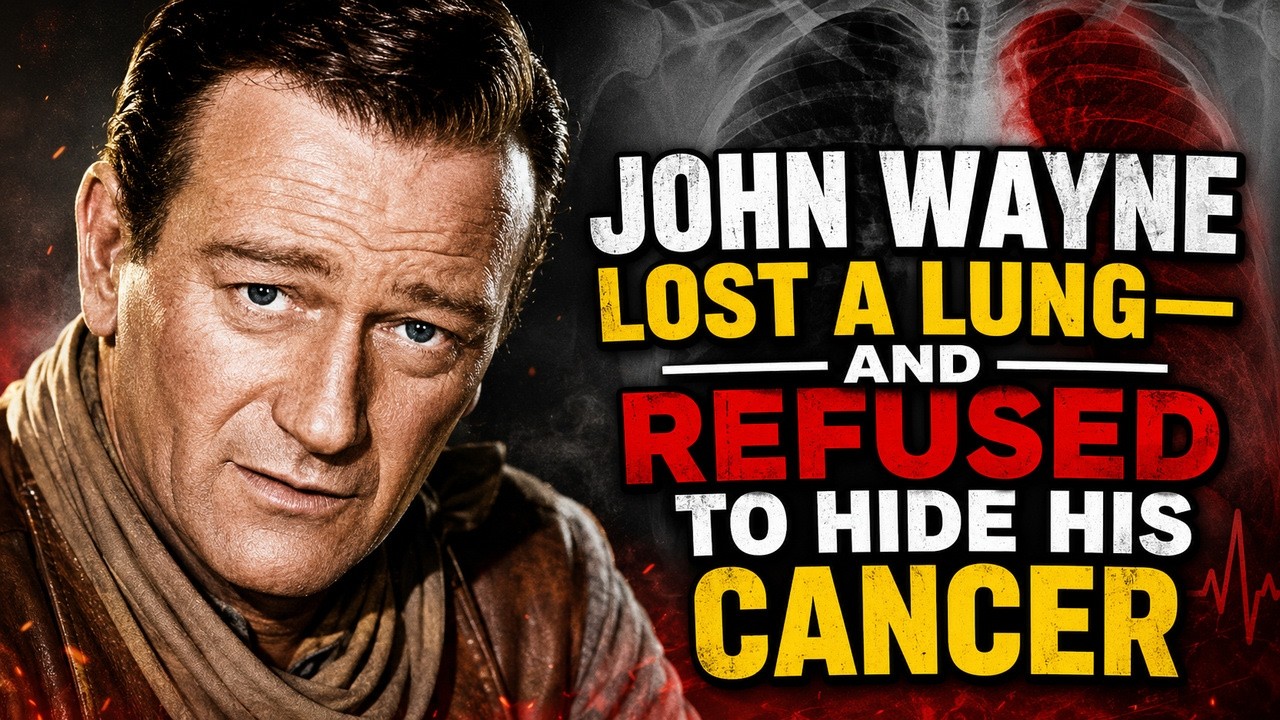
In 1964, Wayne was diagnosed with lung cancer. Advisers worried about what public knowledge might do to his image and career. Wayne chose to disclose the diagnosis rather than pretend nothing had happened. He underwent major surgery in which his entire left lung and several ribs were removed.
Wayne turned the illness into the language he knew best: “There was a hell of a lot of good image in John Wayne beating cancer,” he said. The line is revealing and double-edged. Even at a moment of bodily vulnerability, he thought in terms of image. He returned to demanding work, and the physical consequences of losing a lung did not disappear.
He later became an advocate for cancer checkups and public awareness. The lung cancer of 1964 was treated successfully enough for him to return to work. It was not the same cancer that would kill him 15 years later. The war in Vietnam pulled Wayne’s patriotism into one of the country’s deepest divisions.
In 1966, while *The Green Berets* was being prepared, Wayne traveled to Vietnam. The trip put him closer to American troops and to the war he intended to portray. The production received government cooperation, including support from the Pentagon, and the relationship itself became controversial. The film was openly sympathetic to the American war effort at a time when public opposition was rising.
Wayne’s stated defense focused on the troops. He said they were not trying to settle whether the United States should be in the war; they wanted to show the character of American fighting men. When *The Green Berets* opened in 1968, that separation was impossible. Critics attacked the film, protesters targeted it, and supporters embraced it.
The late 1960s also brought *True Grit*, in which Wayne played Rooster Cogburn, an aging, one-eyed, hard-drinking federal marshal. The role allowed him to make fun of the very authority that had made him famous. Rooster is competent but not polished. He complains, boasts, drinks, and depends on a determined young girl who refuses to be intimidated.
At the ceremony in April 1970, Wayne won the Oscar for best actor. It was his only acting Oscar. In May 1971, Wayne gave a long interview to *Playboy*. The magazine asked him about politics, race, Native Americans, social change, and modern films.
His answers were not coded or ambiguous. He said, “I believe in white supremacy,” then attached conditions about education and responsibility that did not remove the meaning of the phrase. He also dismissed historical guilt over the dispossession of Native Americans and used degrading language about gay men. The interview matters because it prevents a biography from treating Wayne’s politics as a harmless costume.
Context explains why the interview sounded like John Wayne; context does not erase what he said. By 1971, the civil rights movement had transformed American law and public debate. Native activists were demanding recognition of treaty rights, and gay Americans were beginning to organize more openly. Wayne was speaking into those changes, not before them.
His friends and family have often emphasized personal warmth that does not fit neatly with the harshest public statements. Patrick Wayne remembered a father who could enter a room and within minutes make an ordinary person feel known. Those memories are also evidence. They do not cancel the interview, and the interview does not cancel the memories.
A mature biography does not need to choose one set of facts and declare the rest counterfeit. As Wayne moved through his sixties, age became impossible to hide and increasingly useful to the work. *The Shootist*, released in 1976, became the most haunting example. Wayne played JB Books, an aging gunfighter who learns he is dying of cancer.
The role had an obvious connection to Wayne’s own history with the disease, even though he had survived his lung cancer and would not die until several years later from stomach cancer. The film begins by borrowing images from earlier Wayne pictures to give Books a past, collapsing actor and character in a way no ordinary script could. Decades of screen memory become evidence. Production histories show Wayne pushing back against language and story choices he considered wrong for the character.
Even in his final film, he was still policing the border around John Wayne. In 1979, cancer returned in a different form, this time in his stomach. He underwent difficult treatment and surgery. At the Academy Awards in April 1979, Wayne came on stage to present Best Picture shortly after major surgery.
The audience rose for him. The moment felt to many in the room like recognition that the man standing there might not return. Wayne died on June 11, 1979, at the UCLA Medical Center. He was 72.
The cause was cancer of the stomach. His family was with him. A few weeks before his death, Congress had authorized a Congressional Gold Medal honoring him. Maureen O’Hara had been among those who argued for the tribute.
Years later, recalling her testimony, she explained what Wayne had meant to people outside the United States: “He was what they believed Americans were. ”
That sentence is affectionate, but it contains the whole problem of his legacy. No actor can safely bear the weight of representing an entire country. Yet O’Hara was reporting something real about perception.
To many international viewers, Wayne’s bearing, voice, and screen morality became a shorthand for American confidence. The law authorizing his medal required it to carry a compact inscription: “John Wayne, American. ” It was meant as praise, and it also reveals how completely the invented name had merged with a public idea. The afterlife began immediately.
In Orange County, where Wayne had lived for years, the county airport was renamed John Wayne Airport in 1979. The name remains there today. In 1985, his family created the John Wayne Cancer Foundation, which continues to fund research, education, awareness, and patient support. Several major Wayne pictures have been selected for preservation in the National Film Registry, including *Stagecoach*, *Red River*, *The Searchers*, *Rio Bravo*, and *The Quiet Man*.
At the University of Southern California, where young Marion Morrison had once attended college, the School of Cinematic Arts displayed a prominent John Wayne exhibit. Students and others objected, citing his statements about white supremacy, Native Americans, and gay people. In July 2020, the school removed the exhibit from its prominent location. The school explained that it did not want a celebratory presentation to reinforce mythology without fuller context.
Wayne’s case resists both worship and deletion. He was a major film artist in collaboration with major directors. He was also a political actor whose public statements included ideas many people rightly find offensive. The same archive contains both.
Honors and criticism continued side by side. His name stayed on an airport while a university removed a celebratory exhibit. His films were preserved while his interview statements were recirculated. There is also a question of courage, the virtue most often attached to Wayne.
Screen courage is choreographed; the actor knows the blanks are blanks. Wayne’s documented courage appears in less glamorous places: disclosing his cancer, returning to demanding work after losing a lung, and financially committing himself to projects he believed in. Courage in stating a belief does not make the belief wise or just. A person can be brave and wrong.
The strongest Wayne films understood that better than some of the public mythology built around him. *Red River* is about authority that has forgotten limits. *The Searchers* is about purpose contaminated by hatred. *The Shootist* is about a man whose old skill cannot bargain away death.
In each case, Wayne’s familiar strength is not enough by itself; it must be questioned, redirected, or surrendered. The farther we move from his lifetime, the more John Wayne becomes an argument about memory itself. His movies helped define American popular cinema. His public politics helped define a conservative cultural identity.
His racist and homophobic statements belong to the record. And so do his friendships, family relationships, professionalism, illness, and the cancer work created in his name after death. The task is to keep the achievement, the harm, the affection, and the evidence in view at the same time. Return once more to the *Stagecoach* road.
The rifle spins, the camera moves in, and the audience sees a face that seems to announce certainty. Behind it are a failed early launch, years of cheap westerns, an injured college athlete forced toward a different future, an old director’s stubborn faith, a name selected by other men, and a worker who had spent years learning how not to waste a movement. John Wayne was made before he seemed inevitable, and the public meaning of John Wayne kept changing long after the man could control it.
Marion Morrison spent the rest of his life discovering what that name could create, what it could cost, and what it could never completely contain.