The Appalachian hills hold a story of a small walnut music box with a brass crank and a hairline crack across its lid that has surfaced in written records across three different decades, in three different cabins, found by three people who never met. Each person wrote down the same three-line message before vanishing from the record, or losing their minds entirely. The first documented sighting came in late October 1898, when a 44-year-old trapper named Oed Marwick pushed into a stretch of ridge locals called the “quiet side,” a place experienced hunters avoided. Despite warnings, he went up looking for pelts.
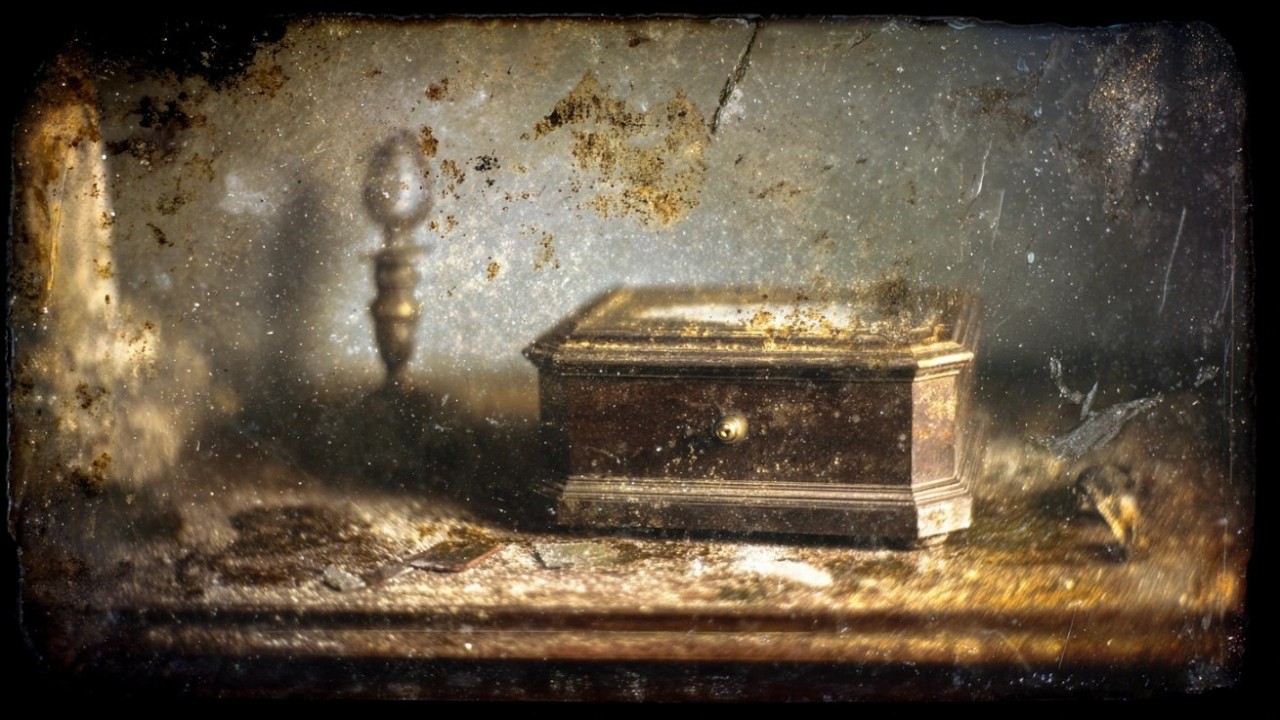
On the third day, he found a cabin that was not supposed to be there, with a walnut music box sitting neatly on the table inside. Marwick picked the box up, turned the crank, and heard a faint, distant tune he could not place. He brought it down with him, but returned to the valley three days late, thinner and hollowed out, carrying no pelts at all. He spent the following two weeks alone with the box, speaking to it, according to a neighbor who brought him bread.
Three nights later, Marwick disappeared from his locked cabin. His coat and boots were left behind. The music box remained on the table with the crank half-turned. Inside, a folded note in his handwriting read: “I think I have been winding it for years.
I think I am the one playing. I think it is almost my turn. ”
The box was taken into evidence by a constable and placed in storage. When the parish office burned down that winter, the crate containing the box was found untouched in the ashes.
The constable retired the following spring, and his daughter later recalled that her father kept the box on his mantle until he died, always warning her never to wind it. The box then disappeared from written records for nearly a generation, until the spring of 1924. A 31-year-old widow named Vera Allgood moved into a cabin on a ridge called Marrow Creek, left alone after her husband’s death. On her fourth night there, she discovered the same walnut box hidden behind a loose stone beside the hearth.
Vera kept a journal, and her entries show the same slow pull taking hold. The music grew louder each night. She wrote that the tune became familiar though she could not place it. She found her hand on the crank without remembering reaching for it.
She heard a voice in the yard that sounded like her mother, who had been dead for twelve years. On the eighteenth night, Vera wrote the exact same three lines that Oed Marwick had written twenty-six years earlier: “I think I have been winding it for years. I think I am the one playing. I think it is almost my turn.
”
The next morning, she was gone. A hunter found the cabin door standing open, unlocked from the inside. Vera’s journal and the music box were on the table, the crank halfway turned. Despite a week-long search, no trace of her was ever found, and there were no footprints in the soft mud outside the cabin.
The sheriff, a careful man named Halford Pine, filed an official report attributing her disappearance to grief and mental distress. But his private notebook, which surfaced in 1973 after his death, told a different story. He wrote that when he picked up the music box, the crank began to turn on its own, and that he felt a powerful urge to keep listening before setting it down. One of his deputies volunteered to carry the box down the mountain.
The horse arrived alone with the saddlebag open and the box gone. The deputy was found two days later thirty miles away, in a mental state from which he never recovered. For the remaining forty-one years of his life, he repeated a single sentence: “I think I am almost done playing. ”
The box went quiet for another long stretch, through the 1930s and the war years, until the spring of 1951.
A widowed repair shop owner named Roscoe Threlfall bought an old cabin on a ridge called Hessle Knob, intending to live out his remaining years away from the sound of his own house. In late April, he found the box in a tin can on a shelf in the root cellar. Like Vera, Roscoe was a man who wrote things down. His ledger shows the same gradual progression: intending to sell the box, forgetting to take it, winding it once, then winding it every night.
He wrote that the tune grew clearer, that he could not remember starting to wind it, and that he saw a tall man with a long face and a dent in his cheek standing at the edge of the yard. That description matched Oed Marwick, a man who had vanished fifty-three years earlier. Roscoe could not have known what Oed looked like, as the constable’s report had been destroyed in a fire years before. Roscoe’s final ledger entry contains the same three lines written by both Oed and Vera.
Unlike them, he did not vanish. His brother found him in July sitting at the kitchen table, alive but in a deep catatonic state, staring at the music box while the brass crank turned slowly on its own. He never emerged from that state and died nine years later in a care facility. Nurses reported sometimes hearing faint music coming from his room at night, though there was no radio nearby.
The box was logged as a personal effect and later given to a local historical society in 1963 with written instructions that it was never to be wound or displayed. It was to be kept in a locked drawer in the basement. When the society was asked about it, the drawer was empty. Records say the box was transferred in 1978 to a private collector whose name was not listed, approved by a board member who has since died.
The current location of the music box is unknown, and the writer of the account notes that if the pattern of the gaps in time continues, the box may have already been found again in recent years, sitting on a shelf or in a drawer somewhere in the hills, waiting for someone to pick up the lid.