King Henry II of England and Eleanor of Aquitaine built an empire stretching from the Scottish borders to the Pyrenees, but their eight legitimate children turned that vast inheritance into a web of rebellion, adventure, and bloodshed. Two of their children wore crowns. Two died in rebellion. One ruled in distant Spain, while others vanished from history entirely.
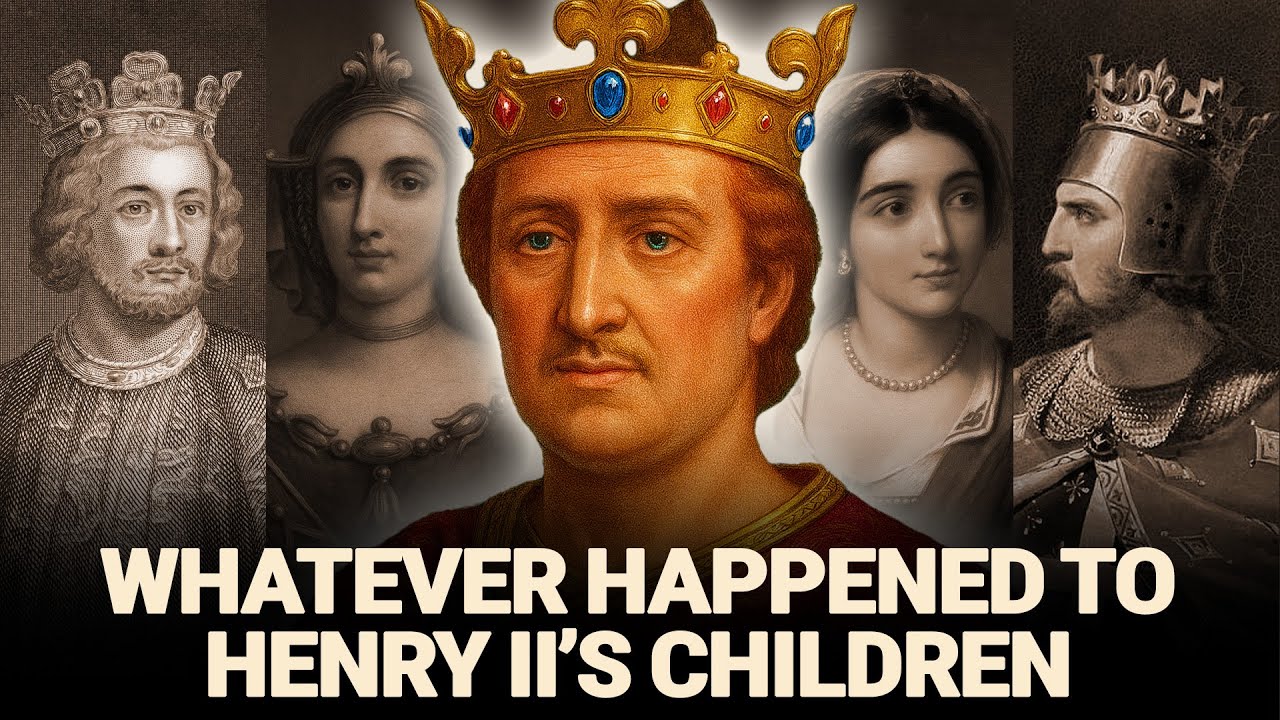
Some of their blood still flows through Europe’s reigning families today. Others left no trace at all. Henry II ascended the English throne in 1154, bringing with him territories across half of France. His marriage to Eleanor of Aquitaine was a political masterstroke that created a dynasty commanding lands larger than those of the French king himself.
But power bred ambition, and ambition bred conflict. Every son would eventually rebel against his father. Every daughter would be married for political alliance. Their children would reshape the map of medieval Europe, yet few would find peace.
The first child of Henry and Eleanor arrived before either wore a crown. William, Count of Poitiers, was born in 1153 as heir to a growing empire and bearer of his parents’ highest hopes. Named after Eleanor’s grandfather, William IX of Aquitaine, the infant prince represented the future of Angevin power. But fate ignored royal ambitions.
In 1156, at just three years old, William fell ill and died. Chroniclers recorded little — perhaps a fever, perhaps an accident. At the time, half of all children failed to reach adulthood, and even royal blood offered no protection. His death sent shockwaves through Henry’s court as carefully laid succession plans crumbled overnight.
Eleanor’s grief was recorded by contemporary writers, though Henry’s reaction remained largely undocumented, perhaps because medieval kings were expected to show little emotion even at the loss of an heir. William’s brief life had profound consequences — his death meant that Henry, the Young King, born two years later, would become the new heir. Today, no tomb marks his resting place, and no descendants carry his name. Born into the shadow of his brother’s death, Henry the Young King became both his father’s greatest hope and his most bitter enemy.
Born on February 28th, 1155, young Henry was groomed for kingship from infancy. At age five, in an unprecedented move, his father had him crowned as heir apparent — a living guarantee of dynastic succession. The boy wore a crown while his father still lived, earning him the title “Young King. ” But this early coronation created an impossible situation.
Henry had the title but no real power, as his father ruled absolutely, leaving his crowned son with ceremony but no authority. The young prince grew restless. Handsome, charismatic, and beloved at tournaments across Europe, he became the ideal of medieval knighthood. But ideals do not satisfy ambition.
In 1173, encouraged by his mother Eleanor and supported by the French king, he rebelled against his father. The great revolt of 1173-74 saw three of Henry II’s sons unite against him. They sought actual control of England and Normandy, but the rebellion failed. It established a pattern — the House of Plantagenet would be perpetually at war with itself.
Reconciliation came and went. The Young King continued to press for real authority while his father clung to absolute control. In 1183, while campaigning in southern France, Henry the Young King fell ill with dysentery. He died on June 11th, 1183, at age 28, still technically a king but never truly a ruler.
Contemporary chronicles describe Henry II’s grief as overwhelming. The Young King left no legitimate children, ending his branch of the dynasty before it began. Among Henry II’s children, Matilda possessed perhaps the most subtle but far-reaching influence. Born in 1156, she was destined for a marriage that would echo through European history for centuries.
Unlike her brothers, who were groomed for battle and rule, Matilda was educated for diplomacy. She learned languages, absorbed court protocol, and understood that her value lay in alliance, not inheritance. In 1168, at age 12, Matilda married Henry the Lion, Duke of Saxony and Bavaria, one of the most powerful nobles in the Holy Roman Empire. For 20 years, Matilda lived as a duchess in Germany.
She bore five children, most notably Otto, born in 1175. Her court in Brunswick became a center of learning and culture. But political fortunes shift quickly. In 1180, Emperor Frederick Barbarossa stripped Henry the Lion of his duchies, and the family fled into exile, finding refuge in Matilda’s childhood home.
Matilda died in 1189, the same year her father passed away. Her legacy lived on through her children — her son Otto would become Holy Roman Emperor Otto IV, linking Angevin blood to the highest throne in medieval Christendom. Of all Henry II’s children, none achieved the lasting fame of Richard Cœur de Lion, Richard the Lionheart. Born on September 8th, 1157, he was destined to become England’s most legendary king, yet he spent barely six months of his ten-year reign on English soil.
Raised primarily in his mother’s duchy of Aquitaine, Richard absorbed southern French culture — its poetry, its music, and above all its warrior traditions. He learned warfare in constant regional conflicts, becoming a master of siegecraft and battlefield tactics. Like his brothers, Richard eventually rebelled against his father. The final revolt came in 1189, and this time Richard succeeded.
Henry II, worn down by years of family conflict, died with his youngest son John at his side. Richard’s kingship was defined by absence. Within months of his coronation, he departed for the Third Crusade, leaving England in the hands of regents. His crusading exploits — the conquest of Cyprus, the siege of Acre, his conflicts with Saladin — became the stuff of legend.
But legends exact a price. On his return journey, Richard was captured by Leopold of Austria and held for ransom by Holy Roman Emperor Henry VI. The enormous sum required for his release, 150,000 marks, devastated the English treasury. Richard’s final years were spent in almost constant warfare defending his French territories.
On April 6th, 1199, while besieging the castle of Châlus-Chabrol, he was struck by a crossbow bolt. The wound turned septic, and the Lionheart died at age 41. He left no legitimate children. Despite two marriages, first to Berengaria of Navarre, Richard’s line died with him.
His legacy lived on in literature and legend — the archetypal crusader king, hero of countless poems and stories. Yet for all his military genius, Richard’s reign was ultimately a failure. His territories were lost, his treasury empty, his dynasty without an heir. The crown passed to his youngest brother John.
Geoffrey, Duke of Brittany, possessed perhaps the sharpest political mind among Henry II’s sons, yet his ambitions ultimately proved his undoing. Born on September 23rd, 1158, Geoffrey was given the duchy of Brittany through his marriage to Constance, the duchy’s heiress. This represented Henry II’s attempt to secure the turbulent western peninsula. Geoffrey proved an able ruler, but his loyalty to his father remained questionable.
He joined the great revolt of 1173-74 alongside his brothers, demonstrating the family pattern of filial rebellion. Unlike his brothers, however, Geoffrey proved particularly adept at playing all sides against each other. Contemporary chroniclers described him as charming but untrustworthy — a prince who could smile while plotting betrayal. His court at Rennes became a center of Celtic culture and political intrigue.
But Geoffrey’s ambitions ended abruptly. In August 1186, while attending a tournament in Paris, he was struck down, either by accident or design — the chronicles remain unclear. He died on August 19th, 1186, at just 27, leaving behind his pregnant wife Constance. His posthumous son, Arthur of Brittany, would briefly challenge John for the Angevin inheritance, but the boy duke disappeared in 1203, almost certainly murdered on John’s orders.
Geoffrey’s daughter, Eleanor of Brittany, was imprisoned by John for life, dying in captivity in 1241. With Arthur’s death and Eleanor’s imprisonment, Geoffrey’s line effectively ended. Eleanor of England carried her family’s political legacy furthest from home, becoming queen of Castile and mother to a line that would influence Iberian politics for centuries. Born around 1161 or 1162 and named for her formidable mother, she was destined for a diplomatic marriage.
In 1170, at approximately eight years old, Eleanor was betrothed to Alfonso VIII of Castile. She adapted remarkably to life in Castile, learning Castilian, embracing Spanish court culture, and becoming a patron of literature and the arts. As queen, Eleanor proved politically astute. When Alfonso VIII died in 1214, she briefly served as regent for their young son, demonstrating the political skills inherited from both parents.
Eleanor and Alfonso had ten children, creating extensive dynastic connections throughout Iberia and beyond. Their daughter would become queen of Castile in her own right, and their son Fernando would unite the crowns of Castile and León. Eleanor died in 1214 at approximately 52, having outlived most of her siblings. Through her descendants, her bloodline would eventually include the Bourbon kings of France and Spain.
Joan of England lived one of the most adventurous lives among her siblings. Born in 1165, she was destined for the complex world of Mediterranean politics. At age 11, she was married to William II of Sicily, known as William the Good. Her journey to Sicily in 1176 was an epic voyage, traveling from England through France and across the Alps.
There she entered a multicultural kingdom where Norman, Arab, and Byzantine traditions blended into a unique civilization. But her peaceful life ended abruptly in 1189 when William II died without an heir. The new king, Tancred of Lecce, initially held her under house arrest. Her rescue came from an unexpected source — in 1190, her brother Richard the Lionheart arrived in Sicily during his journey to the Third Crusade and forced Tancred to release her.
In 1196, she made a second marriage to Raymond VI, Count of Toulouse, bearing him one son. But Joan’s life was cut short in 1199 when she died from complications of childbirth at just 33. John Plantagenet began life as the youngest son with no inheritance, earning the nickname “Lackland. ” Yet through a combination of survival, cunning, and ruthlessness, he would become king of England and father to a dynasty that continues to this day.
Born on December 24th, 1166, John was his father’s acknowledged favorite, perhaps because he posed no immediate threat to the succession. His early years were marked by failed attempts to carve out an inheritance — Henry II’s plan to make him king of Ireland collapsed when John’s arrogance alienated the Irish nobility. Everything changed with Richard’s departure for the Third Crusade in 1189. As Richard’s designated heir, John suddenly found himself at the center of English politics.
But John proved an unreliable regent. He attempted to seize power during Richard’s captivity, allying with the French king Philip Augustus. When Richard returned, John was forgiven but never fully trusted. Richard’s death in 1199 finally brought John to the throne, but his reign would be marked by military disasters and political failures.
Within five years, he had lost most of the Angevin territories in France, earning him another nickname: “Softsword. ” His heavy taxation to fund failed attempts at reconquest alienated his English barons. In 1215, forced by military defeat and baronial rebellion, John was compelled to seal Magna Carta at Runnymede — a document intended as a practical solution to immediate grievances that would evolve into one of the foundational texts of constitutional government. John’s personal life was equally controversial.
His first marriage to Isabella of Gloucester was annulled for alleged consanguinity. His second marriage to Isabella of Angoulême, whom he abducted from her betrothal to a French nobleman, created diplomatic disasters. But from this troubled reign came dynastic success. John and Isabella had five children, including the future Henry III.
Unlike his brothers who died without legitimate heirs or saw their lines extinguished, John established a lasting dynasty. When John died of dysentery in 1216 at age 49, he left behind a kingdom in civil war and an empire in ruins. Yet his son Henry III would rule for 56 years, beginning the recovery of royal authority. Through Henry III and his descendants, John’s line continued unbroken to the present day.
Every English and British monarch since 1216 has been descended from John Lackland. Eight children, eight destinies, one enduring dynasty. Their father Henry II died in 1189, defeated by his own sons, his great empire already fragmenting. Their mother Eleanor of Aquitaine survived until 1204, witnessing the collapse of Angevin power in France.
But something more durable than empire emerged from that failure. In losing everything, the dynasty of Henry II gained immortality. Eight royal children scattered their genes across the continent, creating a web of bloodlines that would outlast any single kingdom. Through Eleanor of Castile, their blood flows in the royal houses of Spain and once reached the thrones of France.
Through Matilda, it touched the German nobility and the Holy Roman Empire. Through John, it established the English monarchy that continues today. When Queen Elizabeth II died in 2022, when King Charles III was crowned in 2023, when Prince William and his children appear on the balcony of Buckingham Palace, they carry forward a bloodline that traces back to the stormy marriage of Henry Plantagenet and Eleanor of Aquitaine.