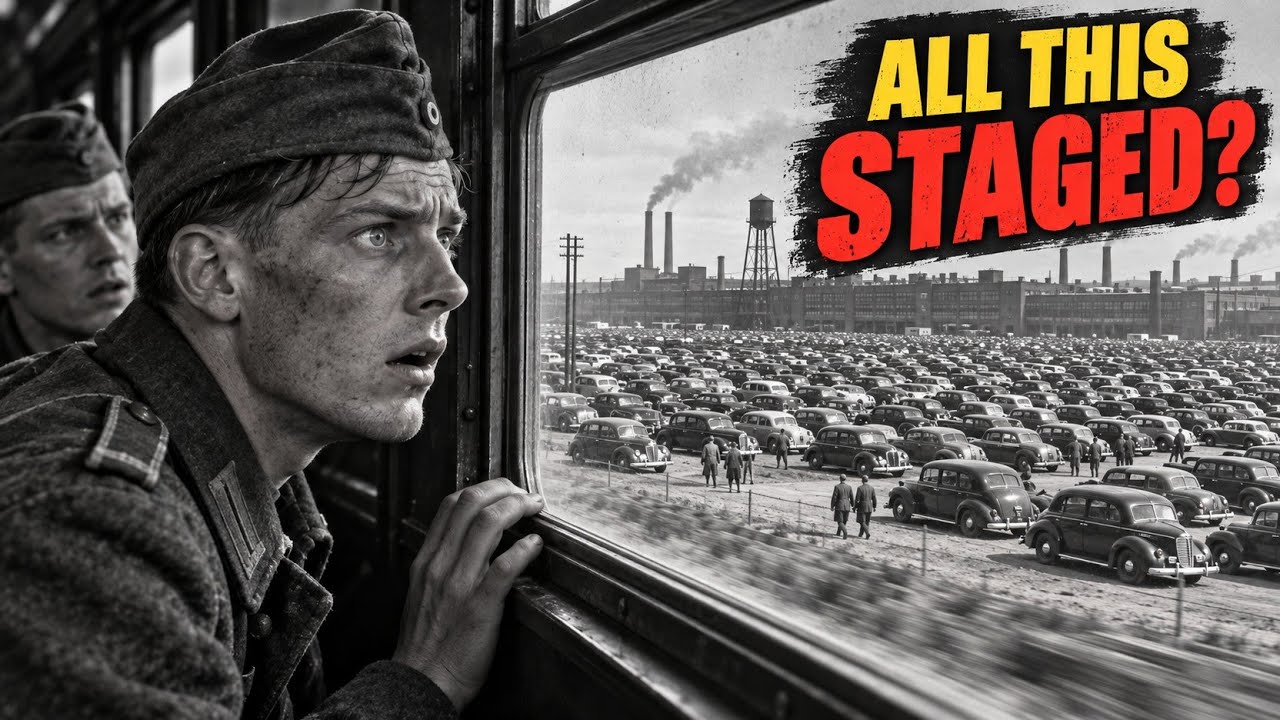
The first car Werner noticed was parked. That was what unsettled him, not the car itself. Germany had cars. His uncle in Stuttgart owned a small Opel before the war, until the army confiscated it along with everything else that had wheels. What bothered Werner was that this car was parked next to another car, and that one next to another, in a row that stretched beyond the edge of his window.
He pressed his cheek against the glass to follow its length. Behind the first row was a second row. Behind that, a third. Hundreds of cars gleamed under the midday sun outside a brick factory somewhere in Pennsylvania on an ordinary workday, with no one guarding them.
He leaned back. Across from him sat a corporal from Hamburg who had surrendered in Tunisia the same afternoon he had. The corporal had seen it too. At the other end of the train car, an American sergeant rested his rifle on his knees, reading a folded newspaper and paying them no attention at all.
For a moment, neither prisoner spoke. Then the corporal leaned forward and whispered, "It's a staged scene. They parked those cars there for us." Werner nodded. It was the only explanation that made sense.
Over the next four days, that explanation was tested across more than 1,500 miles of evidence. More factories, more parking lots, entire cities leaving their lights on after dusk, as if no one had told them there was a war on. The men built theories to explain it all. They counted things, memorized them, and argued in whispers through the night, while the train continued its patient mile after mile, until the theory had nowhere left to stand.
Werner is not one man. He is a composite figure, built from experiences German POWs described again and again in their letters, interviews, and postwar memoirs. The American sergeant at the end of the car is too. Let's call him Ray. Nothing that happens to either of them is invented from nothing. It happened to someone. Often it happened to thousands of people.
To understand how a desert veteran could look at a factory parking lot and see a staged scene, you have to understand what he was carrying when he boarded the train. Werner was twenty-two in the spring of 1943, a soldier for nearly three years. Before that, he was a schoolboy in a country where the radio never stopped talking. And about America, the radio had plenty to say.
He was told America was a nation of gangsters and breadlines. A mongrel country with no culture of its own, held together by money, jazz, and advertising. Its famous industry was just boasting. Its people were spoiled and its soldiers weak. A nation like that could never match peoples hardened by struggle.
Then there were the German submarine reports. Week after week, the radio announced the sinking of astonishing tonnages of Allied ships at the bottom of the Atlantic. The conclusion seemed obvious. America was being strangled. Its ports were nearly empty and its people were lining up for bread.
Somewhere in the barracks, as rumors always travel among armies, a story spread that German bombers had reached New York. They hadn't. No German bomber ever did. But a rumor doesn't need to be true to be believed. It only needs to be repeated by people you trust.
Werner didn't consider himself a fanatic. Most soldiers didn't. He simply believed what those around him believed, because it never occurred to him to check.
In May 1943, the war in North Africa collapsed beneath him. The Axis armies were squeezed in Tunisia between the British from the east and the Americans and British from the west until they were trapped against the sea. The ships trying to reach them from Sicily were sunk. Fuel ran out, then ammunition, then the entire army simply stopped. Nearly a quarter million Axis soldiers were captured within days. The survivors, with the black humor of men who had just lost everything, called the place "Tunisgrad."
Werner surrendered on a dusty road with his hands on his head and an empty canteen on his belt. Then came weeks in open holding camps under the African sun, with more prisoners arriving every day than expected. Britain had no room for them. Its island was already crowded with troops, airfields, and rationed civilians. America, by contrast, had supply ships sailing home empty every week.
So the decision, when it came, was a matter of shipping space. The prisoners would go west.
His ship was a Liberty ship, one of the mass-produced freighters built to carry tanks and ammunition across the Atlantic, with nothing to carry on the return trip. The holds were fitted with bunks, and Werner climbed into one with hundreds of other men. The crossing carried a particular kind of fear. The convoy sailed through the same waters where German submarines hunted. For years, Werner had cheered the submarine news reports. Now, lying in the dark belly of an American freighter, he found himself hoping, for the first time in his life, that the submarines weren't as skilled as the radio claimed.
As it turned out, by mid-1943 the Battle of the Atlantic had turned decisively against Germany, and the convoy crossed without incident. But something happened on that ship that Werner would remember for the rest of his life. On the first morning, the guards served breakfast. There was white bread. Soft, fresh white bread, as much as a man could eat. In Germany, that kind of bread had become a memory. The men around him ate it slowly, with a barely concealed wariness. Some hid pieces in their pockets. A few began to wonder aloud whether the Americans were feeding them this way on purpose, and whether this too was part of a performance.
The coast appeared on a gray morning without anyone knowing exactly what it was. Then they were marched to the railroad lines, and the real confusion began. Every soldier in Europe knew how prisoners were transported. They were moved in freight cars, packed standing, doors locked from the outside. That's what Werner expected crossing America to be like.
Instead, he was directed up an iron stairway into a passenger car. Comfortable seats facing each other in pairs, windows, a toilet at the end of the car, and meals served in the aisle. Guards sat at both ends of the car, armed and alert, but mostly bored. The men looked at each other. The theory was born instantly, because the alternative was too disturbing to think about.
It was deliberate. The Americans knew exactly who these prisoners were. Afrika Korps men, some of the most famous soldiers in the German army. Of course, the Americans wanted to impress them. Of course, they put them in good cars and drove them past their best factories. It was propaganda, the same kind every nation made. The only difference was that this time the audience was sitting inside it.
In Werner's car, the man who formulated the theory was a Feldwebel, a sergeant from Franconia, older than the rest, wearing a party badge he had somehow hidden through every inspection. He explained it patiently, the way you explain a magic trick to a child. The parking lot, the workers had been ordered to drive into it that day. The lit towns, lit specially for the train. The food, borrowed from the officers' table, and someone would pay for it later. "Everything you see," he said, "you see because they want you to see it."
Ray, at the end of the car, caught enough of this to follow along. He had a little German from his grandmother. He shrugged and told them people here drove their cars to work every day. It was simply that way. The prisoners laughed at him. It was the funniest thing they'd heard since Africa.
What none of them appreciated was the irony. At that very moment, Americans were angry about how little they were allowed to drive. Gasoline was rationed. Most car owners had a sticker on their windshield allotting them a few gallons a week. Getting new tires was nearly impossible. The national speed limit had been reduced to 35 miles per hour to save rubber. To an American, those parking lots were a country tightening its belt. To a German prisoner, they looked so lavish they had to be fake.
Even the rationed version of America was more than his theory could absorb, and the train kept moving. That first night, the train passed through Pittsburgh, and the men who were awake saw something they would describe for decades afterward. The steel mills along the rivers were running around the clock. Blast furnaces lit the undersides of the clouds orange. Sparks poured from smokestacks like endless fireworks. No one had switched that on specially for a prisoner car. You could somehow tell it had been burning for years.
The sergeant was quiet that night. By morning they were in Ohio, then Indiana, and the factories gave way to farms. Somehow that was harder. A factory could be a showpiece, but the farms stretched for hours. Tractors in the fields, huge red barns, silos standing in clusters on every horizon. Werner's father farmed a few acres outside Stuttgart with one tired horse.
So a new theory emerged. The train was going in circles, showing them the same prosperous stretch again and again. It was a clever idea, the kind that can only be killed by patience. A young radio operator from Kassel decided to test it. American cities wrote their names on water towers in large letters, so he wrote each one down on the back of a cigarette pack. If they were going in a loop, the names would repeat.
They never did. Not once. The list filled one side of the pack, then the other. He began writing smaller. By the second evening, he stopped showing it to anyone. He kept it in his breast pocket, and Werner would see him take it out occasionally to stare at it. The way a man rereads a letter bearing bad news he hasn't fully accepted yet.
By then, Werner realized how far they had come. He had always thought in European distances. Berlin to Moscow was about a thousand miles, a distance that had swallowed entire German armies. This train had already covered nearly that distance, with no sign of slowing, and they hadn't even reached the middle of the country. And this was only one train.
Over the next three years, more than 370,000 German POWs made journeys like this, heading to hundreds of camps spread across nearly every state. Hundreds of trains, thousands of cars. And in nearly every car, a whisper in the dark between men who had been told one thing their whole lives and were watching something else pass behind the glass.
Then came Oklahoma. The land flattened, the sky widened, and the towns spread farther apart. Somewhere out there, the Feldwebel's theory discussion quietly died. No one declared its death. There was no argument. It simply became impossible to say aloud that the Americans had arranged all of this. Because arranging all of this would have been more astonishing than it simply being true. You cannot stage an entire continent.
On the fourth day, the train stopped in Texas. The camp was in cotton country. A grid of wooden barracks behind two barbed-wire fences. Guard towers at the corners. A water tower in the middle. The conditions weren't comfortable. The summer heat was brutal. The wind carried dust into everything.
But what came next was, for many prisoners, stranger than the train itself. They were fed well. Under the Geneva Convention of 1929, which both Germany and the United States had signed, POWs were to receive rations equivalent to those of the captor's troops at base camps. America took that clause seriously. Not just on principle, either. Thousands of American pilots and soldiers were already in German POW camps, with more arriving every month. Every official in Washington knew that how the Germans were treated in Texas might be reflected in how Americans were treated in Silesia.
So the prisoners ate what the American garrison soldiers ate. Meat, eggs, coffee, fruit. Men who had lived on hardtack in the desert gained weight within weeks. There was a canteen where they could buy cigarettes and toothpaste, and in many camps, light American beer. There was a soccer field, classrooms, and some camps even had bands.
There was work too. Under the convention, enlisted prisoners could be employed for 80 cents a day in canteen vouchers. America was so short on labor that farmers were practically begging for prisoners. So Werner rode a truck every morning to pick cotton, and later peanuts, for a farmer whose family had come from Germany two generations before. One hot afternoon, the farmer's wife came out with a pitcher of iced tea, set it on a fence post near the prisoners without a word, and went back inside.
It would be comfortable to leave the camps at this point, with iced tea on a fence post. But the prisoners brought the war with them inside the wire. In many camps, the most committed Nazis organized quickly. They held their own secret courts. They kept lists of names. Any man who talked too much about what he'd seen from the train, or seemed too friendly with the guards, or was heard questioning Germany's victory, could find himself in real danger.
In November 1943, at Camp Tonkawa in Oklahoma, a prisoner named Johannes Kunze was beaten to death by fellow prisoners who believed he was leaking information to the Americans. Five men were tried for it, convicted, and hanged at Fort Leavenworth in the summer of 1945. It was not the only killing of its kind.
So Werner learned to keep two kinds of thoughts. One for the barracks, where the Feldwebel still held sway and the official line was that Germany would win and America was a paper giant. And one for himself, for the long cotton rows and the long nights on his bunk, where he kept returning to the parking lot and Pittsburgh burning in the dark, and the list of water towers that never repeated.
Some prisoners tried to escape entirely. The most famous attempt came in Arizona just before Christmas 1944, when 25 Germans crawled out of Camp Papago Park through a tunnel they had spent months digging. Many had studied maps and planned their route carefully. They would follow the Gila River down to the Colorado, then float from there to Mexico. Some even built collapsible boats. But the maps showed them a river. The desert showed them something else. When they reached the Gila, most of it was just a dry bed of sand and rock. The last escapees were back in custody within weeks.
Even their escape faced the same problem as the Feldwebel's theory. They had planned for the America in their heads. The real one was bigger and stranger, and utterly indifferent to what they expected.
Back in Stuttgart, in the summer of 1943, Werner's mother was informed that her son was missing in North Africa. For months, that was all she had. Then a printed card arrived through the Red Cross. A few lines in his handwriting saying he was a prisoner and doing well, with a return address somewhere called Texas. She kept it in her prayer book for the rest of her life. She told the neighbors he was fine. But she didn't tell them where. Because it sounded like something out of a Karl May novel.
Werner wrote to her whenever he was allowed. The letters passed through American censorship, then German censorship, and he never knew exactly what reached her. He told her about the food. He told her he was well. He didn't tell her about the factories because he couldn't find a way to describe them that would make her believe him. He began to understand that the hardest thing to explain to someone back home wasn't the horror, but the abundance.
Her replies grew shorter and further apart. Stuttgart was being bombed. So was nearly every city he had ever known. In the summer of 1944 came news of the landings in France. The Feldwebel explained that too, for a while, as a trap the Americans had fallen into. Then the explanations became less convincing. And in May 1945, Germany surrendered. There was nothing left to explain.
The Americans had something else to show them that spring. Allied forces had entered the concentration camps. Buchenwald, Dachau, Bergen-Belsen. Footage from those camps was shown in the weeks after the surrender to German prisoners in camps across the United States. The men were marched into mess halls and recreation rooms. The lights were turned off, and the projector started.
Some men wept. Some stared at the floor. Some went outside and vomited behind the barracks. And some sat motionless, and when the lights came back, they said what Werner had heard before, in a train car in Pennsylvania nearly two years earlier. It's a performance.
He heard it from the Feldwebel. He heard it from men he loved. And for one terrible moment, he felt it rising in himself too. That same comforting instinct that had protected him from the parking lot and the steel mills and the farms. If it was staged, nothing needed to change. If it was staged, he would never have to question what the uniform he wore had been fighting for.
But Werner had already spent four days learning what happens to a theory like that. You can hold onto it for an hour, maybe a day, but the train keeps going. The evidence doesn't stop arriving just because you've stopped wanting it. You can reject one factory, one town, one reel of film. You cannot reject an entire continent.
And as he sat in that dark mess hall, he realized that what he had just watched was not a performance. It was the thing the performance back home had been staged to hide. That night, the radio operator from Kassel took the cigarette pack out of his jacket pocket for the last time. The list of water towers had gone soft and faded by then, worn by two years of sweat and folding. He looked at it for a long time. Then he tore it into small pieces and let them fly out the window into the Texas wind.
Werner asked him why. The radio operator said he had known for two years that the names would never repeat. He just needed a night like this to stop checking.
The Feldwebel never changed his mind. As far as anyone knew, he went to his grave insisting the films were faked in Hollywood. Some men can ride a train across an entire continent without once looking out the window.
Around the same time, camp food lists shrank. The generous rations were cut partly because of public anger at what the newspapers were revealing about camps in Germany, and partly because with the war in Europe over, Washington no longer had to worry about American prisoners in German hands. No one in Werner's barracks complained aloud.
The Americans had also quietly begun trying to change minds. A special program within the War Department had been working on it since late 1944. Selected books in camp libraries, films, courses in American history and government, and a prisoner-written newspaper called Der Ruf, distributed to all camps. In 1945, carefully selected prisoners were sent to special schools in Rhode Island for short courses on democracy. No one knows how well it worked. Some men mocked it, others read every issue.
Werner read Der Ruf in the evenings, and what surprised him most wasn't what it said. It was that no one forced him to read it. The men who guarded the camps were rarely the army's first choice. Many were older than the average recruit, or had flat feet or poor eyesight, or had been wounded overseas and sent home. The army needed them somewhere. Ray fit that description exactly. He stayed. After escorting that first train, he was assigned to the camp and never left. He had been wounded in Tunisia during the same campaign that ended in Werner's surrender, sent home with a stiff shoulder, and assigned to guard duty because the army decided he was no longer fit for combat, but perfectly fit to watch men who were no longer able to fight either.
He and Werner never became friends, exactly. Guards and prisoners weren't supposed to. But two years of work and duties and head counts created a kind of wary familiarity that develops between any two men who see each other every day. In the fall of 1945, just before Ray's discharge, Werner gave him something. Prisoners all over America spent their evenings making things from whatever they could find. Paintings, ship models, chess sets, furniture. Werner had carved a small box from packing crate wood. On the lid, he had carved the outline of a steam locomotive and beneath it, in precise German letters, a single line. Ray couldn't read all of it. He thanked Werner, put the box in his bag, and went home to Ohio.
Then the paperwork took over, as it always does when a war ends. For Werner, an American file recorded his capture, his serial number, his camps, his transfers, and eventually his departure. For Ray, the war was reduced to a discharge form. Service dates, unit, wound, a few medals, a separation center. That form joined millions of others at the National Personnel Records Center in St. Louis.
After midnight on July 12, 1973, a fire broke out on the upper floor of that building. It burned for days. When it was finally extinguished, nearly 80 percent of the files for discharged Army soldiers between 1912 and 1960 had been lost. Ray's file was very likely among them.
Ray died in the 1990s. When his grandchildren emptied the house, they found the box on a shelf in the closet next to a folded uniform jacket and a photograph of a dozen young men staring at a water tower in Texas. No one in the family knew what the box meant. No one could read the inscription. Ray never talked about the war, except to say he'd spent most of it in Texas with the Germans, which everyone always assumed was a joke. His discharge papers, if he'd kept a copy, were never found.
One of the grandchildren photographed the lid, intending to translate it someday. That day never came. Maybe that man was your grandfather. Maybe the box is in your closet. A photograph no one knows the location of, a patch, a ribbon, an inscription in a script no one ever translated. The fire took a lot, but it didn't take everything. And what remains can be pieced back together.
For Werner, the war wasn't over yet. In the spring of 1946, the prisoners at Werner's camp boarded trains again, heading east this time, toward the coast and the ships. Nearly all of them thought they were going home. Many were wrong. Tens of thousands of departing German prisoners were handed over to Britain and France instead, to clear rubble, work farms, and dig in mines. Werner spent most of two more years on a farm in England before finally returning to Germany in the winter of 1947.
He came home the way he had crossed America, by train. This time, no one in the car asked whether anything outside the window had been arranged in advance. The cities passed like ruins. Entire streets reduced to walls with no rooms behind them. Churches open to the sky. Women passing bricks hand to hand in long lines. Stuttgart had been bombed again and again. His mother's building was still standing. Most of the street was not. No one had needed to arrange any of this. For the second time in his life, Werner watched a country pass through a train window and realized it was exactly as it appeared.
Then something happened he never expected. He tried to tell people about America, and they didn't believe him. Neighbors who had lived through firestorms listened to him describe the parking lots, the lit cities, the white bread, the steel mills burning all night, and he could see them deciding he had been fooled. Some said it aloud. They told him the Americans had put on a show for him. Surely he could see that. It was all for the prisoners.
Werner didn't argue. He knew exactly how they felt. He had felt it himself once, pressing his cheek against the glass.
Thousands of men who had been prisoners in America eventually returned, some to visit and some to stay. A few came back for reunions at their old camp sites, where usually only concrete foundations and a historical marker remained. Others wrote to the farm families they had worked for, and those letters went back and forth for decades across an ocean that once seemed like the edge of the world.
Ray's grandchildren finally managed to translate what was carved on the lid years after he was gone. It was one short line, carved by a young man who had spent four days trying not to believe what his eyes were telling him.
Der Zug fuhr weiter.
The train kept moving.
It's not really a line about America or Germany. It's about what happens to anyone who is certain they already know what's out there. You can draw the curtain. You can call it a performance. You can keep a list in your pocket and wait for the names to repeat. But the train keeps moving. And sooner or later, the country behind the glass is the only thing left that tells you the truth.