In the early 1960s, during a preseason trip to Florida, the Cleveland Browns team bus pulled up to a hotel. The white players received their room keys and walked inside. The Black players remained standing in the parking lot, waiting for another bus to take them to segregated lodging. Bobby Mitchell, Jim Brown’s teammate, later described the scene for an NFL documentary.
When the team arrived, he said, the only players still standing were the Black ones. There was no explanation and no apology, just the parking lot. This was not an isolated incident. It happened every preseason, in every Southern city, year after year.
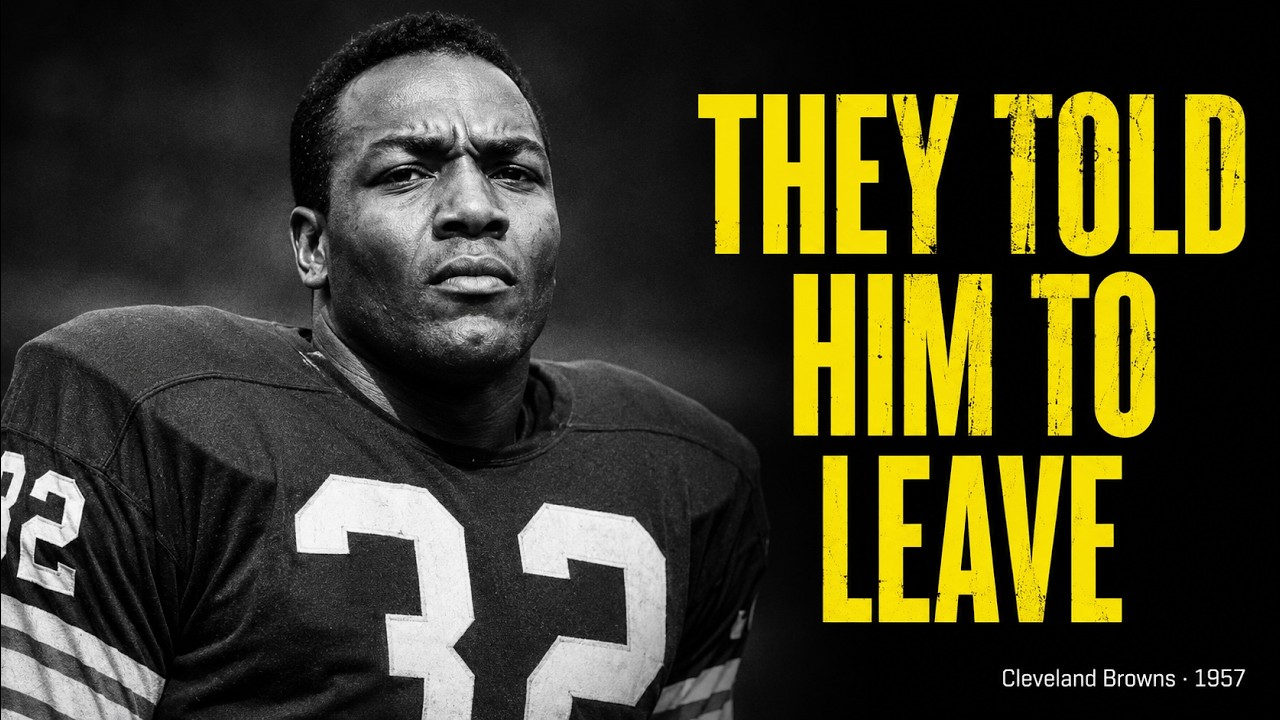
Jim Brown absorbed it the same way he absorbed the hits from every defensive back who tried to bring him down, without stopping, without asking permission, and without ever believing he had to accept it. Selected sixth overall by the Cleveland Browns in the 1957 draft at age 21, Brown led the league in rushing in seven of his first eight seasons. He won three Most Valuable Player awards and was named All-Pro in every season he played. He weighed 232 pounds and ran the 40-yard dash in 4.
5 seconds, and rather than avoiding contact, he ran straight into it. Bobby Mitchell once said the only thing a defender could do against Jim Brown was try to hit him enough times until he finally got tired. The problem, Mitchell added, was that he never got tired. Yet in every city below the Mason-Dixon line, he was still expected to sleep in separate quarters from his white teammates.
NFL Commissioner Pete Rozelle made the league’s position on the matter clear not through a statement or a policy, but through silence. Preseason games in the South drew large crowds and television revenue, and asking Southern cities to change their segregation policies was not a fight Rozelle wanted to have. The ritual continued. The bus stopped, the white players went inside, and the Black players waited for another bus.
Nobody reported it, and nobody wrote about it. That was simply how things were. Jim Brown decided to do something different. He did not hold a press conference or write a letter to the commissioner.
What he did was quieter and, in the end, much louder. He played. On December 27, 1964, at Cleveland Municipal Stadium, 79,544 fans watched the Cleveland Browns host the Baltimore Colts in the NFL Championship Game. The temperature at kickoff was 34 degrees Fahrenheit, and the wind off Lake Erie made it feel much colder.
The Colts were seven-point favorites. They had the best defense in the league, with Johnny Unitas at quarterback. One writer described them as a machine built to stop one man. Before the game, Jim Brown told anyone who asked about Baltimore’s defense the same thing: “We’ll crush them.
”
It was not manufactured confidence. He had already done the work that made confidence unnecessary. In the first quarter, he took the ball, hit the gap, and gained six yards. The next attempt, five yards.
The third, seven yards. The Colts adjusted their plan, but Brown adjusted his approach faster. By halftime, Cleveland led 17-0. Brown had carried the ball 17 times for 69 yards.
The numbers were not spectacular, but the running was relentless. Every carry was designed to make the next one even harder to stop. The second half followed the same pattern, methodical and structural, as Brown dismantled a defense that had been told by its coaches and the press that it had finally solved the Jim Brown problem. The final score was Cleveland 27, Baltimore 0.
The most dominant championship defense in 15 years of pro football had failed to score once. Jim Brown finished with 27 carries for 114 yards and the league title. The parking lot in Florida was not mentioned in the postgame press conference. It was never mentioned.
But every Black player in that room understood what the stadium had just said. Jim Brown was not finished. The following year, in 1965, he led the league in rushing for the eighth time. Then he did something nobody expected.
He retired. He was 30 years old and at the peak of his career, and he left on his own terms. Not because his body had failed him, and not because the game had beaten him, but because he decided there was more important work to do. Years later, Brown said that America in 1964 was a disgrace racially, that equality was not valued and justice was not valued.
He had spent nine years proving that wrong inside the white lines. Now he would prove it wrong somewhere else. On June 4, 1967, in Cleveland, Ohio, Muhammad Ali refused induction into the United States Army. The federal government stripped him of his boxing title.
Ali faced a five-year prison sentence and the destruction of his career. Most of the country, including most of the sports world, believed Ali had made a catastrophic mistake. Jim Brown organized a meeting. It took place in an ordinary office building on East 105th Street and Euclid Avenue.
Twelve men walked in, including Brown, Bill Russell, Kareem Abdul-Jabbar, Bobby Mitchell, Willie Davis, Carl Stokes, and others. They were not there to support Ali, not yet. They were there to question him. For six hours, they asked Ali about everything.
Why he refused, what his religion required of him, and what consequences he expected. Some of the men in that room were veterans. They understood the meaning of military service. Some came prepared to persuade Ali to accept a deal, exhibition games for the troops without actual combat.
Ali refused that option too. His decision was not strategic. It was principled. For six hours, Jim Brown listened.
Brown later said that people got the answers they wanted. When they left that building and held their press conference, twelve of the most prominent Black athletes in the country stood publicly behind the most controversial man in America. No organization asked them to do it, no sponsor approved it, and no commissioner granted permission. They stood there because Jim Brown decided that was what they would do.
The position cost all of them something. Brown knew that when he made the phone calls. He made them anyway. Jim Brown retired at age 30 with 12,312 rushing yards, a record that stood for 19 years.
He led the league in rushing in eight of his nine seasons and was named an All-Star in every year he played. He also founded the Black Economic Union, which supported more than 400 Black-owned businesses between 1967 and 1974, and he organized the Cleveland Summit at a moment when doing so required exactly what running into a defensive line required, the willingness to absorb the impact and keep moving forward no matter what stood on the other side. When Bobby Mitchell was asked years later what he learned from playing alongside Jim Brown, his answer had nothing to do with rushing yards. Mitchell said he learned how to stand as a Black father.
That is not on any stat sheet or in any championship record, but every man who played with him and every man who stood in a hotel parking lot watching the team bus disappear into a Southern evening carried it with them. Jim Brown died on May 18, 2023, at age 87. He never stopped moving forward, and he never did it quietly.