Robert Todd Lincoln, the only surviving son of Abraham Lincoln, spent decades guarding the line between his father’s public legend and the private cost of carrying that name. He lived to be 82, outlasting his father by 61 years, and he spent much of that long life trying to keep his own story separate from the marble image the country built around the 16th president. His earliest memories were of departure. Abraham Lincoln was a circuit lawyer who rode the judicial routes of Illinois for weeks at a time, and the Springfield house on 8th and Jackson Street grew quiet when he was gone.
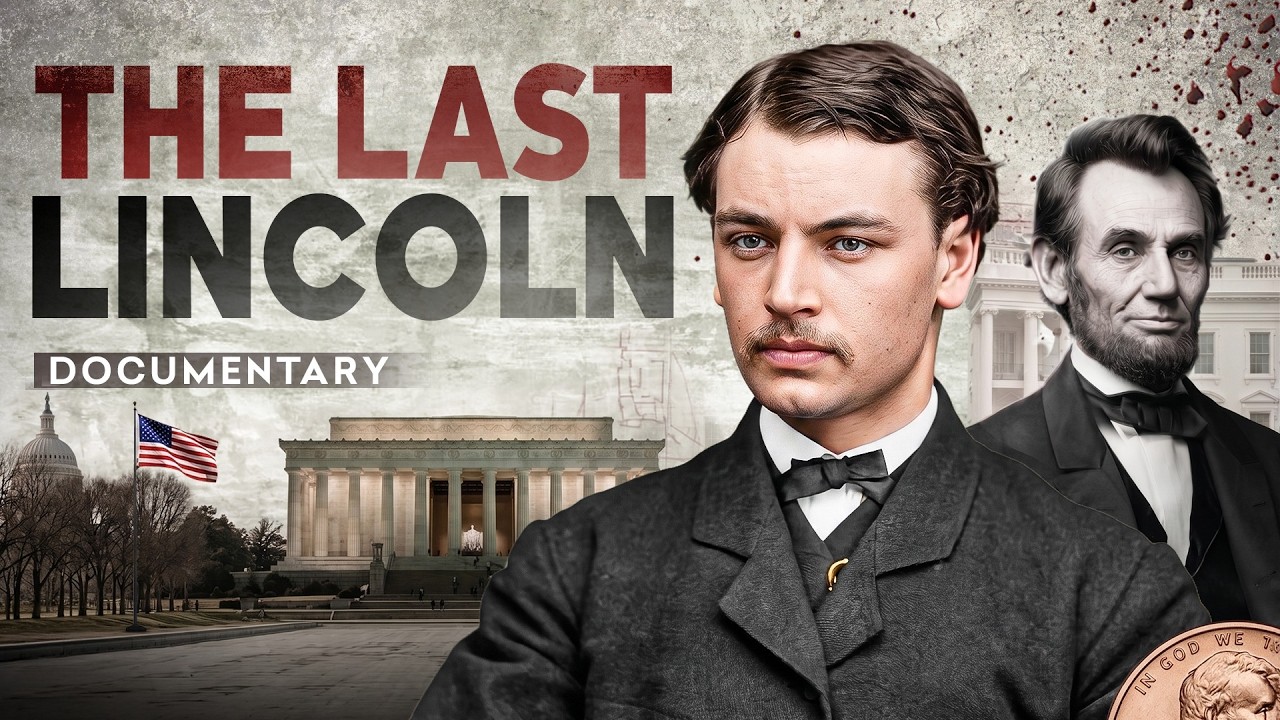
Robert later wrote that he and his father never achieved real intimacy. In a letter to a biographer, he recalled that as a boy he was “almost constantly away from home” and that after he left for school and his father became president, “any great intimacy between us became impossible. ” He said he scarcely had ten minutes of quiet talk with his father during the entire presidency. In the winter of 1863 or early 1864, Robert nearly died on a train platform in Jersey City, New Jersey.
Pressed against a moving rail car by a shifting crowd, he lost his footing and dropped toward the gap between the platform and the train. A hand caught him by the collar and pulled him back. He recognized the rescuer immediately: Edwin Booth, the most celebrated actor in America and the brother of the man who would later kill his father. Robert confirmed the account in a letter to Century Magazine 45 years later.
Robert was in the Petersen House across from Ford’s Theatre when his father died on the morning of April 15, 1865. He was 21 years old. A family friend, John Hay, wrote that after an initial outburst of grief, Robert spent the night moving between his dying father and his mother, who was too distressed to remain at the bedside. He went back to law school that autumn, passed the bar in 1867, and built a practice in Chicago.
He was good at corporate law, which rewarded precision, discretion, and the ability to keep one’s name out of the papers. But the name followed him everywhere. He became Secretary of War under James Garfield in 1881, Minister to Great Britain in 1889, and president of the Pullman Palace Car Company in 1897. He reportedly told his close friend Nicholas Murray Butler, president of Columbia University, that none of it had felt truly his.
According to that account, he said no one wanted him as Secretary of War, Minister to England, or president of Pullman. They wanted Abraham Lincoln’s son. On the morning of July 2, 1881, Robert was walking alongside President Garfield through a train station in Washington when a man shot the president twice. Garfield survived the initial wound but died in September.
Robert reportedly told a reporter that standing on that platform had brought back a feeling he could not easily name. “My God,” he was reported to have said, “how many hours of sorrow I have passed in this town. ”
Between his father’s assassination and the shooting of Garfield, Robert made a decision about his mother that cost him heavily. Mary Todd Lincoln had grown difficult to care for, and in 1875 he arranged a legal hearing and had her committed to a private sanatorium in Illinois.
She later escaped, sued her son, was declared competent, and was released. They never fully reconciled before her death in 1882, and Robert did not attend her funeral. In the autumn of 1889, Robert moved his family to London. His wife Mary, their two daughters, and their son, a 16-year-old boy named Abraham Lincoln the second, whom everyone called Jack, accompanied him.
Jack had his grandfather’s height, his build, and his ease with people. Robert’s correspondence from those years shows a warmth that rarely appears elsewhere in his papers. For the first time in a long time, the future felt like something to look forward to. Then Jack’s arm began to hurt.
It was a carbuncle, a deep abscess beneath the skin. Doctors in London opened it surgically, but the infection did not heal. Weeks of treatment and relapse followed. Robert kept his diplomatic schedule as long as he could, then abandoned it.
He sat beside his son’s bed and waited. In a letter to his cousin, he described Jack’s “own marvelous pluck and patience. ” On the evening of March 5, 1890, a daughter came to find him and told him to go upstairs quickly. Jack was gone.
He was 16. Robert buried his son in London, then accompanied the body home to Springfield, where Jack was placed in the Lincoln tomb alongside his grandfather. He wrote to John Hay, “I did not realize until he was gone how deeply my thoughts of the future were in him. ” After Jack, there were no more male Lincolns.
Robert had two daughters, who would marry and carry other names. The Lincoln line ended in that London sick room. Eleven years later, on September 6, 1901, a Pullman employee found Robert at a station in Buffalo, New York, and handed him a telegram: “President McKinley has been shot. ” McKinley died eight days later.
Robert wrote to Theodore Roosevelt, who was sworn in as the 26th president. According to accounts of that correspondence, he told Roosevelt, “I do not congratulate you, for I have seen too much of the seamy side of the presidential robe to think of it as a desirable garment. ”
Three presidents in 36 years: his father at Ford’s Theatre, Garfield at the train station, McKinley at the Exposition. Robert told friends he had made a decision, half in jest and mostly in earnest, that he would no longer attend presidential functions.
“I’m not going,” he reportedly said, “and they’d better not ask me, because there is a certain fatality about presidential functions when I am present. ”
He resigned from Pullman in 1911 and retreated to Hildene, a Georgian Revival house on a hill in Manchester, Vermont. He stopped giving interviews and declined most invitations to speak about his father. He burned portions of his parents’ personal letters, particularly material from the years surrounding his mother’s commitment.
He kept one folder, labeled in careful handwriting, the MTL Insanity File, documenting the 1875 hearing. He carried it with him, house to house, year to year, to his grave. From Vermont, he watched Washington build the Lincoln Memorial. Workers began laying the foundation on reclaimed ground beside the Potomac, and Robert followed the progress from a distance.
On visits to the capital, he asked his driver to take routes past the construction site. Once, he secured permission to walk through the unfinished chambers alone, standing beneath the incomplete columns before ceremony made it official. In the spring of 1922, an invitation arrived for the dedication on May 30. Robert was 78 and in declining health.
He accepted anyway. He was helped to a seat on the National Mall while 50,000 people pressed against the cordons. Chief Justice William Howard Taft led the ceremony, President Warren Harding spoke, and Dr. Robert Moton of the Tuskegee Institute delivered the keynote.
Robert had been asked to speak and had declined. When the crowd recognized him and stood, he did not wave or smile. He settled into his chair and looked straight ahead as speaker after speaker honored the man in marble. When it was over, he got back into the car.
He never appeared in public again. He died in his sleep at Hildene on the morning of July 26, 1926. He was 82. The obituaries listed his public offices first: Secretary of War, ambassador to the Court of St.
James’s, president of Pullman, son of Abraham Lincoln. The natural expectation was that he would be buried in Springfield alongside his father, his mother, his brothers, and his son. His wife, Mary Harlan Lincoln, said no. She put her reasoning in writing.
In language preserved among her papers, she wrote that her husband was a personage who made his own history and should have, with the word underlined five times, a place “independently of his great father. ” He should have, she wrote, his own place in the sun. He was interred at Arlington National Cemetery in 1928 in a sarcophagus designed by sculptor James Earl Fraser. Mary was buried beside him.
And beside them both, moved from the Lincoln Tomb in Springfield at his mother’s instruction, were the remains of Jack, Abraham Lincoln the second. Three members of the Lincoln family together in the ground at Arlington. None of them beside Abraham. In August 1909, one day after Robert’s 66th birthday, the United States Mint began producing a penny bearing his father’s portrait.
It was the first American coin to carry the likeness of a real person rather than a symbolic figure. Robert lived for 17 more years, and for every one of those years, he would have encountered his father’s face pressed into copper whenever he reached into his pocket. He never gave the interview that would have explained what it all cost. He declined every such request.
But his wife’s note, written after he was gone, offered the clearest account of what his long, careful life had been: the story of a man who was never asked to be anything other than his father’s son and who nonetheless managed, across 82 private and largely uncelebrated years, to become himself.