On July 6, 1962, inside a windowless concrete building in Barbados that locals had been told was an ocean research facility, a U. S. Navy sailor watched a slow-moving roll of graph paper beneath a row of pens tracing faint, wiggly lines. His trained eye was looking for one specific signature: a narrow vertical tone that held steady while everything else drifted.
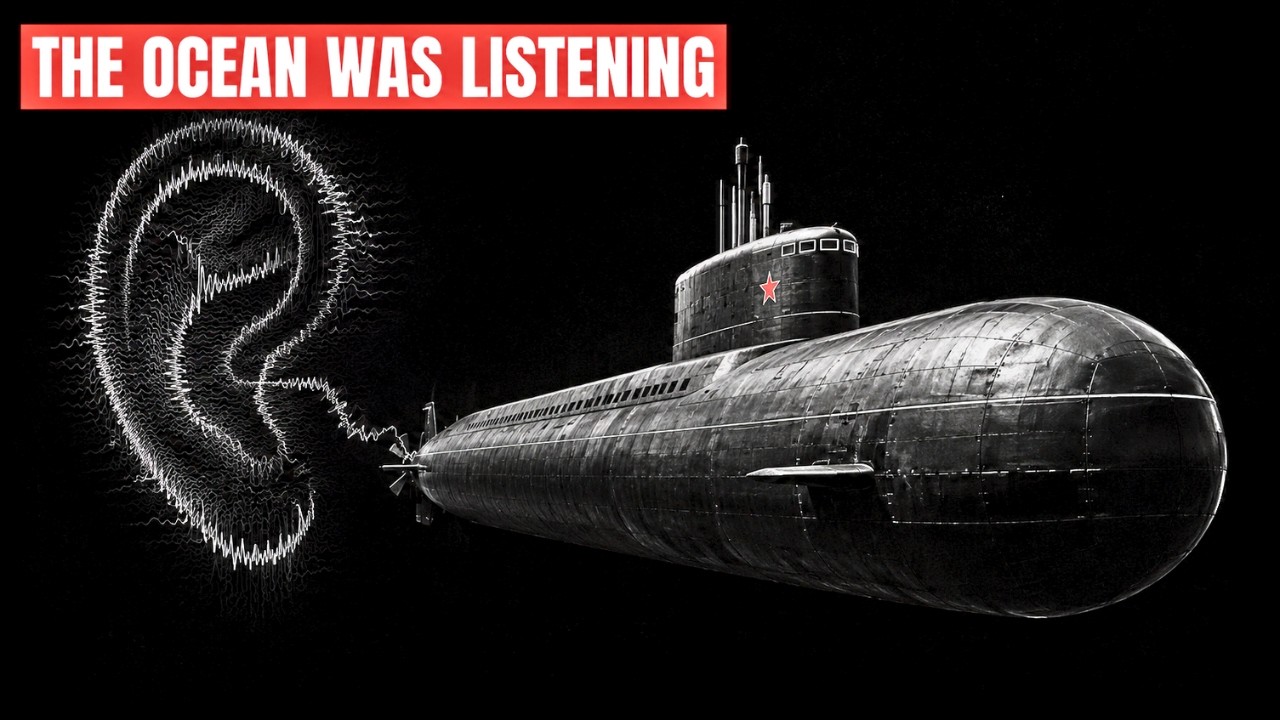
He saw one that morning. He measured its frequency, checked a classified reference book, and picked up the phone. Somewhere in the North Atlantic, nearly 4,000 miles away, a Soviet submarine had just crossed a line the world did not know existed. Her captain believed the deep ocean was silent and that he was invisible in it.
He was wrong on both counts. What the U. S. Navy was about to build on the strength of that morning, and what the Soviet Union would eventually spend in rubles and imperial strength trying to counter, would become one of the Cold War’s greatest secrets.
To understand how that was possible, the story goes back 17 years, to the final days of World War II when Germany surrendered in May 1945. Among the most valuable prizes of the war was a revolutionary submarine design moored in Germany’s northern ports: the Type XXI U-boat. It could remain submerged for weeks at a time, using batteries recharged through a snorkel, and it moved underwater faster than most Allied warships could chase it on the surface. Only a handful entered combat before the war ended, but the plans and many nearly finished boats were divided among the victors.
The United States, Britain, and the Soviet Union each acquired enough Type XXI equipment to reshape their own submarine forces. Moscow moved fastest. The Soviet Navy had entered the war with a small, old submarine fleet. By the early 1950s, it was producing dozens of new submarines a year based directly on Type XXI hulls and machinery, heading toward a total force of more than 300 submarines, the largest the world had ever seen.
For the U. S. Navy, this created a problem for which it had no answer. Radar, the technology that had decided many Atlantic battles, was useless against a submerged submarine.
Radio waves cannot penetrate seawater. Active sonar, which sends sound pulses into the depths to catch echoes, only worked at short ranges, and worse, it revealed the exact position of the hunter. A ship sending out acoustic signals to find a submarine was a ship telling the submarine where it was. Facing 300 Soviet submarines spread across two oceans, the Navy needed something none of its tools could provide: a way to find them without being seen, from long distances, all the time.
The answer, though no one knew it yet, had already been discovered in a laboratory during the war. In 1944, two American scientists working under Navy contracts, Columbia University geophysicist Maurice Ewing and his colleague J. Lamar Worzel, set out to solve a different problem. It was nearly impossible to find downed pilots and sunk sailors in the open ocean.
Ewing proposed a solution: if a survivor could drop a small explosive charge and detonate it at the right depth, the sound might travel far enough to be picked up by shore stations thousands of miles away, allowing rescuers to fix the source. The theory seemed unlikely. Sound, like light, should spread and weaken with distance. But when Ewing and Worzel ran their experiments in the Atlantic, the results astonished them.
A four-pound charge detonated near the Bahamas was clearly heard by hydrophones off West Africa, more than 3,000 miles away. They realized the ocean is not a uniform body of water. Temperature drops with depth. Pressure rises.
Sound travels at different speeds through those layers. At a specific depth, usually about half a mile below the Atlantic surface, those forces cancel each other out and create a narrow horizontal zone where sound waves are trapped: they bend back inward whenever they try to escape up or down. Sound generated inside that zone does not scatter into the sea. It travels across it, focused and confined, the same way light travels through a fiber optic cable.
Ewing and Worzel named it the SOFAR channel. The Navy adopted the discovery for pilot rescue in the final months of the war. Aircrews were given small SOFAR bombs as part of survival gear. Once the war ended, the rescue need faded, and the underlying idea stayed buried in files as a curiosity of ocean physics with no obvious peacetime use.
Then came 1949. Deeply concerned about the pace of Soviet submarine construction, the National Research Council convened a body called the Committee on Undersea Warfare. Its task was to think from first principles about how the U. S.
could detect the fleet Moscow was building. Among the scientists whose thinking shaped the committee’s work was Frederick Vinton Hunt. During the war, Hunt had run Harvard’s Underwater Sound Laboratory, the nation’s leading center for wartime sonar research. He knew exactly what active sonar could do and could not do.
He had followed the work of Ewing and Worzel on the SOFAR channel with great interest. His proposal was straightforward. If a small explosion could be heard across an ocean by shore stations, then in theory a submarine could also be heard. Every submarine, no matter how well designed, emits a low-frequency, continuous sound: the hum of turbines, the vibration of pumps, the rhythm of propeller blades churning the water.
Those low frequencies are precisely the ones that travel best inside the SOFAR channel. If the Navy built arrays of sensors and lowered them into that channel at the right depths and locations, it might be able to detect Soviet submarines from hundreds or perhaps thousands of miles away. The Navy was skeptical but interested. In late 1950, the Office of Naval Research awarded a secret contract to AT&T and its manufacturing arm, Western Electric, to find out whether the theory could be turned into reality.
The research phase was code-named Project Isabel. When the work moved from the laboratory to the ocean floor, the installation program was renamed Project Caesar. Both names and the true purpose of the work were classified from the start. Every shore station would be identified only as a naval facility, or NAVFAC, and publicly described as an oceanographic research station.
Sailors assigned there would be listed as ocean science technicians. The cables running from shore to the deep ocean were described as scientific instruments. Building the network required an engineering effort almost completely invisible to the outside world. Working through Bell Laboratories, Western Electric engineers designed hydrophones for arrays that could sit on the ocean floor for years without maintenance: long horizontal lines of sensitive listening elements arranged precisely so that the direction of a distant sound could be calculated from the tiny time differences in its arrival at each element.
The arrays were connected to shore via armored coaxial cables, some stretching a hundred miles or more across the continental shelf, laid by ships that looked like ordinary commercial cable ships. The first NAVFACs began operating along the U. S. East Coast in the mid-1950s: at Ramey in Puerto Rico, Grand Turk in the Bahamas, Cape Hatteras in North Carolina, and other sites down the Atlantic coast.
In 1957, NAVFAC Barbados was activated as the southern anchor of the chain, next to Harrison Point Light. In 1958, the first Pacific facility opened at Point Sur on the California coast, a cluster of low buildings on the cliffs above Big Sur. To passing tourists, it looked like a small research center. Behind the fenced gate, inside the concrete operations building, sailors watched the same slow-moving graph paper their colleagues watched in the Caribbean.
By the end of the decade, the U. S. had wired a semicircle of listening stations around the North Atlantic and a growing arc of them along the West Coast. Whether the system actually worked operationally was another question.
The first strong signal came from home. In 1960 and 1961, USS George Washington, the Navy’s first ballistic missile submarine, conducted her first deterrent patrols. She was under strict orders to remain undetected, running with the maximum quiet American submarines had ever achieved. The SOSUS arrays on the East Coast tracked her continuously across the Atlantic.
The result was both reassuring and disturbing. If the system could hear an American submarine trying to be silent, it could almost certainly hear a Soviet submarine that was not. The answer came on the morning of July 6, 1962. Operators at NAVFAC Barbados picked up a narrow tone rising from the background noise of the sea and identified it as the mechanical signature of a Soviet nuclear submarine, of the Hotel, Echo, or November class, transiting the gap between Greenland, Iceland, and the United Kingdom: the chokepoint that would soon be known in every American anti-submarine plan for the next three decades as the GIUK Gap.
It was the first time in history an American shore station had heard a Soviet nuclear submarine moving into the open Atlantic. The Soviet Navy was about to enter an ocean it believed was empty. It was not. The Barbados detection in the summer of 1962 was not a stroke of luck.
It was confirmation of a bet the Navy had been placing in secret for more than a decade. And it changed the way the Atlantic would be managed. Within weeks, the preliminary data written on graph paper at every NAVFAC on the East Coast was being reviewed, indexed, and compared. A picture began to form: not of one submarine, but of an entire pattern.
The Soviet Northern Fleet, based on the Kola Peninsula near Murmansk, had only a few practical routes to reach the open Atlantic. It had to head south past the Norwegian coast, then transit through one of three narrow gates: the passage between Greenland and Iceland, the Denmark Strait, or the waters between Iceland and Scotland. Those three passages together formed the GIUK Gap. In that gap, beginning in 1962, the U.
S. Navy began deploying hydrophones in density. New arrays were added off Iceland, Newfoundland, and the Azores. Each one made the ocean feel a little narrower.
A Soviet boat leaving Murmansk in secret was often detected before it cleared the Norwegian Sea, then tracked from network to network, its position plotted on a map in Norfolk before it reached mid-Atlantic. The Navy quickly learned it could not act on every contact. Sending a destroyer racing toward every Soviet submarine would reveal the game. The rule from the beginning was that SOSUS existed to know, not to reveal.
Its value lay in information. When U. S. anti-submarine forces moved, whether a P-3 Orion patrol plane lifting off from Keflavik or a hunter-killer submarine heading toward a specific track, it was supposed to look as if they had found the target by conventional means.
The Soviets, for their part, had no idea what was happening. They knew about SOFAR in theory only. Soviet scientists understood the physics of the deep sound channel, but the prevailing view in Moscow was that using it for tracking was hopeless. The ocean was too noisy.
The signal-to-noise problem was too severe. Finding a specific submarine in all that noise from thousands of miles away would require a global network of listening stations and data-processing capability no one believed any country possessed. By the mid-1960s, the network had grown into a global chain. In 1966, a new naval station opened at Keflavik, Iceland, placing U.
S. listening arrays directly on the GIUK Gap. The network was pushed north through additional stations along the West Coast, up into the Aleutians, and on to Guam. What had begun as a single research contract in 1950 now ringed both oceans.
Then, in a single year, the system was tested by two disasters, one Soviet and one American, which proved exactly what it could do. In early March 1968, a Soviet Golf II-class ballistic missile submarine, K-129, was on patrol in the central Pacific north of the Hawaiian island chain. Her mission was routine. She carried a crew of about 98 men and three ballistic missiles with nuclear warheads.
At some point around March 8, for reasons never precisely determined, K-129 was lost with all hands in water more than 16,000 feet deep. The Soviet Navy had almost no way of knowing where she was. The last contact with the boat had been days earlier, and her patrol area covered hundreds of thousands of square miles. Moscow launched a massive search, sending surface ships and submarines to the area for weeks.
They found nothing. The United States, listening from the other side of the same ocean, heard the boat die. Hydrophones operated by the Air Force Technical Applications Center at Adak, Alaska, recorded an acoustic event consistent with a submarine suffering an internal implosion at extreme depth. When those recordings were matched against SOSUS data from Pacific arrays, the sound was triangulated to a location.
American analysts located the wreck of K-129 within a few miles of the debris field the Soviets themselves could not find. That information would, six years later, launch one of the Cold War’s most audacious intelligence operations, Project Azorian, in which the CIA sent the ship Hughes Glomar Explorer to the site to attempt to recover part of K-129 from the ocean floor. But that came later. In the spring of 1968, the immediate significance was quieter and more strategic: the Americans had proved to themselves that their underwater listening system could locate a submarine their own navy could not find.
Two months later, they proved it again, this time on themselves. On May 22, 1968, the nuclear attack submarine USS Scorpion failed to arrive at Norfolk, Virginia, at the end of a Mediterranean deployment. When she failed to report in, the Navy launched a massive Atlantic search. It found nothing.
The ocean southwest of the Azores, where she was scheduled to transit, was vast and deep. Then, quietly, someone at the Naval Research Laboratory suggested a different approach. They went back to the SOSUS tapes. There, on time, they found the trace of an acoustic event matching exactly the sound of a submarine collapsing under pressure.
Triangulation from multiple arrays fixed the location. The research ship USNS Mizar was sent to the coordinates. Towed camera images confirmed the wreck of Scorpion on the seafloor, about 400 nautical miles southwest of the Azores, at a depth of more than 10,000 feet. For the second time in three months, SOSUS had done something no other system in the world could do.
For the second time, it was done in complete silence. Neither the American public nor the Soviet Navy was told how the wreck had been found. While the arrays were tightening their grip on the Atlantic, the Soviets began to feel, without understanding, that something was wrong. Patrol after patrol reported unexplained encounters.
Attack submarines that were supposed to transit the GIUK Gap unnoticed were met on the other side by American aircraft or destroyers that seemed to be waiting on the same track with precision. Ships operating in silence and under strict radio discipline were tracked for long distances by forces that theoretically should not have known they existed. Moscow’s first reaction was to assume the problem was inside its own submarines. Engineering was blamed.
Machinery noise-reduction programs were accelerated. New classes of nuclear submarines, Yankee, Charlie, Victor, and later Delta, were pushed through the shipyards of Severodvinsk and Komsomolsk-na-Amure at a pace no Western economy could match. Each one was quieter than the last, and each one cost the Soviet defense budget enormous sums. The Soviet Union was, in effect, spending rubles on a problem it had not correctly identified.
Even as it spent, it could not close the gap. The fundamental weakness in Soviet submarine acoustics was mechanical, not conceptual. To make a submarine quiet, propeller blades must be cut with extraordinarily precise curves so they do not create cavitation, the collapsing vapor bubbles that give a spinning propeller its underwater noise. Cutting those blades required computer-controlled multi-axis milling machines of a type the Soviets did not produce.
The theory was understood. The tools were not available. Then, in late 1967, a middle-aged American with monthly money problems walked into the Soviet embassy in Washington, D. C.
His name was John Anthony Walker Jr. He was a U. S. Navy chief petty officer, thirty years old, and his job at the time was duty officer in the communications center of the Commander, Submarine Force, U.
S. Atlantic Fleet, in Norfolk, Virginia. The message traffic passing through his hands included classified messages to and from every American attack and ballistic missile submarine deployed in the Atlantic. He knew where the submarines were at any given hour.
More importantly, he knew the cryptographic keys used to protect that traffic, and the settings for the KL-47 cipher machines that turned the Navy’s plain language into unreadable codes. Walker was deep in debt. A side business had failed. His marriage was falling apart.
He offered the Soviets the key settings themselves. For a monthly fee, he would supply the cards and lists that allowed the KGB to read Navy communications in near real time. Boris Solomatin, the KGB chief in Washington, understood what was being offered and accepted. Over the next 17 years, Walker recruited three others into his network.
In 1974, he brought in a friend from his Navy days, a communications specialist named Jerry Whitworth. In 1979 and 1980, he brought in his older brother, Arthur Walker, a retired lieutenant commander who had worked in anti-submarine warfare. In 1983, he brought in his son, Michael Walker, a young clerk assigned to the aircraft carrier USS Nimitz. Each one added new access, since Walker himself retired from active service in 1976.
The material they passed, estimated by later FBI assessments at one million classified messages, did not include a blueprint of the SOSUS system. Walker did not directly sell the locations of acoustic sensors. What he sold was more damaging. He sold the ability to read American anti-submarine reports as they were transmitted.
In those reports, day after day, appeared the SOSUS tracking results of Soviet submarines: their locations, timing, and movement tracks. From that raw data, Soviet analysts could, over time, infer the truth. They realized American forces were finding their submarines constantly, with excessive precision, and from very long distances. They began to understand that something out there was listening to them.
Even before the full picture became clear in Moscow, the Soviet program to counter it accelerated. In the late 1970s, agents of the Soviet trade organization Tishmaimport contacted Toshiba Machine, a subsidiary of Japan’s Toshiba Corporation, through a Norwegian intermediary linked to the state-owned Kongsberg Vaapenfabrikk. The Soviets wanted large computer-controlled propeller milling machines, specifically the Toshiba MBP-110S model, five-axis machines operating with digital controls supplied by Kongsberg. These machines were on the export control lists maintained by COCOM, the Western bloc’s mechanism for restricting strategic technology transfers to the communist bloc.
Selling them to the Soviet Union was entirely illegal. Through forged end-user certificates and a chain of shell companies, four machines were shipped to Leningrad between 1982 and 1984 and installed at the Baltic Shipyard. There, they were used to cut new generations of Soviet submarine propellers, quieter and more precisely shaped than anything the Soviet Union had built before. The first submarine class to benefit was already in service.
Project 671RTM, the Victor III class, had begun entering service in 1978 with noticeably better acoustic performance than its predecessors. American intelligence noted the change and did not immediately understand its source. Was this a normal development of Soviet engineering? A sudden local breakthrough?
Or was something else behind it, whether Soviet knowledge of American capabilities, access to Western technology, or both? The Navy could see on its displays that the sharp, clear tracks of the 1960s were beginning to fade. The tracks had not disappeared yet, but they were changing. And on the ocean, a fading track meant a submarine that was closer, or quieter, or both.
By the early 1980s, two long-running processes were converging. In American communications centers, the betrayal of an unknown petty officer was being quietly transferred to Moscow month after month, shipment after shipment. In Leningrad, illegally imported machines were cutting propellers that would enable Soviet submarines to evade the American acoustic network. In Norfolk, Keflavik, Barbados, and Point Sur, operators watching their chart paper had begun to notice that some submarines they had been hearing for 20 years were becoming harder to track.
Something was wrong. How deep the wound was had not yet become clear. The end of John Walker’s espionage did not begin in a communications center. It began with a phone call from a woman who had had enough.
In November 1984, Barbara Walker, John Walker’s ex-wife, divorced since 1976, called the FBI office in Boston. She told the agent who took the call that her former husband had been spying for the Soviet Union for years, that she had been aware of it, and that she was now ready to testify. The initial reception was cautious. She had been drinking when she called, and she held personal grievances against Walker going back a decade.
The report was not immediately acted on. But the Bureau followed up. Agents conducted lengthy interviews with Barbara Walker. What she described, dropping packages at rural drop sites, cash payments, encryption material stolen from Navy communications centers, was detailed and consistent enough that it could not be dismissed.
In early 1985, the FBI opened a full field investigation and placed John Walker under surveillance. On the night of May 19, 1985, Walker drove north from his home in Norfolk, Virginia. He was carrying a brown paper grocery bag. FBI agents led by Special Agent Robert Hunter followed.
In a wooded area near Poolesville, Maryland, on a rural road called Partnership Road, Walker stopped his car, left the bag at the base of a utility pole, and drove off. The bag contained 129 classified documents that his son Michael had leaked from USS Nimitz. A Soviet officer from the embassy in Washington was expected to retrieve it. Coordination went wrong.
The exchange did not complete. Walker drove home, unaware of what had happened. In the early hours of May 20, he checked into a Ramada Inn in Rockville, Maryland. FBI agents arrested him in his room before dawn.
Within days, the rest of the network collapsed. Michael Walker was arrested aboard the Nimitz in the Mediterranean and flown back to the United States. Arthur Walker was detained at his home in Virginia Beach. Jerry Whitworth, who had retired from the Navy the previous year, was arrested in California.
What emerged over the following months, in press conferences, court filings, and closed damage assessments, was the scale of what was lost. Defense Secretary Caspar Weinberger described the Walker case in blunt terms as one of the most serious compromises of American national security in the nation’s history. The FBI estimated Walker had exposed about one million classified messages. His son was sentenced to 25 years in prison.
His brother was sentenced to life. Whitworth was sentenced to 365 years. John Walker himself, in a plea agreement that spared his son a harsher sentence, cooperated with damage assessors and received two consecutive life sentences. Years later, when former KGB officers began speaking publicly about Cold War operations, Boris Solomatin, the official who had received Walker in 1967, described him as the Soviet Union’s most valuable spy ever against the U.
S. Navy. The Navy did not need Solomatin’s testimony to see what had happened. The evidence was in the water.
Beginning in the mid-1980s, a new class of Soviet attack submarine, Project 971, entered service. NATO called it Akula. It was quieter than anything the Soviet Union had ever produced, quiet enough in some conditions to approach the performance of the American Los Angeles-class submarines designed to hunt it. Its propellers were made on the same type of high-precision, computer-controlled milling machines that Toshiba and Kongsberg had illegally sold to the Soviet Union.
Its acoustic quietness reflected years of Soviet study of exactly what the Americans were listening to. In some circles of the American submarine community, informally, these boats began to be called “Walker boats. ”
In 1985, the network itself was reorganized. The fixed hydrophone arrays, which had formed the entire network for thirty years, were supplemented by the Surveillance Towed Array Sensor System, SURTASS, a fleet of civilian ships towing long acoustic arrays across the sea, adding mobile ears to the fixed ones.
The unified program was renamed the Integrated Undersea Surveillance System, IUSS. The old name SOSUS and the old cover story about oceanographic research remained classified for another six years. In 1987, the Toshiba-Kongsberg deal became a public scandal. Members of the U.
S. Senate smashed a Toshiba radio with sledgehammers on the Capitol lawn. The Japanese government issued formal apologies. Executives of Toshiba Machine were prosecuted.
The propellers themselves, of course, were already turning in the Barents Sea. And here the answer to the question with which this story began becomes visible. For more than 30 years, the United States was able to monitor the Soviet submarine fleet from distances no other country could match. That capability did not sink a single Soviet submarine in combat.
It fired no torpedoes. It launched no missiles. What it did was force the Soviet Union to make a choice Moscow did not realize it was being asked to make. Faced with the fact that its expensive nuclear submarines were being tracked from the moment they left port, the Soviet Navy had two options.
It could accept that its early ballistic missile submarines could not survive the transit to their advanced patrol areas off the American coast, and abandon the strategic role those boats were built for. Or it could spend whatever was required to make them quieter, faster, and more hardened. Moscow chose to spend. The cost was enormous and cumulative.
New submarine classes such as Delta, Typhoon, Sierra, Akula, and early design stages of Yasen required not just steel, but titanium hulls, high-strength alloys, and precision machinery the Soviet industry could not produce without importing or stealing the tools. Each new class required new shipyards, new training tracks, and new maintenance infrastructure. When the Soviet Navy could not close the acoustic gap, it adopted what became known as the “bastion” strategy. Its most valuable ballistic missile submarines were pulled out of the open ocean and kept in protected areas, such as the Barents Sea and the Sea of Okhotsk, where surface ships, aircraft, mines, and attack submarines were allocated to defend them.
That defensive shield in itself was a permanent, enormous cost. But none of it was enough. By the mid-1980s, the Soviet economy was already in serious trouble. Oil prices collapsed.
The war in Afghanistan was draining resources. The American Strategic Defense Initiative was imposing new spending on top of everything else. The Soviet naval program was one line item in a longer ledger, but it was an extremely heavy one. Thirty years of running to keep up with an American underwater capability Moscow could not match and often could not even see cost the Soviet Union enormous sums, sums a healthier economy might have absorbed.
But this economy, in the end, could not. To say that SOSUS alone bankrupted the Soviet Union is to exaggerate the importance of a single thread. To say that SOSUS was one of the most expensive traps set for the Soviet Union, a hidden financial front that lasted three decades and mounted costs continuously, is closer to the truth. The Kremlin pumped rubles into a race whose finish line was being redrawn every few years.
And often it did not know why it was falling behind. The Soviet Union dissolved on December 26, 1991. Earlier that same year, in a decision made possible by the end of the confrontation, the U. S.
Navy declassified the SOSUS mission. The commands that had operated since the 1950s under the cover names Atlantic Ocean System and Pacific Ocean System were renamed Commander, Undersea Surveillance Atlantic and Commander, Undersea Surveillance Pacific. Finally, sailors who had spent their careers under the job title “ocean science technicians” were allowed to wear insignia reflecting the work they had actually done. In the years that followed, most of the original NAVFACs were closed.
Point Sur had already ceased operations in 1984, its functions merged into a larger central facility. The other sites on both coasts closed one by one. The concrete buildings on the cliffs and shorelines stood empty. Their cables were left on the seafloor, their arrays abandoned in the sediment.
A smaller, updated version of the system remains in operation, still running today, supported by mobile arrays and newer technologies targeting a new generation of Russian and Chinese submarines. Some of the old hydrophones were given a second life. In the 1990s, marine biologists were granted access to parts of the SOSUS network. The sounds once analyzed to track the engine signatures of Soviet submarines were now used to track the migrations of blue whales and fin whales across ocean basins, to record earthquakes on mid-ocean ridges, and to study underwater volcanic eruptions of seamounts no ship had ever seen.
The decisive naval weapon of the Cold War was never a warhead. It was a microphone cable connected to a room where sailors read graph paper. It never announced itself. It never fired a shot.
For 30 years, it simply listened, and by listening it forced the other side to spend and spend and spend, until an economy under strain could no longer keep up.