I was already pulling onto the I-440 when I remembered the brooch. My hands tightened on the steering wheel. That small involuntary grip was the only outward sign of the cold dread that slid straight into my chest. The brooch wasn’t just a piece of costume jewelry or something I’d picked up on a whim at an airport gift shop.
It was a small oval of real pearl set in gold, and my mother had placed it in my palm from her hospital bed fourteen months earlier. Her fingers had been so thin by then. I kept thinking about how thin they were as she closed my hand around it. She said, “Wear this when you get married.
I want a part of me standing beside you at the altar. ” She was gone eleven days after that conversation. I had left the brooch on the side table at Patrice’s house when I took it off my blouse to show her. She’d asked to see it, turning it over in her neatly manicured hands with that warm, gentle voice she used whenever she was performing kindness.
Then I got caught up in saying goodbye and drove off without it. I took the next exit and headed back toward Green Hills. My wedding was tomorrow morning. I had a ten o’clock appointment with the hair stylist at the hotel, the photographer at noon, and the ceremony at four.
The deposit on the venue alone was forty-five hundred dollars. The dress hanging in my closet at my apartment in East Nashville had cost seven thousand. And here I was, heading back into Nashville traffic on a Friday night for a brooch the size of a silver dollar, because without it I would stand at that altar missing the only person who had ever really known me. My name is Mina.
I’m thirty-one years old. I’m a senior financial analyst at a regional investment firm, which means I’m very good at reading numbers and very slow to trust my gut about people. That particular flaw had cost me years of my life, and I was about to discover exactly how much. Patrice lives in a gated community in Green Hills, the kind of neighborhood where every house looks like a greeting card.
Her son Tate grew up there. Tate is thirty-four, a civil engineer with a quiet voice and a habit of placing his hand on the small of my back whenever we walked into a room together. We’d been together for four years. We met through mutual friends at a Predators game, and within six months, I thought he was the most stable, rational man I’d ever dated.
I thought he was someone who would be honest even when honesty was uncomfortable. I thought a lot of things. I parked in the visitor spot outside Patrice’s building, turned off the engine, and sat for a moment. My reflection in the windshield looked calm.
Brown hair, a little makeup, a person visiting her future mother-in-law the night before her wedding. Normal. Ordinary. Nothing out of place.
I got out of the car. The lobby was empty. The elevator came quickly. While I rode up, I thought about what I would say at the door.
Something simple and light. Something that didn’t make this a big deal. Just the brooch. In and out in three minutes.
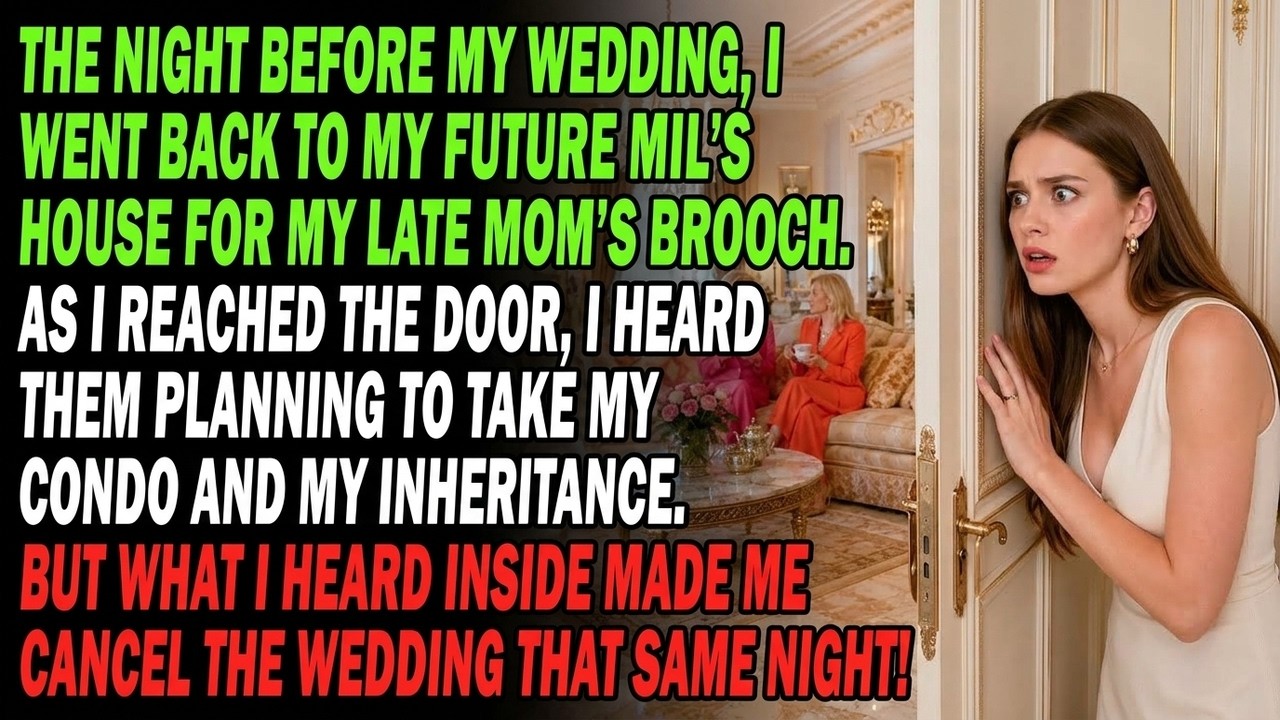
I’d be back on the interstate before traffic got worse. I entered the hallway on Patrice’s floor and walked down the familiar carpet toward her door. That’s when I heard her laugh. Not the laugh she uses with me, the musical, measured one she produces when I say something she finds charming.
This was different. Free. Unrestrained. The laugh of someone who had just taken off a mask.
I stopped about four feet from the door. Her voice carried clearly through it. “Honestly, Darby, that girl handed it to us on a silver platter. ”
A younger voice replied.
Darby. Tate’s twenty-five-year-old sister, who had texted me that afternoon to say how happy she was to officially become my sister. “She really did. I almost felt guilty.
”
“Don’t. ” Patrice’s voice sharpened with amusement. “Save that energy. You’ll need it for tomorrow’s toast.
Make it emotional. Really lay it on thick about how much Tate loves her. The more his relatives cry, the less likely they are to question anything later. ”
I stood completely still in that hallway.
My hands hung at my sides, away from the door. The carpet under my feet suddenly felt very thin. I looked at my phone. I opened the voice memo app and pressed the record button.
I held the phone at my side, aimed toward the door, and didn’t move. “What’s the timeline for the apartment? ” Darby asked. “Mina’s lease with the current tenants ends in August.
After the wedding, Tate will push to accelerate the timeline, get the tenants out early, and move everything into a joint account. Once it’s joint, it’s accessible. ”
A short pause, and the clink of ice in a glass. “She bought that property in the Nations three years ago.
Do you know what those properties are worth now? We’re talking over six hundred thousand, and that’s before what her mother left her in savings. Tate says she keeps the inheritance in a separate account for now. But a wife is more trusting than a girlfriend.
She’ll drop her guard once she’s wearing the ring. ”
I leaned back against the hallway wall. My legs felt far away from me, like they belonged to someone else standing in a different building. “What if she finds out?
” Darby asked. She didn’t sound worried. It sounded like she was asking about logistics. The same tone she’d use to ask what would happen if it rained during a planned picnic.
Patrice sighed. “She won’t. And even if she starts to suspect something, she’s the type to avoid confrontation. You’ve seen her.
So polite, so reserved. She’d rather suffer in silence than cause a problem. That’s why Tate chose her. ”
“Really?
”
Another pause. “She has no family. Her mother is gone. She’s isolated.
We’re the family she was looking for. That’s the easiest kind of person to control. ”
My jaw was clenched so hard my teeth ached. “And Tate is okay with all of this?
” Darby pressed. “He proposed half of it. The apartment strategy was his idea. The inheritance angle came from me.
” Patrice’s voice warmed with something close to pride. “My son knows how to plan. That’s how I raised him. ”
I heard everything I needed to hear.
I walked quietly back down the hallway. I didn’t run. I pressed the elevator button and stood facing the doors. When they opened, I stepped in and let them close behind me.
In the reflective walls of the elevator, a woman with a very still face looked back at me. I watched her. She watched me. Neither of us cried.
In the parking lot, I sat in my car for seven minutes. I know it was seven minutes because I watched the clock. My breathing was deliberately slow. The kind of slow breathing you do when you’re making a decision instead of feeling one.
I thought about my mother. I thought about the way she used to say, very quietly, that she worried about how quickly I trusted people. That the people who smiled the warmest smiles were sometimes the ones to be most careful of. I’d laughed at that.
I was a financial analyst. I did risk assessments for a living. I told her she worried too much. She had worried exactly the right amount.
I stopped the recording and saved it. Then I opened my contacts and texted Tate. It said: “The wedding is off. Don’t call me tonight.
I’ll explain everything when I’m ready. ” I turned off my phone. The drive back to East Nashville was long because I took the slow route through neighborhoods I knew. I passed the coffee shop where Tate and I had our first real date.
I passed the park where he once surprised me with a picnic. And I thought to myself then, “This is the one. This is the right person. ” I didn’t stop at any of these places.
I drove past them at a steady speed, saying goodbye to each of them in my mind, and kept going. My apartment was a one-bedroom on the second floor of a converted Victorian in East Nashville. It was small, with sloped ceilings and a fireplace that clanked in the winter, and I’d loved living there in a comfortable, temporary sort of way. You love a place you know you’re just passing through.
I’d signed the lease five years ago and kept renewing it while I saved money. When I finally bought the place in the Nations, I kept this apartment because the new place had tenants and the commute from East Nashville suited me. I was grateful now that my name was the only name on both leases. I switched on the lamp in the living room and stood looking at my dress hanging on the garment rack in the corner.
White silk, simple lines, the kind I’d always imagined myself wearing. I’d tried it on four times in the store before I approved it. I looked at it for a long time, then walked past it into the kitchen and put the kettle on. My cousin Priya called at 11:15.
She’d just landed. She was texting me from baggage claim. “Mina, your hair appointment is at ten. Do you want me to meet you there, or is it off?
”
I said, “I cancelled it. ”
A pause. “Which part? ”
“All of it.
”
A longer pause. “Tell me where you are. I’ll get a cab. ”
Priya sat across from me at my kitchen table until two in the morning while I played her the entire recording from start to finish.
She didn’t say much while she listened. After it ended, she was quiet for a moment, then said, “Okay, the first thing I’m doing tomorrow is calling Aunt Rosemary. ”
Aunt Rosemary was my mother’s oldest friend. She was sixty-two, lived in Brentwood, and had spent thirty years as a family law and civil litigation attorney before moving into private practice.
She’d come to my mother’s memorial and held my hand the whole time. When she left, she pressed her card into my palm and said, “Call me if you need anything. Anything at all. ” I’d kept the card in my desk drawer without thinking much about why.
Priya called her at eight the next morning. By nine thirty, Aunt Rosemary was sitting at my kitchen table in a dark gray blazer with a legal pad open in front of her. She listened to the recording with her pen motionless. She took notes on only one page.
When the recording ended, she set the pen aside. She said, “You were very smart to record it. And very smart to call me before you spoke to any of them again. ”
I said, “I didn’t.
”
She nodded. “Good. Keep it that way. From now on, all communication goes through me.
” She looked directly at me. “How much money did you give them over the course of your relationship? ”
I pulled out the folder I’d put together the night before, around three in the morning when I couldn’t sleep. I’d printed every wire transfer receipt, every Venmo transaction, every bank draft, fourteen of them in total, spanning three years, including an emergency car repair for Patrice.
And Darby’s last semester of grad school tuition when her loan fell through. And a cash advance to Tate when one of his deals collapsed and he said he needed two weeks to sort it out. The total was just under nine thousand dollars. Aunt Rosemary flipped through the pages with no expression on her face.
She said, “Documented. Good. ” She stacked them into a neat pile. “I’ll write a demand letter today.
”
By noon, she’d sent it. Tate called at 12:40 from three different numbers. I watched each call appear on my screen and vanish. At some point, he texted: “Mina, whatever you think you heard, please just let me explain.
It’s not what it sounds like. ”
I placed the phone face down on the table and thought about the word “explain. ” I thought about how many conversations over the past four years I’d spent accepting explanations for things that felt wrong at the time. The explanations always seemed so smooth, so logical.
That was Tate’s gift. He was very, very good at making things sound reasonable. I didn’t reply. Patrice called that evening.
Aunt Rosemary took the call. I sat in my kitchen listening to one side of the conversation, watching Aunt Rosemary’s face, which remained completely calm. “Yes, this is Rosemary. I’m representing Mina from now on.
Any questions or concerns from your end should come to me directly. ” A short pause. “That’s understood. I advise you to consult your own legal counsel before responding to the letter.
” Another, longer pause. “I understand that. Good evening. ”
She ended the call and looked at me.
“They’ll respond in a few days. She was flustered. Good. ”
That evening, Priya and I ordered Thai food and ate it on my living room floor because my table was still covered in Aunt Rosemary’s paperwork.
We didn’t talk about Tate or the wedding. We watched an old movie and Priya fell asleep on my couch around nine, and I sat in the dark for a while looking at the garment rack in the corner. The dress was beautiful. It was also the most expensive thing I’d ever bought for myself.
And looking at it, I didn’t feel sad or sentimental. I felt tired. Like that feeling when you’ve been carrying something heavy for too long and you’ve only just realized how heavy it is. The following week at work was normal in the way things are normal when your world has rearranged itself and the arrangement hasn’t caught up with your daily routine yet.
I showed up. I ran my reports. I sat through meetings. My manager knew I’d taken a personal day on Saturday and returned Monday, and that was all anyone needed to know.
I was a private person and my colleagues respected that. No one asked about the wedding. There were texts from Darby asking if we could talk. There were two voicemails from a number I didn’t recognize, which I deleted without listening to.
There was a message from a college friend of Tate’s asking if everything was okay, that he’d heard something happened. I replied, “Everything is fine. Thanks for checking. ” I sent nothing else.
On Thursday, Aunt Rosemary called with news. “They want to negotiate. They’re disputing two of the transfers, claiming they were gifts. The rest they acknowledge were loans.
”
I said, “I have the messages where I use that word explicitly. ”
“So do I. We’re in a strong position. ”
Ten days after the wedding that didn’t happen, the first payment landed in my account.
Twelve hundred dollars. I looked at the notification on my phone and felt nothing dramatic, just a small, solid click inside me, like a lock turning. I called Aunt Rosemary and said, “Thank you. ”
She said, “Your mother would be proud of you.
”
I didn’t say anything for a moment. Then I said, “I’d like to think so. ”
Three weeks after the wedding, I made a decision about the dress. I heard through a friend of a friend about a local nonprofit that helps women survivors of difficult domestic situations get back on their feet, providing job placement and housing support, and hosting an annual formal gala to celebrate their progress.
They sometimes accepted donated dresses for the event. I put the dress in a box carefully, wrapped in tissue paper. I drove across town on a Sunday afternoon. The woman who received it at the door was around forty-five, with a warm, guarded manner.
She lifted the lid of the box and her eyes widened. She said, “This is brand new. ”
I said, “I never wore it. ”
She looked at me with a kind of quiet understanding that I appreciated because it didn’t require an explanation.
“Someone is going to feel amazing in this. ”
I said, “I hope so. ” And I meant it. The dress was beautiful.
It deserved to be worn by a woman who would feel nothing but happy in it. Pure happiness, without the weight of everything I’d been carrying. I drove home feeling lighter than I had in months. The second payment came two weeks later.
And the third and final payment arrived on a Tuesday morning in early October. When I saw the amount appear in my account, I sat at my desk for a moment with my hands clasped, thinking about all the ways things could have gone differently. If I hadn’t turned back for the brooch. If I’d knocked on the door instead of eavesdropping.
If I’d heard part of that conversation and convinced myself of a generous interpretation, as I’d learned to do so effectively over four years. I thought about my mother, her thin fingers closing my hand around the brooch. By the way, I got it back. Aunt Rosemary had sent a formal request for its return as personal property of sentimental value, and it arrived in my mailbox a week after the wedding in a small padded envelope, with no note inside.
I keep it now in a dish on my bedside table. Some mornings, I pick it up while I think about the day ahead, turn it over in my fingers, then put it back. In November, the tenants’ lease on the house ended, and they left on good terms. I hired a cleaner and a painter, bought a couch and a dining table and a real bed with a frame.
On the first Saturday of December, I moved in. Priya flew in to help. We assembled furniture badly and laughed about it. We ordered pizza and ate it on the floor because the table wasn’t ready yet.
At some point, Priya looked around the empty room and said, “This is a really great place, Mina. ”
I said, “It’s mine. ” And I meant all of it. The walls.
The space. The mortgage I’d signed alone. The decision to buy it. The decision to keep it.
Mine. That night, I slept in my own place for the first time. The heating system worked. The neighborhood was quiet.
I lay in the dark with my eyes open for a while, listening to the city, thinking about what it meant to be thirty-one and alone in a house I’d bought myself, with money I’d earned, that no one in the world could touch. It meant something. I was still trying to find the exact words for what. Sometime in January, I ran into Tate.
It was inevitable, really. Nashville isn’t a big city, and we had a lot of overlapping circles. It happened at a coffee shop near my office on a Thursday afternoon. He was at the counter when I walked in.
He saw me the same moment I saw him. He looked thinner, a little more tired. He said, “Mina. ”
I said, “Hi.
”
We stood for a moment the way people do when they’re trying to gauge how much acknowledgment the situation requires. He said, “You look good. ”
I said, “I am. ”
He said, “I’m sorry.
About everything. I know that doesn’t fix anything. ”
I thought about what I wanted to say. I thought about the four years and the picnic in the park and his hand on the small of my back, and also the recording, and the fourteen transfers, and my mother’s voice saying she worried I trusted too quickly.
I said, “I know you’re sorry. But I also know who you are. ” Both of those things could be true at the same time. He nodded slowly.
He didn’t try to add anything. I ordered my coffee and left. Walking back to the office, the sharp January air on my face, I realized there was something I’d expected to feel in that moment and didn’t. Anger, maybe.
Or sadness. Or that particular pull of old feelings that makes you second-guess everything you’ve decided. Instead, I felt the same quiet steadiness I’d felt for weeks. Not numb.
I want to be clear about that. Clear, like a room after you’ve opened all its windows. I want to say something to anyone listening to this, because I think about the person I was a year ago and I know she wasn’t alone in being that person. I was good at my job.
I was careful with money. I kept meticulous records, by most reasonable standards. I was a competent adult making sound decisions. And yet I spent four years with a man whose family saw me as nothing more than a financial strategy.
And I only saw it clearly when I was standing in a hallway with recorded proof in my hand. I’m not telling you this to be hard on myself. I’m telling you because I don’t think the version of this story that says “if only you’d been smarter, you would have seen the signs” is the whole truth. Some people are just very skilled at what they do.
Patrice and Tate were skilled. The warmth felt real. The family dinners felt real. The hand on the small of my back felt real.
What saved me wasn’t intelligence. It was a brooch. It was the fact that I turned back. My mother always said that the things we forget are sometimes the things we need the most.
I used to think she meant that in a general, philosophical way. Now I think she was being more literal than I realized. I keep the brooch in its dish by the bedside table. I pick it up some mornings when I think about my day.
I turn it over, and I put it down. It’s small and oval, real pearl and gold. Not flashy. Just present.
Present the way she is, but in a different way now. I made a promise to myself in that hallway the night before my wedding. A promise I’ve kept every day since. I will never again confuse someone’s ease with honesty, or their warmth with character.
I will never hand my resources, my money, my time, my patience, to people who see them only as resources. I will never confuse a family’s desire for me with a family’s knowledge of me. I will turn back for the brooch every time. I will always turn back, because the things that truly belong to you are worth any inconvenience, any detour, any late exit off the highway in the dark.
They’re worth the cold dread in your chest and the strange, still face looking back at you in the elevator mirror. They’re worth coming back for, every single time. I moved into my apartment in December, and in January the sun began slipping through the west-facing windows in the late afternoon, drawing long golden lines across the hardwood floor. I would come home from work and stand in that light for a minute before turning on any lamp.
I would just stand there. I was building something. It was slow, and it was mine, and no one else owned it.