In the autumn of 1876, Lemuel and Verity Ashcroft set out from Lynchburg, Virginia, in a covered wagon with all their possessions, heading for a town called Hollow Mount. Lemuel, 34, had been promised a year of work at a tannery run by a man named Ezra Whitcomb. His wife Verity had just turned 29. They carried $22 in savings, a tin of coffee, a Bible given to Verity by her mother, and a pistol Lemuel had not fired since the war.
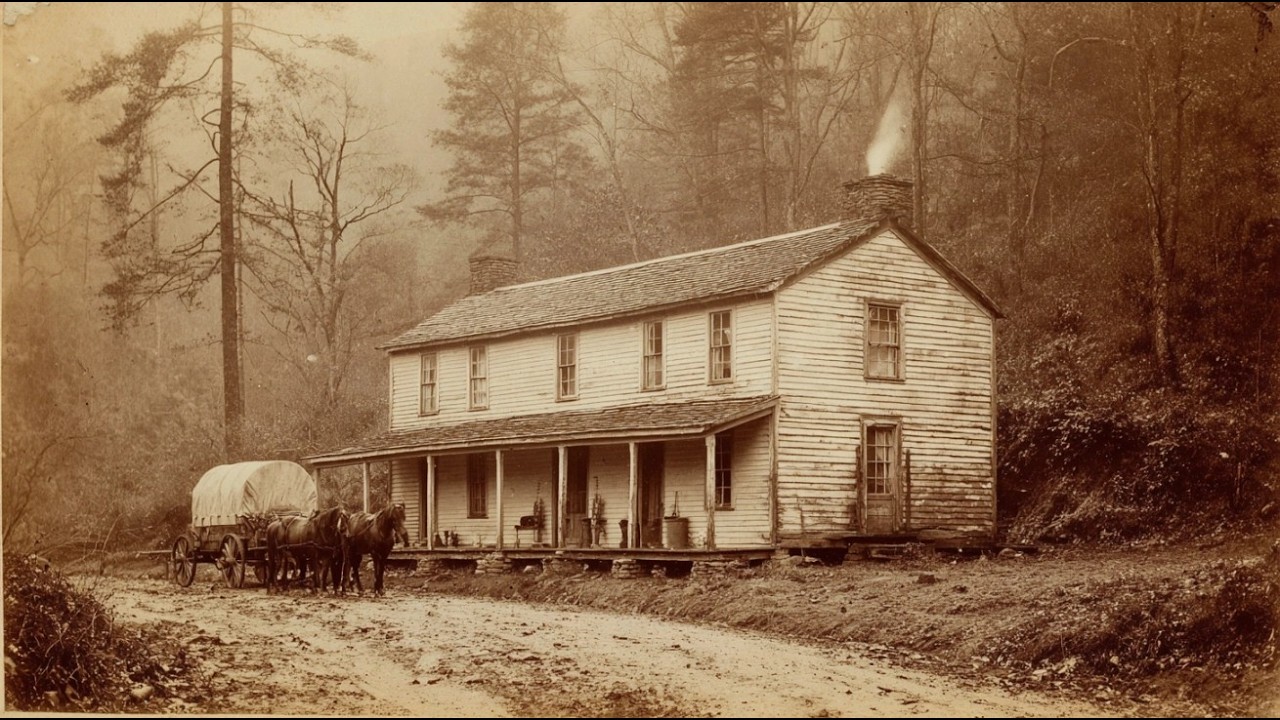
They had been on the road for 11 days when the trail they were following simply stopped. The map Lemuel had bought in Lynchburg had been drawn by a man who had never traveled west of the city, and by the ninth day they had crossed a ridge that did not appear on it at all. Lost, with tired horses and daylight fading, Lemuel climbed a tall pine and spotted a thin line of chimney smoke to the north. They decided to cut through the woods and ask whoever was burning that wood for directions.
It took them two hours to reach the source. The house sat in a shallow bowl of land: a long pale farmhouse with a wrap-around porch, a chimney at each end, a barn, a smokehouse, and a springhouse. The yard was swept clean. There were no animals in the pasture, no birds in the trees, and no sound at all in the bowl of land.
The barn doors were padlocked. There were no curtains in the windows, and in one kitchen window a single oil lamp burned, with a figure standing perfectly still behind it, watching them approach. The door opened before they reached the porch. A tall, gaunt man in his sixties came out wearing a clean white shirt, a black vest, and polished boots.
He introduced himself as Cassian Pell and said he and his sister, Honoria, kept the place together. He insisted they come inside for a hot supper and a soft bed, and he insisted on leading their horses into the barn himself. Lemuel noticed a sweet, heavy smell coming from the barn that was not hay or animal. He told himself it was molasses.
Inside, Honoria was setting the table. She was very thin, dressed in a pale gray dress that no longer fit her, with gray hair parted in the middle and pulled back severely. Her smile was identical to her brother’s. The table was set for four, though no one had been expecting them.
Verity noticed that. She also noticed that the kitchen pots were spotless, the kettle had no soot, and there were no crumbs or peelings anywhere, as if no one had cooked in that kitchen for a year, even though they were about to be served from it. During supper, Cassian talked warmly and easily but never once looked at Verity. Later, after they were shown to a prepared room on the second floor, Honoria paused in the doorway.
Lemuel, putting down the bag, did not hear what she said. Verity heard every word. Honoria said: “If you hear someone tell you to come downstairs in the night, do not come downstairs. ”
That night, the Ashcrofts lay awake in their clothes, Lemuel with his pistol on the table beside his chair.
Around the small hours, they heard footsteps in the attic, then the front door opening and closing, muffled voices downstairs, and then a man’s voice answering Cassian’s. Looking out the window, Lemuel saw Cassian cross the yard carrying something long and heavy into the padlocked barn. He stayed inside for several minutes and came out empty-handed. As he reached the porch, Cassian stopped, turned, and looked up directly at Lemuel’s dark window.
He smiled, and went inside. Around three in the morning, someone came up the stairs and stopped outside their door. A voice, exactly Cassian’s, spoke gently: “Verity, come downstairs, dear. Your husband is asking for you.
”
Lemuel pressed Verity’s wrist to wake her without a sound. The voice repeated the words several times, growing slightly less gentle, then muttered something they could not make out and went back downstairs. It returned with a second set of footsteps. The doorknob turned, but the latch held.
A shoulder struck the door once, then again, testing it. Then there was weeping in the hall, and Cassian’s voice, quiet and almost tender: “Honoria, Honoria, dear, you promised. You promised you would not warn them. ”
At four in the morning, the Ashcrofts left through the window, crossed the porch roof, and slid into the backyard.
Lemuel made the decision to leave the horses, the wagon, the savings, and the Bible. He later wrote that he believed if he had gone to the barn to free the horses, Verity would not have walked out of that bowl of land alive. They walked east through the woods until the sun came up, and kept walking. For the first three hours, Lemuel could hear behind them a voice calling a name he did not know, in a patient, neighborly tone.
Then it stopped all at once. Near noon, they came down out of the trees to a crossroads store run by a one-armed veteran named Colden Raspberry, who had lost his arm at Antietam. When Lemuel told him what had happened, Raspberry went pale. He sat down on a barrel of nails and said: “You are the third.
” He told them two other couples had come down out of those woods with almost the same story, in 1870 and again in 1873. He brought out a wooden box containing nine newspaper clippings describing disappearances of travelers last seen on roads that should have been roads. He told them a deputy from Bedford had ridden up to the Pell house in the spring of 1874 to ask questions. The deputy quit his post a week later and moved his family three counties east without saying why.
Raspberry drove the Ashcrofts to the train at Lynchburg and paid for their tickets out of his own pocket. They settled in eastern Tennessee, where Lemuel found work in a harness shop and Verity took in sewing. They rebuilt their lives slowly. They never went back to Virginia.
For the rest of their lives, they would not sleep in a room without a working latch on the door. Lemuel could not stand the smell of stewed apples. Verity kept a single pressed sprig of dried lavender in a small box at the bottom of her hope chest, taken on the way out from the vase on the windowsill of the room where they had nearly died. She never told her husband where she had got it.
In 1891, fifteen years after the night at the Pell house, Lemuel wrote a long letter to a county historian in Bedford, Virginia, describing everything that had happened. The letter sat in a courthouse archive for almost a century in a folder marked in pencil: “Do not investigate. ” It was not the only letter in that folder. There were nineteen others, written in different hands and different inks, from the 1850s through the 1920s.
They described the same house, the same swept yard, the same locked barn, the same supper, the same smiling brother, the same thin sister whose hands shook when she set down a plate, and the same voice in the deep middle of the night calling a name. In some of the letters, the husband had been dead for years. In 1904, a road crew working about four miles north of the old road to Hollow Mount struck the foundation of a house that no living person remembered. Beneath the foundation was a stone-lined cellar, and beneath that, a deeper cellar fitted with a heavy door of unusual construction.
The foreman walked off the job and did not come back. The site was filled in. A newspaper in Roanoke printed one short article about the discovery. It described the foundation and the deeper cellar, but declined to describe what was found inside, saying it was “of a quantity and arrangement that the present writer cannot, in conscience, set into print.
” The article also described personal effects found scattered in the upper cellar: a wedding ring, a small brooch shaped like a rose, a pocket watch with the initials L. A. engraved on the back, a water-damaged Bible, and a mourning locket. A county coroner, Dr.
Pemberton Yates, wrote in a sealed report that the recovered remains were all of adults, that personal items identified at least seven separate individuals, and that he believed the final count was significantly higher. Cassian Pell was never found. Honoria Pell was never found. By the time anyone went looking for the house in earnest, it was gone.
Burned, some said. Pulled down, others said. A surveyor who walked the bowl of land in 1912 found no trace of a foundation at all. The letter from Lemuel Ashcroft contains a postscript, written on a separate page some weeks after the main letter.
In it, Lemuel wrote that in the spring of 1883 he had traveled alone to Lynchburg and gone to a small Methodist church, where he had been told an elderly woman who had once kept house at a farm on the road to Hollow Mount was buried. He did not write the name on the stone. He wrote only that the dates on the stone were 1817 to 1849, and that the woman beneath it had been dead for 27 years on the night she stood in the doorway and told his wife to use the latch. He left a sprig of lavender on the grave.
He did not tell his wife where he had been. A second letter in the same archive tells a nearly identical story. It was written by a woman named Adelpha Born in October 1868, eight years before the Ashcrofts. She and her husband had become lost on a road that ended where it should not have ended, had come down a slope to a long pale farmhouse with a chimney at each end, had been fed roasted chicken and stewed apples and pickled beets, and had been warned in a low voice by the gray-haired woman of the house to use the latch.
In her account, the man was called Obed Holloway and the sister was called Mercy. They used the latch and escaped east through the woods. She wrote that she did not believe the brother and sister had been a man and a woman in any way she understood those words. She wrote that on the morning they had come down out of the trees, she had looked back just once and had seen, on a low ridge behind them, three figures standing in a row watching them go.
She wrote: “I think it was tall. I think it was waiting. I think we were, that night, only the second course.
“