The story of the Alamo has been told for nearly two centuries as a clean legend of heroic sacrifice, but the reality of what happened on March 6, 1836, was far more chaotic and brutal than the polished version suggests. Before dawn broke over San Antonio, roughly 1,700 Mexican soldiers lay silently in the tall grass, waiting for the order to attack a mission defended by fewer than 200 exhausted men. The man commanding the assault was General Antonio Lopez de Santa Anna, who styled himself the Napoleon of the West. After a 12-day siege, he had grown impatient with the defenders’ refusal to surrender.
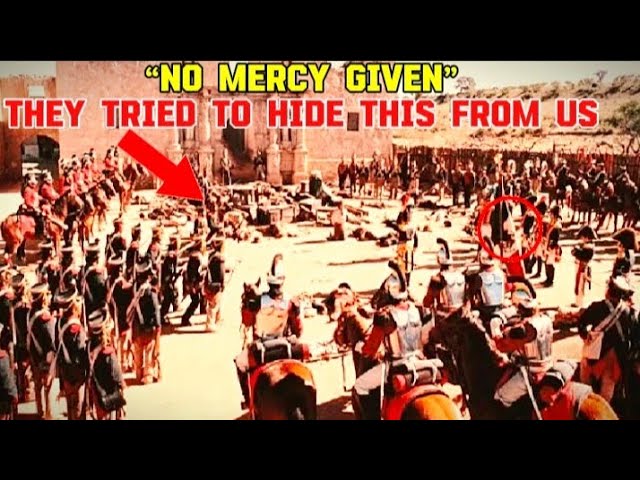
He wanted more than victory—he intended to crush the spirit of rebellion in Texas so completely that no one would ever challenge Mexican authority again. To make his intentions unmistakable, he raised a blood-red flag from the bell tower of San Fernando Cathedral, signaling that no quarter would be given. No prisoners. No mercy.
Inside the walls, the situation was desperate. The defenders were shivering in the late winter cold, running low on ammunition, and exhausted from days of constant vigilance. Only 32 reinforcements from Gonzales had managed to slip through enemy lines. The rest of Texas remained silent.
Shortly after midnight, Santa Anna’s troops began to move. In an act of chilling discipline, the soldiers rose quietly from the frozen ground. Smoking was forbidden. Talking was forbidden.
Even the clink of a canteen could mean death. They organized into four assault columns, carrying ladders, axes, and crowbars—not tools of defense, but instruments for breaching the mission’s walls. William Barrett Travis, the 26-year-old commander of the Alamo, had spent his final days writing letters pleading for aid that would never arrive. He had famously written that he would never surrender or retreat.
That vow was about to be tested in the most violent way possible. Around 5:00 a. m. , the silence shattered.
A shout rose from one of the advancing columns, followed by a chorus of “Viva Santa Anna. ” The element of surprise was lost, but it no longer mattered. Santa Anna ordered the bugles to sound El Degüello, an ancient Spanish call that signaled no lives would be spared. It was the sound of a death sentence set to music.
Thousands of boots surged forward, the ground trembling under the charge. Inside the mission, Travis’s servant Joe was jolted awake by Captain John B. ‘s scream that the Mexicans were upon them. Travis grabbed his shotgun and raced to the north wall.
Seeing waves of dark figures rushing toward the breaches, he shouted to his men that the Mexicans were upon them and they would give them hell. The first two Mexican columns slammed into the north wall. The defenders unleashed volleys of scrap metal and grapeshot from their cannons, tearing through the attacking battalions. For a moment, the advance wavered when a Mexican colonel fell wounded.
But the momentum of 1,700 men was unstoppable. Soldiers climbed over the bodies of their own fallen comrades, using them as stepping stones to reach the base of the walls. What followed was not an orderly battle but a violent storm of fear and desperation. Because the defenders could not man the entire perimeter, the Mexican columns bottlenecked at the base of the walls, creating a deadly crush of humanity.
Ladders crashed against stone. Rifle butts smashed into skulls. Thick clouds of black powder smoke blinded everyone, and in the confusion, some Mexican soldiers were accidentally shot by their own men in the second rank. On the north wall, Travis fired both barrels of his shotgun into the mass below.
Seconds later, a musket ball struck him in the forehead. He fell early, leaving the defenders leaderless in the opening minutes of the assault. Joe witnessed his master fall and realized the wall was lost. He fled toward the back of the compound, hiding in rooms where women and children huddled in silent terror.
With the north wall collapsed, elite Mexican grenadier reserves poured into the plaza. The defenders retreated toward the long barracks and the church, turning the mission into a labyrinth of individual death traps. The most brutal fighting did not happen on the walls—it happened indoors. Mexican forces captured the massive 18-pounder cannon and turned it inward, its blasts ripping open the adobe walls of the barracks and burying wounded men in dust and debris.
In near-total darkness, lit only by the flash of musket fire, men fought with knives, bowie blades, and bare hands. When ammunition ran out, they used their rifles as clubs until the stocks shattered. Doorways were blocked with piles of bodies. There was no room to maneuver, only the primal instinct to kill the person in front of you.
Inside the church, the last stronghold, women and children listened to the thundering footsteps overhead. When Mexican soldiers finally burst in, a young boy, no more than 10 or 11, was shot in the chaos before officers realized there were civilians present. Contrary to the legend that every defender died at his post, some tried to flee. Near the palisade, a group of defenders—accounts vary from 10 to 60 men—attempted to break through the lines and head for the Gonzales road.
They did not make it. Santa Anna’s cavalry, stationed outside the walls for that exact purpose, cut them down in the open fields. The fates of Davy Crockett and Jim Bowie remain the subject of conflicting accounts. The legend says Crockett died in a pile of Mexican bodies, swinging his rifle Old Betsy until his last breath.
But eyewitness accounts from Mexican officers, including Lieutenant José Enrique de la Peña, tell a different story. They claim Crockett and a few others were captured and brought before Santa Anna after the fighting stopped. General Martín Perfecto de Cos pleaded for their lives, but Santa Anna, true to his red flag, ordered them executed on the spot. Bowie, famous for his knife, was bedridden with a lung infection, likely typhoid or pneumonia.
Some stories say he died fighting from his cot with two pistols blazing. Others claim he was found already dead or bayoneted in his bed before he could sit up. In less than 90 minutes, the gunfire faded. The smoke drifted away in the early light, revealing a scene of unimaginable carnage.
Santa Anna’s victory was total, but he showed no dignity to the fallen. Nearly 600 Mexican troops were killed or wounded and were buried or dumped into the San Antonio River. But for the defenders, there would be no graves. Santa Anna ordered their bodies stripped and stacked in layers of wood and flesh.
These funeral pyres were set ablaze, and the smoke from the bodies hung over the city for hours. Only one defender, Gregorio Esparza, was granted a proper burial, and only because his brother served in Santa Anna’s army. The surviving women and children, including Susanna Dickinson and her baby, were brought before Santa Anna. In a strange display of mercy, he gave each woman two silver dollars and a blanket.
But it was not kindness—it was a psychological tactic. He sent them toward the Texan settlements to spread the news of what happened, making them messengers of fear. On the road to Gonzales, Susanna met Joe, Travis’s servant. Together, they delivered the news that would change history.
Santa Anna believed he had crushed the rebellion at the Alamo and written a warning in blood. Instead, he had accomplished the opposite. By refusing to give the defenders a grave, he gave them immortality. The brutality of the battle, the executions, the no-quarter policy, and the burning pyres turned a military defeat into a spiritual rallying cry.
Six weeks later at the Battle of San Jacinto, the Texan army under Sam Houston charged the Mexican lines with a scream that still echoes through history: Remember the Alamo. The men inside those walls were not polished heroes from a movie. They were flawed, terrified, and desperate men who stayed because they believed something mattered enough to die for.
The Battle of the Alamo was not a clean and heroic epic—it was a 90-minute nightmare that ended in a massacre.