They were Stalin’s most loyal men—the architects and enforcers of his Soviet Union. They had signed death lists, defended his decisions, and helped build his system brick by brick. And yet, one by one, their wives were arrested, imprisoned, tortured, or executed. The pattern held across every level of the inner circle: the foreign minister’s wife, the president’s wife, the personal secretary’s wife, the NKVD chief’s wife, even the dictator’s own daughter-in-law.
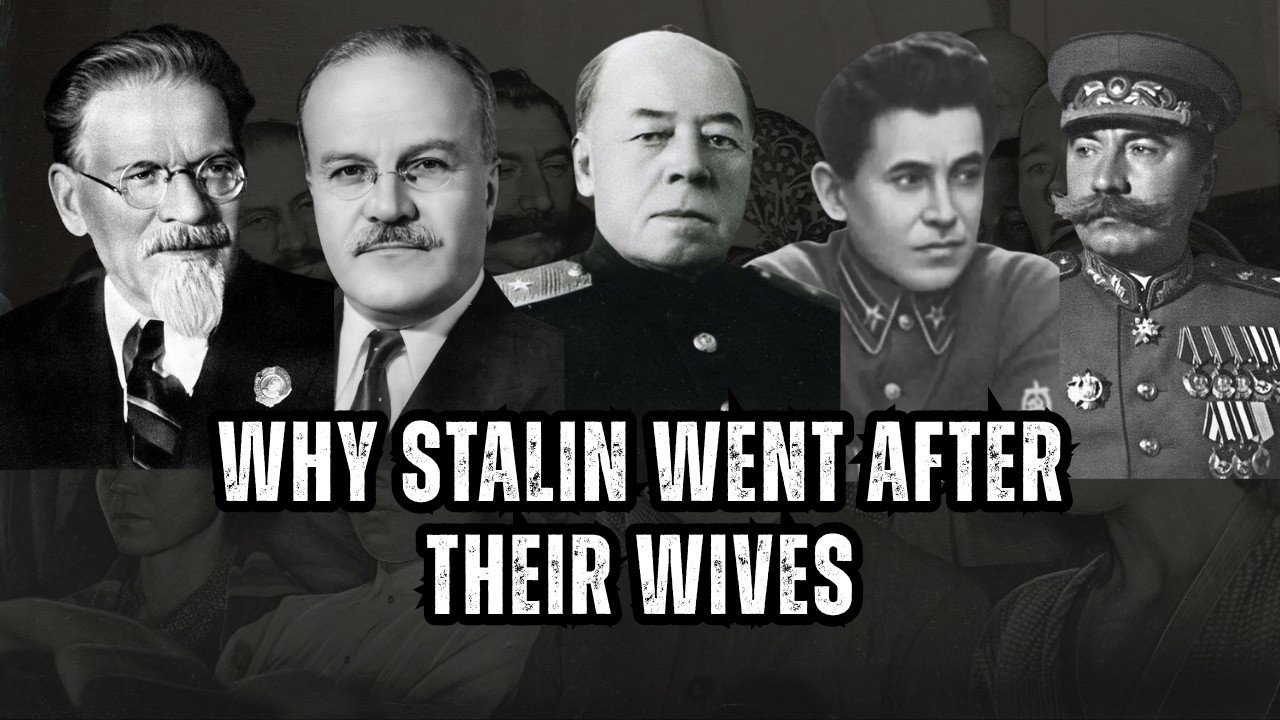
Vyacheslav Molotov served as Stalin’s foreign minister for years and was one of the most powerful figures in the country. His loyalty was so absolute that colleagues called him “Stone Arse”—because you couldn’t move him, and you couldn’t break him. His wife, Polina Zhemchuzhina, became the Soviet Union’s first female government minister in 1939. But Stalin’s hostility toward her reportedly stretched back to November 1932, when his own wife, Nadezhda Alliluyeva, died after a public humiliation at a dinner she had attended.
Historical accounts suggest that moment left a lasting mark on Stalin’s view of Polina. In November 1948, Polina attended a diplomatic reception and spoke in Yiddish with Golda Meir, the newly arrived Israeli ambassador. At the end of the conversation, she told Meir’s daughter: “Be well. If everything goes well with you, it will go well for all Jews everywhere.
” The conversation was monitored. Within weeks, she was expelled from the party for “close relations with Jewish nationalists. ” In January 1949, she was arrested in her squirrel fur coat. Her sisters, her doctor, and her secretaries were taken the same day.
One of her sisters and a brother died in prison. Molotov, who had served Stalin for decades, sat at the Politburo meeting and voted for his own wife’s arrest. Stalin was testing whether personal loyalty—the kind that binds a husband to a wife—could be overridden completely by political obedience. Molotov answered in writing, on the record, in front of witnesses.
Mikhail Kalinin was the nominal president of the Soviet Union, the symbolic head of state. His wife, Yekaterina Kalinina, was arrested on October 25, 1938, charged with espionage and terrorism. She was tortured in Lefortovo Prison and, according to historical records, could not walk to her interrogations and had to be carried. She was sentenced to 15 years in a labor camp and served seven.
During her imprisonment, Kalinin continued appearing at the Kremlin and signing state documents. According to multiple historical sources, he largely did not intervene on her behalf. The one documented request he made was that she not be given hard physical labor. In the camp, she worked as a laundry castellan and lived in a pantry next to the laundry block.
When ordinary citizens came to Kalinin for help with their own arrested family members, he told them: “My dear chap, I’m in the same position. I can’t even help my own wife. There’s no way I can help yours. ” The president of the Soviet Union said it plainly, as a statement of fact.
She was released in late 1945, before Kalinin’s death the following year, but was given a “dog’s passport” restricting her movements and barring her from Moscow. According to historical accounts, she avoided her husband after her release, believing he had chosen not to help her when he could have. Kalinin died on June 3, 1946, after 40 years of marriage. Alexander Poskrebyshev was Stalin’s personal secretary and gatekeeper—the man who controlled access to the dictator.
If anyone should have been insulated from the system, it was him. His wife, Bronka, was a doctor whose brother had been arrested on Trotskyist charges. In 1939, Bronka visited Lavrentiy Beria in person to plead for her brother’s release. She was arrested and never seen by her family again.
Poskrebyshev appealed to Stalin. Stalin’s reply, recorded by multiple sources, was: “Don’t worry. We’ll find you another wife. ” Bronka was executed in 1941.
Poskrebyshev went back to work and remained loyal to Stalin. Nikolai Yezhov was not a bystander in the terror—he was its primary instrument. As head of the NKVD from 1936 to 1938, he oversaw the height of the Great Purge. Under his command, at least 1.
3 million people were arrested and 681,000 were shot. The period became known as the Yezhovshchina, the time of Yezhov. His wife, Yevgenia Feigenberg, lived in a very different world. A Soviet editor and chief editor of USSR in Construction, she hosted literary evenings at their Moscow apartment attended by writers Isaac Babel and Mikhail Sholokhov, filmmaker Sergei Eisenstein, and jazz musician Leonid Utyosov.
She was lively, well-connected, and socially independent. Stalin noticed. He told Yezhov twice to divorce her. By September 1938, Yezhov informed her the marriage was over.
She wrote letters to Stalin asking for his intervention; none were answered. On November 19, 1938, Yevgenia died at age 34. Less than six months later, Yezhov himself was arrested. Under torture, he confessed to espionage, sabotage, and conspiracy.
He was tried in secret and executed on February 4, 1940. Their adopted daughter, six years old at the time, was sent to an orphanage and forced to change her surname. The man who built the machinery of the terror was eventually fed into it. Semyon Budyonny was one of the original five Soviet marshals, a cavalry legend whose name appeared in songs taught to schoolchildren.
He married singer Olga Mikhailova in 1925. In August 1937, while Budyonny was away on a military inspection, Olga was arrested. She served nearly 19 years before being released after Stalin’s death. Budyonny divorced her shortly after the arrest and married Olga’s own cousin.
He did not seriously seek her release until Stalin was gone. But when the NKVD later came for Budyonny himself, he armed himself with his service revolver, called Stalin directly, and demanded the agents be removed. Stalin complied. The matter was not raised again.
Budyonny understood the system clearly: standing firm for himself and standing firm for his wife were two entirely different calculations. The pattern extended into Stalin’s own household. Yakov Dzhugashvili was Stalin’s eldest son, born in 1907 to Stalin’s first wife, who died when Yakov was an infant. The relationship between father and son was cold.
Stalin’s own recorded words about his son were: “He can’t even shoot straight. ”
Yakov married Yulia Meltzer, a Jewish ballerina from Odessa, in February 1938, following the arrest of his first wife. When Germany invaded the Soviet Union in June 1941, Yakov was sent to the front as an artillery officer. On July 16, he was captured at the Battle of Smolensk under disputed circumstances.
Stalin suspected his daughter-in-law immediately. In August 1941, he issued Order No. 270, declaring any soldier who surrendered a traitor and making their family members liable for arrest. He applied it without exception.
Yulia Meltzer was imprisoned at Lefortovo Prison for approximately two years. Germany later proposed exchanging Yakov for Field Marshal Friedrich Paulus, captured after the Soviet victory at Stalingrad. Stalin refused, reportedly saying he would not trade a marshal for a lieutenant. Yakov died at Sachsenhausen concentration camp on April 14, 1943.
When Stalin received the news, he reportedly stared at his son’s photograph in silence. Years later, he described Yakov as a real man who had been treated unjustly by fate. Yulia Meltzer was released in 1946, three years after Yakov’s death. Across different years, agencies, and stated pretexts, the same pattern held: loyal men, arrested wives, husbands who remained in post.
Part of it was control. A man whose wife is in a labor camp cannot afford resistance. Families became leverage. Nothing needed to be stated; everyone in the room understood.
Part of it was that Stalin distrusted any loyalty that existed outside the state. A wife with her own friendships, foreign contacts, or cultural connections represented a world the regime couldn’t fully see. And what Stalin couldn’t see, he considered a threat. Each of the targeted women had exactly these qualities.
Part of it was deliberate fragmentation. You cannot conspire against a dictator if you cannot trust the men around you—and you cannot trust them if you know their families are being held over them, just as yours is being held over you. The arrests didn’t just control individual men; they made collective resistance impossible. Molotov’s case went further still.
When Stalin required him to vote publicly for his own wife’s imprisonment, he was making Molotov do something he could never walk back. That act bound him more completely than any oath. Stalin’s personal relationships were transactional. His family connections were cold.
His own wife had died following a public humiliation he inflicted. He came to see emotional vulnerability in the people around him as a weakness that someone could one day use against him. The wives of his inner circle were exactly that kind of vulnerability, and he removed them. By the late 1930s and continuing into the 1940s, Stalin had constructed an inner circle in which proximity to power provided no protection.
Loyalty accumulated no credit. A man could spend 20 years serving the regime and still watch his wife disappear—and still report to work the following morning. The arrests of Polina Zhemchuzhina, Yekaterina Kalinina, Bronka Poskrebysheva, and the others were proof that the state’s reach was without limit. Not devotion, not decades of service, not marriage, not blood.
Polina Zhemchuzhina was released in March 1953, four days after Stalin died. After years in a labor camp on his orders, after the forced divorce, her first question upon learning she was free was: “How’s Stalin? ” When told he had died, she fainted. The logic behind these arrests is not unique to Stalin.
Dictatorships sustain themselves not only by eliminating opposition, but by destroying trust—not between enemies, but between friends, colleagues, and families. When Molotov voted for his wife’s arrest, the message was not intended for him alone. It was for every man in that room, and every man who understood without being told what would be expected of him. Terror operated at the level of the intimate.
That is what made it so difficult to resist. It did not only threaten the individual—it threatened the people the individual could not protect. And then it waited to see what the individual would do. The camps are gone.
The interrogators are dead. The files on most of these cases have been closed for decades. But the question they leave behind remains open: how does a system reach the point where the most powerful men in a country watch their wives be taken, sign the papers, and go back to work?
Not because they were cowards, but because the system had deliberately and methodically removed every alternative.