A 120-room, six-story castle with 365 windows, underground tunnels, a drawbridge, Italian gardens, and a triumphal arch was built for a woman who never spent a single night there. Neither the man who built it, nor his wife, nor their children, nor any guest ever slept in it for 125 years. The structure was weeks from completion when a telegram arrived on a January morning in 1904. Workers put down their tools and stopped.
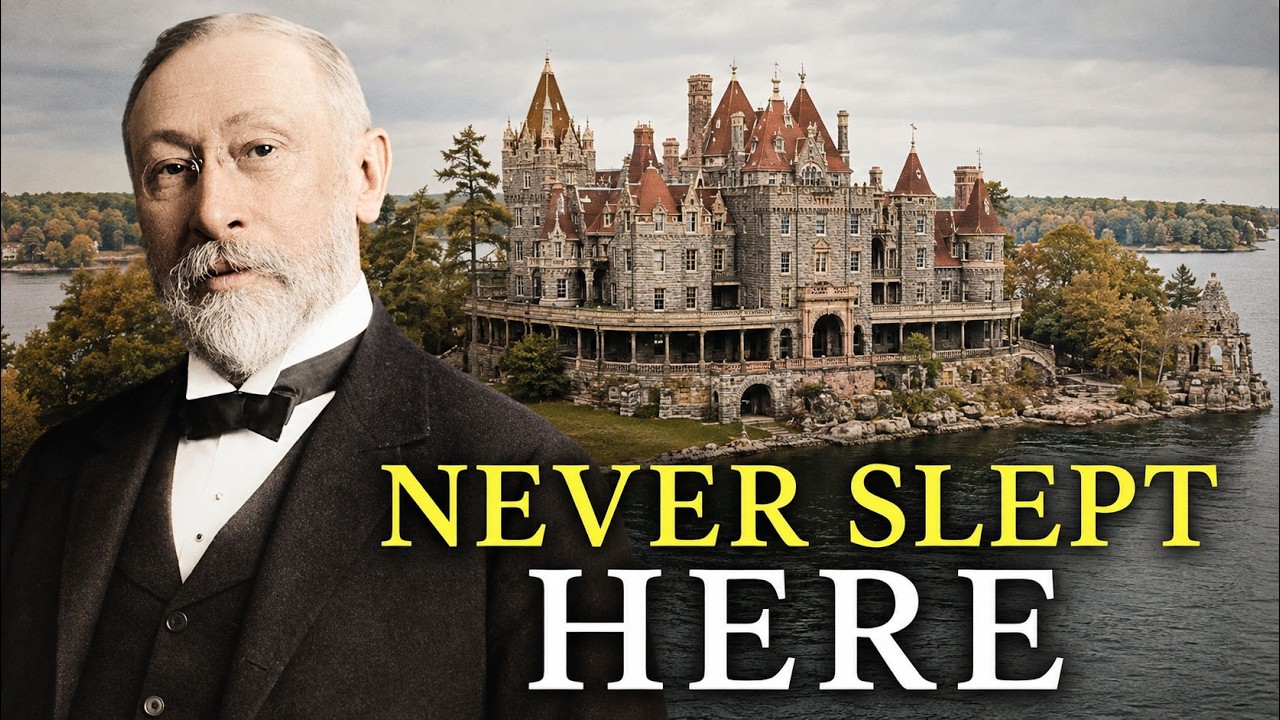
Some stones cut and transported that week still lie where they were left, a silent marker of the moment construction ended. The story begins with George C. Boldt, a Prussian immigrant who became one of America’s most famous hoteliers, managing the Waldorf-Astoria in New York and the Bellevue-Stratford in Philadelphia. He purchased the island in the Thousand Islands region of the St.
Lawrence River, which straddles the border between New York State and Canada, and renamed it Heart Island. He did not stop at the name. He reshaped the island to resemble a heart. Before laying foundations, he moved an existing house across the frozen river to make way for his vision.
Over four years, beginning in 1900, he employed 300 workers to build not one building but eleven, forming a small settlement on the five-acre island: the six-story main castle, a children’s playhouse with deliberately slanted walls, a power plant designed to look like a medieval tower, a dovecote, the grand arch at the water’s edge, a stone observation terrace, and a boathouse across the water on Wellsley Island large enough for vessels up to 128 feet long. The grand project was built as a gift for his wife, Louise, whom he had married years earlier. Construction was scheduled to finish on Valentine’s Day 1904. The heart-shaped island, stone hearts carved into the masonry, the arch modeled after a triumphal arch meant to celebrate his rise from poverty, and the chosen delivery date all pointed to the same purpose: a grand public declaration of love.
Louise Boldt died suddenly in Manhattan at age 31, five weeks before the scheduled delivery. The cause of her death remains unclear. Some accounts cite illness; one circulating version mentions tuberculosis. Another theory suggests she may have overdosed on diet pills.
The records do not clearly state the cause. When the news reached the island, construction was halted at once. Workers left their tools and materials where they lay. The stones for a double row of columns meant to support a covered walkway had arrived that week but were never raised.
Inside the castle, the lower floors were nearly complete, with a swimming pool and bowling alleys in the basement, while the upper floors were left exposed, bare stone and open rafters. Boldt, who continued living across the channel on Wellsley Island for the remaining 12 years of his life, never set foot on Heart Island again. Every summer he returned to his other property within sight of the unfinished castle, but he never crossed the water. After Boldt’s death in 1916, his sons sold the property to Edward John Noble, creator of Life Savers candy and a future co-founder of the American Broadcasting Company.
Noble opened the castle to the public as a tourist attraction in the 1920s. For 73 years, from the stop-work telegram in 1904 until 1977, the castle sat unheated, unguarded, and open to the elements and to anyone who arrived by boat. Snow entered the unglazed upper windows every winter, names were carved into stone, and fixtures were removed. A fire in the 1930s destroyed one of the eleven structures.
The Thousand Islands Bridge Authority acquired the property in 1977 for one dollar, with an agreement that all net revenue from castle operations would go toward restoration and preservation. That arrangement remains in effect today. Millions of dollars have been spent since. The power plant was rebuilt, the children’s playhouse was repaired, the arch was fully restored, and the boathouse across the water opened to the public in 1996.
Inside the main castle, much of the ground floor and part of the first floor have been furnished, mostly with modern pieces since the originals were lost during the decades of neglect. The upper floors have been deliberately left unfinished so visitors can see exactly where the work stopped. The boathouse on Wellsley Island was the only structure in the entire project that was completed. Built in 1903, it was used for its intended purpose, sheltering the family’s fleet of more than 60 boats.
Today, about 250,000 people visit Heart Island each year. They arrive by boat, as Boldt intended, and pass under the arch that was never finished. Guides tell visitors about George and Louise Boldt, a marriage preserved inside the very structure meant to celebrate it. Three questions remain unanswered.
The cause of Louise’s death is still uncertain. Boldt’s decision to return to the river every summer for 12 years without ever stepping foot on the island is unexplained. And no inventory was ever made of what was inside the castle when the workers left. The castle was a gift that was never delivered.
It stood empty before it was ever lived in, its doors open for seven decades. The furnishings that once filled its lower rooms have disappeared without a trace, leaving no record of what was lost. What remains is a castle built as a declaration of love, stopped mid-construction, exposed to 73 winters of damage, and slowly rebuilt with ticket revenue from the very visitors who come to see the place that was never meant to be seen at all.