On April 10, 1912, the Titanic, the largest ship ever built to sail the world’s oceans, left England on its maiden voyage bound for New York. Advertised as the safest vessel ever constructed, it took four days to reach disaster. On the night of April 14, the ship struck an iceberg and sank into the Atlantic. The Titanic disaster became one of history’s most famous tragedies, but documents discovered years later exposed a darker truth about that fateful night that has never been fully told.
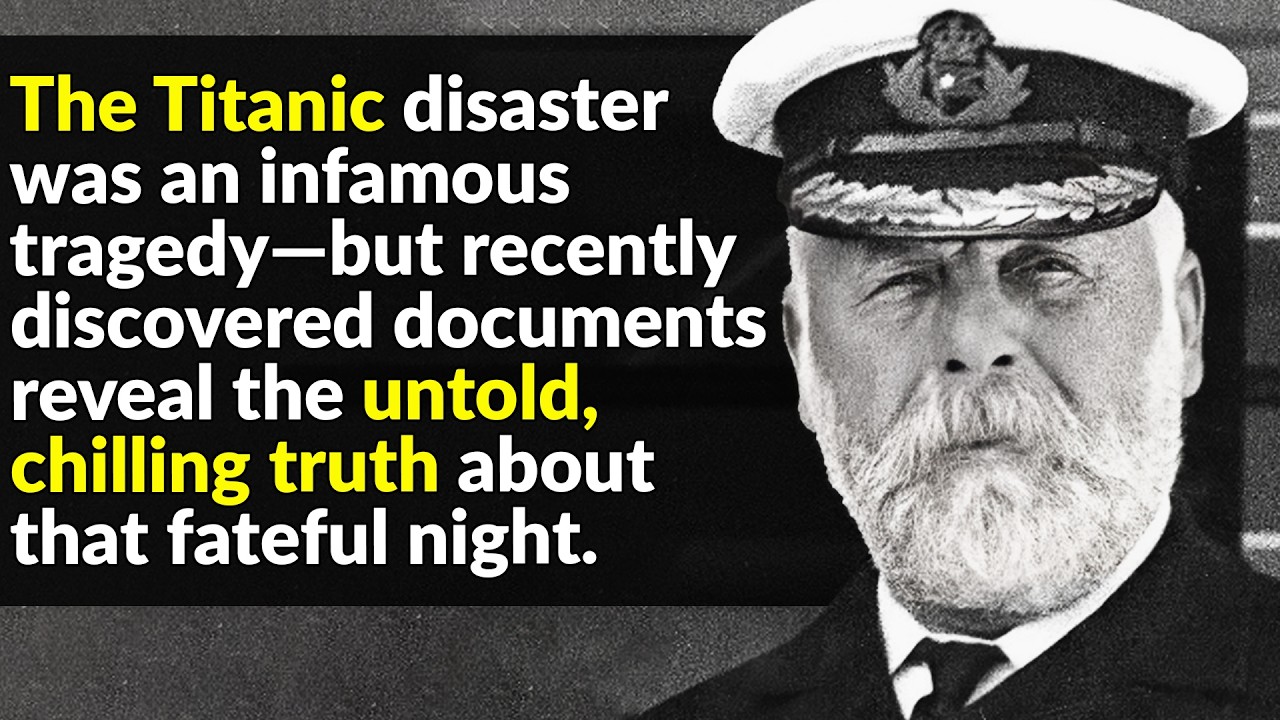
We will return to those documents in time. First, consider the man at the helm. Captain Edward Smith entered history with a reputation for recklessness, blamed for the speed and confidence that doomed his ship. But his true story is more complicated.
Smith was among the most experienced and respected sea captains of his era, so popular that wealthy passengers refused to cross the Atlantic unless he was at the wheel. They called him the Millionaires’ Captain. That trust attracted very important people onto the Titanic that day. Because the ship was among the most luxurious in the world, its first-class passenger list read like a roll call of the era’s greatest celebrities.
Benjamin Guggenheim, whose name still adorns famous museums, was aboard with his fiery French mistress, Léontine Aubart. Even he was overshadowed by another guest. John Jacob Astor IV, founder of the famed Astoria Hotel in New York, was the richest man on the ship. Even on a vessel full of the world’s wealthiest people, his fortune of 85 million dollars, worth billions today, made him the center of attention.
But Astor drew eyes for a reason far more scandalous than money. He was sailing home to America with his second wife, the very pregnant Madeleine. Their marriage in September 1911 had caused a public uproar. At eighteen, the bride was nearly three decades younger than her husband, a full year younger even than Astor’s own son, Vincent.
Yet the person who became most famous after climbing out of the wreckage was a complete surprise. The Unsinkable Molly Brown became a sensation after the Titanic, and for good reason. Born in a small three-room cabin in Missouri, she had married the penniless J. J.
Brown for love and only became wealthy with him years into their marriage. As one of the newly rich, Brown never feared saying or doing whatever she believed would save lives. Still, when she first looked around the Titanic, she must have realized others thought she did not belong. Calling the Titanic luxurious is like calling Versailles a large house.
The ornate grand staircase, reserved exclusively for first-class passengers, stretched across five decks. It featured carved oak paneling, wrought-iron work, and a massive glass dome that poured extraordinary light from above. Designers took their inspiration from London’s Ritz Hotel. Onboard amenities included a gymnasium, a swimming pool, a Turkish bath, a kennel for first-class dogs, and squash courts.
The ship even printed its own newspaper, the Atlantic Daily Bulletin. The Titanic was truly a world unto itself, and that world was about to collapse. In the end, its extravagance contributed to its downfall, because the Titanic cared too much about appearances. The enormous vessel carried roughly 2,228 people, which meant the decks would need to be crowded with enough lifeboats to follow proper safety guidelines.
To keep the view beautiful, planners reduced the lifeboats to twenty wooden boats and four collapsible ones. That was enough for only half the passengers. Nobody seemed concerned, because the Titanic was unsinkable. Right?
Wrong. At 11:40 p. m. on April 14, lookout Frederick Fleet was watching for ice.
Suddenly, his worst nightmare appeared directly ahead. He rang the bell as a warning and phoned the bridge to report the obstruction. A critical mistake followed. The officer in charge ordered the helm to turn hard to starboard.
Researchers now believe this turn doomed the ship. The Titanic had collision bulkheads in her bow, meaning she would very likely have survived a direct head-on impact. Experts say such an impact would either have prevented the ship from sinking altogether or caused it to sink so slowly that rescuers would have had time to save everyone. In other words, doing nothing might have saved them.
Instead, the moment the iceberg scraped along the side, the ship was fatally wounded. The poor lookout, Frederick Fleet, had barely any time to warn the bridge. From the moment he spotted the iceberg to the moment of impact, only thirty-seven seconds passed. There were other failures as well.
The iceberg did not appear out of nowhere. The crew had received six ice warnings before the collision and ignored every one of them. Once the crash happened, chaos took over. The situation aboard the Titanic deteriorated with incredible speed, faster than anyone could control.
Shortly after the impact, water flooded the six forward compartments. That was severe. Four was the maximum number of compartments that could be flooded without the ship sinking. Yet the passengers did not understand the danger.
A painful sixty-minute delay passed from the moment of impact until the first lifeboat was lowered. Why? Some passengers believed the alarms were just a drill and stayed inside where it was warm. There was a bigger problem too.
Even those who accepted the alarms were real had no idea where to go, because no lifeboat drills had ever been held. People did not know it then, but their fates had already been sealed. Because the first lifeboat launch was delayed, the rest of the crew never had enough time to lower the remaining boats successfully, especially as passengers who had been complacent at the start grew frantic. The crew did not even manage to launch two of the collapsible lifeboats.
As people, rich and poor alike, approached their final hours, tragic and extraordinary things began to happen. At first, first-class passenger Benjamin Guggenheim thought the iceberg collision was just a minor mishap. When he realized it was the end, he reacted in a way nobody forgot. He and his valet dressed in their finest clothes.
Then he walked down the grand staircase, settled into a seat with a cigar, and announced, “We have dressed in our best and are prepared to go down like gentlemen. ”
Other passengers responded with even greater heartbreak. Wealthy John Jacob Astor was not just willing to die like a gentleman. He was prepared to die for others.
When it became clear that the Titanic was sinking into the freezing Atlantic, Astor put his young wife, Madeleine, into a lifeboat. He was about to climb in beside her when he noticed a terrible sight. According to a witness, just as Astor was about to join his pregnant wife, he saw two frightened children still aboard who needed rescue. Refusing to abandon people in distress, he stepped aside and gave up his place in the boat.
It was an act of great heroism, and it was also the cause of his death. Reports of Astor’s movements afterward are unclear. At about 1:55 a. m.
, as lifeboat number four was being lowered into the water, witnesses saw him standing alone on the deck. In one of the last sightings of him alive, he was smoking a cigarette with fellow traveler Jack Futrelle barely half an hour before the Titanic sank beneath the waves. That sounds dignified, but his final moments were likely very different. Survivor Philip Mock reported seeing Astor for the last time before the billionaire died.
Mock watched Astor and his personal valet huddled on a raft before the two froze to death in the water. Like so many others that day, it was a horrible way to go. But his sacrifice was not in vain. John Jacob Astor’s time aboard the Titanic was marked by grim heroism, and it remained heroism to the end.
His young wife, Madeleine, and their unborn child survived the wreck, and their son, John Jacob Astor VI, nicknamed the Titanic Baby, lived to the age of seventy-nine. Astor left something else behind as well. He was so wealthy that when recovery workers retrieved his body, they found a real treasure in his pockets, including a diamond ring and 2,440 dollars in American currency. That was not all.
Among his personal effects was a gold pocket watch. His son Vincent claimed the memento and wore it for the rest of his life. Astor’s story teaches a harsh lesson about the disaster. Although there were not enough lifeboats, you might assume there were certainly enough life jackets to keep people from drowning in the ocean.
Unfortunately, most victims that night did not drown. They froze to death in the ice-cold Atlantic waters. John Jacob Astor was likely among them. But his was not the only story, and it was not the only ending.
Isidor and Ida Straus, owners of Macy’s department store, were another wealthy first-class couple traveling on the Titanic. Both were elderly, which meant they should have had the best chance of surviving the wreck. That is not what happened. When the ship began to sink, crew members urged Ida to board a lifeboat, but she refused to leave her beloved husband.
When Ida refused to part from Isidor, Isidor also rejected the idea of leaving before the other men. Instead, the couple went down side by side. As Ida said, “I will not be separated from my husband. As we have lived, we will die together.
” Witnesses saw them for the last time on deck, holding each other. Although it was a night of great tragedy, April 14, 1912, also witnessed hard-won victories. Noël Leslie, the beautiful Countess of Rothes, proved her worth when disaster struck. Like many first-class ladies, she managed to reach a lifeboat.
But that did not mean the danger had ended. The water was rough, and the people in her boat were panicking. The countess knew what she had to do. As her boat was lowered into the choppy sea, the calm countess grabbed the tiller and helped steer and row the boat to safety while the Titanic sank behind them.
During the journey, she paused only to comfort another passenger, a Spanish bride who had lost her husband in the wreck. The surviving crew began calling Noël Leslie the Brave Little Countess, and they presented her with the brass plate bearing her lifeboat’s number as a token of gratitude. The Titanic also carried its fair share of strange stories. The ship’s baker, Charles Joughin, had an extremely odd survival tale.
When he realized the ship was doomed, he first sent his men to bring supplies from the bakery to the lifeboats on deck. But once he was away from the crowds, he started drinking from the ship’s well-stocked bar. Known for his love of whiskey, and believing he was about to die, he got drunk. That had a truly strange turn.
When the ship sank, most people probably thought Joughin had perished in the icy water. Not at all. Rescuers found him floating about two hours later, with only minor health problems. Alcohol generally increases the risk of hypothermia, but some evidence suggests it also slows heat loss.
It certainly worked for the baker. There are other stories from that night that seem too tragic to believe, yet they are true. First-class passengers were allowed to bring their dogs aboard the RMS Titanic. About twelve dogs were confirmed on the ship, including a fox terrier, a French poodle, a French bulldog, and Kitty, an Airedale terrier owned by John Jacob Astor.
Some of the dogs had happy endings. Three small dogs were smuggled into lifeboats and arrived safely in New York. But one dog in particular met a tragic fate. One of the most famous legends of the Titanic disaster is the story of Ann Elizabeth Isham.
Legend says she refused to leave the ship without her beloved Great Dane, which crew members considered too large for a lifeboat. Instead, Isham made an incredible sacrifice. She reportedly stayed aboard rather than abandon the dog. Later, authorities found the body of a woman clutching a large dog.
Everyone knows the story of how the ship’s band kept playing to maintain morale. Incredibly, this is true. The eight musicians played their instruments until the bitter end, literally sinking with the ship in an act of heroism. By the time that happened, though, they had witnessed a true nightmare.
As the ship sank, the crew was supposed to keep filling the lifeboats. That was the plan. When the last lifeboats finally left the Titanic, they were not full. Each boat could safely carry about seventy people.
But the senior surviving officer, Charles Lightoller, claimed he could not fill the boats to capacity without collapsing the mechanism that held them. There were other complications too. By the end, the passengers were terrified, which did not help the crew load people into the few available boats. When collapsible boat B floated upside down, people tried to climb aboard but failed.
Only thirty people managed to survive by standing on the overturned boat. Molly Brown was lucky enough to get a place in lifeboat number six, but crew members had to drag her away from helping other passengers and force her aboard. Her actions afterward secured her place in history. Brown began arguing with quartermaster Robert Hichens, who was in charge of the boat, urging him and her fellow passengers to turn back toward the wreck to rescue more people.
Sadly, Hichens refused to listen, saying the poor souls in the water might try to climb aboard and pull the boat down, killing everyone. It is unclear whether Brown managed to make the boat turn around, but we know she was fiercely brave about it. She took an oar and tried to steer the boat back by herself, and people heard her loudly threaten to throw Hichens overboard. As the survivors watched the ship sink and the water slowly calm, they began to wonder who would rescue them now.
Even the story of the rescue was terrifying. The Titanic sent multiple distress signals through various channels as it sank, but no other ship was close enough to arrive in time. In fact, it was not until four in the morning, more than four hours after the iceberg collision, that the RMS Carpathia arrived to pick up the people in the lifeboats and any extremely lucky survivors still in the water. When dawn broke the next day, people began looking for someone to blame.
In many ways, the Titanic disaster happened because of a series of misfortunes, ending with the iceberg it struck. In April 1912, there were three hundred icebergs in North Atlantic shipping lanes. It was the most common sight on the route between Europe and North America in half a century. The ship was genuinely in the wrong place at the wrong time.
It did not stop there. As details of the tragedy emerged, researchers discovered that the ship Californian was less than twenty miles from the Titanic while it sank, but it failed to hear the distress call because its wireless operator was off duty. Time after time, a single stroke of luck could have saved countless lives, but the Titanic found no chance of survival. Molly Brown became one of the most famous survivors of the Titanic, and legend says her nickname came from her own words after the sinking.
When reporters interviewed her about the disaster, Brown gave a legendary response. She claimed to have said, “It’s the usual Brown luck. We’re unsinkable. ” The phrase stuck.
In 1985, a team of researchers found the wreck of the Titanic resting on the ocean floor. This is where things get eerie. By coincidence, the discovery was made shortly before 2:20 a. m.
, the exact time the ship had gone down. Several previous attempts to locate the vessel had failed. Thanks to this team, we now know exactly where the Titanic sank. When the Titanic sank, experts widely believed the iceberg had torn a three-hundred-foot gash along the ship’s side.
Once the wreck was discovered in 1985, the ship told a different story. The actual damage was clearly visible. The ship had suffered six separate tears totaling only fifteen square feet. That was all it took.
For one reason or another, many celebrities had tickets for the Titanic but did not sail on that doomed voyage. George Vanderbilt and his wife canceled their trip because a family member feared too many things could go wrong on a maiden voyage. We cannot really say they were wrong. Some things are simply fate.
Eerily, some say a novel published in 1898 predicted the Titanic disaster fourteen years before its first voyage. Morgan Robertson’s book Futility tells the story of a ship called the Titan that strikes an iceberg on its maiden voyage. Sound familiar? In the ten years before the Titanic disaster, the White Star Line had carried more than two million passengers and seen only two deaths.
One positive result of the Titanic disaster was a complete overhaul of maritime safety rules. After the tragedy, the first International Convention for the Safety of Life at Sea revised the rules and regulations of ocean travel to ensure this would never happen again. The Titanic had been the largest passenger ship in the world at the time, measuring 882 feet long, the largest man-made moving object on Earth. The newly discovered documents about the Titanic disaster reveal a horrible story.
According to these documents, rescue teams handling the aftermath of the wreck threw the bodies of third-class passengers overboard to prioritize the remains of first- and second-class passengers. The whole thing was laid out in disturbing detail in a series of telegrams between the rescue ship and the White Star Line. While the bodies of first- and second-class passengers were returned to their families, many third-class families were left wondering what had happened to their loved ones. During the initial investigation into the cause of the Titanic disaster, investigators blamed Captain Edward Smith for sailing too fast through dangerous waters.
Although Smith could not have predicted exactly what happened, he could have reduced the ship’s speed as a precaution, especially after receiving iceberg warnings. Did he? No. Captain Edward Smith went down with the Titanic, and his last words were heartbreaking.
He told his crew, “Well, boys, do your best for the women and children, and look out for yourselves. ” Smith was last seen on the bridge minutes before the ship sank, and experts believe he was pulled under the waves and drowned. There is another side to the story. People remain divided to this day about whether Captain Edward Smith was a villain or a victim.
While some portray his mistakes that fateful day as understandable and his later actions as heroic, others reveal a darker side. According to some reports, Smith became paralyzed with fear when he realized the situation and did little to save the lives aboard his ship.