The man who created one of the world’s most recognizable condiments never once mentioned it in his own autobiography. Not a single word. Edmund McIlhenny died in 1890, and his obituary completely skipped over the product that would one day make his family a multi-billion-dollar empire. That strange gap between what he built and what he thought he built is the center of a story that spans five generations, two world wars, decades of courtroom battles, and a long-forgotten ecological disaster still affecting Louisiana today.
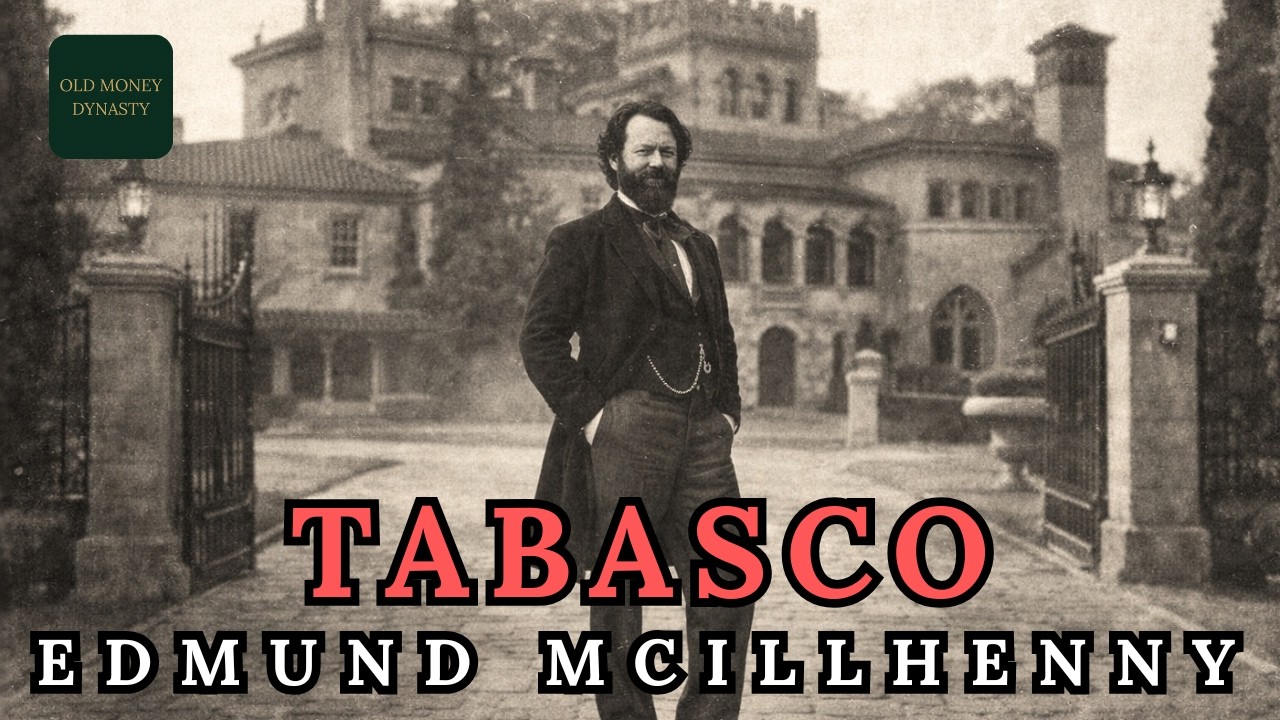
Born in Hagerstown, Maryland in 1815, Edmund McIlhenny moved south as a young man and built a successful banking career in New Orleans. By the early 1840s, he had worked his way into the industry and eventually owned five banks in the city. For someone who arrived without connections, it was a remarkable rise. But the real power in Louisiana lay on the land, not in bank vaults.
In 1859, he married Mary Eliza Avery, whose family owned a remote 2,200-acre stretch of elevated terrain in the coastal marshlands south of New Iberia. It was called Petit Anse Island. Two years after Edmund moved onto the Avery property, the Civil War destroyed everything he had built. His banks failed.
Confederate currency lost its value. Then, in May 1862, workers deepening a natural spring on the property struck something that changed everything. They had discovered a massive deposit of nearly pure rock salt, the first commercially significant salt find in the United States. It became a vital resource for the Confederacy, producing over 22 million pounds of salt in less than a year to supply Southern armies.
In April 1863, Union troops reached the estate. They burned all 18 buildings connected to the salt works, smashed the engines and equipment, and broke apart 600 barrels of salt waiting for shipment. The family fled to Texas for the remainder of the war. When they returned in 1865, the sugar fields had gone to seed and the salt works were rubble.
Edmund was approaching 50 years old with a wife, eight children, and no income. But before leaving, he had planted a small crop of red peppers in the garden, a variety believed to have originated in the Mexican state of Tabasco. Against all odds, those plants had survived the occupation and neglect. Sometime around 1866, Edmund crushed the ripest peppers into a coarse mash, mixed in salt from beneath the property, and left it to ferment instead of cooking it down.
When aging was complete, he stirred in French white wine vinegar, blended it by hand, and strained out the solids. The result was too concentrated to pour, so he acquired small cologne bottles with sprinkler tops from a glassware supplier in New Orleans. He first called it Petite Anse Sauce, then switched to a single word: Tabasco. The peppers themselves were not commonly known by that name at the time.
The label was applied backward because of the sauce. The history of the recipe involves more complication than the family’s official version suggests. Twenty years before Edmund made his sauce, a New Orleans plantation owner named Maunsel White was already growing the same peppers at his estate and serving a homemade pepper sauce at famous dinner parties across Louisiana society. The two men knew each other.
Court testimony recorded decades later described a claim that White gave pods and his recipe to Edmund during a visit before White’s death in 1862. The McIlhenny family has always rejected that account, insisting Edmund obtained his seeds independently, perhaps from a soldier returning from the Mexican-American War. What is beyond question is that Edmund’s method was his own. White boiled his peppers.
Edmund fermented his. In 1870, he secured a patent for the process of crushing, salting, fermenting, and straining. In 1869, he shipped his first batch: 658 bottles at one dollar apiece wholesale to grocers along the Gulf Coast. It was not a business yet.
It was a bet. But the product moved off shelves quickly, and within a few years Edmund connected with one of the largest food distributors in the country, putting the sauce in major markets like New York, Philadelphia, and Boston. By the late 1870s, he was exporting to Europe. He never wrote about any of it.
For Edmund, it seems, the sauce was simply a practical solution to a financial problem. When Edmund died in 1890, his sons saw something he never did. John Avery McIlhenny took charge and modernized the operation, expanding advertising and retail accounts. In 1898, John left to fight with Theodore Roosevelt’s Rough Riders in the Spanish-American War.
He served in Cuba, was promoted twice on the battlefield, and claimed for the rest of his life that he had pushed Roosevelt out of the path of a Spanish sniper. Roosevelt never contradicted him. Afterward, John entered politics, served in the Louisiana legislature, then held a federal post through three presidencies before a diplomatic assignment in Haiti ended badly. His younger brother Ned, a naturalist and Arctic explorer, took over the company and ran it for 50 years.
He renamed it McIlhenny Company, standardized production methods, redesigned the label, and replaced the cork and wax seal with the screw-top bottle cap still used today. Between them, the brothers transformed what their father had built. Edmund had created a product. His sons created an institution.
The most significant legal threat came from a former blacksmith who had worked on the McIlhenny grounds for years. Bernard Trappey watched the operation closely, understood the process from beginning to end, and took pepper seeds when he left. In 1898, he founded his own sauce company and put the word Tabasco on his label, selling to the same markets. The family fought back, but ran into a legal wall: the word was the name of a Mexican state, and geographical terms were notoriously hard to claim as exclusive property.
In 1906, John McIlhenny filed for federal trademark registration, signing a sworn statement that no other company had used the word for pepper sauce in the prior decade. That statement was misleading at best. A man named C. P.
Moss had been operating the New Iberia Extract of Tabasco Pepper Company for years. Moss challenged the registration, the Patent Office canceled it, and a federal appeals court agreed that the word was geographical and could not belong to one producer. The family changed tactics, arguing that after three decades of exclusive commercial use, consumers had come to associate the word with one specific sauce. Courts took years to sort it out.
The decisive ruling came in 1929, permanently barring Trappey from labeling his sauce with the contested word. The next McIlhenny to go to war carried none of the romanticism of the Rough Rider story. Walter Stauffer McIlhenny, John’s son, was a Marine officer who survived 31 months in the Western Pacific during World War II. On Guadalcanal in August 1942, he led a rescue party, drew enemy fire deliberately, and silenced a Japanese machine gun nest despite being concussed by a mortar round.
He received the Navy Cross. During a night engagement on the same island, he stumbled into a Japanese officer in the dark. The officer swung a katana at his head. The blade was still in its scabbard, but the blow dented Walter’s helmet and knocked him off his feet.
Before blacking out, he shot the man. He kept both helmet and sword. Walter took over the company in 1949 and ran it until 1985. His most lasting contribution came from his own experience eating miserable field rations.
During the Vietnam War, he created the Charlie Ration Cookbook, a tongue-in-cheek recipe guide wrapped around a 2-ounce bottle of Tabasco. Soldiers who didn’t receive one wrote home asking families to send it in care packages. By the 1980s, miniature bottles began appearing inside standard military field rations for American troops. The Australian, British, and Canadian armies followed.
The condiment had become standard equipment for modern warfare. From there, the reach expanded in directions Edmund could never have predicted. NASA added Tabasco to space shuttle menus. Astronauts on Skylab used it, and crew members on the International Space Station requested it.
In microgravity, the human sense of taste dulls significantly, and a few drops of concentrated pepper heat solved the problem. The company also licensed the name to dozens of major food producers, from Slim Jim and Spam to Heinz ketchup and Cheez-It crackers. In 2009, Queen Elizabeth II granted McIlhenny Company a royal warrant certifying it as a supplier of pepper sauce to the British royal household. A condiment invented by a ruined banker on a Gulf Coast salt dome was seasoning meals at Buckingham Palace.
Today, 700,000 bottles roll off the production line every day. They reach 195 countries and sit on restaurant tables from São Paulo to Shanghai. The company still uses the same three ingredients and the same aging process. Peppers are ground into a mash on the day they are picked, mixed with salt from beneath the property, and packed into white oak barrels to age for up to three years.
Only then is the mash blended with high-quality vinegar, filtered, and sent to bottling. No preservatives. No colorings. No thickeners.
Field workers still use a small wooden dowel painted the exact shade of red the company requires to decide which peppers get picked. The most paradoxical chapter of the family’s history belongs to Ned McIlhenny, the naturalist who ran the company for 50 years. He saved the snowy egret from extinction by establishing a protected rookery on the estate, and Theodore Roosevelt called it the most noteworthy wildlife reserve in the country. But in 1938, Ned also purchased a group of large South American rodents called nutria, believing their pelts would be a promising addition to Louisiana’s fur industry.
In 1940, he released about 20 of them into the surrounding marsh. By the late 1950s, an estimated 20 million nutria had spread across the coastal wetlands. They devoured native marsh grasses and burrowed into levees and drainage infrastructure. Louisiana has lost more than 2,000 square miles of coastline since 1932, and nutria have accelerated the destruction significantly.
The state now pays a six-dollar bounty per tail to hold the damage steady. That same threatened ecosystem protects the factory from the Gulf of Mexico. In 2005, Hurricane Rita drove a storm surge that came within inches of the production facility. The company responded by building a 17-foot earthen levee around the 40 acres containing the factory, at a cost of five million dollars.
Behind that wall, the same barrels still age. The operation continues as if the Gulf were not creeping closer every year. The company remains entirely family-owned. Harold Osborn, Edmund’s great-great-grandson, became president and CEO in 2019.
He holds a master’s degree in environmental science from Oxford and understands exactly how precarious the situation is. The company funds marsh grass planting programs across 30,000 acres of surrounding wetland. Osborne has described the effort as “probably a standoff. ” In a state that has lost 2,000 square miles of coast, holding your ground counts as a victory.
The McIlhennys have outlasted the Civil War, the collapse of the Southern economy, 30 years of trademark litigation, two world wars, five hurricanes, and 20 million rodents. They have done it by refusing to sell, refusing to relocate, refusing to change the recipe, and refusing to believe that a sinking salt dome surrounded by disappearing wetlands is anything other than home. The man who started it all never imagined any of this. He took some peppers, mixed in salt and vinegar, and poured the result into small cologne bottles.
He was not founding a dynasty. He was keeping his household afloat. Sometimes that is how the most permanent things begin.
Not with a vision, but with a necessity nobody thinks to question.