The story of the Alamo has long been told as a tale of 188 brave men who chose death over surrender against a massive Mexican army. But beneath the heroic legend lies a more complicated history, one involving divided leadership, broken promises, political tensions over slavery, and strategic failures that contributed to the garrison’s destruction. Before the famous siege, tensions had been building for years. Mexican officials required settlers in Texas to convert to Catholicism and register as citizens, yet many colonists ignored these laws.
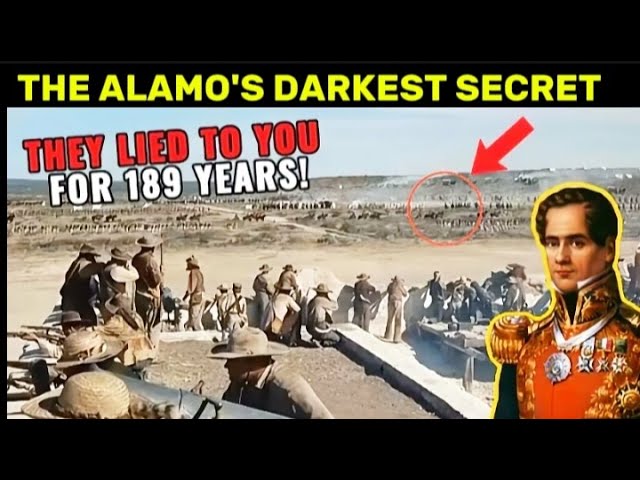
Southern settlers in particular brought enslaved laborers with them despite Mexico’s abolition decree in 1829, creating friction with Mexican authorities. The revolution’s first armed clash occurred in 1835 at Gonzales, when Mexican officials tried to reclaim a small cannon that had been loaned to settlers for defense against indigenous raids. The colonists refused to hand it over, reportedly taunting Mexican troops with the phrase “Come and take it. ” That act of defiance is widely seen as the spark that ignited the Texas Revolution.
By December 1835, the Alamo’s defenses were already in question. A contingent of Texas volunteers who had assembled after the Gonzales clash was illequipped and lacking provisions, and their numbers dwindled rapidly after initial engagements. The Alamo compound itself had originally functioned as a religious mission for converting indigenous populations before being converted to military use. Leadership disputes plagued the garrison.
Colonel James Bowie, the frontiersman known for his famous knife, clashed with William Travis after Travis assumed command. According to historical accounts, the two men had a drunken confrontation that deepened the divisions inside the fort. Volunteers tended to follow Bowie, while regular troops obeyed Travis. The garrison faced severe shortages of provisions, manpower, and weapons.
Colonel Travis sent desperate pleas for reinforcements and arms to the Texas government, but his requests went unanswered amid the chaotic political situation. General Sam Houston considered reinforcements impossible and refused the garrison’s requests for help. Even if aid had been sent, it would likely have arrived too late. Bowie initially arrived at the Alamo with about 30 men intending to remove the fort’s cannons and demolish the structure.
But finding no draft animals available to move the heavy artillery, he abandoned the plan. Mexican forces under General Antonio López de Santa Anna were advancing faster than the defenders had expected. Scouts spotted Mexican troops barely a mile from San Antonio, and Santa Anna entered the city with roughly 1,500 professional soldiers facing just 188 mostly untrained defenders. The siege began on February 23, 1836, when Santa Anna raised a red flag, signaling that no quarter would be given.
The Texans defiantly refused to surrender. Travis responded by firing a cannon at Mexican positions. Bowie, reportedly considering this reckless, attempted his own negotiations, but both men were rebuffed with demands for unconditional surrender. Tragically, Bowie fell severely ill on the second day of the siege and became completely bedridden.
Two doctors examined him but could not diagnose his condition. The sight of their legendary leader incapacitated devastated the already demoralized volunteers. Historians have speculated about the cause, with theories ranging from typhoid to alcoholic pneumonia, while some Mexican accounts later claimed he was murdered helpless in bed. Texas legends insist he fought to his last breath.
The siege ended on March 6, 1836, after 13 days, with the death of every Texan fighter. Only women and children survived. Mexican casualties were staggeringly high, around 600 soldiers, in what many have described as a pyrrhic victory. Santa Anna’s refusal to take prisoners galvanized Texans and turned the Alamo into a rallying cry for revenge at the Battle of San Jacinto later that year.
The Alamo’s aftermath also reshaped history in ways that complicate the legend. After the war, Tejanos who had lived in Texas for generations were branded as enemies or erased from historical accounts. Historians have noted that the Alamo myth served Anglo dominance, fueling manifest destiny and anti-Mexican sentiment for decades afterward. The rebellion was not purely a struggle for liberty.
Scholars have pointed out that the preservation of slavery was a central motivation for many Anglo settlers, a fact that was later whitewashed from Texas lore. The Alamo’s defenders have become legends, but the record shows a more complicated reality. Fatal flaws in leadership, divided loyalties, poor planning, and misjudgment of the enemy’s speed all contributed to the garrison’s doom.
The legend of courage endures, but the buried truths behind those 13 days continue to raise questions about how the story has been told.