When Prince died in 2016, he left behind an estimated 8,000 unreleased recordings locked in a vault at Paisley Park, his sprawling studio complex in Chanhassen, Minnesota. The vault was sealed not by choice, but because Prince himself had forgotten the combination years before his death. On April 21, 2016, the 57-year-old musician was found unresponsive in an elevator at Paisley Park and pronounced dead. The cause was later determined to be an accidental overdose of fentanyl.
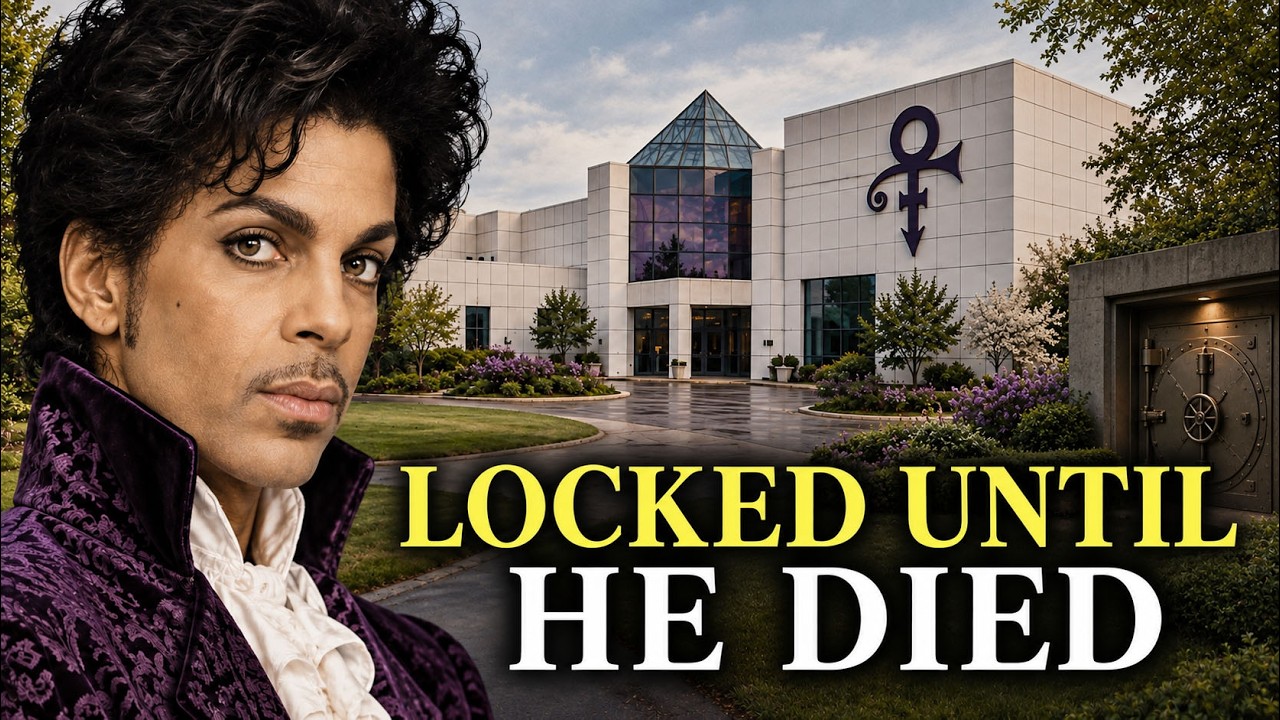
He left no will, no surviving spouse, and no children. Nine days after his death, a company appointed by a Minnesota court hired a professional safe cracker to drill the vault door open. Paisley Park is not an ordinary house. Built in 1987, the 65,000-square-foot facility sits on land about 20 miles from Minneapolis.
It contains recording studios, a sound stage, rehearsal rooms, offices, a nightclub space, and living quarters. Prince lived above the studios so he could work whenever inspiration struck, and by all accounts, it struck constantly. The vault was part of the building’s original design. Lead architect Bret Thoeny of Boto Design said Prince asked for a walk-in repository similar to a bank vault to store his master recordings.
The result was a Mosler American Century vault, the kind a bank would install, fitted with a combination lock that only one person could open. Prince released 39 studio albums during his lifetime, compared to 13 for The Beatles and 10 for Michael Jackson. But he recorded far more than he ever put out. He played every instrument on his first album at age 20 and recorded entire albums over weekends.
During sessions for Purple Rain, he and The Revolution reportedly recorded as many as 200 songs; only nine made it onto the record. The rest went into the vault. Morris Hayes, Prince’s musical director for years, said he had never seen anyone with that much work inside them. The pattern continued for 35 years: finish something, decide it is not right, put it in the vault, start again.
In 2012, Prince publicly discussed the unreleased material on television at age 54. Only Prince knew the vault’s combination from the day it was installed. By multiple accounts, he forgot it several years before he died, not merely weeks. For the final stretch of his life, the room holding his life’s work was sealed to everyone, including the man who built it.
He kept recording anyway, using a second storage area as the material accumulated. After his death, 19 of his albums appeared on the Billboard chart at the same time. His sister, Tyka Nelson, filed court papers confirming he had no will. A Minnesota judge appointed Bremer Trust to take temporary control of the estate, which faced an almost absurd problem: the estate’s most valuable asset was in a room no one could enter.
The estate called Dave McOmie, a professional safe cracker based in Oregon. He had seen a photograph of the vault online years earlier and recognized the model. There is no elegant way to open a Mosler American Century without the combination; it requires drilling through the door using previously established patterns. The door was drilled, and the vault was opened for the first time in years.
Photographs released by the Carver County Sheriff’s Office showed shelving from floor to ceiling, reel-to-reel tapes, binders, and VHS cassettes filling the room. Estimates of the contents vary. One unofficial catalog lists at least 392 unreleased songs written or co-written by Prince, dated from 1973 to 2015. Other accounts, including from people who worked with him, put the figure at 8,000 recordings across 35 years.
Archivists have said there is enough material to release an album a year for a century. No one has published a verified total, and most of the vault had never been cataloged at all. The inventory also contained unexpected items: 67 gold bars valued at around $840,000, 47 pairs of high-heeled ankle boots, and a costume for the Minnesota Twins mascot. None of these had been listed anywhere prior to the inventory.
In late 2017, Comerica Bank and Trust, which had taken over as executor, moved the contents out of Minnesota to a facility in Hollywood for preservation purposes. Magnetic tape from the 1970s and 1980s does not survive well in a basement, and the estate argued the move was necessary. A few months later, Prince’s siblings went to court to have the material moved again due to nearby wildfires in Southern California. A judge denied the request.
Since then, releases have been steady but small. Piano and a Microphone, a recording of Prince playing alone in 1983, was released in 2018. Nothing Compares to You, his own original recording, came out the same year. Welcome 2 America, an album he wrote, recorded, and never released or performed, was issued in 2021.
At the seventh anniversary event at Paisley Park, two more songs were played publicly for the first time: Seven E Flat version and All a Share Together Now. If the estimate of 8,000 recordings is anywhere near accurate, releasing one song every single day starting from the day he died would take until 2038 to finish. Paisley Park is now a museum. Visitors can walk through the studios, the sound stage, and the rooms where Prince worked.
They can stand in Studio B and sit at the soundboard he used. The elevator where he was found is not part of the tour. The vault itself is empty; the tapes are now 2,000 miles away in a climate-controlled facility, being cataloged by people who never met him. Visitors walk past a door with nothing behind it.
Three explanations are often given for why Prince did not release more of his work. The first is volume: he recorded faster than any label could release records, even signing a $100 million contract in the 1990s and still outpacing the machinery around him. The second is control: he fought his record company publicly for years over ownership of his masters, and a vault only he could open was the physical version of that argument. The third is that he did not think most of the material was finished.
The vault was not a curated collection; it was everything that did not make the cut, kept because he could not throw work away. Unlike other closed rooms in music history, this one was not sealed by a deliberate decision. A man forgot six digits, and the room sealed itself for the rest of his life. He built a room with a bank lock specifically so nobody else could reach his work, then lost the number.
For several years he lived directly above a sealed vault containing most of what he had ever recorded, and he kept recording into a second room because the first one would not open. The gold bars sat on a shelf beside master tapes and 47 pairs of boots in a room nobody could enter, belonging to a man with no will. He spent 35 years filling a room he could not get into.
It took a stranger with a drill nine days to open it.