For more than two centuries, a permanent staff of roughly 90 to 100 people has quietly run the White House. They are not the president, the cabinet, or the Secret Service, but the butlers, maids, cooks, florists, calligraphers, engineers, and gardeners who serve from one administration to the next. They know the private habits of every president, yet they have been almost entirely written out of history books. On the day a new family moves in, they have about five hours to make the most famous house in America look as if it has always belonged to someone else.
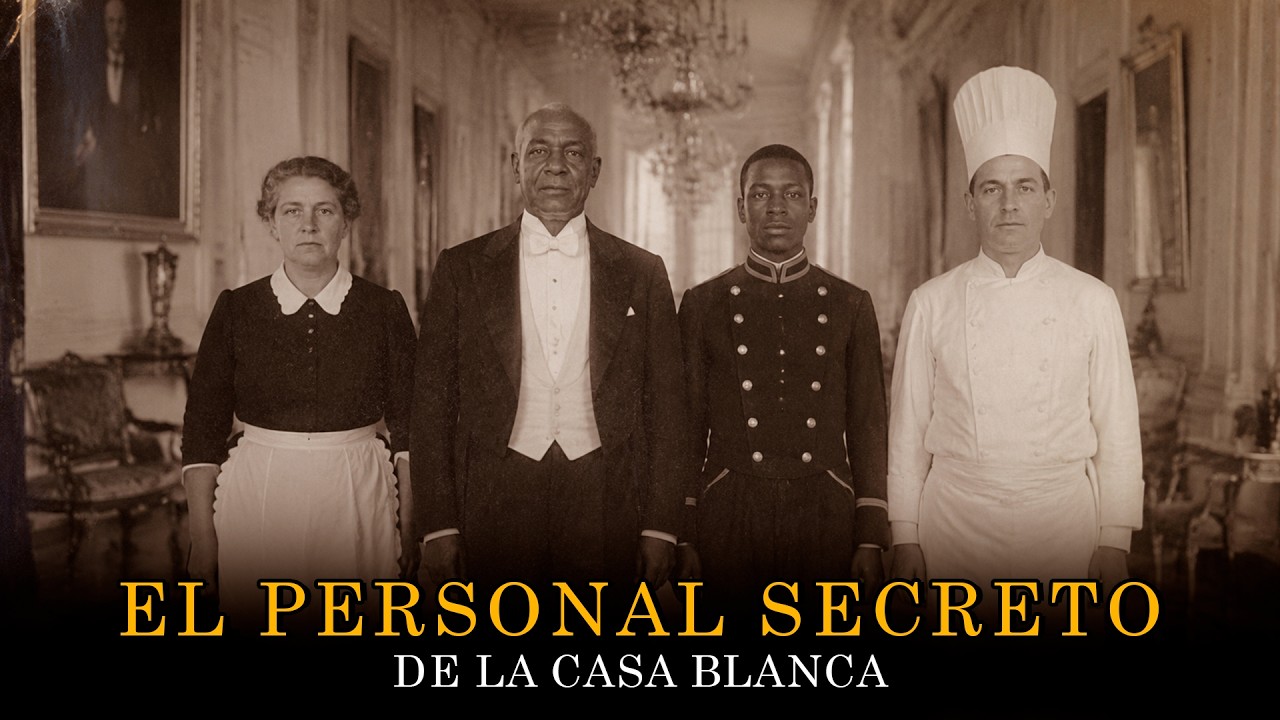
The first person ever to write down what it was like to work inside the president’s household had been born into slavery. Paul Jennings was born in 1799 at Montpelier, the Virginia plantation of James and Dolly Madison. He was trained as a footman and then as a valet to James Madison. When Madison became president in 1808, Jennings was brought to the unfinished, damp, and cold President’s House in the new federal city.
He knew the building intimately, which floorboards creaked, where the silver was kept, and the private habits of the family he served. In August 1814, as British soldiers marched on Washington, Jennings was with Dolly Madison in the house. With the help of two other men, he took down Gilbert Stuart’s famous Lansdown portrait of George Washington from the wall of the State Dining Room and moved it to safety. The British then set fire to the president’s house.
The story was told for over a century almost entirely as Dolly Madison’s story, with Jennings’s role largely rendered invisible. Jennings remained with Madison until the president’s death in 1836. He was promised his freedom but did not receive it. In 1846, an impoverished Dolly Madison sold him to Senator Daniel Webster of Massachusetts.
In 1847, Jennings agreed to buy his own freedom for $10, paying off the debt at $8 a month. He lived as a free man in Washington for the rest of his life, worked as a day laborer for the federal government, and helped organize the Pearl River incident of 1848, a major escape attempt by enslaved people in the District. In 1865, John Brooks Russell published a short pamphlet by Jennings called “Recollections of James Madison by a Colored Man. ” Historians now consider it the first White House memoir ever written.
Behind every formal room of the White House is a second building that runs through the same walls but is deliberately designed to be invisible. Flush service doors open into corridors that run the length of the building, with narrow service stairs and elevators connecting the basement to the third floor. These allow food, linens, supplies, and staff to move between any two points without ever crossing spaces visible to the family or guests. The ground floor houses the main kitchen, a separate pastry kitchen, a chocolate workshop with its own temperature control, a wine cellar, the silver vault, and a flower workshop where florists assemble between 30 and 60 large arrangements in an average week and hundreds for a state dinner.
A permanent calligraphy staff handwrites every formal invitation, menu, and place card. Below ground, the engineering plant operates continuously with boilers, transformers, and fire suppression systems that were expanded during the Truman renovation of 1949 to 1952. For most of its history, the residence’s manual and domestic labor was largely performed by enslaved African Americans. After emancipation, the staff continued to draw heavily on Washington’s Black working population.
For more than a century, the butlers, footmen, maids, cooks, and laundresses were almost entirely Black, while senior administrative positions were occupied almost entirely by white people. Alonzo Fields was born in 1900 in L Station, Indiana, a settlement of free Black families established before the Civil War. He wanted to be a concert singer, but in 1931, at age 31, he was hired as a White House butler. He considered it a temporary stop, but he stayed for 21 years, 20 of them as chief butler, serving Herbert Hoover, Franklin D.
Roosevelt, Harry Truman, and Dwight Eisenhower. He was in the building during the Great Depression, World War II, the attack on Pearl Harbor, and the bombing of Hiroshima. He helped run the residence in the hours after Franklin Roosevelt died in 1945. His private diaries became one of the closest continuous inside records of midcentury American power.
He retired in 1952. In 1960, he published his memoirs, “My 21 Years in the White House. ” The book observes but does not lecture, describes meals cooked and conversations overheard, and never settles scores. He died in 1994 at age 93.
Maggie Rogers arrived at the White House around 1909 as a maid. Her daughter Lilian survived a childhood bout of polio that left her with a limp, so she trained as a seamstress. In 1929, Lilian was hired to help with the personal needs of First Lady Lou Hoover. She would work in the building for 31 years while her mother continued to work alongside her.
Between them, the two women served twelve first ladies over more than half a century of continuous service. In 1961, Lilian published “My 30 Years Backstairs at the White House” with journalist Frances Spatz Leighton. The book covered a 50-year period of intimate domestic life inside the residence. In 1979, NBC adapted the material into the miniseries “Backstairs at the White House,” which was nominated for 11 Emmy awards and won three.
Lilian died in 1997 at the age of 100. In 1949, President Harry Truman learned that the floor beneath his bathtub was about to give way. The story has multiple versions, but the structural verdict was not in doubt. Engineering reports had warned for years that the Executive Residence faced imminent collapse.
The interior wooden framework, dating in significant parts from the post-fire reconstruction of the 1810s, was rotting. The Trumans moved to Blair House, and beginning in 1949 the White House was effectively gutted. A new steel structure was built within the sandstone walls. Two levels of underground cellars were added, new service stairs were built, and the kitchens were enlarged.
The cost was approximately $5. 7 million at the time, the equivalent of about $75 million today. The project lasted until the end of 1952. The building seen from the outside is the original sandstone shell, but the building where staff work is essentially a 1952 structure.
Eugene Allen was born in Scottsville, Virginia, in July 1919, and grew up in the segregated South. In 1952, at age 33, he was hired at the White House as a butler, the lowest grade in the kitchen and dining room staff. He washed dishes, stocked pantries, polished silver, and carried trays. He stayed for 34 years, serving eight presidents from Truman to Reagan.
In 1981, Allen was promoted to maître d’hôtel, the most prestigious butler rank in the residence. That same year, President Ronald Reagan and First Lady Nancy Reagan personally invited Allen and his wife Helene to a state dinner honoring Chancellor Helmut Kohl of West Germany. For the first time in the building’s history, a serving Black butler was invited to a state dinner as a guest. Allen retired in 1986.
In 2008, Washington Post journalist Wil Haygood wrote a long profile of Allen that was published on the day Barack Obama was elected president. Helene died the night before the election. Allen died in 2010 at age 90. In 2013, a film loosely based on his life was released starring Forest Whitaker, though it took significant dramatic liberties with the events.
For most of the twentieth century, no one who actually ran the White House would speak of it in public. Then James Bernard West, known as J. B. , did.
West grew up in Iowa and joined the Federal Civil Service in the late 1930s. He was hired in the White House usher’s office in 1941 at age 29 and stayed for 28 years. In 1957, he was promoted to chief steward, serving five first ladies, from Mamie Eisenhower to Pat Nixon. In 1969, he retired, stating he had no intention of writing a memoir.
Four years later, in 1973, he published “Upstairs at the White House: My Life with the First Ladies. ” The book became a bestseller, remained on The New York Times bestseller list for months, was translated into seven languages, and sold more than two million copies. West described in quiet prose what each first lady was really like in the day-to-day working life of the residence, without violating confidences or settling political scores. He died in 1983 at age 71.
When the outgoing and incoming presidents depart together for the inauguration, the residence staff has five hours to make the new family’s quarters look as if they have lived there for years. The choreography begins weeks in advance. The chief steward meets privately with the incoming family to record their preferences: dietary needs, medications, books, photographs, colors, fabrics, and even the brand of toothpaste they use. On the day itself, about 90 staff members organized into preassigned crews begin work the moment the motorcade exits through the South Entrance.
One crew removes the outgoing family’s belongings while another unloads the incoming family’s. Painters do touch-ups, new rugs are unrolled, beds are stripped, and new sheets are made. Photographs of the incoming family’s children are hung in their new bedrooms, and their books are placed on nightstands. In the kitchen, the refrigerator is emptied and restocked with the new family’s preferences.
Florists place the new first lady’s favorite flowers in her bedroom. Calligraphers produce place cards for that evening’s dinner. When the new family walks through the door, the lights are on, the fireplace is lit, and a meal is waiting. The transformation takes about five hours.
On the morning of September 11, 2001, the residence staff was ordered to leave the White House for the first time. The day had begun normally, with the kitchen preparing for the annual Congressional Picnic. When a third plane hit the Pentagon at 9:37 a. m.
, the Secret Service, fearing a fourth plane was headed for the building, ordered everyone to evacuate to the north. Cooks, butlers, carpenters, and maids left their work and ran out through the service entrances. A maid named Mary Arnold was momentarily unaccounted for, but she had managed to escape on her own. A butler who ran to his basement locker to change out of his uniform was trapped when the security doors closed; a Secret Service agent who recognized him opened the door.
Chief steward Gary Walters stayed behind with a small team to remove the picnic infrastructure from the South Lawn and prepare the building. The president returned that afternoon and delivered an address from the Oval Office at 8:30 p. m. The residence staff were, in the words of the source, the building’s least visible victims that day.
In the early 2010s, journalist Kate Andersen Brower, who had covered the White House for Bloomberg News, began interviewing dozens of former residence staff members, along with three former first ladies and the children of four presidents. In April 2015, she published “The Residence: Inside the Private World of the White House. ” It became a number one New York Times bestseller and was later adapted into a Netflix series in 2024. The book brought together testimony that had previously been scattered across published memoirs and interviews, presenting the residence staff as a coherent body of people with their own institutional history.
Its publication coincided with a broader shift. In 2011, Angela Reid became the first woman and first Black person to serve as chief usher. In 2017, she was ousted at the start of the Trump administration, breaking with the tradition of the position. Cristeta Comerford was named executive chef in 2005, the first woman and first person of Asian descent to hold the position.
She served through multiple administrations and retired in 2024. The most documented house in the world has at its center an undocumented people. Presidents who occupy the building for four or eight years write memoirs and become the subject of entire academic departments. The butlers, maids, calligraphers, florists, engineers, and chefs who serve for 20, 30, or 40 years are almost entirely absent from that output.
That invisibility was built into the architecture, the social conventions, and the public narrative. The result is the only continuity the building has. Administrations come and go, but the staff remains. The work continues regardless of which party controls the building.
The White House is, for these roughly 100 people, not a symbol but a workplace. There are more names in the surviving record that are preserved, and thousands more that are not. The long silence has not been entirely broken, but it has been broken enough that future writers will almost certainly build on what is now being made openly available.