For eleven years, Father Amias Rothven refused to place the Eucharist on anyone’s tongue. If a family requested it, he sent them down the mountain to Elkins. If a bishop’s letter ordered it, he found an excuse—a pain in his leg, a tightness in his chest. Even during the influenza outbreak that winter, he refused.
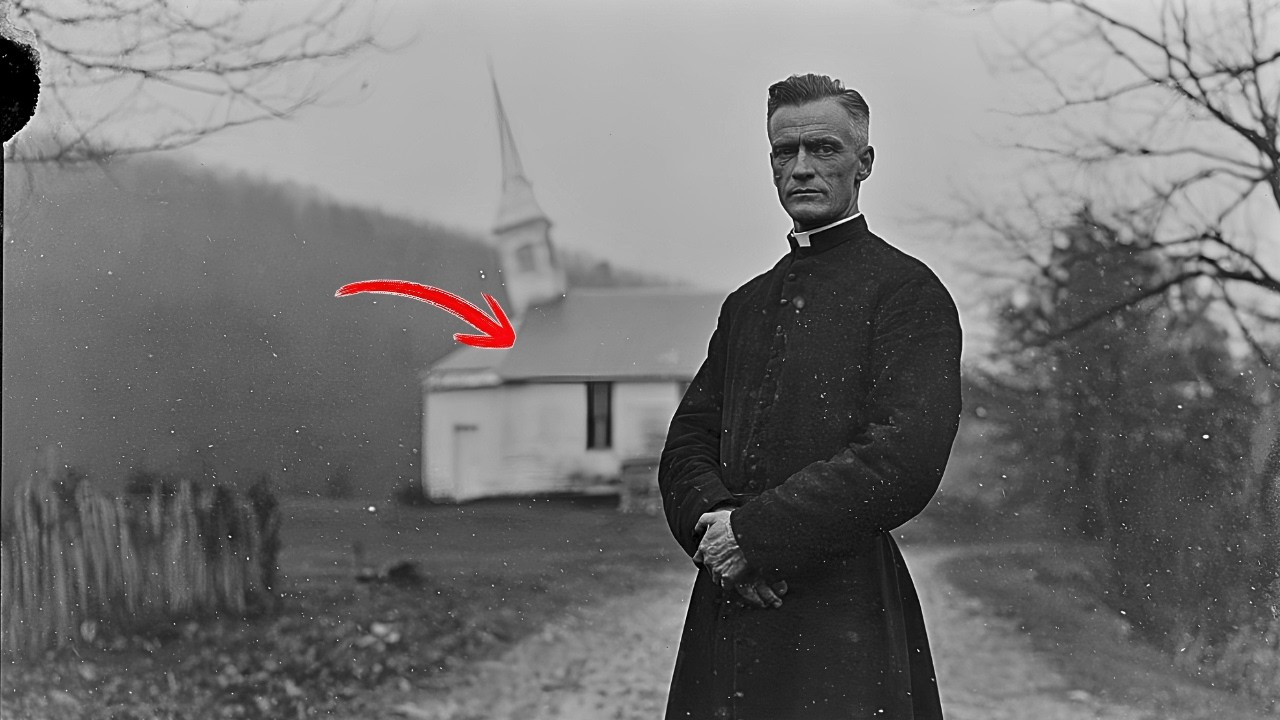
No one who knew him dared ask why. Father Rothven arrived at St. Fidelis Parish in Ossory Hollow, West Virginia, in the autumn of 1920. He was from Baltimore, ordained late at age 31 after a faltering start in law that his family never let him forget.
When he returned home from the seminary wearing his priest’s collar for the first time, his father didn’t stand to greet him. He said only, “Well. They got you in the end. ” That was the end of it.
The bishop sent him to the small Catholic congregation tucked in the mountains. Most men his age considered it a punishment. Rothven considered it mercy. He loved the quiet.
He loved the way the fog settled into the mountain crevices in the morning. The sixty or so souls in his parish were mining families, descendants of Italian and Polish men brought to the mines before the war. They took the sacraments seriously because for a long time they couldn’t get them at all. Ossory Hollow was the kind of town that maps couldn’t always agree on.
Located in a dip between the hills of Randolph County, three miles by wagon from the nearest paved road, mail arrived Tuesdays and Fridays—sometimes not at all in winter. There was a post office, a general store, a blacksmith who also repaired tractor parts, two churches, and a school that doubled as the town meeting hall. The Catholic church was a small white clapboard building with a bell tower tilting slightly east from a settling foundation no one ever bothered to fix. Inside were 22 pews, a walnut communion rail, and a tabernacle carved by a Bavarian miner named Kohler in 1889, who didn’t live to see it finished.
Father Rothven loved saying Mass early, before the men went to the mines. After they left, the church was so quiet you could hear the metal roof crack as the sun hit it. His housekeeper was Corlis Ordway, 63, a widow whose husband died in Mine Number Four in 1915. For eleven years, she never called him anything but “Father.
” He had, by his own count, three good friends in town: an old miner named Ozias Furlong, the postmaster Fane, and a doctor from beyond the hills who came to play cards on Thursdays. He was, by any measure he might apply to himself, a contented man. He turned forty-seven that autumn. He tended a small garden behind the rectory that gave him tomatoes into October in good years.
He kept a bookcase in the parlor with books he’d brought from Baltimore, mostly theology and some poetry, and a copy of Dr. Johnson’s dictionary his mother had given him. He read at night under a green desk lamp, a wool blanket over his knees. He had a photograph of his mother in a silver frame from her wedding day.
That was the extent of privacy in the parlor. He was a man who wanted to be known, and it took him years to understand the difference between not being known and being known too well in a town of sixty people—and to reconcile himself to the latter. He had made peace with it by 1931. That matters.
On October 15, 1931, four adults came down from the trees above Ossory Hollow and asked to speak with him. They arrived late in the morning. The leaves had mostly fallen, and the wind had that bite that tells you the first winter snow is a week away, no more. Corlis saw them from the kitchen window before Father Rothven did.
She came into his study without knocking, which she never did. “Father, there are people at the fence. ” He asked who they were. She said, “I don’t know these people.
They’re not the right people. ”
He went out, and there they stood at the fence by the road, four of them in a row. The tallest of the two men in front extended his hand and gave his name: Wendel Hackworth. He introduced his brother Barnaby, Ellery Marable, and Caster Whitford.
“We’ve come from up above,” Wendel said. “We’d like to be received into the church, all four of us together, if you’ll have us. ”
Father Rothven had been a priest long enough to hear hundreds of requests, and he knew ordinary ones by the tone of voice. This didn’t sound ordinary.
It sounded rehearsed. Wendel was about thirty-three. Barnaby was half a head taller, with a stillness Rothven found hard to describe except to say that most men shift their weight when standing—Barnaby didn’t. Ellery, twenty-eight or so, wore her hair under a scarf.
Caster, the oldest at perhaps fifty, had hands so clean they looked polished. The four wore clothes that weren’t quite old, but approaching it, as if they’d bought them from a catalog in 1920 and hadn’t worn them much since. When Rothven shook Wendel’s outstretched hand, he noticed it was cold—not October-morning cold, but cold like a well pump handle—and dry, dry like old paper. There were no scars on his fingertips.
No woodcutter’s calluses, no farmer’s calluses. A hand that had never done any work Rothven could name. He shook it and let go. He took great care not to wipe his hand on his cassock.
He brought them inside, out of the cold. He sat them in the back pew, all four together, and asked where they’d come from. Wendel said, “From Calpwood. ” He said it easily, the way a man says the name of his own valley.
Rothven had lived in Ossory eleven years and walked those mountains; he’d never heard the name. He asked which turnoff they’d come up. Wendel said, “The north fork, behind the mill wheel, past the old grindstone, where the hills fold in. Our people have lived there four generations.
We never had a priest. ”
Rothven asked what faith they’d been raised in. Wendel said, “Our people had a way of praying, but it had no name. We knew there was more, and we’ve come for that more.
” Caster, when Rothven turned to him, said only: “We’re ready to learn. ”
Rothven agreed to teach them. He set aside Tuesday and Thursday evenings after supper in the rectory parlor. He gave each a small green catechism with gold lettering he’d ordered from Baltimore in 1922, and told them to read the first four sections by the following Tuesday.
Corlis brought in coffee. They didn’t drink it. They said, “Thank you, we don’t drink it. ” When they left, Corlis stood in the kitchen with the pitcher.
“They didn’t touch the cups, Father. Four cups on the tray, still full to the brim. No lip marks. No fingerprints on any handle.
” She said, “I don’t like this. ” He said they’d come a long way, to give them time. She put the cups away and, before bed, held each one up to the kitchen lamp and studied it. Then she washed them even though they didn’t need washing, and put them on the farthest back of the shelf.
Next time, she brought out four different cups. Rothven noticed the next morning and didn’t ask. By the following Tuesday, they hadn’t read the four sections—they’d read the entire book. Wendel recited the Creed without stumbling, pronouncing the hard words correctly.
Barnaby recited the Ten Commandments. Ellery recited the Beatitudes. Caster, the least talkative, listed the seven sacraments in order and gave a definition of each from memory. Listening for the monotone of rote memorization, Rothven heard none.
They spoke with that slight emphasis people place only on words they truly mean. When they finished, Rothven closed his book and asked who taught them. Wendel said, “We taught ourselves. We had a full week.
” Rothven said he’d had seminarians in Baltimore who took nine months to learn what they’d learned in six days. Wendel smiled. The smile had the shape of a smile. He said, “Father, we’ve waited a long time.
”
At the third session on Thursday, Rothven planned to slowly explain the doctrine of the Real Presence. He had a small chalkboard he kept for this purpose, with a simple diagram: “bread” on one side, “body” on the other, an arrow between them, and the word “consecration” above the arrow. Wendel looked at it for perhaps two seconds, then said politely, the way a man corrects a friend’s spelling: “No, Father, that’s not how it is. ” The bread doesn’t become the body, he said.
“The bread is the door, and the body passes through the door when it’s opened. When you speak the words, you open the door. ”
Rothven’s throat went dry. “That is not the teaching of the Church.
” Wendel smiled and said forgiveness, he’d misspoken, they’d learn it as he taught it. Then, without pausing, he recited the correct definition completely from the catechism. But Rothven had heard it. And Wendel knew, before Rothven said anything, which words in his definition would signal to the priest that he’d said something wrong.
That night, for the first time, Rothven left his prayer book on the nightstand, open to the Prayer to Saint Michael, and read it silently before sleeping. After they left, Rothven sat at his desk and began a letter to the bishop. He wrote: “Your Excellency, I write tonight concerning four adult catechumens who have presented themselves to St. Fidelis Parish.
” He wrote nothing more. He sat with the pen in his hand for twenty minutes, unable to think of the second sentence. Every second sentence he tried seemed like a lie or the beginning of one. He crumpled the paper and threw it in the stove.
He never wrote to the bishop. It was one of the things Monsignor Devine would ask him about eleven years later, and he would have no good answer. He would only say, “I didn’t know how to say it in a way that didn’t sound insane. ”
The strange signs began that same week.
Rothven kept a candle burning night and day before the tabernacle, an oil lamp with a red glass bowl, as had been the custom in that church since Kohler carved the door. On the Wednesday after their second lesson, Rothven crossed the yard before dawn to open the church—and saw through the front window that the red light wasn’t there. The lamp was full. The wick was clean.
The small glass cover was in place and unbroken. The flame had been out long enough that oil had filmed on the surface. He relit it. He said his morning prayers before it and watched it the whole hour.
The flame held steady. On Thursday it went out at the same hour, and again on Friday. On Saturday he brought Corlis to the church at four in the morning to sit with him and watch. It didn’t go out that night.
It never went out again, not once, in all the years he served. On Saturday of the second week, Ellery brought him a small carved object. “We made this for the church. ” It was the size of a palm.
It resembled a kind of face. The eyes were carved close together, the mouth more of a slit than a mouth. It was carved from wood he didn’t recognize—dark, dense-grained, oily to the touch. There were marks on the back that weren’t letters.
He asked what they meant. She said, “It’s a saint from the place we came from up above. ” He said thank you. He didn’t place it on the altar.
That night he put it in his desk drawer in the sacristy, at the very back under a stack of old receipts, and closed the drawer. He didn’t sleep well. Ozias Furlong came to see him the following Monday. Ozias was seventy-eight that autumn, a Welsh miner’s son, blind in his left eye from a rockfall in 1901, a man who had come to St.
Fidelis every Sunday for the 59 years he’d lived in Ossory. He sat at the kitchen table and said, “Father, I hear you’ve had visitors from up above. ” Rothven said, “From Calpwood, yes. ” Ozias laid his cane across his knees.
“Father, there’s no such place as Calpwood. ” Rothven said they’d been very specific about the location. Ozias said he’d walked those forks—looking for cattle, for a missing cousin in 1898, on a railroad survey in 1906 that took him across every hill on that ridge for 30 miles north. “There’s no Calpwood.
The north fork past the mill wheel goes nowhere but a rock shelf, and the shelf is bare rock. No one ever built a house on it. ”
He said his grandmother had a name for people who claimed they’d come from up above: “she called them the ones who come from above the fog line. ” And she had a rule: “Don’t feed them, don’t give them names, and don’t put anything in their mouths.
” Rothven was about to laugh when he felt, from two hours earlier, the thing in his palm—the thing no one he knew could have carved from any valley. He said, “Ozias. They’ve asked for their first Communion. ” Ozias closed his good eye.
When he opened it he said, “Father, I ask you as a friend: Don’t. ” Rothven said they’d come to be received; they know the catechism better than he or Ozias; they believe. “What am I supposed to tell them? ” Ozias said, “Tell them the church burned down.
Tell them the bishop forbade it. Tell them you’re dead. Tell them anything. Don’t put that on their tongues.
”
At the door, Ozias held his hand. “Father, my grandmother said one more thing. She said: If you feed them, they’ll open the door—and they won’t come through it alone. ”
That night Rothven dreamed of a small church he’d never visited.
It was smaller than his and older, with walls of black wood, pews arranged in a circle instead of rows, and no cross above the altar. There was a small carved face—the one Ellery had given him—but larger, the size of a human face, mounted on the wall where the cross should have been. He knew in the dream that he was in Calpwood. He knew there were people sitting in the pews behind him, waiting for him to say Mass, and he couldn’t turn to look at them—because if he looked, he would recognize them, and if he recognized them, he would understand something he did not want to understand.
He woke up before he did. It was three in the morning. Corlis was in the hallway with a lamp. “Father, I heard you shout.
” She said she’d dreamed too: the four of them standing at the rail, already having received Communion, smiling—and behind them the church door stood open, and something was coming in through it that she couldn’t see but knew was there because the air moved around it. “Father, please. ” He said they’d talk in the morning. He didn’t sleep again.
At six, he wrapped the carved face in a cloth, took it to the back of the yard, and burned it in the trash barrel with old parish records. It burned slowly. The smell was like something that had once been alive. In the days after he burned it, Rothven tried to think as a priest was trained to think.
He’d learned in Baltimore that eagerness of belief is a shortcut to a lazy soul; that the devil’s easiest trick is convincing a man that the devil exists; and above all, that grace is offered to all, and a priest who withholds the sacrament out of superstition is a priest who has forgotten his office. He knew all this. He said it to himself in the mirror Tuesday morning. He said it in the parlor Thursday night when the four sat before him again, and Wendel recited from memory, with no book open in front of him, the section on the Eucharist from the Baltimore Catechism—not missing a single word.
At the end of the session, Ellery said, “Father, when will you give it to us? ” Rothven heard exactly what Ozias had described a week earlier: being asked for something by people who already know precisely what they’re asking for. Because he didn’t know how to say it, he said, “On the Feast of Christ the King. ” That was the last Sunday of November.
“That gives us three more weeks. If you’re ready. ” Wendel said, “We’re ready. ” He said it for all of them.
The two weeks that followed were the strangest of Amias Rothven’s life. He wrote later in his private diary that he felt like a man asked to open a door in his house he’d never noticed. He understood, without being told, that if he opened it, he wouldn’t be able to close it again. Small things went wrong.
The wine in the sacristy cupboard turned within three days, though the bottles were new and the cupboard was cold. The hosts in their sealed metal box had a taste he’d never tasted in any host before—faintly metallic, like the taste of a coin. Corlis found bare footprints in the flour dust on the pantry floor one morning—longer and narrower than any foot in the parish, entering through the back door and stopping in the middle of the room, with no exit. She didn’t tell him for a full day, and when she did, she wept, which he’d never seen.
The old brown mongrel at the Petrowsky house across the creek, a dog that had never barked at anything more serious than the mail wagon, began sitting at the edge of its yard every evening at dusk, facing north toward the hill, whining—not barking, whining—low and continuous, for up to an hour, then going inside to lie under the kitchen table. Postmaster Fane mentioned it to Rothven on Friday, as lightly as a man who suspects he’s talking about something that isn’t quite his business. Rothven thanked him and didn’t say what he was thinking—that the dog knew exactly where they were, and didn’t want them any closer. Ozias came twice more, asking each time whether he’d reconsidered.
Each time Rothven said no. On the Wednesday before the Sunday, Rothven went up the north fork himself, past the mill wheel, past the old grindstone, until the hill folded—and found no Calpwood. He found a bare rock shelf covered in wet leaves. He found the frame of a hunting shelter unused for twenty years.
He walked for six hours. He returned at dusk, mud to his knees, with the iron taste of the host at the back of his mouth. Corlis met him at the door. “Father, they were here.
” An hour before, she said: they’d come through the back gate, walked around the church to the front, stood at the door, looked through the small window, and gone back the way they came. They didn’t knock. “They knew you weren’t here. ” He asked how they knew.
“Father, I’ve thought about it all afternoon, and I haven’t come up with an answer that will let me sleep tonight. ”
On the Thursday of that final week, Rothven did what he’d told himself for eleven years he would never do: he wrote to a priest he’d known at the seminary, now teaching at Catholic University in Washington. His name was Father Ignatius Hollandbeck, a meticulous, small man with a scholar’s stoop, who kept a private library on the history of what he called “the difficult saints. ” Rothven wrote three pages.
He didn’t describe the four visitors in any detail—only the small carved face Ellery had brought him—and asked whether it matched any tradition Hollandbeck knew. He mailed the letter Friday morning. He didn’t expect a reply for at least a week. He received one Saturday afternoon: a telegram of seven words.
“Dear Friend, burn it and salt the earth. Ignatius. ” Rothven read the telegram twice. Then he asked himself: whatever this was, a scholar in Washington had recognized it from a two-sentence description and replied within a day.
On Saturday, the confession line at St. Fidelis was longer than Rothven had ever seen. Every family in the valley came. Old men who hadn’t been to confession in a decade came.
Ozias came. Behind the screen, Rothven heard him breathe in. Ozias said, “Father, I’m not here for confession. I’m here to tell you I’ll be staying in the church tonight.
I’ll sit in the last pew from now until you finish Mass tomorrow, and I won’t leave. If you won’t turn them away, then there must be someone in the room who knows what they are. ” Rothven closed his eyes in the dark of the confessional. Ozias said, “And Father, when you come out of the sacristy tomorrow morning, don’t look at me.
Because if you look at me, you’ll lose your nerve and you’ll turn them away—and I don’t think that will work anymore. I think they have to meet their end. You started this by saying yes, and the only way now is through. ” Rothven was silent a long moment.
Then he said, “Thank you, Ozias. ” Ozias said, “Don’t thank me yet. ” He got up and left the box. Rothven didn’t sleep at all that night.
He said his prayers in the rectory kitchen by candlelight. Corlis sat with him. She said nothing. At four in the morning she put her hand on his and left it there a long while.
Then she stood and made coffee. The Feast of Christ the King, 1931, dawned with snow. The first snow of the year. It came from the north quietly, flakes so small they seemed like dust.
By seven, the roofs of Ossory Hollow were white. The road had no tracks. Standing at the sacristy window in his black vestments, Rothven watched Wendel Hackworth, his brother Barnaby, Ellery Marable, and Caster Whitford come down from the woods above town in a single file, wearing their twenty-year-out-of-date Sunday clothes. None of them left a footprint in the snow.
By the time they reached the church door, he had convinced himself he hadn’t seen it. Mass began at eight. Only nine people came. Ozias in the back pew, as he’d said.
Corlis in her usual place. The widow Petrowsky, the doctor from beyond the hill, who had come through the snow because Rothven had asked him to the day before without saying why. Three miners’ wives from the road near the railroad. And in the front pew, the four.
They knelt. They stood. They sat. All with perfect precision.
When Rothven read the Gospel, the four didn’t look at him. They looked at the tabernacle. During his short sermon—about the peace that surpasses all understanding, about the mystery hidden from the wise and revealed to the humble—they did not blink. Not once.
He counted. He preached for six minutes, and for those six minutes Wendel Hackworth did not blink. At the offertory, Ellery Marable rose from her pew, walked up the side aisle, and placed on the altar a small cloth bundle. She said nothing.
She returned to her place and knelt again. At the altar, Rothven opened the bundle with his fingertips. Inside was a coin. It was very old and not one he could identify.
It bore a face—and the face was the one he had burned in the trash barrel two weeks before. He put it back in the cloth and set it aside. His hands did not tremble. He was proud of that afterward: that his hands did not tremble.
He said the Creed. At the words “This is my body,” he elevated the host—and from the front pew he heard four people inhale at exactly the same moment. It was a very small sound. He heard it.
At Communion, he came down from the altar with the host. Ozias stayed in the back, motionless. Corlis didn’t come forward. She kept her head bowed.
The widow Petrowsky and Dr. Hallowell and one of the miners’ wives came forward; the other two did not. When they finished, Rothven walked to the communion rail where the four knelt in the order Wendel had set at the fence a month before: Wendel, Barnaby, Ellery, Caster. He stopped before Wendel.
Wendel opened his mouth. His tongue was pale. Rothven said, “The Body of Christ. ” Wendel said, “Amen.
” Rothven placed the host on his tongue. Wendel closed his mouth and shut his eyes. Rothven took one step to his right, toward Barnaby. Barnaby opened his mouth.
“The Body of Christ. ” “Amen. ” He placed the host on his tongue. One step right, toward Ellery.
She opened her mouth, saying “Amen” with half a breath before he said the word “Body,” which he hadn’t expected but heard. He placed the host on her tongue. One step right, toward Caster Whitford. Caster’s eyes were already open, looking at him.
“The Body of Christ. ” Caster answered, “Amen,” in a voice that was not his voice. Rothven placed the host on Caster’s tongue. At that exact moment, with no signal between them, the four opened their eyes, lifted their faces toward the roof of St.
Fidelis, and began to speak. It wasn’t English. It wasn’t Latin. It wasn’t any language Rothven had heard before—though he’d studied Greek and Hebrew at the seminary, had passable German, and had heard Polish and Italian from parish elders his whole life.
It had the structure of language, but the sounds were wrong. They came from all four at once, in the same pitch and the same rhythm, as if one throat were speaking through four mouths. Dr. Hallowell later said the closest thing he could compare the sound to was a person trying to speak with a mouth full of very cold water.
Then the temperature in the church dropped. It dropped so fast that the doctor in the fourth pew said he could see his own breath within seconds. The candles on the altar did not gutter in a draft. They went out all at once—all twelve, in unison, with no smoke.
They went out the way an electric light goes out when the power is cut. But they were candles. And Father Rothven, standing before the four kneeling at the rail, felt a weight settle on the roof of St. Fidelis.
That was the word he used later: weight. He said it felt as if something enormous and cold had lain down on top of the church and was pressing its face against the roof boards to hear better. He didn’t run. He said later he should have run, but he was frozen in place.
The four kept speaking. The words sped up. Wendel’s eyes rolled back until only the whites showed. Then Barnaby, then Ellery, then Caster—one after the other, in the same order, Wendel first.
They leaned forward at the rail, slowly and deliberately, and without any change in their synchronized speech, they spat the hosts onto the walnut. Four white circles, wet and unmarked. Then they stopped speaking all at once. Wendel said, in his normal voice, in plain English: “Father, we’ve opened the door.
He said thank you. ”
At that same moment—with no wind, with no door opening—the four vanished from where they knelt. The clothes they’d been wearing lay on the kneeler, as if someone had stood up from them and walked away. But the clothes didn’t fall.
They remained upright in the shape of four kneeling people—empty. From the last pew, Ozias Furlong, who had not moved once during the entire Mass, said very quietly: “Father, close the door. ”
Rothven recorded in his diary that he does not remember the next hour. He remembers going to the tabernacle, removing the ciborium, returning the fragments from the rail to the purificator, closing the box, putting it back, locking it.
He remembers Corlis approaching him at some point and taking the chalice from his hands. He remembers Ozias standing at the back of the church with his blackthorn cane, watching the door. He doesn’t remember what he said to the congregation. He doesn’t remember dismissing them.
He doesn’t remember taking off his vestments. He remembers, afterward, sitting in the rectory kitchen with a cup of coffee Corlis had set in front of him, with Dr. Hallowell across the table and Ozias in the corner by the stove. It was past noon.
The snow had stopped. Dr. Hallowell said, “Amias, I don’t know what I saw. ” Ozias said he’d seen exactly what he’d seen, and he was glad a non-Catholic doctor had seen it, and a non-Catholic widow had seen it, and he had seen it, and Corlis had seen it, and they’d all seen the same thing.
That night Rothven walked back up the north fork with his boots, his heavy coat, and a lantern. He passed the mill wheel and the old grindstone and climbed to the fold in the hill. He walked onto the bare rock shelf. He stood there in the dark.
There was nothing. No church. No house. No trail leading up.
There were his own footprints in the snow, and the wind was blowing through the gap, and there was a very faint smell of the wood the small face had been carved from—oily, dark, close-grained. He turned and walked back. He never went up there again for the rest of his life. But he stayed awake for the next seven nights in the sacristy, lamp lit, key to the tabernacle in his hand.
He wasn’t sure what he was watching for. He was only sure he had to watch. On the eighth night he slept. He dreamed of the small church again, and this time he turned around—and the pews behind him were full, and every face in the pews was his own face, and every one of them was smiling.
He woke, and did not sleep well again for months. The parish records for October and November of 1931 show the confessions Rothven heard, the baptisms he performed, the Masses he said. They do not show the names Wendel Hackworth, Barnaby Hackworth, Ellery Marable, or Caster Whitford. There are pages in the baptismal register for that autumn, in Rothven’s own hand, where he had written those names—and where the ink has faded.
Not crossed out. Not erased. Simply gone, as if it had never been put on the page. Corlis checked in 1941, ten years later.
The pages were still blank. She showed them to the investigator sent by the new bishop, who came one afternoon in 1942, after Rothven had refused for the eleventh consecutive year to prepare any candidate at St. Fidelis for first Communion. The investigator, a Monsignor Devine, was a precise man.
He read the parish registers. He interviewed Corlis and Ozias—who was ninety at the time and still alive. He interviewed Dr. Hallowell, who had moved to Elkins after the war and returned for the interview because Father Rothven asked him to.
He interviewed the widow Petrowsky, who was in a nursing home and did not have long left. When he finished, Monsignor Devine came to the rectory and sat with Rothven in the parlor for a long while. He said, “Father, I believe you. I don’t know what to do with what I believe, but I believe you.
The bishop will not ask you to prepare any candidate for first Communion in this parish as long as you serve here. We’ll send them to Elkins, and no one will ask you why. ”
And there, Amias Rothven—fifty-eight that spring, a priest for twenty-seven years—put his face in his hands and wept, for the first time in front of another person since his mother’s funeral in 1909. He served in Ossory for ten more years after that.
He was a good priest. He was kind and steady, and the mining families loved him. He said Mass every morning at his time in the white leaning church with the tin roof, and he did not open the drawer in the sacristy where the small carved things sometimes appeared—about once a season, always overnight, always in the same oily wood, always with the mouth like a slit. He would take them out with a cloth and burn them in the trash barrel behind the rectory.
Corlis would sit in the kitchen with the door closed while he did it. Neither of them ever spoke of it. In 1935, four years after the Feast of Christ the King, a young couple from Buckhannon wrote to St. Fidelis asking whether their nephew—a coal engineer working in Elkins—could be received into the church in Ossory Hollow, because the boy’s elderly maternal aunt, too old to travel, had always dreamed of seeing an adult of her family become Catholic in that small white church on the mountain.
Rothven wrote a precise reply. St. Fidelis, he said, was unfortunately not able at this time to receive adult catechumens for the sacraments of initiation. Arrangements could be made through the Elkins parish to bring the aunt on the day of the ceremony instead.
He himself would be happy to participate in the Mass. He signed the letter and gave it to Corlis to post. When she returned from the post office she said, “Father, we’re keeping them away for good, aren’t we? ” He said, “Yes, Corlis.
” She said, “All of them. ” He said, “All of them. ” She nodded and went to the kitchen, and neither of them ever mentioned it again. The bishop, when the Buckhannon couple’s letter reached the diocese, did not intervene.
Neither did any bishop after him. Over the years it became one of those quiet arrangements a diocese makes with a particular parish—the kind nobody puts on paper and nobody asks about. Every year, on the Feast of Christ the King, he said Mass alone at four in the morning in the empty church, in the dark, with the red lamp burning before the tabernacle and the twelve altar candles lit, with every door of the church locked from the inside. He said afterward that he didn’t know with certainty what he was doing—only that the weight on the roof was heaviest on that morning of the year, and that he felt responsible to the parish to be the one under that weight, not someone who didn’t know what it was.
He died in the autumn of 1952, of a heart he’d always known was weak, in his bed, with Corlis holding his hand and a young priest from Elkins in the room with the oils of anointing. His last confession was long. The young priest, a Father Boudreau, said later only that Rothven spoke of an emptiness that wasn’t there, and of a door he’d opened once by mistake, and that he had received absolution and the absolution had been accepted. Father Boudreau also said—though he said it only years later, and only to another priest—that at the moment of Amias Rothven’s death, the temperature in the room dropped for perhaps two seconds, and he felt very distinctly that something in the room turned to look at him, then decided he wasn’t the one it wanted, and left.
He said he never spoke of it because he didn’t want it to be true. Ozias Furlong died the following spring at ninety-nine. He was buried in the cemetery behind St. Fidelis, four rows over from Father Rothven.
Corlis Ordway lived to ninety-one, never remarried, kept cleaning the rectory for the two priests who came after, and told no one the story. In 1965 she wrote it down in a school notebook and placed the notebook in the parish safe with a note asking that it not be opened for fifty years. That notebook is the source from which most of this account is drawn. The parish still stands.
The bell tower still leans slightly east. The metal roof still cracks under the morning sun. The tabernacle Kohler carved is still in its place. No first Communion has been held in that church since the Feast of Christ the King, 1931.
Every priest who has served there since, without knowing why, without being told the story, without any directive from the diocese, has quietly sent his candidates down the mountain to Elkins. And they say that sometimes, during heavy snow, if you walk through Ossory Hollow late at night, you can see a small red light high on the hill above the town, like a lamp in a window, at a place where no house has ever been built.