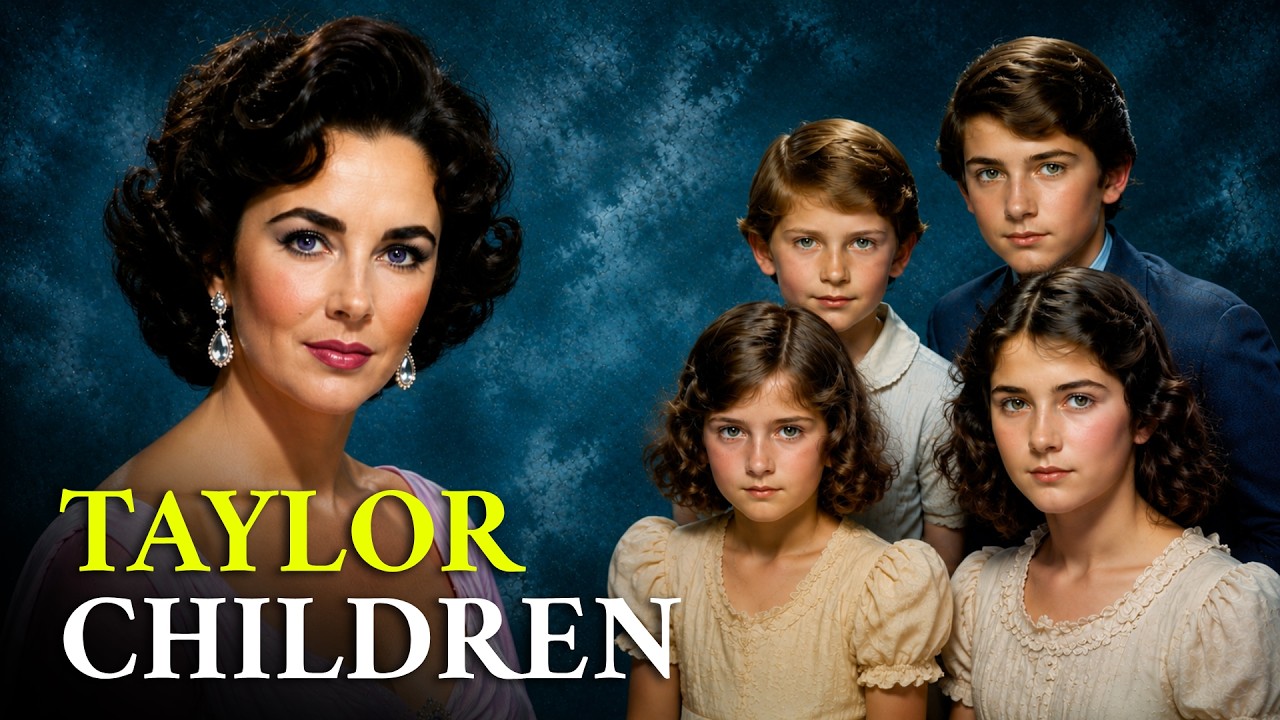
Elizabeth Taylor became one of the most recognizable women in the world, but her four children—Michael, Christopher, Liza, and Maria—built their adult lives almost entirely away from the cameras that followed their mother for nearly seven decades. The daughter who never met her father was born in August 1957. Elizabeth Taylor was married to producer Mike Todd at the time, a man friends called the great love of her early life. Their daughter was named Elizabeth, though everyone called her Liza.
Todd died in a plane crash over New Mexico in March 1958, when Liza was not yet eight months old. She grew up without a single conscious memory of him. Taylor was 26 when she became a widow with an infant daughter. Her life continued at a relentless pace, with marriages to Eddie Fisher and later Richard Burton, who became something close to a real father figure for Liza.
As a young woman, Liza shrank from attention where her mother thrived on it. She trained seriously as a sculptor, working mostly in bronze, and built a reputation depicting horses and wildlife with careful anatomical accuracy. People in that field said she never traded on her mother’s name, and many of her early clients had no idea whose daughter she was. In 1984, she married an artist named Hap Tivey, and the couple settled on a large wooded property in the Hudson Valley, about as far from Beverly Hills as a life can get.
They had two sons. The couple separated in 2003 after nearly 20 years of marriage, but the split was described as gentle, and they reportedly still live only a few miles apart on good terms. She created a life-sized bronze of a rescue dog using material recovered from the wreckage of the World Trade Center as a tribute to the search and rescue teams who worked there after September 11. Later, her focus shifted to African wildlife, and she worked directly with an elephant orphanage in South Africa.
The childhood that involved the most physical suffering belonged to the daughter adopted from Germany. Maria was born in Munich in the summer of 1961 and was placed for adoption as an infant. She was born with a serious hip deformity, a congenital condition that could leave a child with a permanent limp if untreated. Taylor reportedly told friends she wanted this particular child because she was unwell and because she believed she could help her.
The adoption was still being processed when Taylor’s marriage to Fisher fell apart. When Taylor married Richard Burton in 1964, he completed the legal adoption and became Maria’s father in every way that counted. She took his name and was raised as Maria Burton. To correct her hip, Maria went through close to 20 separate surgeries throughout her childhood.
Each one required recovery time, carried risks, and asked a small child to be brave in a way most adults never have to be. While her siblings were at school or out riding horses, Maria was often recovering, relearning how to walk after another procedure, spending long stretches in casts or braces meant to reshape her hip as she grew. By most accounts, she was never treated as fragile within the household. Taylor made a deliberate point of including her in everything the other children did.
As an adult, Maria worked in clothing and fashion while staying involved in charitable causes tied to her mother’s name. She had a daughter with her first husband, Steve Carson, and the marriage came to an end around the turn of the millennium. She remarried in 2002 and had a son, but that marriage also proved difficult and the couple separated in 2004. Some reporting from that period suggested the split involved tension, with accusations made afterward about how family resources factored into the disputes, accusations Maria and her representatives pushed back on at the time.
Today, Maria lives a quiet life in Idaho, largely removed from the entertainment world. She stays connected to her mother’s charitable legacy. The brother who married into a cursed fortune was Christopher Edward Wilding, born on February 27, 1955, sharing a birthday with his own mother. He was the younger of Taylor’s two sons from her marriage to British actor Michael Wilding.
As a boy, he appeared briefly as an extra in his mother’s 1967 film alongside Richard Burton. As an adult, Christopher built a steady career behind the camera, working in sound and assistant directing on a handful of films through the 80s and 90s. Colleagues on those sets reportedly had no idea, at least at first, that the quiet crew member working sound equipment was the son of one of the most famous women alive. In 1981, he married a young woman named Aileen Getty, the granddaughter of oil tycoon J.
Paul Getty, whose personal fortune was frequently compared to the total economic output of entire small nations. But that wealth came bundled with a tragedy that had shocked the world less than a decade before they crossed paths. Aileen’s brother, John Paul Getty III, had been kidnapped in Rome in 1973 when he was only 16. His captors demanded an enormous ransom.
His own grandfather initially refused to pay, telling reporters that if he paid for one grandchild, he’d have 14 more kidnapped by morning. The standoff dragged on for months. In a horrifying escalation, the kidnappers caused the teenager serious and lasting physical harm and made sure evidence reached an Italian newspaper with a note warning that worse would follow. Only then did the family relent.
A reduced ransom was paid, and the young man was released after roughly five months in captivity, found alive on a roadside in southern Italy. He survived but never fully recovered, struggling badly with substance use and later suffering a severe medical crisis in his mid-20s that left him with permanent disabilities. Christopher and Aileen reportedly eloped quietly at a small chapel. The couple had two sons together, one adopted and one biological, born in 1985.
Aileen then went through a genuinely difficult stretch involving substance use and serious depression following the birth of her second son. Elizabeth Taylor, worried about her daughter-in-law, reportedly brought her along on a trip to Paris connected to Taylor’s earliest work supporting AIDS research. Neither woman could have known that the disease being discussed would soon touch their own family directly. In the mid-1980s, Aileen learned she had contracted HIV.
At first, she told people the likely source was a blood transfusion. Years later, she opened up about the real circumstances: she had contracted it during an especially painful period in her marriage, at a time when she and Christopher were both struggling and the relationship had already begun to break apart. Christopher and Aileen divorced by the late 1980s, with Christopher taking on primary care of their two young sons. Here is where the story took its most unexpected turn.
Aileen did not disappear from the family after the divorce. She and Elizabeth Taylor stayed close for the rest of Taylor’s life. Taylor never treated her with anything resembling judgment, not over the affair, not over the diagnosis. Many people close to the family have said that watching her former daughter-in-law go through that experience up close played a real part in pulling Taylor into AIDS activism at a moment when almost no major public figures wanted anything to do with the cause.
Taylor became one of the earliest and most visible celebrity advocates for HIV and AIDS research, eventually founding her own foundation dedicated to the cause. Aileen became a long-term survivor and built a second career around advocacy, founding organizations focused on housing and supporting people affected by the disease. She remains an ambassador for the Elizabeth Taylor AIDS Foundation to this day, and the two women stayed close until Taylor’s death in 2011. Christopher remarried a sound editor named Margaret Carlton, and the couple had a son in 1992.
He has stayed almost entirely out of the public eye. By his own account, he keeps one particularly meaningful piece of his mother’s legacy in his home: the first Academy Award she ever won, not displayed for visitors but simply kept close. The eldest son, Michael Howard Wilding Jr. , was born in Santa Monica in January 1953.
Like his younger brother, he made a brief childhood appearance in that same 1967 film. Years later, he pursued acting more seriously than any of his siblings, landing recurring roles on daytime soap operas through the mid to late 1980s. But his personal life revealed just how far he was willing to drift from the world his mother lived in. In 1970, he married Beth Clutter, and the couple had a daughter, Leila.
For a stretch of years afterward, Michael lived on a commune, a lifestyle about as far removed from Beverly Hills as possible for the son of one of the most glamorous women alive. During that period, he welcomed a second daughter, Naomi, born in 1975. By every account, his mother never held it against him. She stayed present in his life and in the lives of his children, visiting when she could and never suggesting he owed her a more conventional path.
In 1982, he married Brooke Palance, the daughter of Oscar-winning actor Jack Palance, and the couple had a son in 1989. At some point, Michael stepped away from acting almost entirely. In 1991, he moved to Santa Fe, New Mexico, and began working as a stone sculptor, carving flowing shapes out of marble and limestone, drawing inspiration from the desert landscape. He has said the discipline leaves no room for shortcuts, and a single piece can take months.
That career is still active today. Michael continues to show work through galleries in Santa Fe and Los Angeles, with exhibitions as recently as this year. All three of his children eventually became involved with the Elizabeth Taylor AIDS Foundation. Between the four children, they gave Taylor 10 grandchildren, several of whom now carry her legacy forward directly, running her AIDS foundation and managing her estate.
None of the four children ever chased the kind of fame their mother carried for nearly 70 years. Each of them built a life around the opposite instinct entirely: privacy, craft, and real distance from the cameras that followed her everywhere. In old interviews, Taylor rarely spoke about her children in terms of achievements or careers. She spoke about how they made her feel steady, how coming home to them after a film shoot or a hospital stay was the one part of her life that never felt like performance.
Elizabeth Taylor spent her entire career in front of more cameras than almost anyone in the history of American entertainment. Her four children spent their adult lives mostly and deliberately staying out of the frame. Given everything each of them lived through to get there, it is hard not to see that as a legacy all its own.