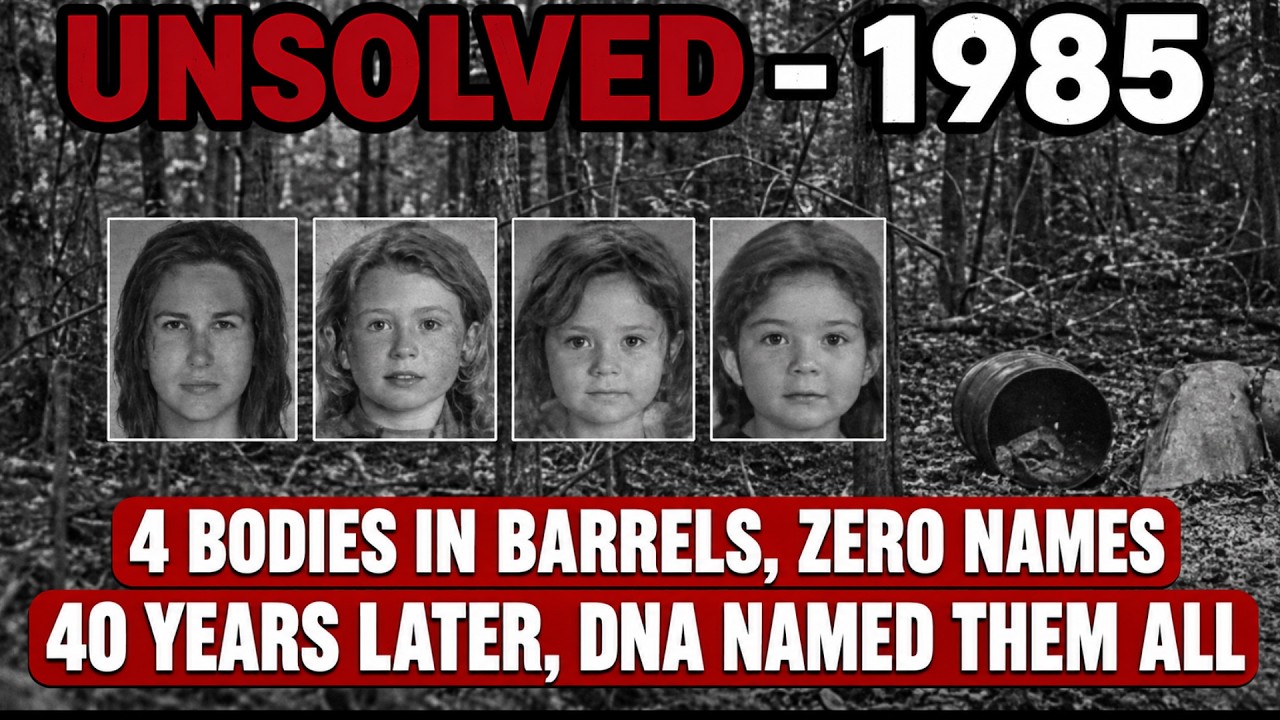
On November 10, 1985, a hunter walking through the woods near Bear Brook State Park in Allenstown, New Hampshire, found a 55-gallon drum lying among the trees. Inside were the skeletal remains of a woman and a young girl, wrapped in plastic and bound with industrial electrical wire.
Police distributed composite sketches of the victims across New England. No one recognized them. No missing person reports matched. They were buried in the town cemetery under a headstone that read only “Unknown.”
Fifteen years later, in 2000, a second barrel was found less than 100 meters from the first. It contained the bodies of two more young girls, disposed of in the same manner. Four victims. No names. No suspects.
The case became known as the Allenstown Four. For decades, it remained one of New Hampshire’s most haunting unsolved mysteries. The killer was still alive, changing his name, moving from state to state, and killing again. No one knew.
It took 40 years, forensic technology that didn’t exist at the time, a librarian searching family forums at midnight, a genealogist building a family tree of 25,000 people, and a volunteer organization tracking a 2005 obituary to finally give the four skeletons their names back.
This is the story of the longest cold case in New Hampshire history. It is the story of a killer who called himself Bob Evans. And it is the story of ordinary people who refused to let four lives be forgotten.
When police opened the first barrel in 1985, they found something no one in New Hampshire law enforcement was prepared for. Inside the industrial metal drum were the bodies of an adult woman and a young girl. Both had been beaten to death with a blunt object. They were wrapped in black plastic bags and bound with industrial electrical wire.
Investigators later determined the wire came from Carol Cable, a cable manufacturing facility that once operated in New England. It was one of the first concrete physical clues. For years, it remained one of the only ones.
The woman was estimated to be in her early 20s, between 23 and 25 years old. The girl was between 5 and 11. There was no identification, no recognizable jewelry, no clothing intact enough to trace. The bodies had been in the barrel for years, possibly since the late 1970s or early 1980s.
No one in Allenstown or any neighboring town had reported a young woman and child missing during that period. The timeline was too broad to narrow down. The sketches went out. No one called. Not even once.
The two victims were buried in Saint Jean Baptiste Cemetery in Allenstown, a small Catholic cemetery in a town of fewer than 5,000 people. Their headstone carried no names, no dates. Just a line confirming that two human beings were found one day and now lie here without identity.
The town learned to live with the mystery. People talked about it at the coffee shop, at the post office, in backyards. But there were no answers, and after a while, the questions faded. Not because people forgot, but because there was nothing new to say.
Then came May 9, 2000. A worker clearing land near the site of the first barrel found a second one. It was less than 100 meters from the original, hidden behind dense brush that 15 years of growth had turned into a natural green wall.
Inside were the bodies of two more young children, estimated to be between 2 and 4 years old and between 1 and 3 years old. Same method. Plastic wrapping. Electrical wire. Blunt force trauma.
Investigators quickly concluded that both barrels were likely placed at the same time by the same person. They had shifted over the years, possibly due to rainwater, animals, or very likely children playing in the area.
Think about that for a moment. For years, children in Allenstown played in those woods, kicked balls, built forts, and ran between the trees, just dozens of meters from where four bodies lay. No one knew.
The discovery of the second barrel turned the case from a mystery into a nightmare. It was no longer two victims. It was four. No longer a single murder. It was the pattern of a serial killer.
The FBI joined the investigation. DNA from all four victims was entered into the national CODIS database. Facial reconstructions were updated with newer technology. America’s Most Wanted aired a segment on the case. Information was sent to the National Center for Missing and Exploited Children.
No matches were found. DNA technology at the time could only compare samples against existing references. It could not identify a person from scratch without a starting point. It was a vicious cycle. To identify the victims, you needed family DNA. But to find the family, you needed to know who the victims were.
The case became New Hampshire’s most famous unsolved murder case. Every few years, the media would return, republish the sketches, retell the story, and appeal for information. Each time, it ended the same way. Silence.
Four lives had been completely erased. Not just taken, but wiped out of existence. No names. No past. No one claiming them. No one grieving them. And all the while, their killer was still alive, living under another name, in another city, perhaps killing again.
In the late 1970s, a man calling himself Bob Evans appeared in Manchester, New Hampshire, the state’s largest city, less than 20 miles from Bear Brook State Park. No one knew where he came from. No one asked.
Evans was hired as a master electrician at Waumbec Mills, a large textile factory that had been operating for over a century. He was skilled at his trade, reliable at work, and seemed like an ordinary worker in an ordinary industrial city.
But Bob Evans was not his real name. And he was not an ordinary man.
Between February and October 1980, Evans was arrested three times in Manchester for bad checks and stealing electricity. Three arrests in eight months, all under the name Robert T. Evans. Manchester police never once verified his true identity. No fingerprint comparison. No criminal record check.
He gave a name. The police wrote it down. The system accepted it.
This was the late 1970s and early 1980s. There were no federal digital databases, no automated identification systems. A man could walk into a new city, assume a new name, and start over without anyone asking questions.
That is exactly what Terry Peder Rasmussen did, over and over again, in multiple places, over decades.
His real name was Terry Peder Rasmussen, born December 23, 1943, in Denver, Colorado, the fourth of five children. The family moved to Phoenix, Arizona, when he was young. Rasmussen attended North High School in Phoenix but dropped out after his sophomore year.
In April 1961, at age 17, he joined the U.S. Navy. The Navy trained him as an electrician, a skill he used for the rest of his life, both for legitimate work and to cover up his crimes. He served six years, including time in Okinawa, Japan, before receiving an honorable discharge in July 1967.
After the military, Rasmussen moved to Hawaii and worked in his parents’ shoe store. He married in July 1968. In 1969, the couple moved to Phoenix, where they had twin daughters. The family later moved to Redwood City, California, where Rasmussen worked as an electrician in Palo Alto. A son was born in 1970. A third daughter followed in 1972.
Four children in less than four years. From the outside, it looked like a normal family. A veteran. A skilled electrician. A father. From the inside, the story was very different.
In 1973, Rasmussen was arrested in Arizona. In June 1975, he was arrested again for violent assault. That same year, his wife decided to separate from him. She left with the four children. Rasmussen’s family believed it was the last time they would ever see him.
In late 1974 or early 1975, Terry Peder Rasmussen disappeared from the lives of everyone who knew him. No goodbye. No forwarding address. No phone call. He simply stopped existing under the name Terry Rasmussen.
From that moment on, he lived under different names in different cities, building fake lives and leaving when things became uncomfortable or dangerous.
Bob Evans in Manchester, New Hampshire. Curtis Mayo Kimball in California. Gordon Jensen somewhere else. Jerry Mockerman when stopped by police in San Luis Obispo. Lawrence William Vanner when he needed a cleaner identity.
Each name was a new shell. A new life. A new opportunity to get close to people who trusted him. Investigators later called him the Chameleon Killer. But the comparison was inadequate. A chameleon changes color to protect itself. Rasmussen changed to hunt.
Criminologists later noted what set Rasmussen apart from most serial killers. Most target strangers. Rasmussen targeted women he had relationships with. Women who trusted him enough to live with him, and enough to bring their children into his home.
He did not stalk his victims on the street. He cooked them dinner.
While Bob Evans lived in Manchester in the late 1970s and early 1980s, getting arrested for bad checks and stealing electricity, going to work every morning at Waumbec Mills like an ordinary citizen, he was also doing things the world would not learn about for over three decades. The forest less than 20 miles away was hiding the evidence.
To understand what was inside those two barrels at Bear Brook State Park, you have to go back to the late 1970s and trace the lives of people who were erased before anyone even knew they existed.
Marlyse Elizabeth Honeychurch was born and raised in California. She was 24 years old and used several different names, including Marlyse McWatters. She had two daughters from different fathers. Six-year-old Marie Elizabeth Vaughn and one-year-old Sarah Lynn McWatters.
The last time any family member saw Marlyse and her daughters was November 1978. Then all three disappeared. No official missing person report was filed for years. No search was launched.
In a family where members constantly lost touch with each other, Marlyse’s absence was not unusual. People assumed she had moved away, started a new life somewhere else, maybe with a new man. No one suspected she and her daughters were dead.
But Marlyse, Marie, and Sarah were not the only ones who disappeared in Rasmussen’s orbit during that period.
Around the mid-1970s, Rasmussen met a woman named Pepper Reed. Reed was born in 1952, originally from Texas, and grew up in Houston, where Rasmussen is known to have lived for a time after leaving his family in Arizona.
In 1976, in Orange County, California, Pepper Reed gave birth to a child. The birth certificate listed the father as Terry Rasmussen and the mother as Pepper Reed. The child was named Rhea Rasmussen.
After that, Pepper Reed vanished. No records exist for her after the late 1970s. No address. No tax records. No driver’s license. No bank accounts. A whole life simply evaporated from every administrative system.
Authorities later came to believe that Rasmussen killed Pepper Reed, although her body was never found. Rhea, his biological daughter, ended up inside the barrel at Bear Brook State Park. She was between 2 and 4 years old when she died, killed by her own father in the same manner as the other three victims.
Blunt force trauma to the head. Then her body was wrapped in plastic and stuffed into a 55-gallon metal drum with Sarah McWatters, Marlyse’s one-year-old daughter.
Two children with no blood relation to each other, dying side by side in the same metal barrel, in the same forest, at the hands of the same man. One of those children was the killer’s own daughter.
Investigators later described this as the most brutal aspect of the case. Not the crimes themselves, though they were horrific enough. But the fact that a father killed his own daughter, stuffed her in a barrel with three strangers, dumped them in the woods, and went on with his life as if nothing had happened.
Rasmussen did not stop after Bear Brook. He could not stop.
After killing Marlyse, Marie, Sarah, and Rhea sometime between roughly 1978 and 1981, he continued living in Manchester as Bob Evans. There, he began a new relationship.
Denise Beaudin, 23 years old, lived in Manchester. She met Bob Evans and they began living together. She had a baby daughter, only 6 months old.
On Thanksgiving 1981, all three disappeared from Manchester. Denise, her daughter, and Bob Evans. Denise’s family did not file a missing person report. They thought she had left for financial reasons, maybe to escape debt, or maybe to start over somewhere else with her boyfriend.
Denise’s father later identified Bob Evans from a photo, confirming he was the man who lived with his daughter. Authorities believe Rasmussen killed Denise somewhere in California after they left New Hampshire. Her body was never found.
But Rasmussen did not kill Denise’s daughter. He kept the little girl, named her Lisa, and pretended to be her father for years.
He took Lisa with him as he moved around California, working as an electrician in Los Alamitos from March 1984 to May 1985 under the name Curtis Kimball. In May 1985, he was arrested in Cypress, California, for DUI and child endangerment, but never appeared in court.
In June 1986, he left Lisa at an RV park in California and fled. The little girl, about 5 years old at the time, was found alone and placed in foster care. She was adopted by a new family and grew up not knowing who her mother was or what had happened to her.
Rasmussen was arrested in March 1989 for child abandonment and sentenced to 3 years in prison. He served one year and was released on parole in October 1990. He violated his parole the very next day and disappeared.
For nearly 8 years, no one knew where he was. Then in 2002, Rasmussen resurfaced, this time under the name Lawrence William Vanner, living in Richmond, California, with a woman named Eunsoon Jun, a Korean-American woman he was living with.
In June 2002, Eunsoon Jun disappeared. In November 2002, police went to the home after receiving a suspicious tip and found Jun’s body in the garage. She had been killed with a blow to the forehead, dismembered, and buried under hundreds of pounds of cat litter.
A medical examiner found a 3-inch cut in one of her neck vertebrae. Employees at a local pet store confirmed that Rasmussen had bought 10 bags of cat litter, each weighing 25 pounds, in the preceding weeks.
He pleaded guilty to second-degree murder and was sentenced to 15 years to life in prison.
In 2003, DNA testing revealed a truth no one expected. Rasmussen was not the biological father of Lisa, the child he had kept for years and then abandoned. That meant Lisa had been kidnapped. But from where? And from whom?
Her mother’s identity remained unknown. Rasmussen refused to answer any questions. He did not speak. He did not cooperate. He just sat in his cell and remained silent.
On December 28, 2010, Terry Peder Rasmussen died in a California state prison of lung cancer. He was 67 years old. He died under the name Curtis Kimball in prison records, not his real name.
At the time of his death, no investigator in New Hampshire or anywhere else knew that this man was connected to the four bodies in the barrels at Bear Brook State Park. No one knew he was Bob Evans. No one knew he had once lived in Manchester. No one had connected the dots.
A serial killer died in prison for one murder while at least four of his victims remained unidentified in a small-town cemetery in New Hampshire, and two more women, Pepper Reed and Denise Beaudin, remained missing without anyone knowing where to look.
He took all the answers with him to the grave.
Six years after Rasmussen died in prison, and 31 years after the first barrel was found, answers began to come from a place no one expected.
In July 2016, the San Bernardino County Sheriff’s Office in California contacted New Hampshire authorities. They were investigating the background of a deceased inmate they knew as Curtis Kimball and Lawrence Vanner, the man convicted of killing Eunsoon Jun.
While tracing the man’s false identities, California investigators discovered he had previously lived in New Hampshire under the name Bob Evans and was connected to unsolved cases in that state.
The call from California to New Hampshire was the turning point that three decades of previous investigation had failed to achieve. But the information from San Bernardino was just the first piece.
The second piece, which changed everything, came from a field most law enforcement agencies around the world had never heard of in 2016. Genetic genealogy.
To understand why this technique mattered, you have to understand why traditional DNA testing failed in the Bear Brook case. Traditional DNA testing relies on comparison. Police collect a sample from a crime scene or victim and compare it to criminal databases like CODIS. If there is a match, you have an answer. If there is no match, you hit a dead end.
In the Bear Brook case, the DNA of the four victims sat in CODIS for years without any match. Their families, the people who could have provided reference DNA, did not know their relatives were dead and therefore never submitted samples.
Genetic genealogy solved this problem by taking a different path. Instead of direct comparison, this technique takes a victim’s or suspect’s DNA and uploads it to public genealogy databases like GEDmatch, where millions of ordinary people have voluntarily submitted their DNA to research their ancestry or connect with distant relatives.
The algorithms look for matching segments of DNA. Not exact matches, but partial matches that indicate two people share common ancestors. From those results, a genetic genealogist builds a family tree in reverse, starting with distant relatives and narrowing down until the person in question is identified.
The process requires thousands of hours of work, combining DNA analysis with public records research, obituaries, birth certificates, marriage records, and sometimes pure patience.
The woman at the center of this achievement was Barbara Rae-Venter, a genetic genealogy expert who retired from her work as a patent attorney and turned to DNA ancestry research. She was not a government employee, not a police officer, not a traditional forensic scientist. She was an ordinary citizen with expertise in a field most people did not even know existed.
In 2016, Rae-Venter began working on the Bear Brook case. Her first task was to identify Lisa, the little girl Rasmussen had kidnapped and abandoned in 1986, who DNA testing in 2003 proved was not his biological daughter.
Rae-Venter uploaded Lisa’s DNA to GEDmatch and began building a family tree. After weeks of analysis, she identified Lisa as the daughter of Denise Beaudin, the woman who disappeared with Bob Evans on Thanksgiving 1981.

After 30 years, the little girl left at an RV park in California finally knew who her mother was.
But Rae-Venter did not stop there. Her second task, far more difficult, was to identify the true identity of the man known as Bob Evans, Curtis Kimball, Gordon Jensen, Jerry Mockerman, and Lawrence Vanner.
He was dead. He had never revealed his real name. But his DNA was still in the California prison system.
Rae-Venter took that DNA, uploaded it to GEDmatch, and began the process of building a reverse family tree for the killer himself. That process took thousands of hours. She had to trace distant matches, sometimes fourth or fifth cousins, then build family branches from fragmented public records scattered across multiple states.
Every branch led to more branches. Every name led to dozens of possible names. But in 2017, Rae-Venter finally cracked through more than six false identities and determined that the man the world knew as Bob Evans was in fact Terry Peder Rasmussen, born in 1943 in Denver, Colorado, a Navy veteran and father of four in Arizona.
The man who disappeared from his family’s life in the mid-1970s. For the first time, someone had spoken the killer’s real name.
At the same time, in October 2016, another DNA result shocked investigators. Testing confirmed that Terry Rasmussen was the biological father of the toddler found in the second barrel in 2000. He had killed his own daughter.
Now there was scientific proof that could not be disputed.
The bodies of the four victims were exhumed from Saint Jean Baptiste Cemetery in Allenstown for additional DNA testing. The skeletons that had lain in the ground for decades were brought back to the surface. Not to be reburied, but so that science could speak for those who had died so long ago without a voice.
In January 2017, New Hampshire police held a press conference. For the first time in 32 years, the public learned that the killer of the Bear Brook Four was Terry Peder Rasmussen. And that he had died in prison 7 years earlier.
This was also the first time in criminal history that genetic genealogy had been used to solve a cold case. Not traditional DNA compared to a criminal database, but DNA combined with public genealogy, obituaries, birth certificates, and the patience of a woman who sat in front of a computer screen for thousands of hours.
The Bear Brook case became living proof that this technique worked. It opened the door for hundreds of other cold cases across the United States.
But at that moment, despite knowing the killer’s identity, the most important question remained unanswered. The four victims found in the barrels still had no names. Knowing who killed them did not mean knowing who they were.
That is where a podcast changed everything.
In October 2018, New Hampshire Public Radio launched the Bear Brook podcast, a six-episode series produced by reporter Jason Moon. Moon spent months investigating, conducting dozens of hours of interviews with investigators, amateur sleuths, affected families and friends, and longtime and new residents of Allenstown.
He visited the crime scene, the cemetery, and the mobile home park near where the barrels were found. The podcast did not just recount the details of the case. It explained genetic genealogy to millions of listeners, turning a complex scientific technique into a story anyone could understand.
Bear Brook quickly became one of the most listened-to true crime podcasts in the United States. But more important than the number of listeners was what the podcast did for the case.
It brought new people into the investigation. Ordinary people sitting in their cars on the way to work, listening before bed, or while making dinner. And thinking that maybe, just maybe, they knew something that could help.
The podcast did not provide new evidence. It did something more important. It made the case a story that mattered to everyone.
Among the millions who listened to the Bear Brook podcast was a woman in Connecticut named Rebecca Heath. Heath was a librarian. Not an investigator. Not a scientist. Not a journalist.
She had a habit of searching online family forums at night, where people post looking for missing relatives, where siblings search for each other after decades of separation, and where fragments of scattered families are displayed publicly in the hope that someone will recognize them.
Heath had been interested in the Bear Brook case even before the podcast. In the fall of 2017, during a routine search of forums, she found a post by a woman saying she was looking for a half-sister named Sarah McWatters.
The post described a family in California. A young mother with multiple names. Multiple relationships. Two daughters from different fathers. The family had lost touch in the late 1970s.
Heath read the post and felt something familiar. The details matched what she knew about Bear Brook. A young woman and two children who disappeared in the late 1970s. No one knew where they were.
She shared her suspicions with a small group of online amateur sleuths but did not get much response. She did not call the police. She did not follow up further.
The thread sat on a computer screen in a Connecticut librarian’s home for more than a year without anyone acting on it.
Then in October 2018, Heath began listening to the Bear Brook podcast. Episode after episode, the story pulled her back to the case, back to the forum post, back to the name Sarah McWatters.
She later said the podcast changed everything for her. “I thought listening to this podcast made me believe that these are the people, these are the girls. It matched. It matched perfectly.”
This time, Heath acted. She contacted the family members who had posted the search request directly. She gathered more information, verified details, and eventually brought the thread to law enforcement.
Heath’s information was not DNA evidence. It was a thin thread connecting an online post to four skeletons in the woods. But that thread, combined with the genetic genealogy work that Barbara Rae-Venter and her team were already doing, provided enough basis for police to investigate.
Heath was not alone. Rhonda Randall, a social worker and amateur investigator, spent years patiently tracking down people who had lived in the mobile home park near where the barrels were found in the 1980s. Every interview, every phone call, every knock on a door was a small piece of a larger puzzle.
Randall and Heath represented a phenomenon that the Bear Brook case proved more clearly than almost any other. Ordinary citizens, working without pay, without authority, and without official resources, achieved breakthroughs that the official system could not.
On June 6, 2019, the New Hampshire Attorney General’s Office held a press conference. Deputy Attorney General Jeff Strelzin stood at the microphones to announce the three names the world had waited 34 years to hear.
The woman in the first barrel was Marlyse Elizabeth Honeychurch. The little girl beside her was Marie Elizabeth Vaughn, her daughter, who was 6 years old when she died. The toddler in the second barrel was Sarah Lynn McWatters, Marlyse’s second daughter, who was only 1 year old when she died.
Three of the four victims now had names.
Marlyse Honeychurch’s siblings attended the press conference. Some of them had not known where their sister was for over 40 years. They had assumed she moved away, started a new life, cut off contact. They never imagined she and her daughters had died in the late 1970s and been dumped in barrels in a New Hampshire forest.
Seats were reserved for the victims’ families in the front row. Some attendees wept. Others sat in silence, staring ahead, trying to absorb the fact that their relatives, whom they had searched for over decades, had been dead for a long time, killed by a man who was also dead.
But one question remained. The fourth victim, the little girl investigators called “the middle child” because her age was estimated between 2 and 4, found between older Marie and younger Sarah, still had no name.
DNA showed she was not related to the other three victims. But she was Rasmussen’s biological daughter. Beyond that, no one knew who she was.
In early 2024, the New Hampshire Cold Case Unit began collaborating with the DNA Doe Project, a nonprofit organization specializing in using genetic genealogy to identify unidentified remains. The project team, led by researcher Matthew Waterfield and genetic genealogist Giana Fiore, took on the final task. Identifying the middle child.
They built a massive family tree of approximately 25,000 people. They traced distant DNA matches, branch by branch, name by name. Eighteen months of research.
In the summer of 2025, investigator Chris Elvik of the New Hampshire State Police said the team had finally gotten lucky. They found a significant DNA match within the family tree that led them to a couple born in the 1870s. From that couple, the team traced generations of descendants.

They found a 2005 obituary for a great-granddaughter of that couple, which mentioned that she left behind a daughter named Pepper Reed.
The name. Pepper Reed.
The team searched further and discovered there were no records for Reed after the 1970s. She was born in 1952, from Texas, Houston, where Rasmussen had once lived. The threads began to come together.
Then, within 30 minutes of identifying Pepper Reed as the mother, the team found a birth certificate for a child named Rhea Rasmussen, born in 1976 in Orange County, California. Father: Terry Rasmussen. Mother: Pepper Reed.
There were hundreds of girls named Rasmussen born in California in the 1970s. But there was only one with the mother’s name Pepper Reed.
A team member went to Orange County to obtain a copy of the birth certificate. From there, they located a family member and conducted a DNA test.
On September 5, 2025, the identity was officially confirmed. The middle child had a name. Rhea Rasmussen. Daughter of Terry Rasmussen and Pepper Reed. She was about 3 years old when her father killed her.
Forty years for four skeletons in the woods to get their identities back. Marlyse. Marie. Sarah. Rhea.
But confirming Rhea’s identity also opened a new mystery. Her mother, Pepper Reed, is still missing. No body. No grave. No evidence. Authorities believe Pepper was also a victim of Rasmussen, but there is no physical proof.
Pepper Reed’s family, after being notified, issued a brief statement. “Pepper was deeply loved and her memory is present every day. Although we never had the chance to meet Rhea, she is also precious in our hearts. Our family requests privacy as we navigate through our grief.”
Rasmussen’s half-siblings, his children from his first wife in Arizona before he disappeared, also issued a statement. They asked for privacy, saying they were facing something deeply personal and painful.
In 2019, when the first three victims were identified, Marlyse Honeychurch’s siblings held a memorial service at Saint Jean Baptiste Cemetery in Allenstown. At that service, one image left a deep impression.
The Honeychurch family standing beside Lisa, Terry Rasmussen’s kidnapped daughter, the child he took from Denise Beaudin as an infant. The victim’s family and the killer’s surviving daughter standing side by side to mourn those killed by the same man.
The headstone at Saint Jean Baptiste now bears names.
Terry Peder Rasmussen was never tried for the Bear Brook murders. He died in prison in 2010, 7 years before DNA linked him to the four bodies in the barrels, 9 years before the first three victims were identified, and 15 years before the last victim received a name.
There was no courtroom. No jury. No defense attorney. No witnesses under oath. No conviction echoing in heavy silence.
Rasmussen was convicted of only one murder out of at least six he is suspected of committing. The murder of Eunsoon Jun in 2002 in California. The other five victims, Marlyse, Marie, Sarah, Rhea, and almost certainly Denise Beaudin, never had their day in court in the traditional sense.
You cannot convict a dead man.
But justice in the Bear Brook case did not take a familiar form. It did not come in the form of handcuffs or a prison sentence. It came in the form of names.
For 40 years, the four victims existed only as the Allenstown Four. Four unidentified skeletons in a small-town cemetery. Their killer did not just take their lives. He took their existence. He did not just kill them. He erased them.
Turning four people who had names, pasts, and families searching for them into four anonymous skeletons no one claimed. Giving them their names back was the precise reversal of what he had done.
New Hampshire Attorney General John Formella stated in a release following the identification of Rhea Rasmussen in September 2025 that the case had weighed on New Hampshire and the country for decades, and that with Rhea’s identification, all four victims had now regained their names.
Deputy Attorney General R. Christopher Knowles, head of the New Hampshire Cold Case Unit, said Bear Brook was one of the first cases to prove the potential of genetic genealogy in identifying victims and solving crimes. He said they hoped this final identification would bring some measure of relief even as the investigation into the full scope of Rasmussen’s crimes continues.
The criminal legacy of the Bear Brook case extends far beyond the borders of New Hampshire.
In 2017, when Barbara Rae-Venter identified Rasmussen through genetic genealogy, it was the first time the technique had been successfully used to solve a cold case. One year later, in 2018, Rae-Venter used the same method to identify the Golden State Killer, Joseph James DeAngelo. The case that shocked the nation and pushed genetic genealogy into the international spotlight.
After that, the technique was applied to hundreds of other cold cases across the United States. Unidentified bodies were identified. Killers who had escaped justice for decades were exposed.
A retired woman sitting in front of a computer screen, building family trees from fragments of DNA, launched a revolution in forensic science that no one expected. And it all started with Bear Brook.
The media legacy is equally far-reaching. The Bear Brook podcast proved that a story told the right way can accomplish things the official system cannot. Rebecca Heath, a librarian in Connecticut, listened to the podcast and decided to act on information she had held for over a year. Her action directly led to the identification of three victims in 2019.
That model, where a podcast inspires ordinary citizens to join investigations, has been repeated in dozens of other cases since.
The Bear Brook case was not solved by police or scientists alone. It was solved through a combination of cutting-edge technology and ordinary people who refused to give up. A retired genetic genealogist. A librarian searching forums at midnight. A social worker knocking on doors. A reporter who spent months investigating. A volunteer organization that built a family tree of 25,000 people over 18 months.
Looking at Rasmussen’s criminal pattern, criminologists noted an unusual and frightening characteristic. Most serial killers target strangers. Random victims with no personal connection to them. Rasmussen did the opposite.
Marlyse Honeychurch was his girlfriend. Pepper Reed was the mother of his child. Denise Beaudin was his girlfriend. Eunsoon Jun was his live-in girlfriend.
He targeted lonely or vulnerable women, gained their trust, became part of their lives, then killed them when he decided to move on. Each time, he changed his name, changed his state, changed his life, and started the cycle again.
Approach. Control. Kill. Change name. Move. Repeat.
In many cases, he did not just kill the women. He also killed or kidnapped their children. Marie and Sarah, Marlyse’s daughters, were killed with their mother. Rhea, his biological daughter, was also killed. Denise Beaudin’s daughter was kidnapped and abused for years before being abandoned.
This pattern has led investigators to ask a question they know may never be answered. Whether there are other victims who have not yet been discovered.
Rasmussen lived under multiple identities for nearly four decades, moving across the United States from Arizona to California to New Hampshire and back. There are significant gaps in his timeline that investigators are still unable to fill, especially from 1974 to 1978 when he disappeared from his family in Arizona and resurfaced in New Hampshire as Bob Evans.
Where he was during those four years, what he did, who he met, remains a mystery.
Two women remain missing. Pepper Reed, born 1952, originally from Texas, mother of Rhea, disappeared in the late 1970s. Denise Beaudin, 23 years old, from Manchester, disappeared on Thanksgiving 1981.
The investigation into both disappearances remains open. Authorities continue to seek information about Rasmussen’s movements during those gaps, particularly in New Hampshire, California, and Arizona. They urge anyone with information to contact the New Hampshire State Police Cold Case Unit.
The case is not closed. It may never be fully closed.
On November 10, 1985, a hunter walking through the woods near Bear Brook State Park in Allenstown, New Hampshire, found a 55-gallon drum containing two unidentified bodies. Forty years later, four names have been restored to four people whose lives and identities were stolen.
Marlyse Elizabeth Honeychurch. Marie Elizabeth Vaughn. Sarah Lynn McWatters. Rhea Rasmussen.
They are no longer the Allenstown Four. They have names. They have families who searched for them. They have a story.
And that story, after four decades of silence, has finally been told.