The noble knight in shining armor, armed with a gleaming sword and engaged in an elegant duel, is one of the most enduring images of the Middle Ages. Historical evidence, however, paints a radically different picture. On the battlefields of 14th- and 15th-century Europe, the sword was not the weapon that won fights. It was a symbol of status, carried in court and blessed in church, but against a man in full plate armor, it was largely useless.
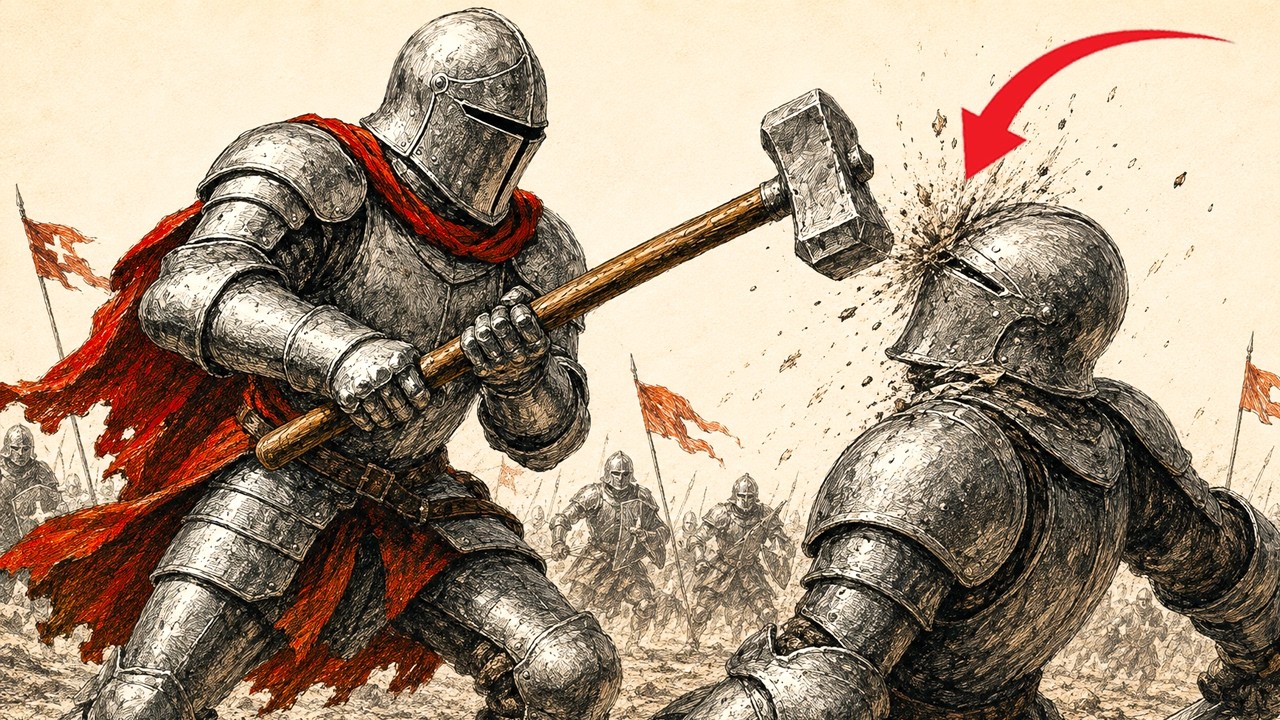
The reality of armored combat was brutal, pragmatic, and far removed from the romanticized versions seen in films. Between roughly 1350 and 1500, armor became so sophisticated that it effectively defeated the sword. A complete suit of high-quality plate, often costing as much as a small farm, could turn a well-equipped fighter into a walking fortress. Swords would glance off the curved steel plates, leaving only scratches.
To kill an armored opponent required weapons designed specifically to overcome this protection: the war hammer, the poleaxe, and the heavy mace, along with a dagger used to finish a downed foe. These weapons were seen as ugly and practical, like agricultural tools. A war hammer, about three feet long with a steel head weighing around two and a half pounds, was designed not to pierce armor but to deliver a concussive shock. A heavy blow to a helmet could cause a concussion, stunning the wearer even if the steel did not break.
The poleaxe, a five-foot staff with an axe blade, hammer face, and spear point, was a preferred weapon for knights fighting on foot, and entire fencing manuals were dedicated to its use. The start of a major battle was a cavalry charge, with knights using lances designed to be used once and shatter on impact. After that first clash, the battle devolved into a dense, confusing melee. The primary target for infantry facing a knight was often the horse; a dead or wounded horse would throw its rider to the ground, leaving the heavily armored man vulnerable.
The dust and noise were so intense that visibility dropped, formations broke apart, and men could not distinguish friend from foe. For two armored men fighting on foot, their confrontation lasted about 90 seconds. It was less a duel and more a grappling match. Fighters aimed for the joints, such as the knees, where armor had to be thinner to allow movement and where force could be transferred directly to the bone.
A skilled fighter would use his weapon to unbalance his opponent, close the distance, and take the fight to the ground. Once a man in full plate armor was on his back with an opponent on top of him, he was finished. The actual killing blow was delivered with a rondel dagger, a stiff, narrow blade with a needle-like point. The winner would find a gap in the armor, often at the visor, armpit, or groin, and drive the dagger in.
At the Battle of Agincourt in 1415, many French knights were killed in this manner by English soldiers, including common archers, who moved among the fallen and dispatched them through the gaps in their helmets. Contemporary chroniclers described French nobles being slaughtered by the most lowly of Englishmen with knives while they lay on the ground, unable to rise. The medieval economy of war was driven by ransoms, not slaughter. A captured noble was a valuable asset.
He was treated well, housed, and fed while messengers were sent to his family with a bill. Ransom amounts could be so high that entire estates were mortgaged to secure a captive’s release. The most famous ransom was that of King John II of France, captured at the Battle of Poitiers in 1356; his ransom was three million gold crowns, roughly double France’s annual royal revenue. This economic reality is why a weapon like a war hammer was so important: a skilled fighter could disable an opponent without killing him, allowing the victor to decide on the spot whether the man on the ground was worth more alive or dead.
Survivors of a battle faced the grim aftermath. The first people to enter the field were not medics or priests, but looters—soldiers, camp followers, and local peasants—who stripped the dead of their valuable armor and weapons. Wounded men who could not prove they were worth a ransom were often killed quickly, not out of cruelty but out of simple economics. The victors who were captured and ransomed returned home, while the dead were often buried in mass graves, their armor sold in markets.
The chivalric image of the knight with a shiny sword is a romantic fabrication. It was largely constructed in the 19th century by writers, painters, and architects such as Sir Walter Scott and the Pre-Raphaelites, who reshaped the raw material of the Middle Ages into a world of sparkling weapons and moral clarity. The true knight was a professional worker of violence, clad in expensive engineering. He carried the sword for social standing, but he used the war hammer and the dagger for his actual work.
In fact, a significant portion of surviving medieval fencing manuals, written by masters like Fiore dei Liberi and Hans Talhoffer, focuses on grappling, dagger fighting, and how to defeat an armored opponent by throwing him to the ground. Popular history and film have shown the wrong half of this story for a century. The true image of a late-medieval armored fight is not an elegant duel. It is a large man using a heavy tool against another large man in the dust, at close range, until one of them stops moving.
The sword survived in paintings, which were made by people who had never fought, while the war hammer survived in the earth, in fighting manuals, and in the records of ransoms.