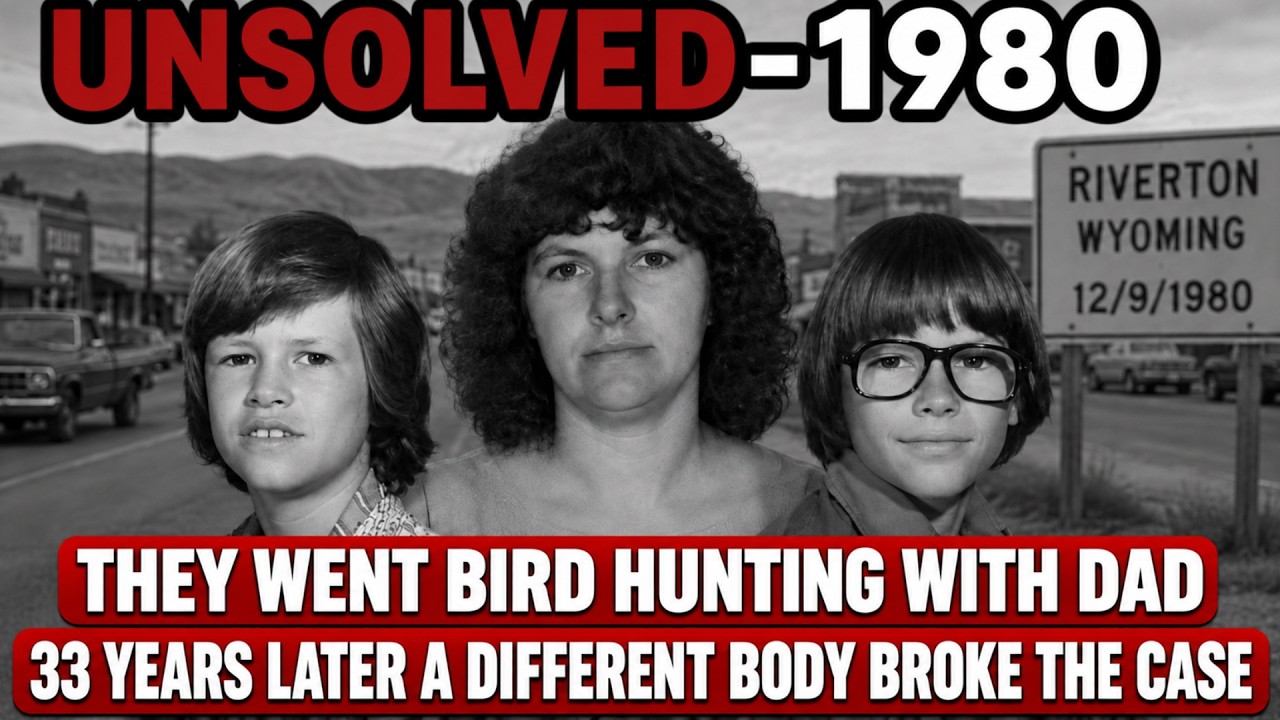
On the afternoon of September 12, 1980, Virginia Uden drove her mother’s family car out of Riverton, Wyoming, with her two sons, Richard, 11, and Reagan, 10. They were on their way to meet her ex-husband for a bird hunting trip. A .22 caliber rifle was in the car. Virginia was 32 years old and had just moved to Fremont County to be closer to her mother. The three never arrived at the meeting point.
Three weeks later, the car was found at the bottom of Trout Creek Canyon, 75 feet below the rim, covered with pine branches. Someone had tried to push the vehicle over the edge, but it got caught on rocks. The seats were soaked with Virginia’s blood. There were no bodies and no trace of the boys.
The only suspect was Gerald Uden, the ex-husband who had arranged to pick up the children for the hunting trip that day. He said they never showed up. The case went cold.
For 33 years, Gerald Uden lived free. He remarried, moved to Missouri, and aged in peace. The truth only emerged after the discovery of a body from another murder at the bottom of an abandoned gold mine, the unearthing of a secret from 1974, and a fatal misunderstanding that made Gerald open his mouth.
This is the story of Wyoming’s oldest unresolved criminal case. It is about a mother and two sons erased from the face of the earth, and the thread connecting two murders six years apart, committed by the same husband and wife.
But this story does not begin on the day they disappeared. It begins six years earlier, when Alice Uden shot her third husband while he slept.
—
Gerald Lee Uden was born in 1942 in Wyoming. He was an ordinary man, so unremarkable he was nearly invisible in the small Fremont County community. He worked as a maintenance man at the local iron mine, with steady shifts and an hourly wage. Three marriages, three divorces. Investigators who later examined Gerald’s background noted he had no criminal record, no history of violence, and no documented signs of mental illness.
Nothing in his past suggested he would kill three people.
Fremont County, where Gerald lived and where the three victims disappeared, sits in the middle of Wyoming. It spans more than 23,000 square kilometers, larger than some eastern states, yet has fewer than 40,000 residents. This is a land of vast valleys, where the Wind River Range runs along the western edge and small towns are separated by dozens of miles of dirt roads. Landers, Riverton, Pavilion. Names most Americans have never heard.
Here, neighbors live five miles apart and never see each other’s faces. Here, a family could disappear in the middle of the afternoon and no one would notice until someone started asking questions.
—
Gerald’s third wife was Virginia Uden, about 32 years old in 1980. Virginia had two sons from a previous marriage: Richard Lauren Uden, 11, and Reagan Cordell Uden, 10. Gerald was not their biological father, but he had legally adopted both boys. When the marriage to Virginia ended, Gerald did not just lose a wife. He took on financial obligations for two children with no blood connection to him.
Child support: $150 a month. On a miner’s wages in Wyoming in the late 1970s, that was not a small amount. This number would haunt the entire case.
Then Alice appeared.
Alice Brantley was born March 8, 1939. When she arrived in Fremont County in 1976, she was 37, had been married three times, had five children, and was looking for what she called a fresh start. Alice’s biography mirrored Gerald’s. Same number of divorces, same exhaustion, same desire to find someone who would stay.
But Alice carried something Gerald did not know about. A secret.
That secret involved her third husband, Ronald Holtz, a U.S. Army veteran who was 25 years old when he disappeared in late 1974 or early 1975. No one ever found Holtz. Alice filed for divorce in February 1975 and was granted it by default because her husband could not be located to serve papers.
In rural western America in the 1970s, men disappearing was not unusual. People left, changed their names, started over in another state. No one looked for deeper reasons.
—
Gerald met Alice and saw everything he was looking for. Investigators later described Alice as the perfect partner for Gerald. Independent, resourceful, good at managing a farm, able to fix things, self-reliant. Five months after meeting, they married. It was noticeably quick, but in Pavilion, Wyoming, no one commented.
They bought a farm and began building their life together. Two people who had failed three times at marriage had finally found each other. From the outside, it was a story of two lonely people finding a late refuge.
But there was a problem the new marriage did not solve. That problem had a name: Virginia Uden.
Every month, $150 left the household budget of Gerald and Alice. A coworker at the mine later said Alice constantly complained that Gerald had no money because he had to support Virginia and the children. The $150 was not just a financial burden. It was an uninvited presence of the ex-wife in the new marriage.
According to author Ron Franscell and investigators, Alice began applying pressure. Virginia was using the children to demand more money. Virginia was trying to drive them apart. Virginia was a problem that needed a solution.
Gerald was trapped between two women. On one side, the new wife he loved and feared losing. On the other, the old wife he resented and owed money to.
In the summer of 1980, Virginia, Richard, and Reagan moved to Lander, Wyoming, near Virginia’s mother, Claire Martin, in Riverton. Suddenly, the ex-wife was no longer just a name on a monthly check. She was there, in the same area, within the same residential range as Gerald and Alice.
For Alice, that was unacceptable.
—
Claire Martin, Virginia’s mother, lived in Riverton. She was the type who kept track of everything. She knew her daughter’s schedule and knew where the children went. She was the first to notice something was wrong. She was the one who called the police, and she was the one who refused to stay silent when everyone else gave up.
Claire Martin began to worry on the evening of September 12. Virginia said she would return after the bird hunting trip, but darkness fell and there was no sign of her daughter or grandsons. She called. No one answered. She called again. Still silence.
The next morning, she called Gerald Uden. He picked up the phone and said the same sentence he would repeat for the next 33 years: “They never showed up.”
Gerald said Virginia and the boys never reached the meeting point. He waited, saw no one, and went home. His voice was normal. No worry, no urgency, not even a question about what might have happened to them. Just one statement. They never came.
Mrs. Martin did not believe him. She knew her daughter well. Virginia was not the type to leave without a word. Virginia was not the type to disappear overnight without calling her mother, nor the type to cut two young children off from their grandmother for no reason.
Something was wrong. Mrs. Martin knew it in her gut, the way only a mother knows. She called the Fremont County Sheriff’s Office. From that moment, Claire Martin entered the longest battle of her life.
—
The police began searching, but in Fremont County in 1980, the search did not look like what you see on television. No traffic cameras, no cell phones to track, no GPS, no digital data to analyze. Just 23,000 square kilometers of vast land, dirt roads connecting towns dozens of miles apart, and total silence.
Officers asked a few neighbors. No one had seen anything. They checked a few roads. No trace. They logged the disappearance and waited, because people in rural western America sometimes disappear and then come back on their own. Sometimes a wife left her husband, took the children, and started a new life in another state.
But Mrs. Martin knew her daughter had not run away. Virginia had no reason to flee. She had just moved to live near her mother. She had a job. She was building her own life in Lander. And most importantly, Virginia would never abandon her mother without a word. Never.
Three weeks passed. Three weeks with no call, no sign, no clue. Then, on October 4, 1980, something was discovered.
Claire Martin’s 1973 Ford station wagon, which Virginia had borrowed that day, was found in Trout Creek Canyon in the Wind River area of Fremont County. The car was resting 75 feet below the cliff edge, caught on a rocky ledge, covered with pine branches. Someone had tried to push the car into the canyon bottom. If the car had fallen completely, it might have remained undiscovered for years in that rugged terrain.
But the car refused to fall. It caught on a rock outcropping and stopped halfway down. Then someone covered it with pine branches to hide it. It was a hasty, sloppy attempt, but enough to show this was no accident. This was concealment.
When officers opened the car doors, they found blood. A lot of it. Tests confirmed it was Virginia Uden’s blood. This was not a minor cut or a nosebleed. The amount of blood on the seats and inside indicated someone had been seriously injured inside or near the car. The kind of injury people do not usually survive.
But there were no bodies. Not Virginia, not Richard, not Reagan. Three people, and their bodies, if they had died, had vanished completely from the face of Fremont County. All that remained was blood, pine branches, and a car someone desperately wanted never to be found.
—
Everything pointed in one direction. Gerald Uden. He was the last person with an appointment to meet Virginia and the boys that day. He was the ex-husband with child support obligations. He was the only one the entire Martin family suspected from the first moment. And he was the only one with an answer.
That answer never changed. They never showed up.
On November 14, 1980, about two months after the three disappeared, police went to Gerald and Alice Uden’s home for a formal interview. It did not last long. Alice was highly emotional, crying and saying she knew nothing. She did not understand what had happened to Virginia and the children.
Gerald’s reaction was different. When Claire Martin was present at the interview and accused him directly, Gerald became physically ill. He vomited. He ended the interview.
No lawyer was called. No arrest warrant was issued. The officers left empty-handed.
They suspected Gerald. Everyone suspected Gerald. Claire Martin looked him directly in the eyes and said she knew what he had done. But suspicion is not evidence. And that was exactly the wall the case hit.
The absence of bodies meant no direct physical evidence of murder. The blood in the car proved someone had been injured, but legally, blood does not prove someone died. No witnesses saw Gerald with Virginia that day. No murder weapon was found. No confession, no holes in the statements, no part of Gerald’s story the police could grab and dismantle.
Gerald said they never came. He stuck to that. Alice said she knew nothing. She stuck to that. Two people, one story, and not a single gap.
Gerald and Alice’s silence was more effective than any defense team in America. They did not need complex denials, elaborate excuses, or fabricated details that could be disproven. They only had to say, “I don’t know.” Then stay silent.
—
The case began to die. Not by official decision, not by a closure announcement. It died the way most cold cases die. Slowly, quietly, and with each passing week without new evidence, another layer of dust settled on the file. Eventually, the file settled into a drawer and no one opened it again.
Virginia Uden, 32. Richard Uden, 11. Reagan Uden, 10. Three people who disappeared in the middle of a September afternoon in Wyoming.
In the months following the case freezing, Gerald and Alice Uden made a decision that in hindsight looks like the behavior of people with something to run from. They left Wyoming. Not immediately, not in the middle of the night with hastily packed bags. They sold the farm in Pavilion, packed up their lives, and moved to Chadwick, Missouri, a small town in the Ozark Mountains with a few hundred residents.
Far enough away that no one in Missouri knew about a missing family in Wyoming. Far enough to start over without questions.
Gerald became a long-haul truck driver, a job that kept him on the road for weeks at a time. Alice stayed home, raised the children, and lived the quiet life of a middle-aged woman in a small American town. They went to church. They greeted neighbors. They paid their bills on time.
If you had met Gerald and Alice Uden in Chadwick at any point over the next three decades, you would have seen an ordinary elderly couple. He worked on cars in the garage. She cooked for grandchildren. They aged slowly, hair graying, backs bending, like millions of American couples living out their final years in peace.
No one in Chadwick asked about their past in Wyoming. No one knew. And Gerald and Alice told no one.
—
But in Fremont County, the story did not end so simply. Claire Martin did not leave. She did not move to another state, did not start over, did not accept that her daughter and grandsons were gone forever. She stayed in Riverton and kept asking.
She asked the Fremont County Sheriff’s Office. She asked the county attorney’s office. She called, wrote letters, showed up in person, and sat waiting in hallways until someone would talk to her. The question was always the same. Is there anything new? Any evidence? Is anyone doing anything?
The answer was always the same. Nothing new, no new evidence, no new witnesses. We are very sorry.
Year after year. Every time Mrs. Martin asked, she received the polite silence of a system that had run out of options. But she did not stop. She could not. That was her daughter. Those were her grandchildren. And she knew, with a mother’s certainty, that Gerald Uden had done something to them.
She had no evidence. She only had her instinct. And that instinct kept her going for decades.
—
In Lander, the small community where Virginia once lived, people whispered. In cafes, grocery stores, and church parking lots, people talked about the Uden family in hushed voices. Everyone had a theory. Everyone thought Gerald did it. But thinking and proving are two different things in Wyoming, where the land can swallow evidence and never give it back.
People talked, then forgot. Life went on. Children grew up, went to school, left town. Adults aged, retired, died. The community changed slowly. And the case of Virginia Uden became one of those stories people tell new neighbors when they run out of things to talk about. That local mystery everyone knows about but no one can solve.
But there was one person besides Claire Martin who did not forget. At the Wyoming Division of Criminal Investigation, known as the DCI, an investigator named Andy Hansen kept the case file open. Hansen was not assigned to the case from the beginning. He picked up the threads when others dropped them and refused to let go.
For years, Hansen gathered every scattered piece of information he could find. He reviewed old files. He talked to people who lived in Fremont County in 1980. He looked for connections between Virginia’s disappearance and other unsolved cases in the area. He made no breakthroughs. He had no strong new evidence to reopen a formal investigation.
But he had patience. And in investigative work, patience is sometimes the only thing that keeps a case from dying completely.
—
Time passed as it always does when nothing happens. Slowly and mercilessly. Five years after the disappearance, Richard Uden would have been 16, learning to drive and playing ball in high school. Reagan would have been 15, perhaps starting to think about the future, about college, about a life outside Wyoming. Virginia would have been 37, still young, her whole life ahead of her.
Ten years later, Richard would have been 21, maybe a college graduate. Reagan 20, and Virginia 42. But none of those possibilities became reality. They did not grow up. They did not age. They froze at ages 11, 10, and 32 forever, while the world around them kept moving without them.
Fifteen years, twenty years, and Claire Martin still asked. The police still had no answers. Gerald and Alice still lived quietly in Missouri, and the distance between crime and justice widened every year like a crack in dry earth.
Evidence did not get newer. It only got older. Memories did not get clearer. They faded. Potential witnesses did not appear. They died or forgot. Every passing year was a small victory for Gerald and Alice, and a small defeat for Claire Martin and Andy Hansen.
—
In 2000, 20 years after the disappearance, Gerald Uden was 58 and Alice was 61. They had lived in Missouri longer than they had lived in Wyoming. The past in Fremont County seemed like another life, lived by two different people in a different era.
Gerald still drove trucks. Alice still lived the life of a grandmother in Chadwick. If you asked their Missouri neighbors, they would say they were a nice old couple living at the end of the road. He was quiet. She was independent. They never bothered anyone.
No one in Chadwick knew that four bodies were waiting underground in Wyoming, in two abandoned gold mines and at the bottom of a lake more than 180 meters deep. No one knew that the nice old couple carried the secret of four murders between them. Four people erased from the face of the earth by two different sets of hands that slept in the same bed every night.
Gerald and Alice bet their entire lives on time finishing what silence had started. That Wyoming would forget. That Claire Martin would tire and stop. That Andy Hansen would retire and the file would close. That the earth would keep its secret and the water would keep its secret, and that no one would dig in the right place or ask the right question.
They were almost right.
—
In 2005, 25 years after Virginia and her sons disappeared, the Wyoming Division of Criminal Investigation decided to reopen the file. The decision did not come from a breakthrough or new evidence. It came from the persistence of people like Andy Hansen, investigators who kept the case alive in their minds even when the file was dead in a drawer.
Hansen spent years connecting scattered pieces and asking questions no one wanted to answer. He looked at the bigger picture, of which Virginia Uden’s disappearance was only a part. That bigger picture included a name most people had long forgotten: Ronald Holtz.
Remember that Holtz was Alice’s third husband, the 25-year-old veteran who disappeared in late 1974 or early 1975 in Cheyenne. Alice got a default divorce. No one ever found Holtz. No one asked for more.
But Hansen asked. While reviewing the complete history of Gerald and Alice Uden, Hansen realized Alice had a previous husband who was never found, that Holtz disappeared under circumstances no one had investigated, and that the disappearance happened only six years before Virginia and the boys vanished.
Two disappearances, two people connected to the same family, six years apart. That was not evidence, but it was the kind of coincidence a good investigator never ignores.
—
On January 18, 2005, a team from the DCI made an unannounced visit to Alice Uden’s home in Missouri. Gerald was on the road, driving a truck somewhere across America. Alice was home alone.
The interview began gently. Investigators asked about life in Wyoming, about time in Fremont County, about Virginia and the boys. Alice answered quietly and politely. The answers of a 65-year-old grandmother drinking tea in her living room. She said she knew nothing about Virginia’s disappearance. She said she felt sorry for the family, but had no information to offer.
Her voice was steady. Her eyes were dry. Twenty-five years of practicing silence had built a wall the investigators could not breach with polite questions.
Then they mentioned the name Ronald Holtz.

Alice’s reaction was something investigators would remember for years. According to what they later told the program “Killer Couples,” Alice fell off her chair. Not figuratively. She lost her balance and nearly fainted. Her body betrayed her mind in a moment where 25 years of self-control was not enough to hide anything.
The name Ronald Holtz hit her like a blow to the stomach, the kind you do not see coming and cannot prepare for.
After she regained her composure, Alice offered an explanation. She said that years earlier, she had told her son a story about Holtz, that she had gotten rid of him. But that story, Alice said, was just a cautionary tale for the child, the kind of threat mothers make to teach their children to stay out of trouble. She had not actually done anything to Holtz. She simply kicked him out and moved on with her life.
The investigators did not believe her. But disbelief and proof remain two different things, exactly as it had been 25 years earlier. Fremont County deputies did not believe Gerald, but they could not prove anything.
Alice remained calm for the rest of the interview. She said nothing else of value. The investigators left with deeper suspicions but still empty-handed. Another dead end.
—
Three years later, in 2008, more efforts were made in Fremont County. This time the goal was to find bodies. An archaeologist from the University of Wyoming led a team of eight students to Pavilion, where Gerald and Alice once lived, to dig around an old pig barn on the farm. There was information suggesting Gerald may have hidden the bodies near the home before moving them elsewhere.
For days in the hot summer, the archaeology team dug into the ground, sifting through sand, looking for anything. A bone fragment, a scrap of fabric, a sign that the earth here had been disturbed to bury someone. They found nothing. The pig barn and the wing held no secrets, or if they did, they kept them with a force that shovels and human hands could not overcome.
The excavation team packed up and left. The case remained cold.
But Andy Hansen did not stop. He continued connecting pieces, placing the two disappearances side by side and pondering the gap between them. Virginia Uden disappeared in 1980. Ronald Holtz disappeared in 1974. Both connected to the same couple. Both vanished without a trace in Wyoming. Both were never found. And both had been married to one of these two people.
Hansen realized that if he found Holtz, it might pull everything else with it. Holtz was the easier link because there was a witness: Alice’s son, whom she had once told the story of getting rid of her ex-husband. If they found Holtz’s body and proved he was murdered rather than simply leaving, Alice’s cautionary tale would collapse. And when Alice collapsed, Gerald might collapse with her.
That was the theory. And in August 2013, that theory became reality.
—
DCI investigators conducted excavations at Remount Ranch, a wilderness area between Cheyenne and Laramie containing abandoned gold mines from the 19th century. At a depth of about 40 feet in an old gold mine, they found what they had been looking for for nearly 40 years. Human remains inside a barrel.
Forensic examination confirmed they belonged to Ronald Holtz. Cause of death: a small-caliber bullet fired into the back of the head. The .22 caliber bullet remained inside the skull, resting there for nearly four decades, waiting to be found.
Stop at this discovery for a moment. Remember the beginning, when Alice Brantley arrived in Wyoming in 1976 with the story that her ex-husband Ronald Holtz had simply left. Remember that she obtained a default divorce because Holtz could not be found. Remember that no one asked for more because men disappearing was not unusual in the West.
Now the truth emerged. Ronald Holtz did not leave. His wife shot him in the back of the head while he slept in their bed in Cheyenne. Alice stuffed his body into a barrel, drove to the wilderness, and dropped him into an abandoned gold mine 40 feet deep. Then she went home, cleaned the bedding, filed for divorce, and started her life over as if her husband had simply walked out the door and never returned.
She lived with this secret for 39 years. Thirty-nine years with Ronald Holtz’s body lying in the darkness beneath Wyoming’s soil, the bullet still in his skull, waiting for someone to dig in the right place.
And now, someone had dug in the right place.
Alice’s reaction when she heard Holtz’s name in 2005, that fall from the chair, suddenly took on entirely new meaning. That was not the reaction of a woman asked about an ex-husband who had left. That was the reaction of a killer hearing her victim’s name from the mouth of police for the first time in 30 years.
—
In September 2013, authorities in Christian County, Missouri, arrested Alice Uden at her home. She was 74 years old, with gray hair and a small frame, looking like any grandmother you might meet in a store. She was charged with first-degree murder in the death of Ronald Holtz nearly 40 years earlier. She was placed in a police car, handcuffed, and driven away.
The news spread. Gerald Uden, 71, was at home when he learned his wife had been arrested. And here, at this exact moment, the Uden family story was about to take a turn no one expected. Not even Gerald. Not even the investigators.
Gerald knew Alice had been arrested. The question was, what did he think she was arrested for?
Gerald Uden did not understand why police arrested Alice, but he thought he understood the reason. And that misunderstanding would destroy him.
When investigators came to the home in Chadwick, Missouri, after Alice was taken away, Gerald voluntarily said he wanted to talk. He did not ask for a lawyer. He did not ask what Alice was charged with. He simply said he wanted to explain.
Investigators later said Gerald seemed to believe Alice was arrested for the Virginia Uden case, that police had somehow connected Alice to the 1980 disappearance, and that he needed to confess to protect his wife from that charge. He did not know Alice was arrested for Ronald Holtz, for the body under the gold mine, for the .22 caliber bullet in her ex-husband’s skull.
He did not know that at that moment, police had no direct evidence linking him to the Virginia case. He walked voluntarily into the interrogation room and opened his mouth because of a misunderstanding.
That was the moment 33 years of silence collapsed. Not because police solved the case. Not because of new technology. Not because a witness suddenly appeared after three decades. But because Gerald Uden loved Alice Uden enough to take the blame for her. And he did not know she was charged with a completely different murder.
—
Gerald’s statement in the interrogation room that day was recorded. The recording was later shown on Oxygen’s “Killer Couples.” His voice was monotone, without emotion, without hesitation. He described killing his ex-wife and two adopted sons in the tone of a man recounting a job completed long ago. The tone of voice you use when talking about fixing the roof last summer.
Gerald said he met Virginia and the boys on September 13, 1980, at the meeting point near Pavilion. Virginia drove her family’s station wagon there. Richard and Reagan in the back seat. A .22 caliber rifle in the car for bird hunting.
Gerald said he drove all three to a remote area in Fremont County. A dirt road, open grassland, no house in sight. All four got out of the car. Gerald took the rifle, the rifle Virginia brought, the rifle the boys thought would be used for bird hunting.
He shot Virginia first, in the back of the head. Then Richard. Then Reagan.
He told the investigator literally on the recording: “Virginia was there, and the gun was there. I shot her right in the middle of the back of her head.”
Ten seconds and they were gone. Ten seconds, three shots. A 32-year-old mother and two children aged 11 and 10 in a Wyoming field on a September afternoon, under a sky where Richard and Reagan thought they would be hunting birds with their father.
When investigators asked about motive, Gerald offered several accounts. He said Virginia had become unbearable. He said she used the children to create a wedge between him and Alice. He said he had to choose between the two women.
But on the recording, he also said something more direct than all those justifications: “I got no pleasure out of doing it, none at all, but it ended the child support payments.”
$150 a month. That was the price Gerald Uden placed on three human lives.
According to author Ron Franscell and investigators, Alice played a much larger role than Gerald admitted. Alice turned Virginia into a problem Gerald had to solve. She complained constantly. She applied pressure. She issued an ultimatum. Get rid of Virginia or I will leave.
Gerald could not lose another wife. He had failed three times before. He could not afford a fourth failure. And he solved it the only way he could think of. Three bullets in three heads in less than 10 seconds.
—
Gerald continued describing the part police never knew for 33 years. What he did with the bodies.
After shooting them all, he temporarily hid the bodies in an abandoned gold mine near Pavilion. The kind of mines scattered across the hills of Fremont County. Deep, dark, visited by no one. That was a temporary measure. Gerald returned later, retrieved the bodies, and took the next step.
He placed Virginia inside a 55-gallon steel barrel. He punctured the barrel or shot it so it would sink. As for Richard and Reagan, small enough to fit together, he stuffed them into a 35-gallon steel trash container.
Gerald transported the containers to Fremont Lake near Pinedale, about 75 miles northwest of the crime scene. Fremont Lake is the deepest natural lake in Wyoming, over 180 meters deep, cold year-round, with a black bottom. The kind of lake where nothing that sinks floats back up on its own.
Gerald pushed the containers beneath the surface and watched them disappear into the darkness.
Then he dealt with the car. He drove Claire Martin’s 1973 Ford station wagon to Trout Creek Canyon and tried to push it over the edge. The car caught on rocks 75 feet below the rim. Gerald covered it with pine branches and left.

He disposed of the rifle. He returned home, to Alice, and continued his life as if that evening had never happened.
—
Gerald Uden was charged with three counts of first-degree murder on September 27, 2013, by the Wyoming Division of Criminal Investigation. Both Udens, both over 70, were held in Christian County, Missouri, pending extradition to Wyoming.
On November 1, 2013, in a Lander courtroom in Fremont County, Gerald Lee Uden pleaded guilty to three counts of first-degree murder. Before Judge Norman Young, he repeated what he had told investigators. He said Virginia had become unbearable. He said he had no justification. He said he placed the bodies in containers and sank them in the lake.
Judge Young said he agreed there was no justification. Gerald Uden was sentenced to three life sentences. He was 71 years old.
Alice’s trial followed in May 2014 in Laramie County District Court in Cheyenne. She was tried for the murder of Ronald Holtz nearly 40 years earlier. Prosecutor Scott Homar presented the evidence. Holtz’s body in the gold mine, the .22 caliber bullet in the skull, and the account of Todd Scott, Alice’s son, that his mother once confessed to killing Holtz while he slept.
Alice’s defense team presented a different story. Holtz was violent, aggressive, and unpredictable, and had threatened to kill Alice and their two-year-old child. Alice shot him not because she wanted to kill, but because she feared for her life. Self-defense.
The jury weighed both accounts. They found Alice Uden guilty of murder, but not first-degree murder. The jury rejected the first-degree charge and convicted Alice of second-degree murder.
The defense attorney requested a suspended sentence. Prosecutor Homar demanded a minimum of 20 years. The judge chose the harsher option: life in prison.
Alice Uden, 75, was committed to the Wyoming prison system. She and Gerald were both held at the Wyoming Medium Correctional Institution in Torrington. The couple who shared the secret of four murders for over three decades now shared the same prison.
—
Alice Uden died on June 12, 2019, at Regional West Medical Center in Scottsbluff, Nebraska. She was 80 years old, suffering from chronic health problems. She had been transferred from Torrington prison to the hospital one day before her death. She served five years in prison, from age 75 to 80, and never tasted freedom again.
News of Alice’s death reached Gerald in the same prison. What happened next showed that the Uden couple’s story was not as simple as the confession suggested.
Two days after Alice’s death, Gerald Uden wrote a letter to Ron Franscell, author of the book “Alice and Gerald: A Fatal Love Story,” who had researched and written about the case for years. In the letter, Gerald recanted his full 2013 confession.
He said he did not kill Virginia, Richard, and Reagan. He claimed Alice was the one who killed them. He said he confessed only to protect Alice. When police came to the house in Missouri in 2013, he feared Alice would be charged with both murders, Holtz’s and Virginia’s. So he took the Virginia case to lighten her burden.
He said now that Alice was dead, he was free to tell the truth. And the truth was that Alice was the real killer in both cases.
Franscell, who spent years studying the case, wrote about the letter on his personal website. He reminded readers of what Gerald said in 2013. The detailed, cold, unrepentant confession describing three shots in 10 seconds with a strange pride. He reminded readers that Gerald provided details only the perpetrator could know: the shooting locations, the disposal method, the type of containers, which lake, the water depth.
And he pointed out one simple thing. If Gerald did not kill them, how did he know where the bodies were?
—
Gerald filed a petition with a Wyoming state court under the actual innocence statute, seeking to overturn his convictions and be released. The Fremont County District Court, presided over by Judge Jason Conder, reviewed the petition and denied it.
The reason: Gerald presented no new evidence. He merely resubmitted the trial transcript and his guilty plea. To be considered under this statute, a defendant must present new factual evidence proving innocence, not simply withdraw previous statements.
Judge Conder wrote in his decision that Gerald’s argument lacked any basis whatsoever.
Gerald appealed to the Wyoming Supreme Court. The Supreme Court denied the appeal. In their opinion, the justices noted that Gerald had confessed to the details of the crimes in open court, pleaded guilty voluntarily, and had legal counsel before entering the plea. One justice added in a footnote that with confessions this detailed presented in court, withdrawing statements after the wife’s death was not convincing.
Gerald Uden, now 84, continues to serve three life sentences at Torrington prison. He will die there.
—
But there is one part of the case that even court rulings could not resolve. Virginia, Richard, and Reagan Uden were never found. 46 years after their disappearance, their bodies remain in a place no one knows for certain.
Gerald provided different locations in successive statements. At first, he said he disposed of the bodies in the Pacific Ocean. Later, he said they were in Fremont Lake. He even participated in a trip to Fremont Lake under police supervision in 2013 with the Sublette County Search and Rescue team, who scanned the lake with side-scan sonar and thermal imaging drones. They found nothing.
In 2014, another search was conducted. They found nothing.
Fremont Lake is over 180 meters deep, cold year-round, with a black bottom, and a surface area of about 21 square kilometers. Finding two containers at the bottom of that lake is like finding two grains of sand on a beach in the dark.
Many in law enforcement began to believe Gerald was lying about the location of the bodies, that he was still playing psychological games from behind bars, and that the truth of where Virginia and the boys were would die with him.
—
Then in 2026, new efforts emerged from an unexpected direction. Stacy Koster, founder of the Wyoming-based search and recovery organization Wyofind in Gillette, began writing letters to Gerald Uden in prison. She told him directly about her goal. She wanted to bring Virginia, Richard, and Reagan to their final resting place in peace.
At first, Gerald denied any involvement. Then he changed his story, providing more precise details about the location in the lake.
In 2026, Bill Dodds, head of the nonprofit search and rescue organization, launched a campaign called “Operation Cold Stream,” the first major search of Fremont Lake in over a decade. Dodds’ team brought more modern technology than any previous search. Underwater drones, next-generation sonar, and high-resolution scanners of the lakebed. They scanned the lake at depths previous searches had never reached.
At a depth of 388 feet in the dark lakebed, they found a barrel. The barrel was sealed, and its surface appeared to have holes resembling bullet marks. Near it, at a slightly greater depth, they saw what might be the remains of a small trash container.
Two containers, exactly as Gerald described. A 55-gallon barrel for Virginia, and a trash container for the boys.
For the first time in 46 years, something at the bottom of Fremont Lake matched Gerald’s statements. The news spread across Wyoming. The victim’s family held hope. The community held hope. The search team held hope.
—
On August 29, 2026, after weeks of preparation, Dodds’ team extracted the 55-gallon barrel from the lakebed. They struggled against harsh conditions using a special hook device designed and built by Dodds and colleague Dave Sparks themselves to pull the barrel from nearly 400 feet below the surface. The barrel reached the surface that evening. It was delivered to Erin Ivey, the Fremont County coroner, for forensic examination.
Two days later, on August 31, 2026, Ivey announced the results. No human remains were found inside the barrel. Only a small amount of lakebed sediment. The barrel was empty.
46 years of hope, weeks of searching the bottom of Wyoming’s deepest lake, the latest technology, and an extensive volunteer campaign. The result was an empty barrel on the shore of Fremont Lake.
The search team said the trash container had not yet been recovered and might contain the remains of Richard and Reagan. The coroner’s office pledged support if another campaign followed. But at this moment, Virginia, Richard, and Reagan Uden have still not come home.
—
The Uden case inspired a true crime book titled “Alice and Gerald: A Fatal Love Story” by Ron Franscell, a former Wyoming newspaper editor who knew both Virginia and Amy Bethal, another woman who disappeared in Lander and whose case remains unsolved. The story was adapted into a documentary on Oxygen’s “Killer Couples” series.
It became Wyoming’s most famous unsolved criminal mystery. Proof that time does not erase crime, that silence is not an eternal fortress, and that the perpetrator sometimes destroys himself through a misunderstanding.
But it is also a reminder that justice has limits. Gerald Uden was convicted. Alice Uden was convicted. Both died or will die in prison. But Claire Martin never learned what happened to her daughter and grandchildren. She was never able to bury them. She never found a place to put flowers.
And Richard and Reagan, aged 11 and 10 when their adoptive father shot them in a Wyoming field, remain somewhere in the darkness. Perhaps at the bottom of Fremont Lake. Perhaps somewhere no one has touched for 46 years.
—
On September 12, 1980, Virginia Uden drove a 1973 Ford station wagon away from her mother’s home in Riverton at 1:30 in the afternoon. Richard sat in the back, 11 years old. Reagan beside him, 10. A .22 caliber rifle in the car. They were on their way to hunt birds with their father.
Midday light in Fremont County. Wind blowing across the valley. Pastures stretching to the horizon. Three people in one car on their way to meet the man the boys called father.
They never came home.