The spring of 1945 found the war in Europe dying in great, grinding spasms. The Third Reich was shrinking with each passing day as Allied forces pushed deeper into its collapsing heartland. At the tip of the spear stood General George S. Patton Jr., commanding the United States Third Army with his trademark ivory-handled pistols and a jaw set like iron.
Patton was not a patient man, nor was he known for tolerance of pretension. He was known for winning. So when a German officer walked into his presence and announced he considered himself Patton’s equal, the response was swift and telling. The German clicked his heels, drew himself to full height, and waited. Patton looked at the man’s rank insignia and laughed.
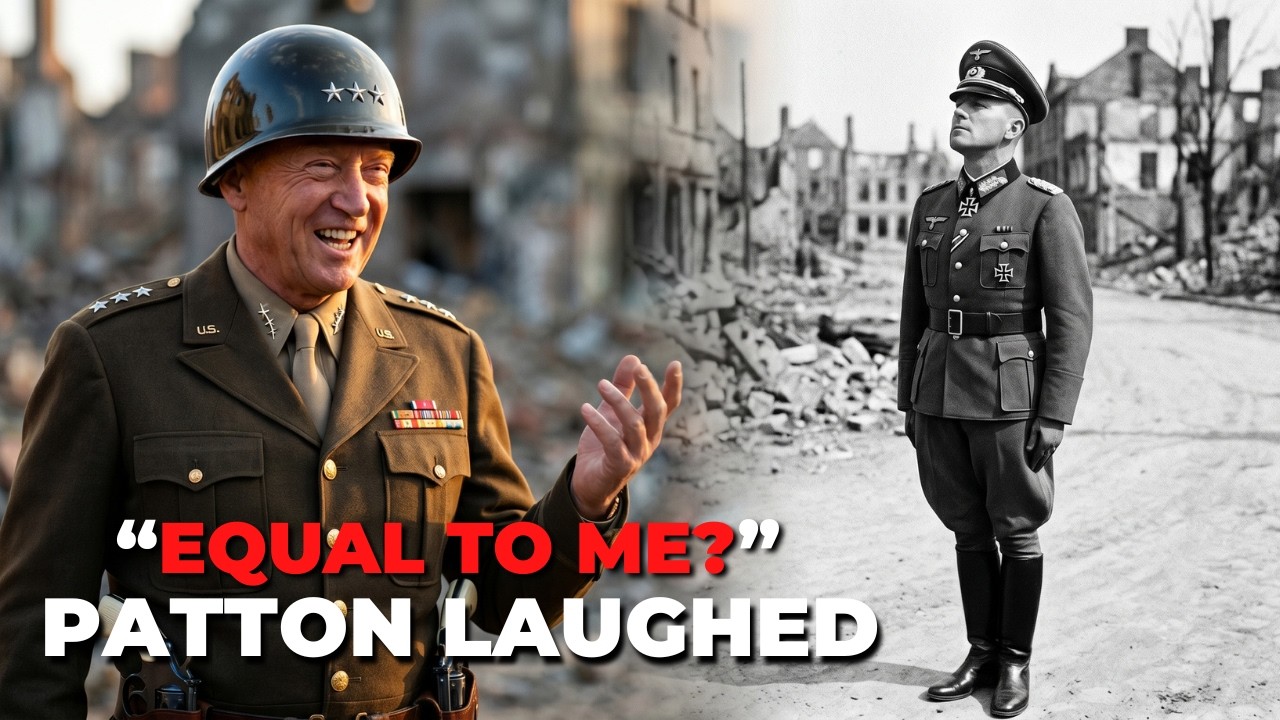
To understand why this moment has endured, you must understand the two military cultures colliding in that encounter. The German officer corps was the product of a Prussian aristocratic tradition stretching back centuries. Its rigid hierarchies and ceremonial precision were a language of their own, communicating professionalism and institutional superiority. By 1945, however, that tradition had been overwhelmed by forces it was never designed to withstand.
The Wehrmacht had been formidable. German commanders had executed breathtaking maneuvers in the early war years, from the Blitzkrieg through France to the armored thrusts into the Soviet Union. German tactical doctrine remains studied in military academies to this day. But by the spring of 1945, the gap had inverted entirely. American factories were producing tanks and aircraft in quantities that beggared comprehension. In 1944 alone, the United States produced roughly 17,500 tanks. Germany managed approximately 8,300.

Patton understood this arithmetic better than anyone. Born in 1885 into a family steeped in military tradition, he had spent four decades studying the nature of war. He competed in the 1912 Stockholm Olympics and built a command philosophy around a single conviction: speed was life, hesitation was death. When his Third Army became operational in July 1944, he drove it across France at a pace that covered 600 miles in about two months.
The German officer who stood before Patton carried the weight of a great military tradition and the ghost of an army that no longer existed. Patton carried an army of 300,000 men backed by the most powerful industrial nation on Earth. The heel click was a relic of a world that had already ended. The laughter was the most honest response available.

Patton’s greatest moment came in December 1944, when the Germans launched their last great offensive in the Ardennes. In approximately 72 hours, he pivoted roughly 250,000 men from an eastward axis to a northward one through winter conditions to relieve the besieged garrison at Bastogne. It was a logistical feat that most military planners considered impossible.
The war in Europe ended on May 8, 1945. Patton’s Third Army had advanced further and faster than any comparable force in the Western Allied armies. Patton himself died on December 21, 1945, following injuries from a car accident near Mannheim, Germany. He was 60 years old and was buried with his soldiers at the American Military Cemetery in Hamm, Luxembourg.
The German officer stepped into that room carrying rank. Patton carried a force of nature. One man was a designation. The other was history in motion. Patton laughed because in that moment, history was laughing too.