In 1861, a young German immigrant named Edward Frauenheim arrived in Pittsburgh with a brewer’s trade and a belief that American taverns were serving the wrong kind of beer. While most of the country drank heavy English-style ales and porters, he began brewing a lighter, crisper, cold-fermented lager and named it after the industry building the city around him: Iron City. It was reputedly the first lager brewed commercially in the United States. Demand was immediate.
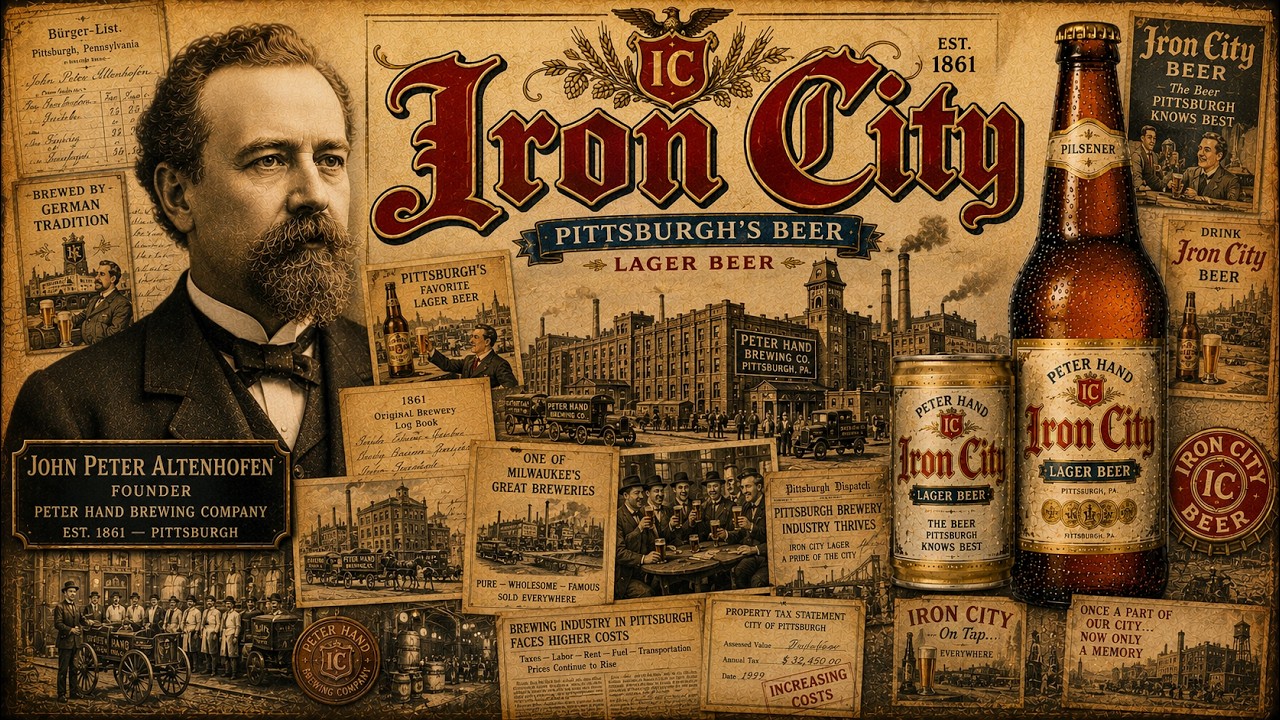
Within five years, Frauenheim’s original 17th Street brewery could no longer keep up, and in 1866 he moved the operation to a new site at the corner of Liberty Avenue and 34th Street in the Lawrenceville neighborhood. That four-story brick building would remain the company’s address for the next century and a half. A second building was added in 1869, and the firm eventually incorporated as the Iron City Brewing Company in 1889, becoming the largest brewer in Pennsylvania at roughly 200,000 barrels a year. By 1899, Pittsburgh’s crowded brewing industry was fracturing under its own weight.
Dozens of independent breweries were fighting for the same taps while national giants in St. Louis and Milwaukee were building scale no single local brewery could match. On February 9, 1899, 12 Pittsburgh-area breweries and nine more from outlying counties combined into a single company: the Pittsburgh Brewing Company. Iron City was the largest of them.
The merger produced one of the three largest brewing operations in the United States, with a combined capacity of over one million barrels a year. Under one corporate umbrella, most of the founding breweries eventually disappeared, with production consolidating at the most efficient site. By the 1980s, more than 80 years after the merger, only one of the original 21 breweries was still operating: Iron City. Iron City’s success was built on cultural loyalty as much as innovation.
In Pittsburgh, a shift-ending mill worker would order “an iron,” the brand name having replaced the product category in the local vocabulary. The beer became a fixture of Steelers culture, with its advertising built around the voice of longtime color commentator Myron Cope, a Pittsburgh-born broadcaster who helped popularize the Terrible Towel. The company also backed its identity with technical firsts. In 1962, Iron City became the first brewery in the United States to package beer in aluminum cans, a bet against the industry standard that eventually became universal.
It was also credited with introducing the twist-off bottle cap and draft beer packaged in cans, and later one of the earliest light beer products in the American market. The company’s survival through Prohibition set it apart as well. When the 18th Amendment took effect in 1920, Pittsburgh Brewing kept its Lawrenceville plant running by producing soft drinks, ice cream, near beer, and cold storage through a subsidiary. When Prohibition was repealed on December 5, 1933, Pittsburgh Brewing was one of only 725 breweries left standing in the entire United States, out of thousands that had existed before.
By the middle of the 20th century, Iron City was the bestselling beer in its own city, outselling every national competitor. But the company’s early technical advantages carried a hidden cost. A packaging breakthrough is a head start, not a permanent patent, and once national brewers had the capital to copy those innovations, they could outspend Pittsburgh Brewing on the advertising needed to make sure customers noticed. The fight had changed from a contest over product quality into a contest over who could out-advertise and out-distribute everyone else indefinitely at a national scale.
That need for capital opened the door to a series of outside owners. In 1986, Bond Brewing Holdings, controlled by Australian businessman Alan Bond, acquired the company. During that era, production fell from roughly one million barrels a year to around 500,000. By 1993, Bond’s own financial difficulties led him to give up the brewery, passing control to Pittsburgh entrepreneur Michael Carlo.
Carlo’s tenure ended in a courtroom when he was forced to relinquish control after being convicted on fraud charges. In September 1995, Pittsburgh native Joseph Pitterelli, representing an investment group called Keystone Brewing Company, gained ownership. A former industry insider who worked at the brewery in the 1980s later described the years that followed as “a parade of ineptitude,” with “too many crooks spoiling the broth. ”
By the early 2000s, Pittsburgh Brewing was carrying debt it could no longer manage.
In 2005, the company asked the federal government’s Pension Benefit Guaranty Corporation to take over its pension plan, which carried a deficit of roughly $5. 6 million. That same year, the federal government filed a lien against the company for $750,000 in unpaid excise taxes. A dispute over an unpaid water and sewage bill owed to the Pittsburgh Water and Sewer Authority, which had grown to an estimated $2.
5 million, became the final pressure point. When the company missed an early December deadline to pay that debt, the authority threatened to shut off its water entirely, an ultimatum a working brewery cannot survive. On December 7, 2005, Pittsburgh Brewing filed for Chapter 11 bankruptcy protection. Production had slowed in the weeks before the filing because the company no longer had enough cash to pay suppliers for the raw materials needed to brew beer at all.
In 2007, a new ownership group, United Growth Partners, led by a Connecticut equity fund manager, took over the company and renamed it Iron City Brewing Company. Union workers even voted to accept a $5 million reduction in their labor contract that year to help keep production inside the city. It was not enough. By then, IC Light, which had once held roughly 75% of the regional light beer market, had fallen to a mere 3% as national brands moved into the space.
In August 2009, the gates at Liberty Avenue and 34th Street closed for the last time. Production moved 40 miles down the road to Latrobe, Pennsylvania, into the former Rolling Rock plant, operated under contract by an outside company called City Brewing. The plant had employed over 300 union workers as recently as the early 1980s, but after the move, the company’s entire Pittsburgh-based staff shrank to a small marketing and sales office. For the first time in nearly a century and a half, Iron City Beer was no longer brewed anywhere within the city of Pittsburgh.
In 2011, the brand changed hands one more time, sold to Uni World Capital, a private equity firm headquartered in New York City. The historic Lawrenceville building was no longer owned by the brewery at all; the company was renting office space inside it from a separate developer. Then in January 2018, something happened that almost never happens in this genre of story. The brand was bought by one man from the city it had been named after.
Cliff Forrest, a Pittsburgh-area coal industry entrepreneur and graduate of North Hills High School and the University of Pittsburgh, learned Pittsburgh Brewing was for sale almost by accident while working with a local investment firm on unrelated deals. By his own account, the sellers did not expect a coal executive to have any real interest in a struggling regional beer company. Pittsburgh Brewing by that point had shrunk to a skeleton operation: a marketing and sales company with a small handful of employees, one brewer still on payroll for consulting, and 100% of its actual production still happening 40 miles away in Latrobe. Forrest’s stated goal was simple and one that no owner since the 1980s had prioritized: bring the brewing back to Pittsburgh.
Renovating the aging Lawrenceville complex, more than 20 buildings spread across nine acres dating back to the 1880s, proved too complex and too costly. So Forrest looked elsewhere and found it in an unlikely place: the original Pittsburgh Plate Glass Company plant in Creighton, Pennsylvania, along the Allegheny River, built in 1883 for an entirely different industry. In August 2020, the company committed to converting that century-old glass plant into a working brewery. On February 4, 2021, Pittsburgh Brewing announced it would resume brewing its own beer for the first time since 2009, less than 20 miles from the original site, in a facility capable of producing 150,000 barrels a year.
The old Lawrenceville plant still stands today, its red brick buildings dating in part to the 1880s, formally recognized as a historic landmark. In bars across Pittsburgh, at Steelers tailgates, and at the Octoberfest celebrations Pittsburgh Brewing now hosts under its new ownership, Iron City is still what a Pittsburgher orders when someone asks what the local beer is. National conglomerates could buy the name, the recipe, the trademark, and the equipment. What none of them—not Bond Holdings in Perth, not the equity fund in Connecticut, not the private equity firm in New York—could ever fully buy was the thing that brought the beer home again: a local person willing to bet his own money on a brewery that made no obvious financial sense to buy.
The system that hollows out regional brands is not inevitable; it is simply the default outcome absent someone willing to bet against it with their own money and their own name.