In the late 1920s, the Castellammarese War erupted within the Mafia, pitting two influential bosses against each other: Joe "the Boss" Masseria and Salvatore Maranzano. By 1931, a rising mob figure named Lucky Luciano sought to quell the escalating violence and public scrutiny by eliminating both powerful leaders and restructuring the organization's operations.
Luciano devised a meticulous plan to remove the bosses. His initial move involved the elimination of Joe "the Boss" Masseria, a task entrusted to one of his most reliable hitmen, Albert Anastasia. The pivotal moment arrived on April 15, 1931, at a seafood restaurant in Coney Island, a frequent haunt of Masseria.
During a card game with Luciano and his bodyguards, Masseria excused himself for a restroom visit. This was the agreed-upon signal. The hitmen, including Anastasia, Bugsy Siegel, Vito Genovese, and Joe Adonis, stormed in. More than 20 gunshots from .32 and .38 caliber pistols echoed through the air. Four bullets struck Masseria's back, and another found its mark in his head, ending his reign of power.
In the subsequent months, another hit team targeted Maranzano, effectively terminating the war between the factions. With the elimination of the warring bosses, Lucky Luciano and his associates seized the opportunity to reconstruct the Mafia structure. They established a governing body known as the Commission, aiming to streamline operations and maintain order. However, an enforcement wing was still needed to execute the Commission's directives.
In the wake of the power vacuum, a menacing force emerged on the streets of New York: Murder, Inc. At its helm stood Albert Anastasia, a figure whose name struck fear throughout the criminal underworld. Anastasia, a notorious hitman, wielded significant control over New York's waterfront and the influential dockworker unions. The press bestowed upon him the chilling moniker "The Lord High Executioner."
Anastasia's roots traced back to the fishing village of Tropea on Calabria's east coast in southern Italy. Born as Umberto Anastasio on September 29, 1902, his upbringing shaped his ruthless trajectory in organized crime. He transformed into Albert Anastasia, a figure who would etch his name in history as one of the most feared leaders of Murder, Inc.
Raised in a family of 12 siblings, Albert faced early adversity when his father, a railroad worker, passed away when Albert was just 10 years old. To support his family, a young Albert abandoned his education and embarked on a perilous journey as a deckhand on steamers. At the age of 15, he clandestinely boarded a ship bound for New York as a stowaway, accompanied by his brother Anthony.
Arriving in New York in 1917 with scant resources, Albert Anastasia faced an arduous start. His determination and physical strength paved the way for him to secure employment as a longshoreman on the bustling Brooklyn docks. It was in this environment that Anastasia would grow in stature and wield significant influence.
In 1920, a dispute between Anastasia and another worker named Joe Torino escalated into a physical brawl over cargo. The altercation turned fatal as Anastasia drew a knife, resulting in Torino's demise. Witnesses recalled the chilling expression on Anastasia's face, describing his eyes as cold and devoid of emotion.
Subsequently convicted of murder, Anastasia was sentenced to await execution in the electric chair at Sing Sing prison. However, fate took a turn when, after 18 months, his conviction was overturned. A pivotal figure named Jimmy "the Shiv" DeStefano, who had ties to the emerging Lucky Luciano, recognized Anastasia's potential and recommended him as an addition to Luciano's cadre of young mobsters.
Lucky Luciano's intervention proved pivotal in saving Anastasia's life. Prior to a new trial, Luciano's hired hitmen eliminated the witnesses, resulting in Anastasia's release on a technicality. This experience imparted a crucial lesson: eliminating witnesses became a crucial strategy, a principle Anastasia would adopt.
Stepping out of Sing Sing as a free man, Anastasia encountered a transformed world. The Prohibition era had taken hold, offering lucrative opportunities for the mob. At just 20 years old, Albert Anastasio changed his name to Anastasia, solidifying his connection to the underworld. He found himself in the company of influential figures such as Lucky Luciano, Meyer Lansky, Frank Costello, and Lepke Buchalter.
Returning to the waterfront, Anastasia assumed control over local gambling operations and managed the mob's loan-sharking activities. Throughout the 1920s, his stature grew exponentially. He was associated with approximately 30 assassinations between 1920 and 1923, yet managed to evade indictment or conviction for any of them.
The aftermath of the Castellammarese War ushered in one of the most violent periods in mob history. Over the course of two years, New York streets became the battleground where Joe "the Boss" Masseria and Salvatore Maranzano fiercely vied for supremacy. However, it was Lucky Luciano who ultimately orchestrated the cessation of this brutal conflict in 1931.
Following Masseria's elimination, Maranzano met a similar fate later that year. Anastasia chose to remain uninvolved in this particular hit. Maranzano fell victim to an attack within his Manhattan office, paving the way for Lucky Luciano's ascendancy.
Luciano then established the Commission, a consortium comprising five influential mob bosses. This collective aimed for equal power distribution among its members, instituting a voting-based mechanism to settle disputes and avoid further gang wars. The formation of the Commission symbolized a paradigm shift in the Mafia, reflecting a departure from autocratic leadership toward a more collaborative governance system.
For carrying out sanctioned hits, an enforcement wing was imperative. This gave rise to Murder, Inc., operating discreetly from a candy store in Brooklyn. At the helm stood Lepke Buchalter, known for his role as a labor racketeer, alongside Albert Anastasia, an imposing figure controlling the New York waterfront. Murder, Inc. struck terror within the mob, orchestrating an estimated 1,000 hits during its active years.
Under Anastasia's leadership, Murder, Inc. assembled a cadre of ruthless, disciplined, and efficient hitmen. Mendy Weiss, born in July 1906, proved to be one of Buchalter's most reliable associates. Harry "Happy" Maione gained his nickname ironically due to his perpetually sullen expression. Martin "Bugsy" Goldstein emerged as a prominent figure within the organization.
Charles "the Bug" Workman gained notoriety for his involvement in the 1935 Dutch Schultz murder. Harry "Pittsburgh Phil" Strauss stood out as one of the most prolific and versatile killers within the gang, with methods ranging from shooting to stabbing victims with ice picks. Frank "the Dasher" Abbandando had a grim penchant for fatally stabbing his victims through the heart with an ice pick.
Abe "Kid Twist" Reles gained notoriety for becoming an informant responsible for executing several key members of Murder, Inc. Lepke Buchalter, born in February 1897, was a central figure in the gang and a close confidant of Albert Anastasia. Notably, Buchalter remains the sole American mob boss to have received the death penalty, meeting his end in March 1944 in the electric chair.
During Anastasia's tenure with Murder, Inc., he implemented a crucial lesson he learned from his time in prison: the importance of eliminating witnesses. This philosophy became evident in multiple instances. In 1933, Joe Santoro, a defiant laundryman refusing to pay kickbacks to the mob, was gunned down by Anastasia in front of witnesses who subsequently suffered amnesia or disappeared.
In 1939, Pete Panto, a longshoreman aiming to purge the union of racketeering, met a grim fate at the hands of Anastasia, strangled and buried in a lime pit. However, the year 1935 presented a significant challenge for Murder, Inc. following the assassination of Dutch Schultz, the Bronx beer baron.
Anastasia played a pivotal role in a plot targeting Thomas Dewey, who posed a threat to the Mafia's operations. He meticulously observed Dewey's routines, even masquerading as a father with a borrowed baby carriage to survey Dewey's Fifth Avenue apartment. However, when the Commission learned of Anastasia's plan, they intervened, cautioning him against such an action due to the potential heat it could bring upon the mob's leadership.
Amidst the tension between Dutch Schultz and Thomas Dewey, Schultz sought to eliminate Dewey, who was closing in on a conviction for tax evasion. The Commission refused Schultz's request, aware of the potential repercussions. However, Schultz approached Albert Anastasia for aid. Anastasia promptly informed Lucky Luciano and the Commission, prompting an urgent meeting. The consensus was clear: a contract was put out on Dutch Schultz.
Schultz found himself shot in the bathroom of the Palace Chop House Restaurant. The hit, carried out by Charles Workman and Mendy Weiss, led to Schultz's demise. However, the aftermath took an unexpected turn. Instead of alleviating law enforcement interest, the incident backfired. Dewey redirected his focus to Lucky Luciano, who was subsequently convicted on charges related to forced prostitution in 1936, receiving a 30-to-50-year sentence.
Amidst this upheaval, Anastasia seized a period of relative calm in 1937 to marry Elsa Barsini, a 19-year-old who had relocated from Canada to New York. Together they built a family of two sons and two daughters. Despite Anastasia's deep involvement in the New York underworld, Elsa steadfastly maintained the facade of her husband being an industrious, law-abiding citizen.
Anastasia presented a starkly different persona to the public eye. He claimed ownership of a dress factory and portrayed himself as a mattress salesman. His wife painted a picture of Anastasia as a devout churchgoer who abstained from alcohol and was always home by 9:00 p.m.
The sanctity of marriage didn't deter Anastasia from being involved with organized crime. When Lepke Buchalter faced looming racketeering and narcotics charges, he sought Anastasia's assistance. Anastasia obliged, orchestrating the disappearance of over a dozen witnesses crucial to Buchalter's case. Astonishingly, Anastasia had kept Buchalter hidden in plain sight right within Brooklyn's boundaries.
In 1939, a murder-for-hire associate named Jack "The Dandy" Parisi was tasked with eliminating Morris Diamond, a Teamster official and key witness against Buchalter. Parisi swiftly eliminated Diamond, crucially removing a vital obstacle in Buchalter's legal battles.
Observing the escalating heat from law enforcement, Anastasia found himself at a crossroads. The Commission pressured him to reveal the whereabouts of Buchalter, forcing him to choose between loyalty to his friend and allegiance to the mob. Opting for the latter, Anastasia arranged a clandestine meeting with Buchalter, assuring him that a deal had been brokered with the FBI.

Eventually, on August 24, 1939, Buchalter turned himself in, facilitated by radio broadcaster Walter Winchell. However, this marked the termination for Buchalter. He was subsequently charged with the 1936 murder of Joseph Rosen, a Brooklyn candy store owner. Buchalter's legal proceedings ended with his conviction and execution in 1944, becoming the first mob boss to face capital punishment.
The downfall of Murder, Inc. materialized in 1940 when one of Anastasia's top hitmen became a government informant. Abe Reles disclosed comprehensive details about Murder, Inc.'s operations, including unsolved murders, as part of a plea to evade the electric chair. This betrayal signaled the unraveling of the once-formidable criminal organization.
By November 1941, Abe Reles found himself ensconced in the Half Moon Hotel on Coney Island under the strict surveillance of the FBI. However, Reles's mysterious death on November 12, 1941, sparked controversy. Officially labeled a suicide attempt by jumping from his fifth-floor window, speculation swirled that he might have been pushed. All five policemen entrusted with Reles's safety claimed to have inexplicably fallen asleep.
Amidst the murky circumstances surrounding Reles's demise, the lack of concrete evidence led to the dropping of charges against Albert Anastasia. District Attorney William O'Dwyer remarked on the "perfect case" against Anastasia disintegrating without a trace.
In 1942, Anastasia enlisted in the Army, assuming the role of a tech sergeant. This strategic move was geared towards bolstering his application for naturalized citizenship, which was granted in 1943. By 1945, Anastasia had relocated to a fortress-like mansion nestled on the Palisades cliffs in Fort Lee, New Jersey.
This opulent estate sprawled across 1.3 acres, boasting 34 rooms and five bathrooms, with a perimeter fortified with barbed wire and vigilant Dobermans. However, this palatial haven eventually emerged as a focal point of a looming tax evasion scandal in the 1950s. The discrepancy between his reported earnings and the acquisition of a $100,000 property peaked the interest of the FBI.
As the pressure mounted, Anastasia harked back to his earliest lesson in the underworld: eradicate potential witnesses. In April 1954, Vincent Macri, Anastasia's bodyguard, met a grim fate. His demise was perceived as an attempt to silence him due to his intimate knowledge of Anastasia's financial dealings.
A year later, in May 1955, Charles Ferry, a plumber, and his wife were brutally murdered. Ferry was on the brink of divulging details regarding services he had rendered to Anastasia at the Fort Lee mansion. The suspicious series of events prompted a reduction in Anastasia's charges, resulting in a lenient one-year prison sentence.
Following the disbandment of Murder, Inc., Anastasia found himself reverting to the role of an underboss to Vincent Mangano. However, his history as a formidable gang leader rendered him reluctant to settle for a subordinate position. Tensions mounted between the two mobsters, exacerbated by Mangano's growing resentment toward Anastasia's close affiliations with Lucky Luciano and Frank Costello.
In April 1951, the disappearance of mob boss Vincent Mangano and his brother Philip sent shockwaves through the criminal underworld. Philip's body was discovered in a Brooklyn swamp. Anastasia was confronted with a dire predicament: his presumptive act of seizing control by declaring himself boss of the family was a direct breach of implicit Mafia protocol.
When summoned by the Commission, Anastasia offered a staunch defense, asserting that he had acted in self-defense. Supported by Frank Costello and other influential figures, Anastasia's narrative was validated, and he was officially sanctioned as the new head of the crime family.
A few months into his ascendancy, Anastasia found himself in the Commission's crosshairs alongside Willie Moretti. Moretti was tasked with handling a $200,000 payment but faced a critical discrepancy. Anastasia swiftly distanced himself from the dubious transaction. Moretti wasn't as fortunate. On October 4, 1951, Moretti met a tragic demise, with gunfire erupting at a restaurant in New Jersey.
Albert Anastasia's role as a crime boss placed him back under the spotlight in 1952. The backdrop was the capture of Willie Sutton, a notorious bank robber connected to the Mafia. Arnold Schuster, a 24-year-old clothing salesman and amateur detective, played a pivotal role in the capture. Schuster, interviewed on television, inadvertently angered the underworld.
According to government informant Joe Valachi during the 1963 McClellan hearings, Anastasia allegedly ordered the silence of Schuster. Less than a month after his televised appearance, on March 9, 1952, Schuster met a brutal demise. He was ruthlessly shot twice in the groin and once in each eye, a stark reminder of the merciless repercussions within the Mafia for those perceived as informants.
In May 1955, Anastasia faced the consequences of his financial misdeeds. Found guilty of tax evasion for underreporting his income, he was ultimately sentenced to a year behind bars. Upon his release in 1956, he emerged amidst a shifting power dynamic. Figures like Lucky Luciano were no more, and Murder, Inc. had dissolved.
May 1957 marked a critical juncture when Vito Genovese, alongside Anastasia's underboss Carlo Gambino, plotted a power move against Frank Costello. Vincent "Chin" Gigante received orders from Genovese to assassinate Costello. As Costello walked toward the elevator in his Manhattan apartment lobby, Gigante approached him, shouting, "This is for you, Frank!" Costello turned, narrowly escaping a fatal bullet that grazed his head.
The startlingly close call prompted Costello to reassess his position. Feeling vulnerable, Costello made the decision to step down, relinquishing control of the family to Genovese. Anastasia, having survived his own legal battles, found himself positioned within a landscape undergoing seismic shifts.
Conflicting narratives emerged regarding the attempted assassination of Frank Costello. Early accounts suggested Anastasia's involvement, while subsequent narratives asserted that it was actually Genovese who orchestrated the attack. Some theories even proposed that Genovese eliminated Anastasia to weaken Costello before targeting the latter.
Genovese's maneuvering within the mob's ranks turned mobsters against Anastasia, creating fissures in his position at the top. Amidst this turmoil, Anastasia's attempts to encroach on Meyer Lansky's territory, particularly in Havana's casino operations, further aggravated tensions. With Genovese and Carlo Gambino consolidating power, Anastasia's fate was sealed.
On the eve of his death, on October 26, 1957, Anastasia met with Santo Trafficante, a formidable mob boss entrenched in Florida operations. The purpose of their rendezvous was to discuss joint ventures, particularly investments in a new hotel in Cuba.
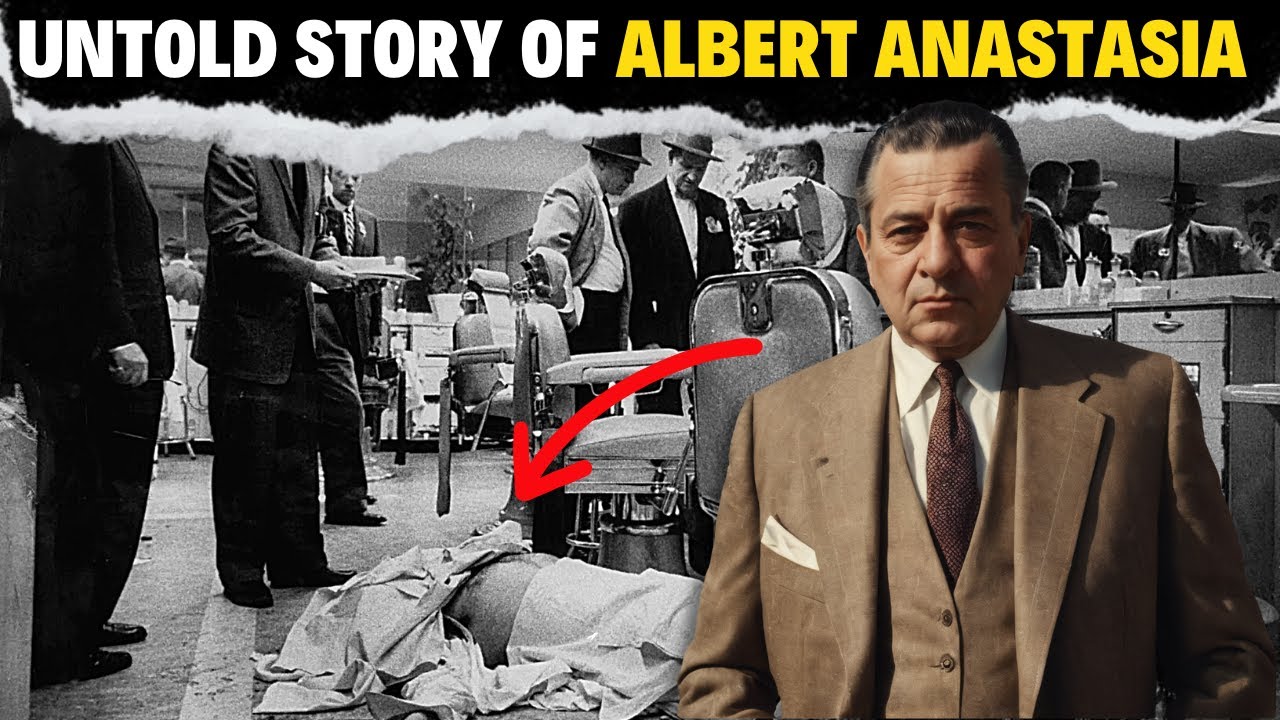
On October 27, 1957, the morning was chilly in Manhattan when Anastasia arrived at the Park Sheraton Hotel alongside his bodyguard Anthony Cope. Entering Arthur Grasso's barber shop within the hotel for his routine grooming session, Anastasia settled in for a customary haircut, shave, and hot towel treatment.
While the barber attended to him, two masked gunmen abruptly entered the shop. Seizing the moment of vulnerability while Anastasia was in the midst of the relaxing hot towel shave, the assailants unleashed a hail of bullets toward the mob boss. Startled and in a state of shock, Anastasia instinctively lunged forward, believing the attackers were in front of him. However, the reflection in the mirror portrayed a disorienting scene, and in the frenzy, Anastasia inadvertently lunged toward his own reflection.
Tragically, amidst the chaos and confusion, bullets tore through Anastasia's back, hip, and hand. In the aftermath of the chaotic scuffle, a final fatal shot ended the life of the once-dominant mob figure, marking the violent end of the Lord High Executioner.
The aftermath of Albert Anastasia's assassination was marked by an eerie silence. Anastasia lay motionless on his back, surrounded by a pool of his own blood. A mere day after his tragic demise, Anastasia's funeral took place at Greenwood Cemetery in South Brooklyn. However, the turnout was notably sparse, with only a small gathering of 12 individuals attending the ceremony. Anastasia had been cast out and abandoned by the once-loyal circles of the criminal underworld.
The void left by Anastasia's demise swiftly became a battleground. Speculation swirled around the Gallo crew, led by the notorious "Crazy Joe" Gallo, being assigned the contract for the hit. However, the identities of the hitmen remain shrouded in mystery, their roles in Anastasia's demise never conclusively revealed.
In the wake of Anastasia's death, Vito Genovese convened a pivotal gathering of top-tier mob leaders at Appalachin. This assembly served as the platform for Genovese to announce his ascendancy as the leader of his own crime family. However, the infamous Appalachian meeting in 1957 signaled a turning point. Over 100 high-profile mobsters congregated, attracting the attention of local law enforcement and triggering a swift FBI intervention, resulting in 58 arrests.
The unwanted publicity and increased scrutiny on the Mafia drew blame upon Genovese from within the mob itself. His association with narcotics conspiracies led to his eventual downfall, culminating in Genovese's indictment and imprisonment in 1959 for 15 years. He passed away in 1969 due to a heart attack.
In contrast, Carlo Gambino navigated the turbulent aftermath to secure a successful tenure at the helm. Under his leadership, he rebranded the crime family as the Gambino crime family, guiding it to prominence. Gambino lived until 1976, reaching the age of 74.
The assassination of Albert Anastasia in the barber shop at the Park Sheraton in 1957 marked the conclusion of a violent chapter in organized crime. However, it also opened the doors to a new phase in Mafia history, signaling the beginning of a transformative period for the underworld.
There exists a fascinating debate regarding the relationship between Albert Anastasia and Frank Costello. While some narratives paint them as adversaries, a prevailing sentiment suggests that they were more likely allies. George Wolf, whose book "Prime Minister of the Underworld" delves into the intricate underworld connections, presents a perspective that leans towards them being friends. Ed Bennett Williams, another lawyer with ties to both figures, echoes this sentiment, recalling accounts of the two mob figures spending time together and seemingly maintaining an amicable rapport.