In November 1877, two brothers walked into the woods of northwest Arkansas and vanished for eleven days. When they returned, they were clean, well-fed, and moving in perfect synchronization. The doctor who examined them said their pulses beat at exactly the same time, as if one heart were beating in two bodies.
The Pickrel brothers, Wystan and Talmadge, were identical twins who lived in a one-room cabin in Whitten Hollow, about four miles from the settlement of Lock Step Crossing. They were trappers, known for their quiet patience and skill in the woods. They had run the same trap line for a decade, covering three creek bottoms across two ridges.
On the morning of November 4, they left their cabin at first light to check their traps. They told their neighbor, an old widower named Renfro Cabe, that they expected to be gone three or four days. They asked him to look in on their horse, Reuben.
Renfro checked on the horse on the fifth, sixth, and seventh. On the seventh, he noticed the brothers’ dog, a brindle hound named Bucket, had returned to the cabin alone. The dog was shivering under the porch. The dog had never come back without the brothers before.
A search party of nine men rode up the hollow on the eighth. They searched for three days. They found no tracks, no campfire ash, no torn cloth, no blood. The trap line itself was gone, as if the traps had never been set. One old hunter named Hardacre told the doctor, “Doc, we are not finding them ever.” He said the hollow had eaten them.
On the night of November 19, the brothers walked back into their cabin. Renfro Cabe was inside, sleeping on a pallet by the stove. He heard the door open and two pairs of boots come in.
The brothers were wearing the same canvas coats and boots they had left in. But the coats were clean. The boots were clean. The rifle Wystan carried was clean and oiled, which Renfro said was unlike him. Wystan had never oiled a rifle clean in his life.
Renfro made them a bowl of beans. He watched them eat slowly, together. Their hands moved at the same time. Their spoons came up at the same time. Their jaws worked at the same rhythm. When they swallowed, they swallowed together.
The dog, Bucket, had backed himself into the far corner of the cabin and would not look at the table.
Renfro rode four miles in the dark to fetch the doctor, Goff Tatum, a 51-year-old widower who kept careful ledgers and doubted what he could not measure. The doctor came back with Renfro and examined the brothers. He took both their wrists to feel their pulses. Under his left thumb and his right thumb, the same heart was beating at the same moment at exactly the same speed.
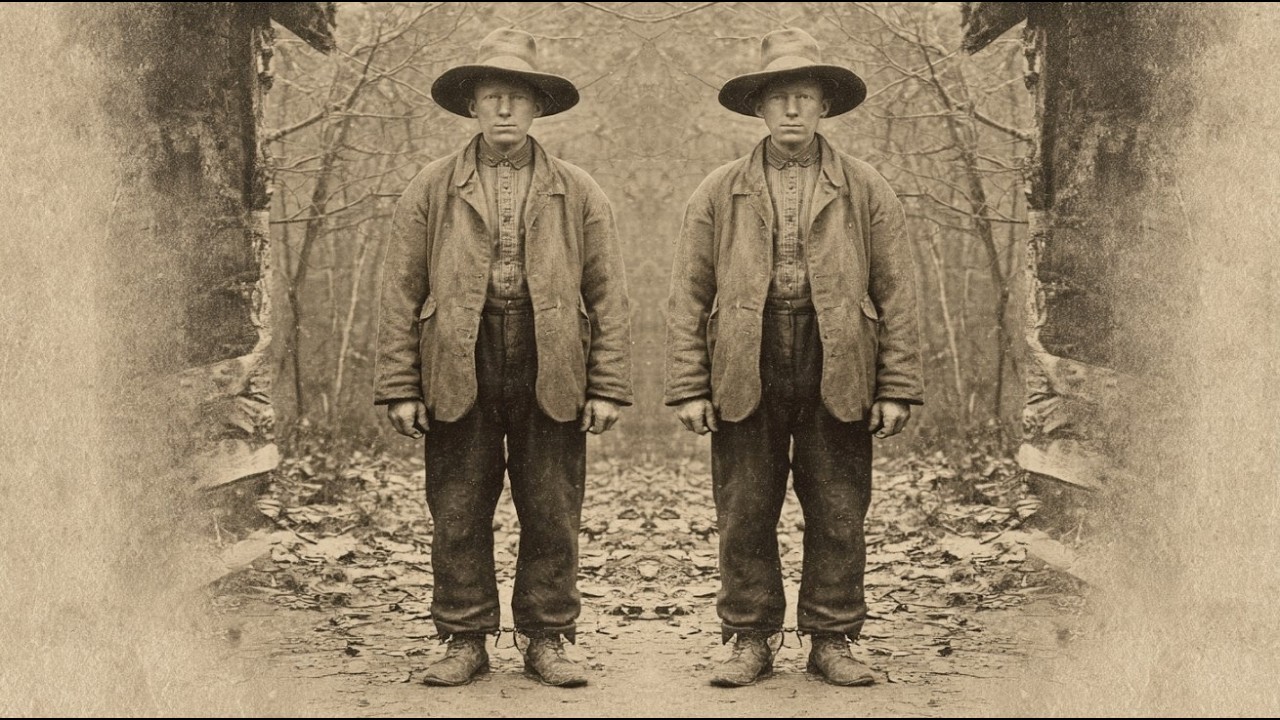
The doctor visited the cabin every morning for days. The brothers were always at the table, always doing the same thing. They were polite. They offered coffee. They poured it at the same moment.
When the doctor asked what had happened in the woods, Wystan said, “Up the ridge.” When he asked what they had done there, Talmadge said, “We waited.” When he asked what they had waited for, they both said, at the same time, in the same voice, “We don’t remember.”
The doctor asked small questions to test their minds. Wystan knew his father’s name. But when the doctor asked Talmadge the name of the dog he had raised from a pup, Talmadge said, “I don’t recall, Doc.”
The country around the crossing began to notice small things. A horse that had stood next to the brothers a hundred times would not let them touch it. The Methodist preacher said the brothers had not been to meeting since they returned. He said, “They don’t sing anymore.”
The doctor checked his ledger and found a date that stopped him. The day the brothers walked into the woods, November 4, was the exact anniversary of the day their mother, Sela Pickrel, was buried. She had died of a fever in the winter of 1846, the same winter the twins were born. Their father had never told them her name.
The doctor walked to the cemetery. The earth at the foot of Sela Pickrel’s stone had been turned. It had been carefully smoothed back and covered with moss, but the dirt was a different color from the graves on either side.
The next morning, the doctor asked Wystan what his mother’s name was. For 31 years, Wystan had always said his father never told him. This time he said, “Sela.” When the doctor asked Talmadge how he knew, Talmadge said, “She told us. In the woods, Doc, when we were waiting.”
The old hunter Hardacre came to the doctor’s office in December. He said he had gone to see the brothers himself. He told them he had taught them to set snares when they were boys. Wystan said, “We remember the snare.” But when Hardacre asked if they remembered him teaching them, Talmadge said, “We remember the snare. We do not remember the teaching.”
Hardacre told the doctor about a buck he had shot as a young man. He hung it in the smokehouse for three days. When he went to butcher it, he knew whatever was hanging there was not the buck he shot. “Same hide, same antlers, same hole in its chest for my rifle, but it wasn’t him. Something else had got in.” He said, “Doc, that’s the Pickrel boys.”
The doctor went up the high side of the ridge alone to find where the brothers had spent their eleven days. He found a small bowl in the rock, a half-shelter against the cliff. The ground in the center was smooth and dark, as if it had been swept. There was no ash, no fire ring, no bones. In the very middle, pressed into the dirt, were two impressions side by side, about three feet apart. They were the size and shape of a man’s seated print, as if two men had sat cross-legged facing each other for a very long time.

On the night of December 17, Wystan rode down to the doctor’s office and invited him to supper. The doctor went, carrying a small revolver at the bottom of his medical bag.
The brothers had set the table with their mother’s blue-rimmed china, which they had never used. They ate together, in the same careful, considered motions. Around eight o’clock, they asked the doctor to stay the night. He stayed.
He lay on a pallet by the stove. He did not sleep. Around midnight, he heard a single long, slow intake of breath from the loft, then a long letting out, as if one of the brothers had only just remembered that breathing was something a body was supposed to do. It happened again at one in the morning.
At about two, the doctor opened his eyes. The lamp had gone out. The stove was cold. Wystan and Talmadge were standing about ten feet from his pallet, side by side in their nightshirts, barefoot on the cold boards. They were facing him. They did not move. They did not blink. They did not breathe in any way he could see.
For an hour, they stood there. The temperature in the room dropped. The doctor could see his breath in the moonlight. At about three in the morning, they turned at the same instant and climbed back up the ladder without a sound.
The doctor left in the first gray light. He left two dollars on the table for the hospitality.
In the spring of 1878, on April 15, Wystan Pickrel walked out of the cabin at dawn with his canvas coat and his Henry rifle. He walked up the ridge into the woods. He did not come back.
There was no search this time. The doctor said, “There are some things in a country like that that you learn not to do twice.”
Talmadge stayed. He kept the cabin. He ran the trap line by himself. The horse, Reuben, which had refused to be touched by either brother for months, slowly came back to him. By the end of the summer of 1878, the horse let Talmadge brush his neck again.
In the early summer of 1880, Talmadge asked the doctor to ride out with him. He took him to a small clearing under the white oaks where his father was buried. He handed the doctor a shovel. He said he was going to dig his brother a grave.

The doctor said, “Talmadge, your brother is not dead that we know of.” Talmadge said, “Doc, my brother is not coming back. I know that the way I know my own name.”
They dug a grave at the regulation depth. Talmadge set a wooden marker with the name burned into it: Wystan Eli Pickrel, born 1846, died 1877. He said the death year was the year the brother he knew was gone. They covered the empty grave with dirt and tamped it down.
The years went by. Talmadge slowly seemed to come back into himself. By 1882, he was singing again in the Methodist meeting hall. By 1890, he was a man you could sit beside in a hayfield and not feel anything strange about. He never married. He never spoke of his brother. He read his mother’s Bible in the evenings.
People in the crossing began to say that whatever had happened up that ridge had happened to Wystan, and Talmadge had survived it.
The doctor let them say that. He knew better.
On the night he stayed in the cabin, the night the two of them stood over his pallet in the moonlight, the doctor opened his eyes once, just for a second. The man on the left was wearing the nightshirt with the small mended tear at the collar, the nightshirt he had always known as Wystan’s. His head was tilted very slightly to one side. The man on the right was wearing the nightshirt with the bone button at the throat, the nightshirt he had always known as Talmadge’s. He was looking down at the doctor with eyes that were Talmadge’s eyes, in Talmadge’s face, with the small scar above the brow. But the look in them was Wystan’s.
The doctor never knew what came back out of those woods on November 19, 1877. He never knew if the man who walked off up the ridge in April was Wystan, or whether what walked off was the thing that had been wearing Wystan’s body, finally finished with whatever it had needed a body for. He never knew if the man who stayed, who lived another forty years and was buried in the Methodist churchyard in 1922 with a stone that read “Talmadge Pickrel, beloved of God,” was Talmadge.
Talmadge died on October 18, 1922, at the age of 76. The doctor was 96. He held Talmadge’s hand at the deathbed. Talmadge looked up at him and said, “Doc, you remember that night.” The doctor said he did. Talmadge closed his eyes. He said, “I remember it, too.” And he died.
The doctor wrote the death certificate. He filed it. He tried to make himself believe what the certificate said, that a man named Talmadge Pickrel had died of natural causes in his bed. He could not quite get there.
The doctor wrote all of this down in 1925, when he was 99 years old. He said he had carried it in his ledger for 48 years and did not want to carry it across.
The ledger turned up in 1961 behind a panel in the wall of a house in Lock Step Crossing, when the new owner went to rewire it. The doctor had died in 1926, four months after putting down the last page.
The hollow is still there. The cabin is gone. The trap line is grown over. The Pickrel graves, both of them, are still there. The one for Talmadge in the churchyard, and the empty one for Wystan that the brothers themselves dug in 1880 beside their father’s.
And if you walk up that ridge in the late part of November on a day when the wind has died and the woods have gone very still, you will sometimes hear, at the edge of your hearing, the sound of two men singing the doxology in a perfect mirrored voice, in one body that has two mouths.