The Ozark Mountains in 1887 were a vast, untamed wilderness, a place where civilization was a fragile thing, and the forest stretched on in every direction, indifferent to the lives of the men who tried to tame it. It was into this world that Vernon Caulfield, a telegraph lineman known for his quiet and practical nature, was sent on a routine assignment. A line was down, and it was his job to fix it, a task he had performed countless times before.
The instructions came via a telegram delivered to his cabin by a nervous station operator. The message was simple: a section of the telegraph line in a remote region known as the Harrow Valley was out, and Vernon was to go and repair it. The operator, Silas Pemberton, seemed uneasy, warning Vernon that the valley had a reputation, that the local wildlife refused to go near it and that the forest itself fell silent at its edges. He spoke of a settlement that had been abandoned there decades ago, a place where something felt fundamentally wrong.
Vernon, a man of logic and labor, dismissed the warnings as the superstitions of country folk. He had a job to do, and he wasn't about to be deterred by ghost stories. He packed his gear, loaded his horse, and set off into the mountains, his mind focused on the task ahead. The first day's journey was uneventful, the forest familiar and the trail clear, but as he drew closer to the valley, the atmosphere began to shift.
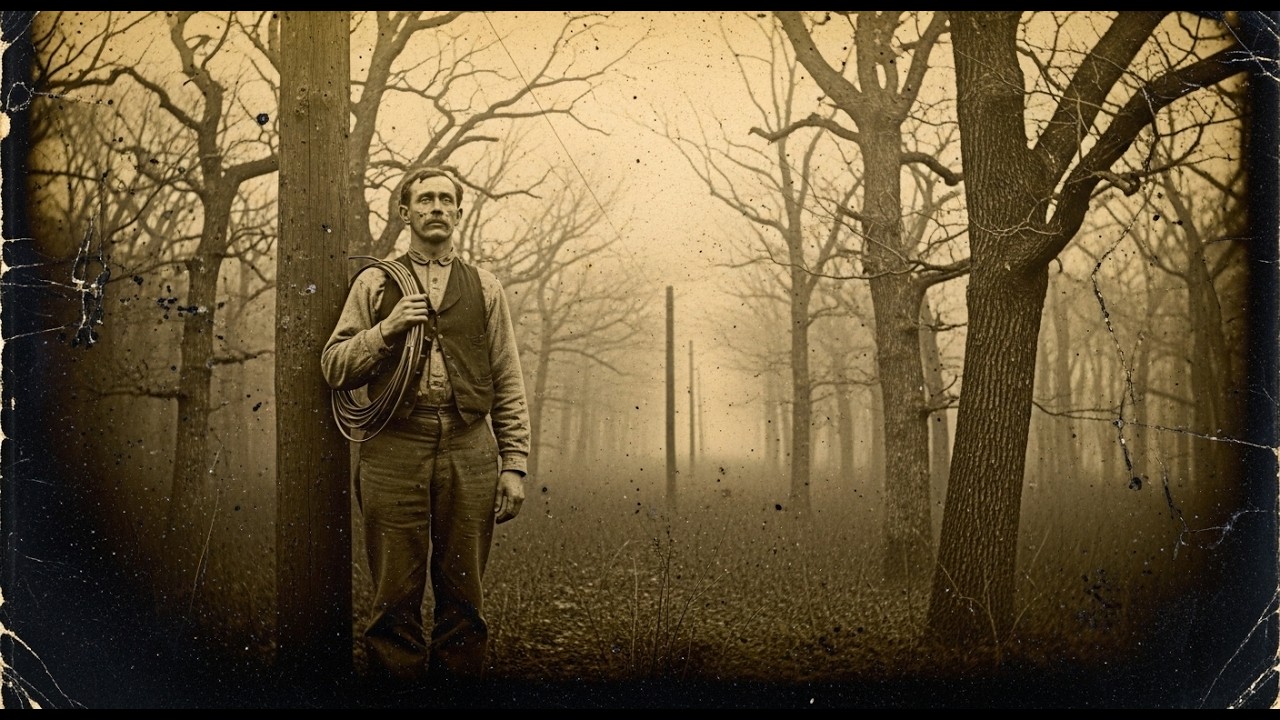
The silence that greeted him was the first sign that something was amiss. It wasn't the natural quiet of the woods, but a profound, unnatural absence of sound, as if the world itself was holding its breath. The trees began to look wrong, their branches twisted and gnarled, and the usual signs of animal life were completely absent. By the time he crested the final ridge and looked down into the Harrow Valley, a deep, primal fear had taken root in his chest.
The valley floor was not covered in the vibrant green of a healthy forest, but in a field of gray, ash-colored grass that seemed to absorb the light. The air was thick with a low-lying mist, and the entire place felt wrong, a scar on the face of the earth. His horse, Bess, refused to take another step forward, trembling with terror. No amount of coaxing or urging could convince the animal to descend into that unnatural place.
Vernon was left with a choice: turn back and report the line as irreparable, or continue on foot into a place that every instinct screamed at him to avoid. His pride, and his sense of duty, won out. He left Bess behind and began the descent into the valley, his rifle held tight, his heart pounding against his ribs.

The gray grass crunched under his boots with a brittle, unnatural sound. The mist was thicker than it had appeared from above, and it seemed to swallow up sound, making the world feel muffled and distant. He followed the telegraph poles, which were covered in a strange, wire-like growth, and eventually came upon a town that should not have existed. The buildings were old, their wood weathered and gray, but they were perfectly preserved, as if the occupants had just stepped out for a moment. A blacksmith's shop with the forge still intact, a saloon with bottles still on the shelves, a hotel with a registry book filled with blank pages.
The town was a perfect, frozen tableau of a life that had been interrupted, but there were no people, no bodies, no sign of what had happened. The only thing that moved was the mist, which seemed to shift and writhe with a life of its own. In the center of the town square stood a well, and when Vernon looked into it, he saw not water, but a darkness so complete it seemed to be a hole in the world itself.
He was about to leave, to flee this place that defied all reason, when he heard a sound from the hotel. It was a faint, rhythmic sound, like a creaking. He entered the building, his rifle ready, and found a room where a rocking chair was moving slowly back and forth, as if pushed by an unseen hand. The room was filled with a terrible cold, and he knew, with a certainty that chilled him to the bone, that he was not alone.

He ran. He ran out of the town, through the gray grass, and into the mist, not daring to look back. He ran until his lungs burned and his legs screamed, and when he finally stopped, he was at the edge of the valley, and the town was gone. It had vanished completely, swallowed by the mist as if it had never existed. He climbed the ridge, found his terrified horse, and rode back to civilization, a changed man.
The story he told was fragmented, a tale of a ghost town and a malevolent presence. He tried to find answers, pouring over old records and maps, but the Harrow Valley had been erased from official documents. He found a journal from a circuit preacher that spoke of the valley as a place where the barriers between worlds were thin, and a government memo that suggested the town had been built as a containment measure, a cage for something that should not be free.
Vernon Caulfield lived the rest of his life in the shadow of that experience. He never spoke of it willingly, but those who knew him said he was never the same. He was haunted by the memory of that place, and he knew, with a certainty that never left him, that the valley had let him go. It had released him, not out of mercy, but for a purpose. It wanted him to tell others what he had seen, to spread the warning, to make sure that others would know to stay away.
The Harrow Valley still exists, hidden in the mountains, a place of silence and mist and things that should not be. And somewhere in the darkness, something is waiting, patient and watchful, for the next person who is foolish enough to find it.