On the morning of May 23, 1934, Bonnie Parker and Clyde Barrow were driving a Ford V8 sedan down Louisiana State Highway 154 near Gibsland. Bonnie held a half-eaten sandwich in her lap. Up ahead, a truck appeared to be broken down on the side of the road.
Clyde slowed to see if the man beside it needed help. He had no idea that Texas Ranger Frank Hamer and five other lawmen were hiding in the dense brush. Hamer had been chasing Bonnie and Clyde for months. He knew exactly where they would be that morning because the father of Henry Methvin had made a deal to reveal their location to save his son’s life.
When the lawmen opened fire, they emptied everything they had into the car. Machine guns, heavy shotguns, and sidearms all blazed at once. The first bullet struck Clyde in the head and killed him instantly. His foot slipped off the clutch, and the Ford rolled forward in low gear for about 30 feet before stopping in a ditch. The rest of the posse kept firing.
Around 130 rounds were fired in less than 20 seconds. Of those, 112 bullets struck the car. When the gunfire finally stopped and the lawmen approached the smoking Ford, what was inside no longer resembled two people.
History books rarely discuss what happens when the cameras turn off and the dust settles. Someone was left holding a bucket of bleach, a stiff wire brush, and a badly shaken stomach. The parish coroner, Dr. J.L. Wade, was tasked with officially documenting the damage to the outlaws’ bodies. His report listed 17 entry wounds on Clyde and 26 on Bonnie, including devastating head injuries to both.
One high-speed bullet had shattered Clyde’s spine. Bonnie’s right hand had all of its fingers completely severed by gunfire. Later researchers argued the actual bullet hole count was much higher, exceeding 50 rounds per body. But while the medical reports detailed the human toll, the physical reality inside the Ford was becoming an unprecedented biological nightmare.
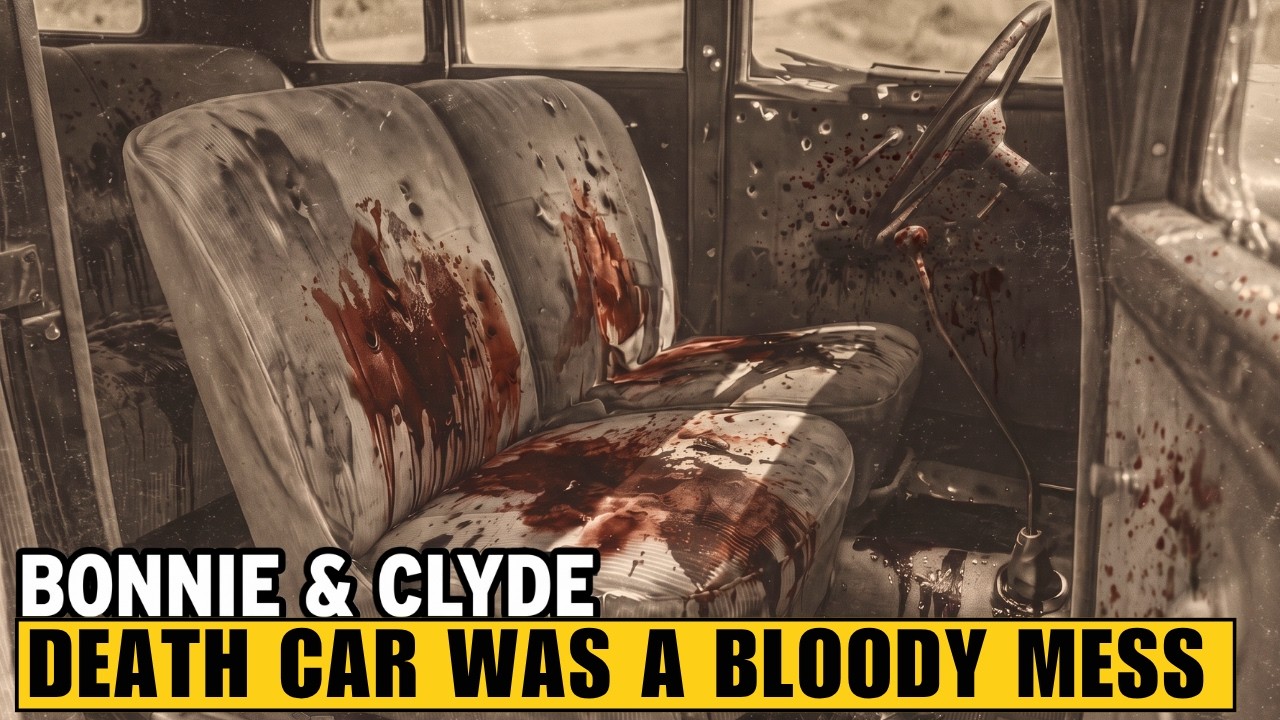
When up to a hundred bullets strike two human bodies inside a car cabin, the physics turn horrifying. Bone fragments, tissue, hair, and gallons of blood do not simply fall to the floor. They fragment and spray from the kinetic energy of the bullets. The interior of the car was completely covered. Biological matter spread across the dashboard, steering column, headliner, and glass windows.
Louisiana’s harsh climate made the nightmare worse. It was late May, and the morning was unusually hot even for northern Louisiana, with matching high humidity. But before any cleaning could begin, the Ford sat for hours in the still air. The car was towed over dusty roads toward Arcadia with the bodies still inside, turning it into a mobile oven.
Under the blazing sun, blood, brain matter, and deep tissue began to dry, liquefy, and fuse directly into the fabric of the car before a sponge or bucket of water ever arrived. The vehicle was delivered to Conger’s Furniture Store and Funeral Home in downtown Arcadia, Louisiana.
The seats were upholstered in mohair, a heavy, carpet-like fabric woven tightly from Angora goat hair. Mohair is extremely durable, but its deep fibrous texture meant it acted like a heavy sponge. Gallons of blood did not pool on top of the seat. Instead, they penetrated deep into the weave, clinging to the animal fibers.
Beneath the mohair lay layers of thick, unrefined raw cotton padding. Once the liquid biological waste seeped through the mohair and saturated the dense cotton cores, removal became practically impossible. The cotton trapped the moisture, causing the inside of the seat cushions to rot and decompose from the inside out in the summer heat.
Ford bodies from that transitional era still relied heavily on internal wooden frames behind the outer steel panels. Structural pillars, door frames, and floor supports contained thick wooden beams. Blood and fluids pooled in the dark, unventilated crevices between the outer metal body and these inner wooden frames. The wood absorbed the liquids, trapping the smell of human decomposition directly inside the car’s structure.

No amount of surface scrubbing could reach these hidden pockets of decay. The car did not belong to Bonnie and Clyde. It belonged to an ordinary citizen named Ruth Warren from Topeka, Kansas. She had bought the car brand new for $835 from the Mosby-Mack Motor Company. Bonnie and Clyde stole it from a private driveway on April 29, 1934, less than a month before their deaths.
In the aftermath of the ambush, Warren found herself trapped in a fierce legal battle with local Louisiana law enforcement who wanted to keep the vehicle as spoils or state property. When Ruth Warren finally won her court case and recovered the vehicle in August 1934, the car she received was completely unrecognizable.
The car had sat in storage for nearly three months. Blood had fully clotted and dried into a hard, paint-like crust, permanently bonded to the floor, dashboard, and gearshift. Dried chunks of human tissue were still stuck to the dashboard and the shattered window frames. Warren quickly realized she could not use the car as a normal family vehicle. The damage was too severe. The bullet holes were a public spectacle. And the smell was unbelievable.
Seeking to recover her financial losses, the Warren family first leased the car to a Topeka fairground, then to a showman who defaulted on payments. Finally, it went to a carnival operator named Charles W. Stanley, who eventually bought the car for around $3,500. Stanley purchased the vehicle with one goal in mind: commercial exhibition.
He understood that a clean car was worthless to the curious American public. A fully cleaned Ford was just an old, damaged car. But a blood-soaked Ford was a gold mine. This was the era of Public Enemy No. 1. Dillinger, Pretty Boy Floyd, and Baby Face Nelson dominated the headlines. Americans were obsessed with outlaws.
Stanley took the Death Car on tour across the United States, displaying it at local fairs, carnivals, and roadside attractions. The car was cleaned, but only primitively and only as much as necessary for public display. The original mohair seats, still saturated with blood, remained. The cotton and wood that had absorbed everything was still there. They traveled from fair to fair, every summer.

There was a dark secret that carnival barkers and ticket staff deliberately hid from the paying public. The car had been cleaned only crudely, for operational necessity. The original mohair seats and rotting cotton padding emitted a dense, foul odor of human decomposition so strong that crowds outside could smell it from dozens of feet away. When the car was placed inside enclosed tents or trailers during fairs, the air became unbreathable. Paying customers felt nauseated and vomited.
In 1960, Stanley retired and sold the car to a man named Ted Toddy for $14,500. The front seat still carried bloodstains. One of Bonnie’s teeth was still lodged in the floorboard of the passenger seat. Remnants of Clyde’s brain remained in the back seat. That was the point.
By the 1960s, fake death cars were touring the same fairs. A major reason for this explosion of replicas was the 1967 Warren Beatty and Faye Dunaway film that turned Bonnie and Clyde into American legends again. Every fake car had two mannequins in the front seat splattered with red paint. The real car was the only one that needed no mannequins and no red paint. It had the real things inside.
A boy named Perry Carver, whose parents were friends of the Toddy family, was allowed to play inside the car. He grew up to become the owner of the Bonnie and Clyde Ambush Museum in Gibsland. He is the one who remembers the tooth. Toddy kept the car in a warehouse for most of the 1960s.
In 1971, the car returned to the road. By the mid-1970s, it settled at a racetrack in Nevada where anyone could pay a dollar to climb in and sit behind the wheel. They sat on the original seat that still bore bloodstains.
In 1973, a 22-year-old casino owner named Peter Simon bought the Bonnie and Clyde Death Car at auction for $175,000, the highest price ever paid for a vintage car at that time. In 1987, it entered a cross-country antique car race as a publicity stunt. Mechanics got the engine running, replaced the shattered windshield to pass inspection, and covered the side windows with Plexiglas because the bullet holes let in the weather.
The seats were still worn. They were still in bad condition. The blood had faded, but it was still there. The woman who drove that car covered the seats for the race, not to hide the stains, but to protect them. The following year, in 1988, Gary Primm bought the car for $250,000 and moved it to Whiskey Pete’s Casino on the California-Nevada border.
That is when someone finally cleaned the interior of the Bonnie and Clyde Death Car. If you want to see it today, the car is still there. If the name Frank Hamer sounds familiar, you may know him from the 2019 Netflix film The Highwaymen, where Kevin Costner played the Texas Ranger who orchestrated the entire ambush.
That is the disgusting truth of cleaning the Bonnie and Clyde Death Car. It was cleaned 54 years after the ambush. All those people sat in the blood and touched brain tissue, perhaps never realizing how gruesome it was. They would sit in it, then go eat a hot dog. The car remains a relic of one of America’s most infamous crimes, forever carrying the stains of that deadly morning.