In the autumn of 1944, somewhere in the English countryside, a group of German officers sat down to dinner in a grand country house that had been stripped of its furniture and filled with filing cabinets and recording equipment. The tablecloths were white linen. The wine was sufficient. The conversation flowed easily among men who believed, for the first time in months, that they were safe.
They had been captured. They had given their names, ranks, and military numbers. According to the Geneva Convention, they were not required to say anything else. Yet as they leaned toward one another and spoke freely about fuel depot locations, planned counterattacks, and the positions of Panzer divisions the Allies had spent weeks trying to locate, none of them thought to lower their voices.
Why would they? There were no guards nearby. No interrogators in the room. Just German comrades eating together, speaking their native language. What could possibly happen?
Everything, as it turned out.
Every word they spoke was recorded. Every name mentioned, every location given, every piece of information they believed they were hiding traveled through hidden microphones and concealed cables to headphones worn by fluent German speakers sitting in adjacent rooms, transcribing everything at maximum speed.
This was the Combined Services Detailed Interrogation Centre, known by the deliberately unremarkable acronym CSDIC. It ran one of the boldest, most sophisticated, and most effective intelligence operations of World War II. It used no torture. It used no threats. It used something far more powerful and far harder to defend against: the simple, deeply human need to talk.
The question of how to extract reliable intelligence from prisoners of war is as old as war itself. By the start of World War II, the Allies were painfully aware that their existing methods were inadequate. Formal interrogation had produced only limited results.
Experienced German officers, particularly Wehrmacht officers trained in resistance techniques, knew exactly what they were required to say and what they were not. Name, rank, number. The interrogator’s notebook remained largely blank. Time passed, and intelligence that could have saved lives or redirected divisions stayed locked away.
There was also an urgent time problem. On the Western Front especially, tactical intelligence had a shelf life of only hours. A German officer captured on Monday morning might know the location of a fuel depot that would be moved by Tuesday afternoon. A pilot shot down over the Channel might carry in his memory the precise coordinates of a radar station the RAF was desperate to bomb. Waiting weeks for traditional interrogation methods to bear fruit was not just frustrating. It was deadly.
The Americans relied heavily on what military intelligence experts call direct interrogation: a formal, structured interview conducted by a trained officer across a desk. The results were inconsistent. Some prisoners talked willingly. Others remained silent. Even those who cooperated could not always be trusted to provide accurate information, as deliberately feeding interrogators false intelligence was itself a skill the German intelligence services had developed.
What was needed was something the prisoner did not know was happening. Something that exploited not his weakness under pressure, but his natural human instinct to relax when the pressure seemed to stop.
The solution was elegant in its simplicity and effective in its execution. It had roots in a pre-war British intelligence operation known as the M Room, named after the microphone equipment that formed its technological backbone. The mastermind behind its wartime expansion was a quiet, methodical German-born Jewish emigrant named Fritz Lustig, who had fled Nazi Germany in 1937 and was now, with considerable personal satisfaction, helping dismantle the regime that had expelled him.
Lustig was not alone. CSDIC employed dozens of German-speaking informers, a term the organization used without embarrassment, mostly Jewish refugees or anti-Nazi Germans who had reached Britain before the war. These individuals were placed in cells with high-value prisoners and trained to steer conversations toward subjects of operational interest without appearing to do so. They were, in essence, professional friends: men who could share a cigarette, sympathize about captivity, and guide the discussion toward Panzer divisions as naturally as if they were merely filling silence.
The technology that made it all possible was hidden with remarkable skill. The main CSDIC facility was at Latimer House in Buckinghamshire, a Victorian country house requisitioned by the War Office in 1942. It had been modified with microphones embedded in the walls of certain cells and common rooms, wired through the original Victorian masonry. The microphones were small by the standards of the era, roughly the size of a coat button, and sensitive enough to pick up conversations at normal speaking volume from anywhere in the room.
Recording was done on wax discs, each capable of capturing about four minutes of sound. Teams of linguists worked in shifts around the clock, transcribing the recordings. The transcribed intelligence was then evaluated, compiled into reports, and sent to the appropriate command. Sometimes within hours of the prisoner speaking words he never knew he had uttered.
Latimer House was not the only facility. A second site was established at Wilton Park in Beaconsfield for lower-priority prisoners. A third was created specifically for Luftwaffe personnel at Trent Park in North London, where senior German air force officers were housed in extremely comfortable conditions. Comfortable men relax, and relaxed men talk.

At the height of operations, the three facilities together held hundreds of prisoners at once, with intelligence flowing out almost continuously.
The operational results were, by any reasonable measure, exceptional. At Trent Park, British intelligence first learned details of the V-1 flying bomb program. Not from a technical document or aerial reconnaissance photograph, but from a Luftwaffe general who mentioned it casually to a fellow prisoner, apparently forgetting in that comfortable setting that walls might have ears.
Through the CSDIC network, the Allies obtained detailed information about German armored unit positions in Normandy in the weeks following D-Day. Intelligence that shaped the ground campaign in ways that traditional interrogation alone could never have achieved.
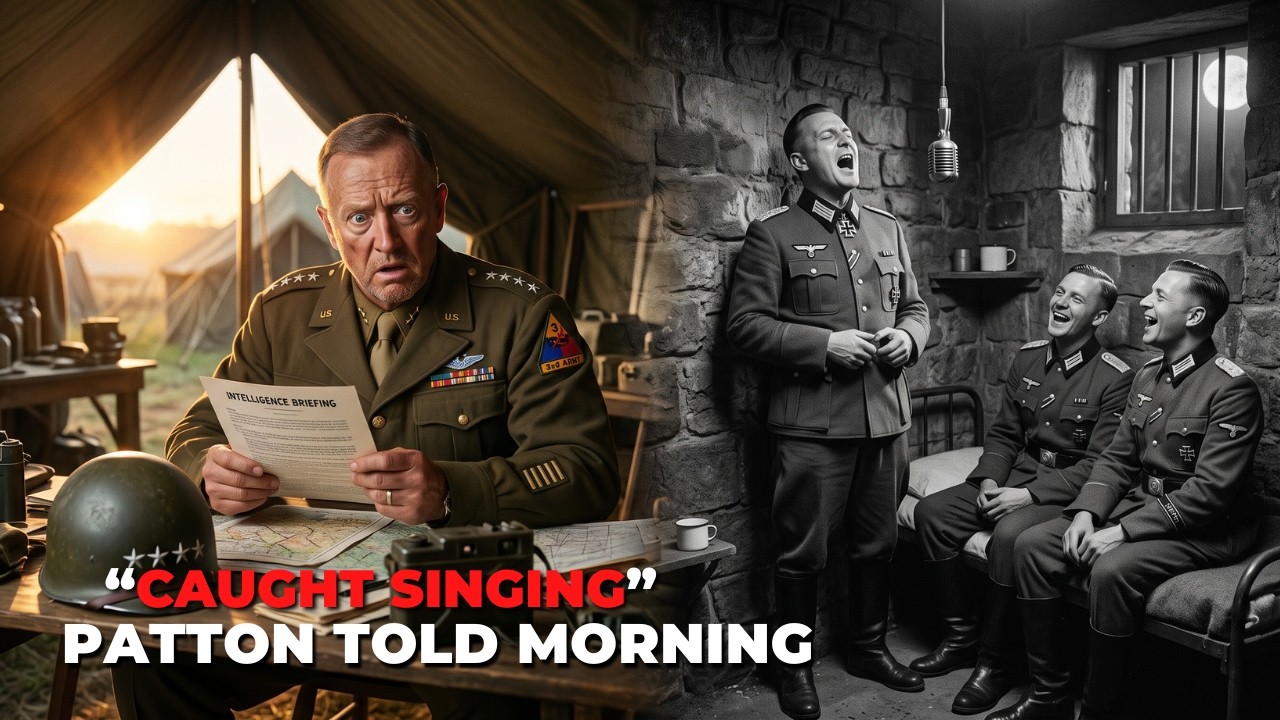
General George S. Patton, known for his impatience, his exacting demands, and his conviction that no intelligence problem could not be solved with sufficient aggression, was among those who received CSDIC briefings. Details of what reached his desk and when remain partially classified. But accounts from former staff suggest that tactical intelligence derived from prisoner conversations reached senior American commanders with a speed that sometimes astonished them. A German officer captured late in the evening might, by morning, have unintentionally provided the outlines of an operation already under discussion in Allied planning rooms.
The records are not entirely complete. CSDIC operated in secrecy, and the disposal of some documents after the war means a full assessment of its operational impact may never be possible. What remains is enough to establish the scale and seriousness of the operation.
Interestingly, the Germans ran a similar program. The Luftwaffe operated an equivalent of the M Room for captured Allied aircrew at Dulag Luft near Frankfurt. Allied pilots were briefed before deployment that the rooms they would be placed in after capture might be monitored. The warning was not always taken seriously. Many RAF and US Army Air Force aircrew later recalled, with some chagrin, that they talked far more freely than they should have during captivity, having convinced themselves the warnings were routine precaution rather than specific intelligence about a known German capability.
The Americans ran their own version as well. Military Intelligence operated wiretapped facilities at Fort Hunt, Virginia, for prisoners of particular importance, a program officially known as P.O. Box 1142. Like its British counterpart, it produced significant intelligence and remained secret for decades after the war, with files only declassified in 2007.
What distinguished the British operation from its Allied and German counterparts was its scale and the sophistication of its integration into the broader Allied intelligence apparatus. CSDIC was not an improvised addition to formal interrogation. It was a parallel system, staffed by specialists, supported by technology, and connected directly to the intelligence consumers who needed it most. The German operation at Dulag Luft was competent but narrower in scope and slower in output. The American facility at Fort Hunt processed fewer prisoners and, by its own postwar accounts, operated with less systematic efficiency than its British counterpart. At its peak, CSDIC was the most productive source of prisoner-derived tactical intelligence in the Western Allied arsenal.

The true impact of what happened in those listening rooms is difficult to measure. Perhaps that is why it has received less historical attention than the dramatic events of the war: the battles, the bombing, the codebreaking. This kind of intelligence work is almost invisible by definition. Its successes leave no trace, no photographs, no memorial. A tank division ambushed because a general mentioned its location over dinner in a comfortable room in Buckinghamshire would never know why the ambush happened.
The men who listened and transcribed and decoded and dispatched never fired a shot. They never crossed a beach. They sat in small rooms, headphones on, pens in hand, and changed the course of the war one conversation at a time.
Latimer House still stands. It is now a conference center and hotel. Its Victorian facade is unchanged. Its gardens remain lovely in the manner of an English country house that has never quite decided which century it belongs to. The cells are gone. The wiring is gone. The recording equipment is gone. Guests sleep in rooms where German officers once spoke freely, and eat breakfast in halls where the clink of cups and murmur of conversation rises and fades into the air unrecorded, unheard by anyone outside the room.
Trent Park is now a university campus. Wilton Park hosts international political conferences. The buildings have moved on. Perhaps the ghosts remain.
Fritz Lustig survived the war, lived in Britain, and spoke about his work at CSDIC in interviews decades later, with the measured pride of a man who fully understood what had been accomplished and its significance. He was in his nineties when he last spoke publicly about it. He was still precise, still cautious, and still, after all those years, not entirely comfortable saying too much.
It is, when you think about it, a habit worth keeping.
The German officers who dined at Latimer House believed that silence after interrogation was safety. They were wrong. The silence was the interrogation. And by the time they realized it, if they ever did, the information they had so easily disclosed had already traveled somewhere it could do them and their army considerable harm.
Patton was told by morning. The Germans never knew what they had said.