In the summer of 1970, a romance began at Royal Ascot between Princess Anne and Andrew Parker Bowles, a dashing officer in the Household Cavalry. He was 30, charming, and widely considered the most eligible man in their circle. She was 19, sharp, fearless, and already one of the best riders in the country.
The attraction was immediate and genuine. They moved in the same tight world of country houses, race meetings, and regiments. For a season, they were a couple, and the press took notice. But the relationship had a wall at the end of it that no amount of charm could overcome: Andrew was a Roman Catholic.
Under laws dating back to 1689 and 1701, any member of the royal family who married a Catholic would forfeit their place in the line of succession. The penalty fell on the royal, not the Catholic. Had Anne married him, she would have stepped out of the line entirely. The romance was doomed by statute before it ever fully began.
It ended quietly, as everything in that world ended, without a scene and without a public word from either of them. Anne turned back to her sport and her duties. Andrew turned back to a woman he had known for years: Camilla Shand.
Camilla had been drifting in and out of Andrew’s life since the late 1960s. Theirs was a loose, unhurried attachment that never quite settled into a promise. While Andrew courted the princess, Camilla was noticed by another royal: the Prince of Wales.
Charles and Camilla were introduced through a mutual friend, and the connection was immediate. She was funny, unimpressed by his rank, and entirely unintimidated by the institution he represented. For a while, it seemed the relationship might last. But the prince’s duty called him to sea with the Royal Navy in early 1973, and the romance was put on hold.
Distance did what distance always does. While Charles was away, the attachment loosened. Andrew Parker Bowles, his own royal romance long over, drifted back toward Camilla. By the time the prince returned, the relationship was over, and Camilla had turned again to the man she had known the longest.
The square had closed. Andrew could not marry Anne because of his faith. Charles could not marry Camilla because of duty and distance. The two who were left found their way back to each other.
The engagement was announced in a most unusual way. According to biographer Sally Bedell Smith, the two fathers placed a notice in the Times before Andrew had actually proposed. His hand publicly forced, he asked, she accepted, and the arrangement the fathers had willed into being became real.
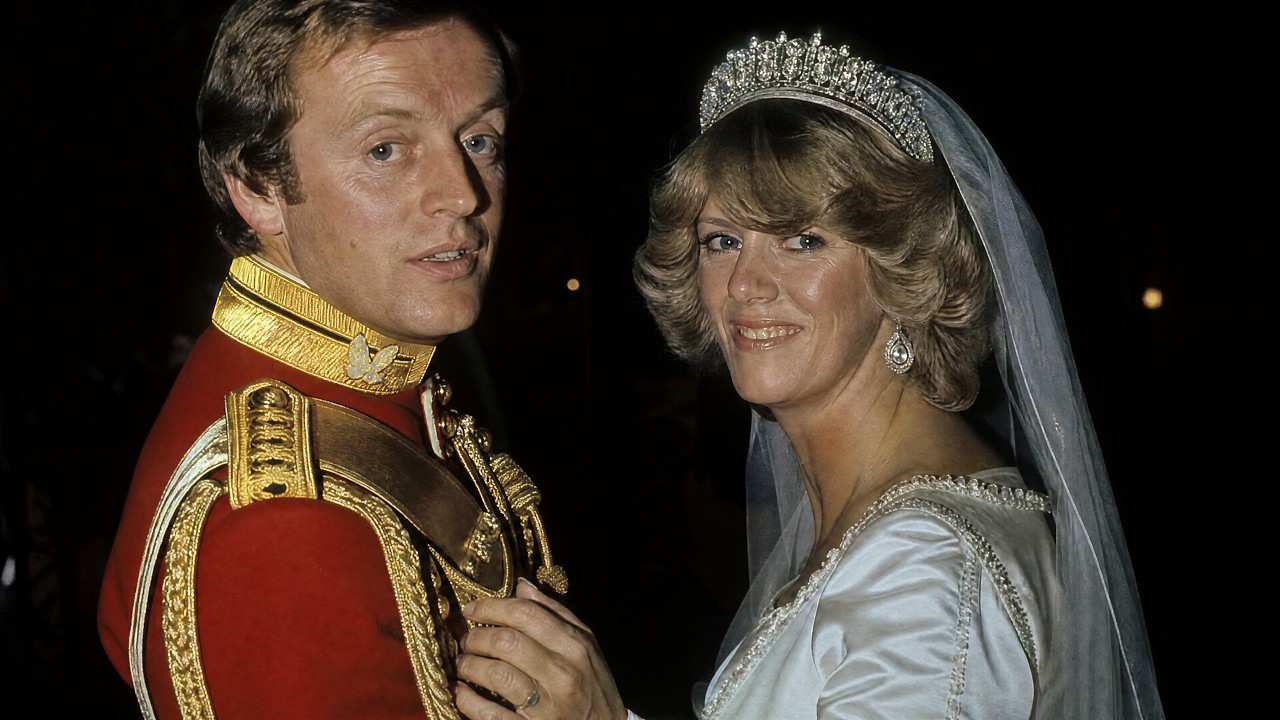
On the 4th of July 1973, 800 guests filled the Guard’s Chapel at Wellington Barracks for the society wedding of the season. Camilla wore the Cubitt Shand tiara from her own family. The service was a Roman Catholic one, held in keeping with the groom’s faith, the very faith that had made him impossible as a husband for a princess three years before.
The Queen Mother was there. Princess Margaret was there. Princess Anne was there, watching the man she had been linked with only three summers earlier marry another woman. The Queen did not attend. She sent her mother, her sister, and her daughter in her place.
Everyone in that chapel understood the geometry of the marriage they had come to bless. The bride had loved the heir to the throne. The groom had courted the heir’s sister. Both royal romances had proved impossible, and the two who were left had turned back to each other. Nobody rose to say any of it. Nobody was expected to.
Barely four months later, on the 14th of November 1973, Anne married Captain Mark Phillips at Westminster Abbey. He was a Protestant, an Olympic horseman, and in every particular the marriage the system approved of. The symmetry of the year was complete. Andrew had married in July. Anne married in November.
For years, both marriages held their shape. Anne and Mark Phillips settled into a country life with their two children, raised without royal titles. Andrew and Camilla ran their marriage on the old aristocratic code: separate lives, perfect public silence, and an understanding that what happened behind closed doors stayed there.
The code had a deep foundation. It assumed the walls held, that servants were loyal, and that the press kept a respectful distance. Camilla carried that code in her bloodline. Her great-grandmother, Alice Keppel, had been the mistress of King Edward VII and had managed the position with such tact that she kept the respect of society.
In 1980, the Prince of Wales bought Highgrove, a country house in the very heart of the hunt country where the Parker Bowleses lived. The geography was almost too neat. The attachment between Charles and Camilla, which biographers date to the late 1970s, now had a permanent setting, woven into the ordinary daily fabric of a small piece of English countryside.
The following year, Charles married Lady Diana Spencer at St. Paul’s Cathedral before a global audience of hundreds of millions. The world was told it was a fairy tale. By the accounts of every biographer who has studied those years, the attachment to Camilla carried on quietly through the hunt country.
The pressure inside that triangle built across the 1980s. It burst into the open in 1992 with the publication of Andrew Morton’s book about Diana’s unhappiness. In December of that year, the Prime Minister announced to Parliament that the Prince and Princess of Wales were to separate.

Then came the recordings. In January 1993, a private telephone conversation between Charles and Camilla was intercepted, taped, and published to the world. The old assumption on which the entire aristocratic code rested, that what was said within the walls stayed within them, was gone.
In the summer of 1994, Charles sat down for a television documentary and admitted to the country that he had committed adultery. The following day, his own staff confirmed that the woman was Camilla Parker Bowles. The surface was gone for good.
Through all of it, Andrew Parker Bowles said nothing. His wife’s name was joined to the future king in the headlines of every country on earth. He was, by any ordinary reckoning, the most publicly wronged husband in Britain. He stayed off television. He refused the papers that would have paid a fortune for his story. He kept every bitter word to himself.
Anne ended her marriage first. The divorce from Mark Phillips was made final in April 1992, with the same absence of public drama that marked everything she did. There was no interview. There was no bitter statement.
Andrew’s marriage held on a little longer. In January 1995, he and Camilla announced that they would divorce after 21 years. Their joint statement was a model of restraint: “Throughout our marriage, we have always tended to follow rather different interests. But in recent years, we have led completely separate lives and have grown apart to such an extent that with the exception of our children and a lasting friendship, there is little of common interest between us.”
The decree was made absolute on the 3rd of March 1995. Two people who had married in a chapel full of royalty parted after 21 years with a few dignified sentences and no recrimination at all.
Both of the marriages made in 1973 came apart within three years of each other, two decades on. The neat closing of the square was answered by an almost equally neat unraveling.
Remarkably, what survived both marriages was friendship. Anne married again in December 1992, quietly marrying Commander Timothy Lawrence in a small service in Scotland. He brought her no dynastic advantage, but he brought her, by every account, the settled private happiness her first marriage never gave her.
Andrew found his own second happiness in 1996, marrying Rosemary Pitman, a woman he had long known. Theirs were the years when the cameras finally moved on, when the man at the strange center of the century’s greatest scandal faded into a half-remembered name.

When Rosemary died in January 2010, the funeral was held at a Catholic church in Wiltshire. Among the mourners was Princess Anne, the woman Andrew had courted 40 years before at Ascot. Camilla, by then the wife of the future king, attended a memorial service in her memory.
The princess he had loved and could not marry stood in a Catholic church to mourn the wife who had come after her. The woman he had married and lost to the heir to the throne grieved for the woman who had married him next. These were not people performing reconciliation for the cameras. There were no cameras that mattered.
On the 6th of May 2023, the woman who had married the princess’s former lover was crowned Queen of England. Camilla was crowned beside King Charles III in Westminster Abbey. Seated among the family watching was Andrew Parker Bowles, the officer who had courted the king’s own sister in 1970, who had married Camilla in 1973 while Princess Anne looked on, who had lost his wife to the heir and kept his silence through the whole storm.
He sat in the abbey as an honored guest while she was crowned. His and Camilla’s children were there, too. The press, casting about for a phrase, settled on “friendly exes” and moved on.
Fifty years separated that morning from the one in the Guard’s Chapel. Across every year of it, the pattern had been carried forward and never once named. The coronation was the tangle’s final form, staged under the crown itself in front of the whole world, and blessed in exactly the silence that had blessed its beginning.
The silence was not a plot ordered from above. It was a habit of a whole class, the reflex of people who had always understood that the way you survive love’s untidiness is to keep everyone in the room and describe nothing. To the world outside, the refusal to name the tangle looks like an elaborate cover-up. To the people inside the circle, it was simply good manners.
When Andrew Parker Bowles was an old man and a reporter asked him about his private heart, he gave the answer that had been the philosophy of his whole life: “Mind your own business.”
Four words. They are the truest thing anyone in this story ever said. He had loved the queen’s daughter and let her go. He had married and lost his wife to a king. He had stood dry-eyed through the most public humiliation an Englishman of his generation endured, and he had never traded a word of any of it.
The romance began at Ascot in the June sun among the horses and the hats. And it ends there, too, in a photograph taken every summer of two old friends at the races, still in each other’s company, still telling the world to mind its own business.