In the summer of 1995, the most famous woman on Earth was, in every way that mattered to her, alone. Diana, Princess of Wales, was 34 years old. She had been separated from the Prince of Wales since December 1992, and the divorce that would formally end the marriage was still more than a year away.
She lived at Kensington Palace. Her two sons were with her half the week. The other half she spent on airplanes and podiums, the most watched charity worker in the world. When the cameras were switched off, she went home to rooms that were very quiet.
Behind that public story sat a plainer and lonelier one. She had loved and lost a run of men who had, in the end, belonged too completely to her own world. What she told her healer, Simone Simmons, was that she wanted something different now. She wanted a man who was not from her world. She wanted someone to whom the title meant nothing at all.
It was, for a woman in her position, close to an impossible wish. She had wealth, fame, beauty, and the love of millions of strangers, and almost no one she could simply be herself with.
It was into that exact hunger that Hasnat Khan would walk without knowing it. On a bank holiday Monday in late August 1995, she walked into a hospital in Chelsea to sit with the recovering husband of a friend. She left having noticed a tall, tired, unhurried man in surgical scrubs who had not, so far as anyone could tell, noticed her at all.
The man who would shape the last two years of her life was, at that moment, working 90-hour weeks and entirely indifferent to who she was. His name was Hasnat Khan. He had been born in 1958 in the town of Jhelum in the Punjab in Pakistan. His father owned a glass factory and had studied at the London School of Economics. His mother, Naheed, was a traditional Pashtun matriarch whose word carried great weight in the family.
Through the wider clan, he was a distant cousin of Imran Khan, the cricketer who, in that very year, had married the young Englishwoman Jemima Goldsmith. By the summer of 1995, Khan had taken a post at the Royal Brompton Hospital in Chelsea, working under Sir Magdi Yacoub, the Egyptian-born surgeon who had built Britain's heart and lung transplant program.
Those who worked with him remembered the same handful of things. He was quiet. He was unimpressed by rank and untouched by celebrity. He smoked. He read. He lived in a small rented flat and drove nothing anyone would look at twice. He was, in almost every particular, the opposite of the men Diana had loved before.
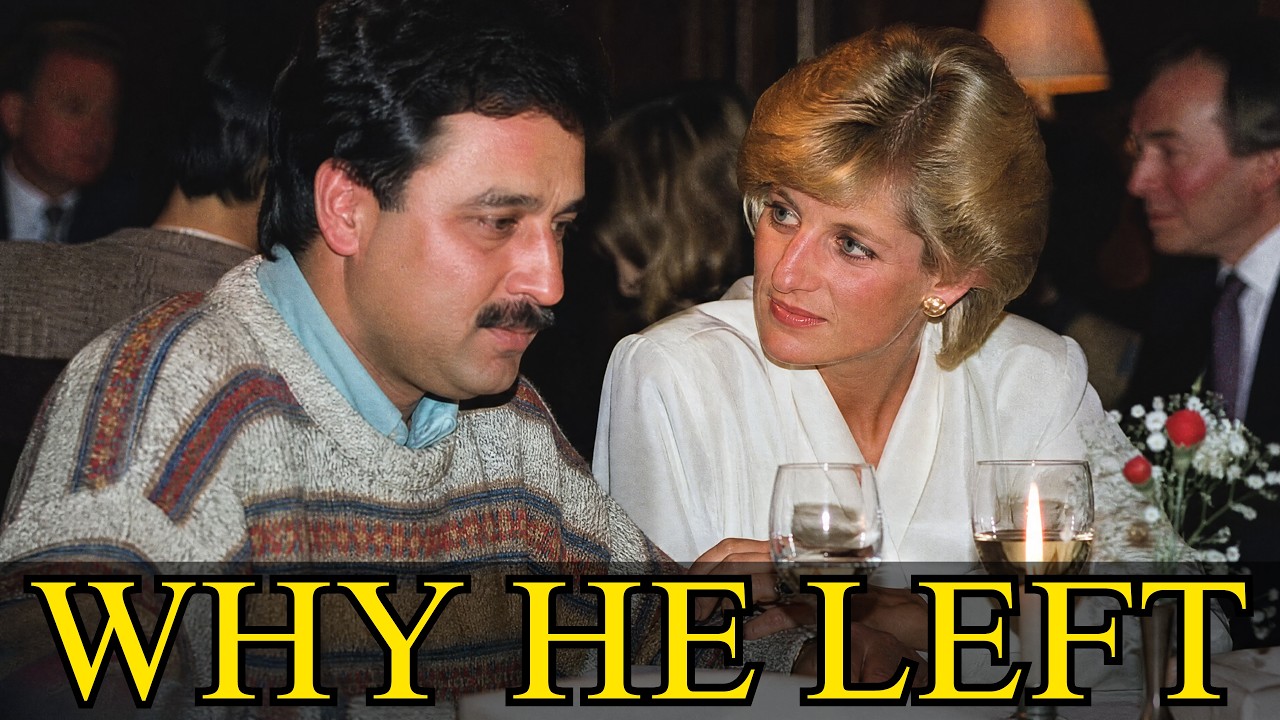
The meeting itself was almost absurdly ordinary. Diana had come to visit a friend whose husband had undergone a triple heart bypass at the Royal Brompton. She was drawn to the man in the scrubs and began to talk to him about the hearts he mended for a living. He answered her questions as he would have answered anyone's. He did not seem to register that he was speaking to the most recognizable face on Earth.
In the weeks that followed, the acquaintance became something more. About a fortnight after that first meeting, the two of them drove north together toward Stratford-upon-Avon to visit an uncle of Khan's. It was an ordinary outing, a couple in a car on an English road, the sort of thing Diana had not been able to do for years without a convoy and a crowd.
For Diana, being looked past was a kind of miracle. She would tell Simone Simmons soon afterward that she thought she had met her Mr. Wonderful. It was the beginning of something she would guard more fiercely than anything else in her life.
What made it possible was the setting. A hospital is a world of private corridors, staff entrances, and back stairs. It was, as Khan himself would later put it, one of the few places where the two of them could have any real privacy at all.
For three weeks that September, the Princess of Wales returned to the same hospital almost every day. The patient she claimed to be visiting was recovering well. Diana kept coming anyway. Khan learned to bring her in and out through the service entrances, away from the front doors where a photographer might be waiting.
At Kensington Palace, the problem was the gates and the long lenses beyond them. The solution was her butler, Paul Burrell, who more than once smuggled Khan into the palace grounds hidden in the boot of a car. He carried messages between them.
Then there was Khan's own flat, a small rented place in Chelsea. Diana would drive herself there late at night in her own car, a wig over her hair, and let herself in. She left before dawn. Inside, she did the things no one on Earth would ever have pictured her doing. She washed the dishes. She put away his laundry. She waited for him to come off a punishing shift.
Those closest to her described her delight in exactly this, the sheer ordinariness of it. The most surveilled woman in the world built, out of wigs and back entrances and late-night driving, a small private country where she was free.
Somewhere in the middle of it, Diana stopped imagining a love affair and started planning a marriage. She sent Paul Burrell on one of the more remarkable errands in the history of the royal household. He was to sound out a Roman Catholic priest, quietly, about the possibility of a private wedding.
She turned toward his faith as well. Diana began to study the Quran. She spoke with a London Imam about the practicalities of a marriage across two religions. She was not staging a conversion. She was a woman in love with a Muslim man trying seriously to understand the world he came from because she meant to enter it.
She was the mother of the future king of England. Even shorn of her royal rank, the informal weight pressing down on that choice was immense. She seems to have understood the scale of what she was contemplating and to have wanted it anyway.
And yet the striking thing is how little of that weight seems to have touched her private resolve. In the flat in Chelsea, none of it applied. There she was simply a woman who had found a man she wanted to keep.
But a marriage does not happen only in a kitchen at midnight. It happens in the world. For Diana, marrying Khan meant escape, ordinariness, peace. For Khan, marrying Diana meant the precise opposite. It meant the end of the anonymity that let him do his work. It meant photographers outside the hospital, his family named in newspapers, his patients turned into headlines.
They wanted the same marriage for opposite reasons, and those reasons would in the end pull it apart. But first, Diana had to win over the one person whose blessing she believed she needed most. That person was in a house in Lahore.
To marry Hasnat Khan, Diana understood she would first have to win over a woman who wanted nothing that she represented. That woman was Naheed Khan, Hasnat's mother. A traditional Pashtun matriarch, she had a clear and settled idea of the wife her eldest son should take. That wife would be Pakistani.
Diana's path to her ran through an unlikely bridge. In May 1995, three months before Diana met Hasnat, the cricketer Imran Khan had married Jemima Goldsmith. Imran was a distant cousin of Hasnat. Jemima, newly married and living in Pakistan, became the natural go-between.
Years later, Jemima would write the clearest first-hand account of the whole affair. "For a son to marry an English girl," she wrote, "was every conservative Pashtun mother's worst nightmare."
Diana went to Pakistan more than once. She traveled there in February 1996 and again in May of that year, staying with Imran and Jemima and using the trips in public to raise money for Imran's cancer hospital in Lahore. The private reason was Hasnat.
On the May visit, she went to the Khan family home in the Model Town district of Lahore and took tea with Naheed Khan and the elderly women of the family. There was a problem. According to Tina Brown's account, Diana had not warned Hasnat that she was going to do this. When he learned that she had gone to his family behind his back, he was, by that account, outraged.
She was trying to open a door. He knew the door was not hers to open. She made a further, quieter visit in May 1997, again with the question of marriage somewhere beneath it. And still Naheed Khan's position did not move.
In the Pashtun world she came from, a marriage joined two families rather than two individuals. A son who married outside all of that did not simply choose a wife. He stepped away from the family's whole understanding of itself. Seen from Lahore, Diana was no prize. She was a beautiful, dangerous rupture.
Diana was not used to being told no, and certainly not by a force she could not charm or outmaneuver. Naheed Khan was exactly that. Blocked from the front, Diana did what she had always done when a wall would not move. She looked for a way around it. And the way she chose would cost her the very thing she was trying to save.
In trying to save the relationship, Diana did the one thing that broke it. The account rests principally on two of her biographers, Kate Snell and Simone Simmons. According to them, Diana, desperate to reduce the pressure that press attention was placing on Hasnat, went to his employer, Sir Magdi Yacoub, and tried to arrange a transplant post for Khan abroad, most often named as Australia.
On its face, it was an act of love. She was trying to build a world where they could be together without the cameras. But look at it from where Khan stood. His career was the spine of his life. Now, the woman he was seeing had gone without asking him to his own boss to arrange his professional future for him.
When he found out, by these accounts, he was furious. To a man like Khan, private, self-made, allergic to being managed, it must have felt like the whole danger of loving Diana made concrete in a single act. This was what her world did. It arranged people. It moved them about for reasons of its own.
The transplant post was never the real issue. The real issue was that the episode showed him in one clean stroke exactly what marriage to her would feel like for the rest of his life.

Beneath the specific quarrel lay the fault line that had been there from the first day. Khan had a settled private conviction, one he would state plainly years later under oath, that a public life beside Diana would be unbearable. His main concern about marrying her, he said, was that his life would be, in his own word, hell because of who she was.
He was blunt about it in the way people are blunt only about the things they have thought through to the end. The idea of the marriage Diana was quietly building toward struck him, he would later say, as a ridiculous one. He never questioned her loyalty. What he questioned was the world and whether it would ever let a surgeon and a princess marry and then be left alone.
Diana wanted to shrink her life to fit inside his. Khan understood that her life could not be shrunk. They had built a perfect private country together. And the tragedy was that it had no room in it for two whole lives. It could hold a love affair. It could not hold a marriage.
On the 26th of January 1996, a Sunday newspaper put the secret on its front page. The Sunday Mirror ran the story under a headline built for the pavement, calling it the tale of Di, her driver, and a dishy doc. It was the first time Hasnat Khan's connection to Diana had been named in the press.
The dinners were real. On drives out of the city, the two of them had eaten at a Greek restaurant near Stratford-upon-Avon, once lingering over a meal that ran for four and a half hours. What had felt, from the inside, like a stolen scrap of normal life looked from the outside like a scoop.
For Khan, the headline was more than an embarrassment. It was proof. Everything he had told himself about what a life with her would mean was there in black and white on a Sunday morning. If a quiet dinner in the countryside could reach the front page, then nothing was safe.
A cardiac surgeon holds lives in his hands on an almost daily basis, and the work demands a mind wholly free of distraction. Khan understood that a man who could not walk from his car to the hospital doors without a scrum of photographers was a man who could not do that work properly.
Underneath the headlines, something darker was working on Diana in these same months. In 1995, the journalist Martin Bashir had won her trust for the Panorama interview by showing her forged bank statements, documents faked to suggest that people close to her were being paid to spy on her. In October 1996, she handed Paul Burrell a sealed note predicting that she would be killed in a staged car accident.
The Dyson report of 2021 established something sadder. The specific fears in it had been planted, cultivated in her by a man using forged paper to manipulate a vulnerable woman for a story. Diana was not simply a woman in love. She was a woman in love while being quietly destabilized.
The break, when it finally came, was quiet, and it came from him. There was no scandal in it, no public rupture. By Khan's own account, given years later under oath, Diana ended the relationship in two meetings in the early summer of 1997.
The decision that the relationship could not become a marriage was, in its heart, his. She may have spoken the words that closed it. He had, over the preceding months, made the closing inevitable.
What passed between them in those meetings is known mainly through what Khan later told the inquest into Diana's death. She told him, he said, that it was all over between them. He said that she denied there was anyone else. He was, in his own word, surprised when she told him there was no one else because he sensed a change in her he could not place. He did not, at that point, know about Dodi Al-Fayed.
He came to believe, he said, that Diana had finally realized that Al-Fayed could give her all the things that he, Khan, could not. He meant the openness, the ease, the willingness to live a public life beside her. It was the very thing Khan had refused.
The dignity of that reading is almost hard to bear. He could have cast himself as the wronged man, thrown over for a richer rival. Instead, he offered an account in which no one was the villain.
What the evidence suggests is a woman who had reached for two years toward a life with a man who could not give her the one thing she needed most, which was simply to be able to love him in the open. At some point a person stops walking into a wall. That is not fickleness. That is exhaustion.
Within weeks of leaving the surgeon, Diana was photographed on a yacht with another man. The man was Dodi Fayed, a member of the wealthy Fayed family. In July 1997, she joined the Fayed family on holiday in the south of France.
Where the relationship with Khan had been built entirely in shadow, this one unfolded almost entirely in light. There were paparazzi. There was a yacht, the Jonikal. There were long-lens photographs sold around the world. Diana, who had spent two years perfecting the art of not being seen, now moved through her days in full view.
Her closest friend of that last year, Rosa Monckton, would later testify that Diana was never engaged to Dodi, and that her heart, in some measure, remained tied to the man she had just left. What is certain is that the machinery of publicity, which Khan had fled, now surrounded her completely.
Then came Paris. In the early hours of the 31st of August 1997, Diana and Dodi were being driven through the city in a Mercedes, pursued by photographers, when the car crashed in the tunnel beneath the Pont de l'Alma. The driver was a man named Henri Paul. Dodi Al-Fayed and Henri Paul died at the scene. Diana, gravely injured, was taken to the Pitié-Salpêtrière Hospital, where she died in the early hours of the morning. She was 36 years old.
Somewhere in London, Hasnat Khan heard it as almost everyone else did. The man who had loved her in secret, who had ended the road to marriage, who had learned of her last romance from a radio, now learned of her death from the same impersonal sources as the rest of the world.
On the 6th of September 1997, among 2,000 mourners inside Westminster Abbey, one man in dark glasses said nothing at all. Hasnat Khan was there. The man Diana had wanted to marry sat among the invited mourners in the great church, silent behind dark lenses.
He had lost her twice now. Once to the wall between their worlds, and once to a tunnel in Paris. And he grieved for both losses in the only way he knew, which was quietly and alone in a crowd.
The funeral drew a television audience of around 32.1 million people in the United Kingdom. Across the world, an audience estimated at two to two and a half billion watched the coffin carried through the streets. And somewhere inside the Abbey sat the one man in the building who had known her not as a princess, but as a woman who did his washing up at midnight.
Diana was buried afterward at Althorp, the Spencer family estate in Northamptonshire, on a small island in an ornamental lake, an island reachable by no crowd, watched by no lens, private at the last in a way she had almost never been allowed to be in life.
For the rest of his life, the man Diana had wanted to marry chose the one thing the press could never forgive, which was silence. Khan sold nothing. He gave no interviews trading on the relationship. He wrote no book.
He did speak twice, when the machinery of the state required it. In 2004, he sat for a police interview as part of the Metropolitan Police inquiry into Diana's death. And in February 2008, he submitted a written statement to the inquest at the Royal Courts of Justice.
His own life went on in the shape it had always had. He kept operating. He worked on at the Royal Brompton, where the whole story had begun, and later at other London hospitals. In 2007, he resigned from the health service altogether to lead a cardiac unit in Malaysia. He returned to Britain a few years afterward.
In 2006, his family arranged his marriage to a woman of Afghan royal descent, the marriage his mother had always wanted for him. It ended in divorce within about a year and a half.
Only twice did he break his silence with any force, and both times it was to defend the truth of what they had been. In 2013, when a film about the romance was released, Khan rejected it publicly, calling it based on hypotheses and gossip. And in 2021, after the Dyson report exposed how Martin Bashir had manipulated Diana, Khan spoke again, saying that Bashir had filled her head with rubbish.
By 2025, in his late 60s, Hasnat Khan had returned to the country of his birth, taking up a senior post at a cardiac institute in Lahore, the city from which his mother had once said no. He had gone home.
The story is almost always told as something that was done to Diana. But this chapter of it was a choice made by two people who were each too serious to pretend. She chose a man freely, pursued him, planned a future around him, and he, just as freely, chose to keep the life he had rather than be swallowed by hers.
His reasons were never cruel. He did not leave because he stopped loving her. He left because he had looked, with a surgeon's cold honesty, at what a public life beside her would do to his work, his family, his patients, and his sanity, and he had judged it unsurvivable.
A shallower man would have taken the fame and enjoyed it. A weaker man would have said yes and let the marriage destroy them both. Khan did the harder thing. He said no to the most desired woman in the world, and he carried the cost of that no in silence for the rest of his days.
What survives in the end is not the tragedy, but the tenderness underneath it. Picture her again where the story began, letting herself into a small flat in Chelsea in the dark, a wig over her hair, doing the washing up while a tired man slept. That was what she wanted. Not a palace, not a crown. Just that. An ordinary evening with a man who saw a woman and not a princess.
She found it briefly. And she could not keep it. Because the woman who could have kept it would not have been Diana. And Khan had fallen in love with Diana.
He said it himself years later with the plainness that ran through everything he ever said about her. There was no hierarchy in their relationship, he insisted. She was not a princess and he was not a doctor. In his words, they were simply friends.
For a little while in a world that would not allow it, a woman everyone watched and a man nobody knew managed to be to each other nothing more or less than two people. And then the world, which had never once left her alone, took her back.