In the summer of 1941, Germany had been invading the Soviet Union for only three weeks, yet the Wehrmacht had already advanced deeper into Soviet territory than almost anyone thought possible. Entire armies were encircled, the Red Army was losing hundreds of thousands of men each week, and Stalin had shut himself in his office while his generals tried to hold a front that kept breaking. As the military situation collapsed, one 37-year-old economist was given the task of saving the Soviet economy. His name was Nikolai Voznesensky, chairman of Gosplan, and he ended up running the most extraordinary logistical operation in the history of modern warfare: the relocation of more than 1,500 factories east, beyond the reach of the German army.
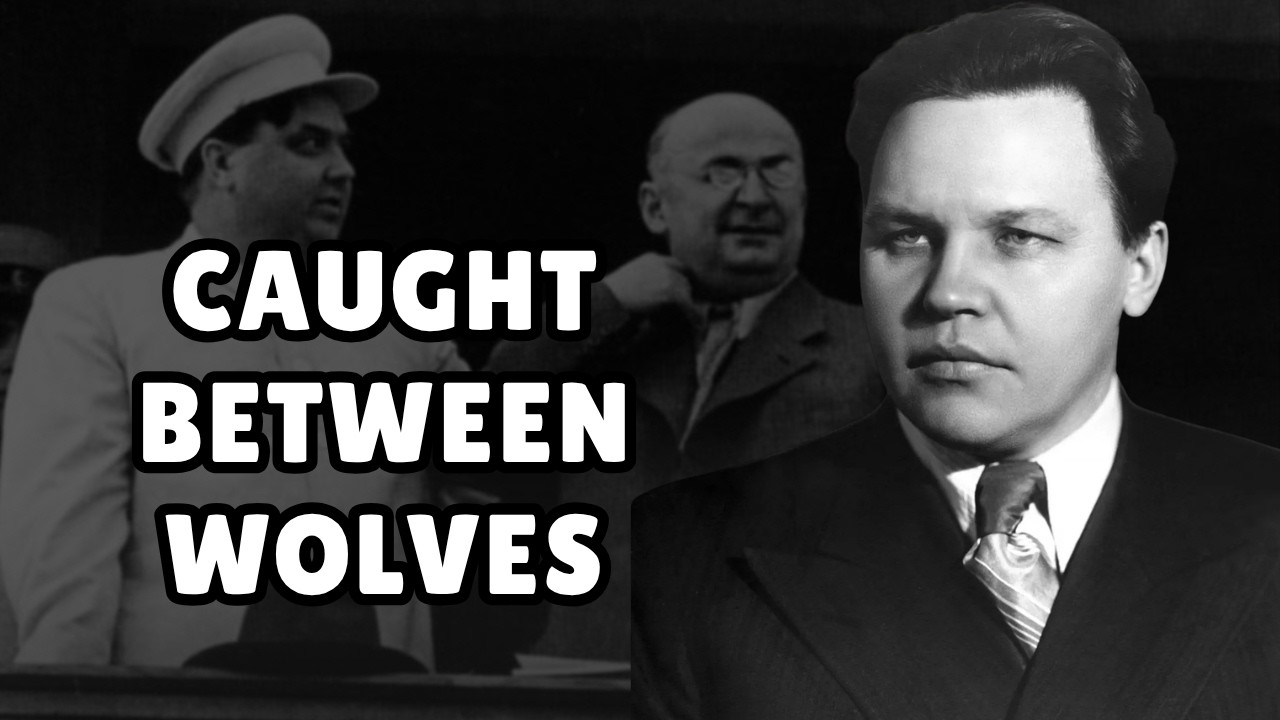
Voznesensky was born on December 1, 1903, in the village of Teplo in Tula Oblast. His father was a clerk in a forestry office, and there was no family money or political connections. He started out as an apprentice locksmith, joined the Komsomol at 15, and by 1925 was editing the official newspaper of the Tula Komsomol. By 1928 he was studying at the Institute of Red Professors in Moscow, the country’s most prestigious economics faculty, and he stayed on as a professor at the age of 28.
In 1935 he was sent to Leningrad to work under Andrei Zhdanov, who had taken over as the city’s party secretary after the assassination of Sergei Kirov. Zhdanov quickly recognized Voznesensky as the rare kind of man who could hold a vast system in his head and identify where it was going to break before it broke. From that point on, Voznesensky was considered Zhdanov’s man, an association that would define his career and eventually contribute to his destruction. In November 1937, as the Great Purge emptied senior positions across the Soviet apparatus, Voznesensky was appointed deputy chairman of Gosplan.
Two months later, the sitting chairman was arrested, and Voznesensky took his place. He now controlled the economic planning of the entire Soviet Union. In the Soviet system, Gosplan was not simply a planning agency; it was the mechanism through which Stalin’s vision of what the country should produce, how much, and where was translated into reality. Every factory, mine, farm, and railway line ran through it.
Voznesensky rebuilt the agency, created new monitoring systems, and aligned industrial prices with actual production costs for the first time. He reportedly had the kind of mind that could track steel output in the Urals, grain production in Ukraine, and tank production in Leningrad at the same time, while predicting in real time what was going to fail and why. By March 1941 he had become a candidate member of the Politburo and deputy chairman of the Council of People’s Commissars. He was 37 years old, and by any measure one of the five most powerful men in the Soviet Union.
Three months later, Germany invaded on June 22, 1941, and Voznesensky was immediately reappointed to lead Gosplan alongside his broader responsibilities. The country faced a catastrophe that was not only military. Its most productive industrial regions, Ukraine, Belorussia, and the western Russian territories, were being overrun. The factories producing tanks, aircraft, artillery, and ammunition were either being destroyed or falling into German hands.
Without them, the Red Army could not fight, and without the army fighting, there would be no factories left to save. Voznesensky was brought onto the State Defense Committee, Stalin’s inner war cabinet and the body that actually ran the country during the war. He was its only economist. In the first six months of the conflict, more than 1,500 industrial enterprises were dismantled and moved east beyond the Urals, with many relocated to Siberia and Kazakhstan.
Entire factory complexes were taken apart by hand, loaded onto trains, transported thousands of kilometers, and reassembled on bare ground in the middle of a Russian winter while the war raged to the west. Workers lived in tents beside the machines they were reassembling and labored through temperatures of minus 30 degrees. Soviet tank production went from 4,800 in 1941 to 24,000 in 1943. The Wehrmacht that invaded in June 1941 faced a Red Army running short of almost everything.
By the time the Germans stood at Stalingrad in November 1942, they faced a Red Army with more tanks, aircraft, and artillery than Germany could replace. That shift did not happen by geography; it happened because Voznesensky moved the factories, rebuilt the supply chains, and kept the numbers climbing while the front was still collapsing. By the end of the war, Voznesensky was at the peak of his power. He presented the first post-war five-year plan in March 1946, became a full member of the Politburo in February 1947, and sat on the special committee overseeing the development of the Soviet atomic bomb alongside Beria, Malenkov, and the physicist Igor Kurchatov.
Those who worked with him described a man who had not lost his edge. He argued with Beria over resource allocation in front of Stalin, taking money from commissariats that operated under Beria’s protection, and Stalin let him do it. In December 1947 he published “The Wartime Economy of the USSR During the Great Patriotic War. ” The book won a Stalin Prize and became the definitive account of how the Soviet economy had survived and rebuilt itself during the war.
He was the man who had lived it, and he had now written it down. He was reportedly at work on a second manuscript, considered his most important work, an economic analysis that went further than anything he had published before. In August 1948, Zhdanov died, and Voznesensky lost his protector. Georgy Malenkov and Lavrentiy Beria had watched his rise for years.
Voznesensky was younger than both of them, more technically brilliant, and had been positioned by his work, his relationship with Zhdanov, and his proximity to Stalin as a possible successor. That, the facts of his career suggest, was the problem. After Zhdanov’s death, Malenkov moved against him. The first accusation was that classified documents had gone missing from Gosplan.
The second was that Voznesensky and his Leningrad associates had organized a trade fair in the city using federal resources for local benefit, which was labeled treasonous separatism. Both accusations were later found to be fabricated, but both were sufficient. In March 1949, Voznesensky was removed from the Politburo and from his position as deputy chairman of the Council of Ministers. He lost Gosplan.
Stalin, however, did not yet arrest him. One of the most revealing details of the entire Leningrad Affair is that while Voznesensky was stripped of power, he continued to come to dinner at Stalin’s dacha. He was broken and diminished, but still present at the table. While he continued to attend, Stalin was arresting members of his family around him.
Voznesensky himself was not yet arrested. Archive evidence suggests Stalin was still weighing whether to complete the destruction of the man who had run his wartime economy. Malenkov assembled the final fabricated evidence and forced the decision. On October 27, 1949, Nikolai Voznesensky was arrested.
When security officers came for him, they took him and they took his manuscript. The second book, the work he considered his most important, was destroyed on the spot. His trial was held in Leningrad on September 30, 1950, and lasted one day. The charges were treason, embezzlement of the Soviet state budget, and anti-Soviet activities.
He had spent 11 months in custody before the trial, and the confessions had been extracted under prolonged interrogation, sleep deprivation, and physical pressure. By the time he stood before the tribunal, he had already admitted to everything. The verdict was delivered the same day: death. Voznesensky was executed within hours.
His brother, Alexander, was executed in the same operation. Their bodies were cremated at the Donskoy Monastery Cemetery and thrown into a mass grave. The Leningrad Affair, of which Voznesensky’s destruction was the centerpiece, ultimately claimed more than 1,300 victims. More than 100 were executed, nearly 2,000 were dismissed from their positions, and 145 relatives of the accused were convicted alongside them.
Stalin died on March 5, 1953. In 1954, the Military Collegium of the Supreme Court rehabilitated Nikolai Voznesensky, finding that the charges had no factual basis and that the trial had been a fabrication from beginning to end. In February 1956, Nikita Khrushchev stood before the Party Congress and named Voznesensky and Kuznetsov among those who had lost their lives innocently, describing them as talented and eminent leaders who had once stood very close to Stalin. Voznesensky had moved 1,500 factories east in the middle of a war.
He had pushed tank production from 4,800 to 24,000 in two years. He had been the only economist in Stalin’s inner war cabinet. Without what he did in the summer and autumn of 1941, the battles that turned the war might not have been possible. He was executed by the same state he had saved, and his most important manuscript was destroyed the night they came for him.
The factories he moved are still there. The book is gone.