Clint Eastwood was 62 years old when the screenplay for *In the Line of Fire* reached him, and he nearly turned it down. He believed the part of a Secret Service agent should go to a younger actor. Instead, the production rewrote the character to embrace his age, giving Frank Horrigan aching knees, a slower step, and a quiet sense that the job had outlasted his ability to do it cleanly. Eastwood was coming straight off *Unforgiven*, where he had played an aging man haunted by his past.
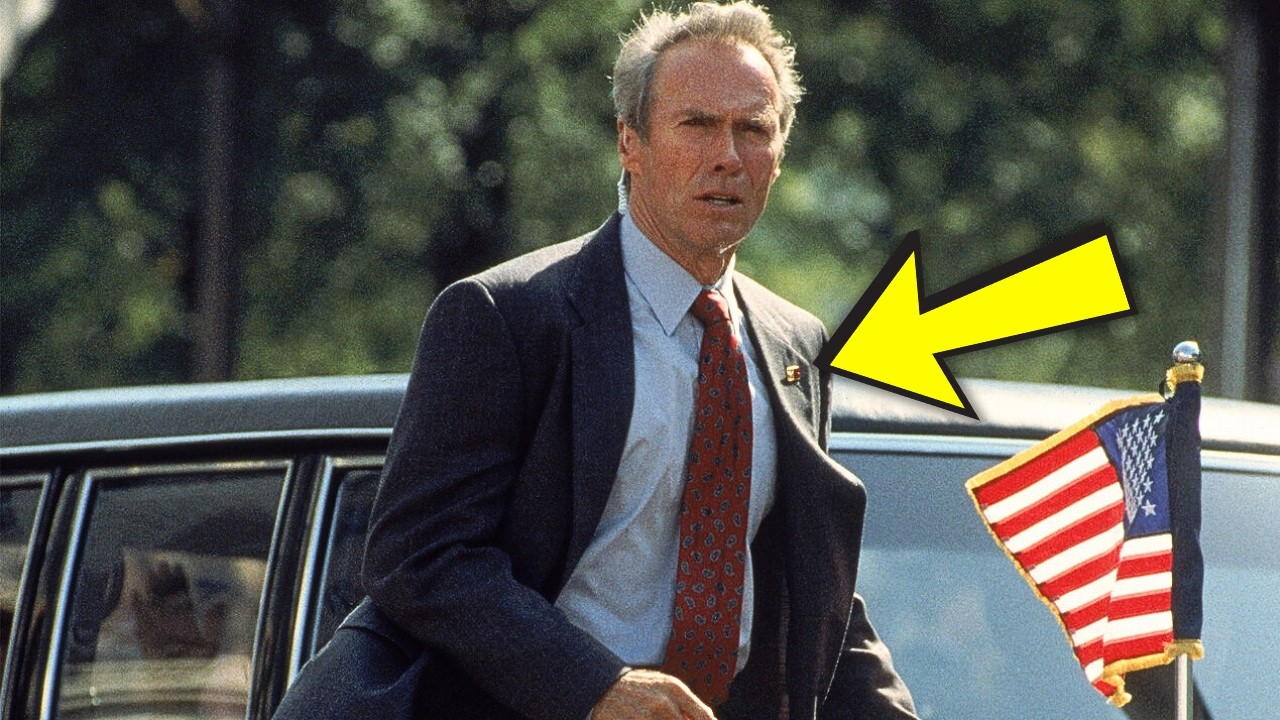
That same mood carried into the thriller. The film’s central character is an agent who rode in the Kennedy motorcade in 1963 and has spent three decades believing he could have stopped the shot that killed the president. The character was shaped loosely around Clint Hill, the real Secret Service agent who threw himself onto the back of John F. Kennedy’s limousine in Dallas.
Hill’s televised grief on *60 Minutes* became the emotional core of Eastwood’s performance. The film’s hero is defined not by action-ready toughness but by a failure he has never been able to set down. The screenplay was written by Jeff Maguire, who was weeks away from leaving Hollywood for good when Castle Rock bought his script in under two days for $1. 4 million.
Maguire later earned an Academy Award nomination for best original screenplay. He told a small story about the sale afterward: to afford a celebration dinner, he and his wife had to return a blouse he had just bought her for her birthday because the money from the sale had not yet reached his account. Before Eastwood accepted the role, the part had passed through or been offered to Robert Redford, Dustin Hoffman, Sean Connery, James Caan, Tommy Lee Jones, Val Kilmer, and Tom Selleck, who had developed a version of it as a television project years earlier. The script drifted through years of development until Eastwood attached himself, carrying full creative control.
That control allowed Eastwood to pick the director. Wolfgang Petersen was not an obvious choice. His American career had stalled after his film *Shattered* came and went without much notice a year earlier. Eastwood watched the film, saw craft beneath the weak reception, and pushed for Petersen personally.
The partnership paid off for both men. Over the next decade, Petersen directed *Outbreak*, *Air Force One*, and *The Perfect Storm*. Renee Russo played agent Lily Raines as Horrigan’s equal. The film wrote the age difference between the two characters straight into the dialogue instead of softening it.
Russo was fresh off *Lethal Weapon 3*, and her role here was a working professional rather than the decorative love interest the genre usually gave actresses in 1993. The same year the film was made, the United States Secret Service declined to cooperate with *Dave* and *Guarding Tess*, two friendlier portraits of life around the White House. Then it agreed to fully assist with *In the Line of Fire* for the first time in its history. The agency sent a retired assistant director to coach the cast on how agents scan crowds, stand, and move.
Officials also hoped a popular thriller might help recruiting the way *Top Gun* had helped naval aviation. The production included a famous early special effect. In one sequence, Eastwood appears in archival footage of the 1963 Dallas motorcade, looking decades younger. The effects team lifted footage of his younger face and hair from his early 1960s films and digitally grafted it into the historical footage.
One producer joked that Eastwood had received the world’s first digital haircut. The technique became famous a year later in *Forrest Gump*, which is usually credited as the breakthrough, but *In the Line of Fire* did it first. John Malkovich played the assassin Mitch Leary with a soft-spoken stillness that became the most frightening thing in the film. He believed real dread comes from control rather than volume, and he played Leary as a man who never raises his voice.
Malkovich insisted on keeping his natural reddish hair rather than dyeing it darker. The one part of the job he disliked was running. By his own account, he refused to train for the physical work and simply set down his cigarettes and ran. The film featured an unprecedented rally scene with roughly 2,000 extras.
The production also built a $4 million interior of Air Force One on a sound stage in Culver City for only a few minutes of screen time. The score was composed by Ennio Morricone, who had written the music for Sergio Leone’s Dollars Trilogy three decades earlier, the same films that made Eastwood and Morricone famous. Neither man made any public fuss over the reunion. The score used a tense modern electronic pulse for the pursuit sequences and full orchestral warmth for the romance.
Eastwood genuinely plays the piano in the film’s bar scene, and some of the music heard in the movie came from his own pen. His personal taste shaped the soundtrack in other ways too. The Miles Davis recording playing in Horrigan’s apartment was Eastwood’s own choice. Eastwood performed most of his own physical stunts, including hanging from the edge of a rooftop several stories above a downtown street with nothing but a hidden harness holding him.
He was 62. Stunt doubles handled the genuine falls, but the shots of the star clinging to the building are mostly the man himself. One of the film’s most famous moments was improvised. In a tense standoff, Malkovich pressed the barrel of his own pistol into his mouth to mock the helpless agent.
Petersen loved it and kept the take. The story that has trailed the moment is that Eastwood, watching from just off camera, laughed out loud at the audacity of it. The beat became the single image most people carry out of the entire film. The villain’s weapon was built around a real public fear.
During the 1980s, Washington spiraled over the idea of a plastic gun that could pass through metal detectors, leading to a 1988 law banning undetectable firearms. In the film, Leary handmakes a composite gun engineered to defeat security screening. The reality was less alarming than the headlines. A fully working firearm made entirely of polymer was and to a large extent still is fiction, because a live round needs metal parts to fire.
The film’s climactic shootout was staged in the Westin Bonaventure in downtown Los Angeles, a cluster of mirrored glass cylinders with elevators climbing the outside of the building. The building later mounted a plaque marking its role in the film. A few blocks away, the older Biltmore stood in for the Denver Hotel. The phone conversations between Eastwood and Malkovich were recorded with both actors on set together, speaking to each other in real time.
The two worked in completely different styles. Eastwood liked to print early takes, while Malkovich built his readings with exacting care. The friction between their methods made the scenes work. The film’s editor was Anne V.
Coates, who had cut *Lawrence of Arabia* three decades earlier. The famous match cut from a blown-out match to a desert sunrise was her work. She earned her fourth Academy Award nomination for editing *In the Line of Fire*. A sitting president once praised the film on national television, and the studio chose to hide it.
Bill Clinton talked the movie up during an appearance on *Larry King Live*. Nervous executives could not decide whether a presidential endorsement would draw audiences in or drag the film into partisan crossfire, so they shelved it. The film was also one of the very first major studio movies with a preview posted online. When the clip was uploaded to America Online in 1993, it was downloaded by roughly 170 people in its first week.
The film opened in third place in July 1993, behind a glossy legal thriller and *Jurassic Park*. Instead of fading out, it climbed to second place and held there for weeks. Built on a $40 million budget, it earned well over $100 million domestically and around $187 million worldwide. It received a 96% fresh critical rating that has held for more than three decades.
The film earned three Academy Award nominations that spring and lost all three. Malkovich was nominated for best supporting actor but lost to Tommy Lee Jones for *The Fugitive*. Maguire was nominated for best original screenplay but lost to Jane Campion for *The Piano*. Coates was nominated for film editing but lost to Michael Kahn for *Schindler’s List*.
The Malkovich loss is the one audiences still argue about. Mitch Leary became a permanent reference point for intelligent screen menace. He never raises his voice, explains himself calmly, and treats violence as a matter of cold logic. The performance influenced a generation of screen assassins who came after him.
After this film, Eastwood did not act in a movie directed by anyone else for 19 years, until he took the lead in *Trouble with the Curve* in 2012. The experience of watching Petersen run a lean, controlled set may have confirmed something about how Eastwood wanted to work. The film sits at a hinge point in his career: the last time the actor would hand the reins to anyone but himself for nearly two decades.