In the fall of 1944, a German signals officer pressed his fingers to a map and said nothing for nearly a minute. His staff was waiting. Reports from three intercept stations matched. For the past sixty hours, the large American formations moving east through the gap south of the Moselle had gone completely silent on the radio.
Not just quiet. Silent.
A force of three armored divisions, eleven infantry divisions, and everything behind them—more than 280,000 men—had simply vanished from German radio observation. The officer was looking at Patton’s Third Army. He just could not find it.
By that point in the war, German officers at every level on the Western Front had built a working model of how American armies operated. They knew American logistics, American rest cycles, and the radio habits of American signal units. They had been studying the Allies since the North African campaign. Three years of careful, professional observation.
Most believed they understood what they were dealing with. The Third Army kept proving them wrong—in ways they did not expect and could not always explain.
Here are seven things German officers found genuinely strange about Patton’s force.
—
The first mystery was something the German signals community never solved. It shaped everything that followed.
Standard American signal procedure was, to be generous, noisy. American signal units transmitted frequently, often without adequate encryption. The German intercept service, the Horchdienst, had become expert at building operational pictures from intercepted traffic. By 1944, a competent German intelligence officer could make accurate predictions about Allied movements based on radio patterns alone.
A rise in communications volume in a sector meant something was coming. Message content usually confirmed what and when. It was methodical. It was reliable. It worked against nearly every Allied formation the Germans faced.
Patton knew this. What he did about it was direct.
Before major operations, the Third Army ordered near-total radio silence. Wire communications only. Physical couriers for anything sensitive. His signal officers called it “going into the dark.”
The effect on German intelligence was real and immediate. When the Third Army moved in late summer and fall of 1944, it did not appear in German monitoring as a growing radio footprint. It appeared as a physical fact. Armor and infantry materializing in sectors where no increase in communications had suggested anything was coming.
German intelligence officers who survived the war described tracking the Third Army as uniquely confusing. One officer from the Seventh Army signal staff put it plainly in a postwar interrogation. He said they could locate most American formations within six hours through their signal patterns. With Patton, they were often wrong and did not know they were wrong.
The army moved through the German intelligence picture the way water moves through a closed fist. By the time you realize what is happening, it has already happened somewhere else.
—
The second surprise was personal, and it caught captured German officers off guard in a way that took time to process.
German intelligence assessed American armies as relatively informal by European military standards. This was not a criticism. It was a professional observation. American command culture allowed horizontal clarity between ranks, which was unusual in the Wehrmacht. American troops were pragmatic about uniform regulations, adaptable, and practical.
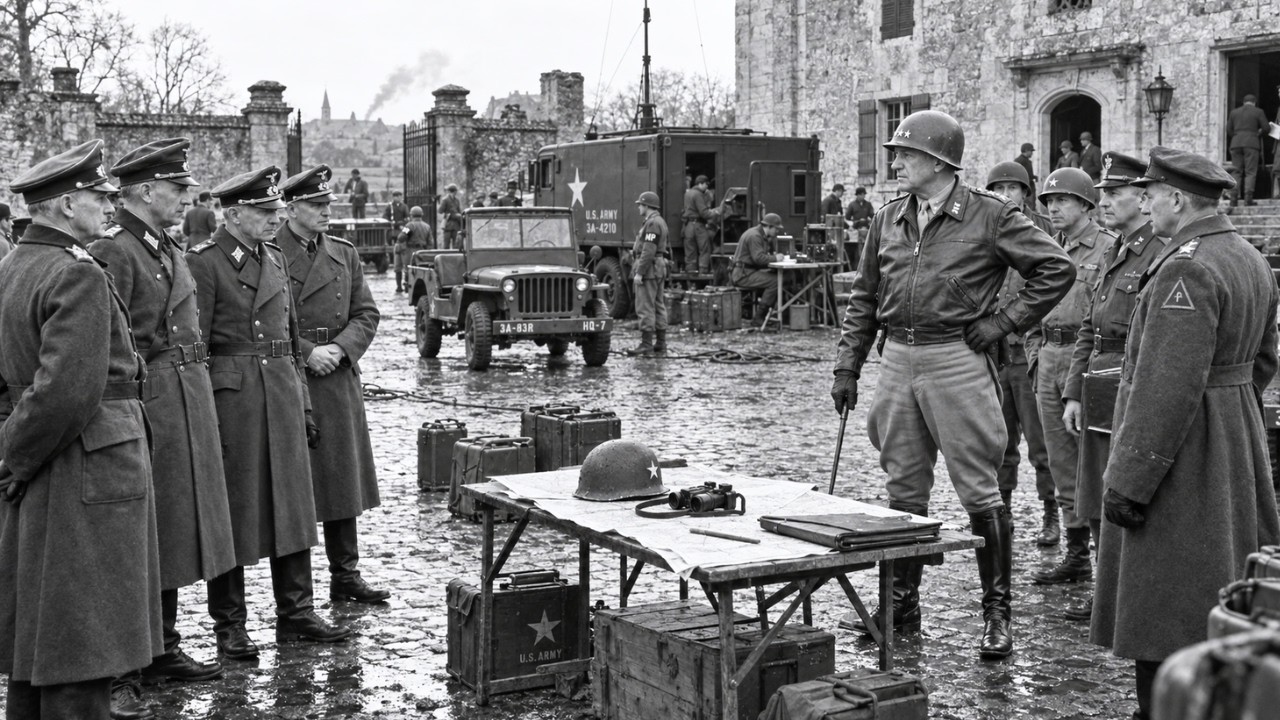
The dominant German model of the American soldier was a capable fighter—well-equipped, flexible, and not much concerned with ceremony.
Then they ran into Third Army uniform regulations.
Patton required his men to wear neckties under fire and in winter mud. Daily shaving was mandatory. Helmet straps were fastened at all times. Leggings were laced and worn properly. Officers who violated these standards received official reprimands.
Patton himself would stop a column, get out of his vehicle, and personally dress down any soldier whose appearance did not meet his standards. He fined officers for appearing before him in improper uniform. This was not theater. It was enforced consistently throughout the army’s operations in Europe.
Captured German officers processed through Third Army sectors in 1944 and early 1945 reported this pattern constantly. A German lieutenant colonel captured near Metz in November 1944 noted in his statement that the American troops guarding him were more precise in appearance than a Wehrmacht honor guard during a general’s parade. He meant it as an observation, not a compliment.
He said he found it difficult to reconcile with anything he had been told about Americans. Harder still to reconcile with an army that was simultaneously advancing faster than its own command could retreat.
—
The third item spread through German POW camps because prisoners talked, and the story was too strange to keep quiet.
It happened in December 1944, when the clouds over the Ardennes would not lift. Patton was moving north toward Bastogne. The German winter offensive had torn the American line, and the Third Army was ordered to execute a 90-degree turn in harsh winter conditions and attack the German flank.
Military historians still study the logistics of that turn. It worked.
But alongside his tactical orders, Patton issued an additional instruction with no precedent in Wehrmacht command doctrine. He called in the Third Army’s senior chaplain, Colonel James H. O’Neill, and ordered him to write a prayer for good weather.
A direct order.
O’Neill wrote it. Patton approved the text, made minor edits, and ordered it printed on pocket-sized cards—250,000 copies, one for every man in the Third Army, accompanied by a personal Christmas greeting from the commanding general.
The prayer specifically asked God to remove the clouds keeping Allied air forces grounded. It was distributed like ammunition.
The weather cleared four days later. Whether that connection means anything is a question for another debate. What matters here is what the incident revealed. A three-star general in the most powerful army in the world issued a prayer as an official military document, put his name on it, and distributed it widely.
Captured German officers who learned of this reacted in various ways. A major captured in the Saar in January 1945 told his American interviewer that in the Wehrmacht, a commander who attached a prayer to his operational orders would be quietly asked about the soundness of his mind.
He did not say this with contempt. He said it as a man who had encountered a system of measurement he had no scale for.
—

The fourth revelation was structural. German staff officers trying to model Third Army command rotation had real difficulty incorporating it into their analyses.
In the Wehrmacht, a regimental commander or division staff officer who performed acceptably kept his position. German military culture had a deeply rooted officer corps with strong traditions of institutional continuity. Men who did not make catastrophic mistakes kept their commands. Replacement was rare, often political, and always considered a sign of crisis rather than routine administrative action.
Patton relieved officers the way other commanders changed maps.
A colonel whose regiment arrived in chaos when Patton appeared without warning was replaced within 48 hours—not by court-martial, but quietly transferred, with a replacement arriving by the next morning. Patton kept an informal reserve of trusted officers who could be placed into command positions on short notice.
The turnover rate at regimental and brigade level throughout 1944 was astonishing by Wehrmacht standards. It was relentless. And the army did not slow down each time it happened. It often accelerated.
German intelligence officers tracking American command structures found this difficult to explain. In their framework, high command turnover was a symptom of organizational crisis, not an administrative tool.
A German colonel interrogated in February 1945 described the effect on his assessment work. Every time his team built an accurate picture of Third Army command structure, it became partially outdated within weeks. He said his officers began treating Third Army personnel records as living documents rather than fixed reference points.
Through a translator, he said: “They feared being replaced more than they feared being killed.” He said it as a cold clinical observation. It took a moment to realize why the American officer sitting behind the desk across from him was almost smiling.
—
The fifth item troubled German armored commanders specifically. It was the speed of something that was not supposed to be fast.
German air-ground coordination in 1944 worked through a chain of command. A field commander requested air support from his division, which sent it to the corps, which coordinated with the air force, which allocated aircraft and issued orders through its own structure. In good conditions, on a normal working day, this process delivered aircraft to the target within two to four hours.
In practice, it often achieved nothing because the target had already moved.
Now consider this. Patton’s armored columns had air liaison officers riding in the lead vehicles—in some engagements, in the first tank—with direct radio links to P-47 Thunderbolt groups flying standing patrols. A field commander who spotted a target, any target, could direct fighter-bombers toward it in under 15 minutes.
German tank commanders in fall 1944 reported a specific phenomenon in their after-action reports. American aircraft appearing over positions they had occupied for less than 20 minutes. Positions so recently taken that their own communications were not yet fully established.
They could not explain how they were found so quickly.
A captured armored commander near Lunéville described it in interrogation as less like air support and more like a weapons system that was tracking him before he stopped moving. His tank crews developed a behavioral response. They refused to stop in the open even briefly, because the interval between stopping and the appearance of aircraft had shrunk to something their doctrine could not absorb.
His men gave the American fighter-bombers a name that translates roughly to “the ones who are already coming.” The name came from the feeling that by the time you realize there is a problem, they are already in the air.
—

The sixth item was mechanical in its simplicity. German commanders took longer to accept its implications than to notice it.
Their military doctrine treated night as a natural operational pause for armored formations. The reasons were practical. Tank crews needed maintenance periods. Night navigation was difficult and dangerous. The risk of friendly fire in darkness outweighed most tactical benefits. And fighters who had been in contact since dawn were a depleted force by midnight.
German armored units made rest a structural assumption of their operational cycle. An experienced German staff officer could predict with reasonable confidence where any German armored formation would be at 3 a.m. To a close approximation: where it stopped at dusk, refueling and performing maintenance.
German intelligence applied this model to the Third Army. They were consistently wrong. It took weeks to realize the pattern was repeating.
Patton’s columns moved at night. Not always, and not every formation, but routinely—as a standard feature of the army’s operational rhythm rather than an emergency exception. Maintenance was done while moving or during stops measured in hours. The night march system was enforced and strict. Blackout conditions, reduced speed, road guides—but movement continued.
German commanders who designed defensive positions on the assumption of a nighttime halt found American armor arriving in darkness at places their doctrine said would not be occupied until noon the next day.
A captured German division commander in Lorraine in September 1944 described this to interrogation officers with a tone approaching exhaustion. He said his staff used standard Allied movement formulas, calculated rates, and predicted positions. “They were in places we calculated they would reach at noon the next day,” he said. “They were there at 3 a.m.”
He spread his hands in a gesture his interpreter noticed but did not try to translate into English. It did not need translation.
—
The seventh item was the hardest for German officers to explain because it touched the core of something they thought they understood correctly about American combat capability—and discovered they did not.
German military doctrine placed enormous weight on individual initiative at every level of command. Mission tactics—giving a subordinate an objective rather than a detailed scenario and trusting him to find the way—was essential to how the Wehrmacht thought about leadership and decision-making.
But it operated within a framework that placed that initiative primarily at the officer and senior NCO level. German soldiers fought fiercely and were well trained, but expecting tactical creativity from the bottom up stopped at a certain rank. The system was distributed, but not fully decentralized.
What German officers kept encountering in the Third Army, and failed to fit into their models, was an aggression that did not seem to require delegation from any level.
A platoon that found a gap in the German line pushed through it and reported afterward. A squad leader who identified an opportunity took it and explained to his commander later. American soldiers were making field decisions that in the Wehrmacht would have required, at minimum, explicit instructions from a company commander.
Intelligence officers interrogating German POWs through fall 1944 began noticing a pattern in the accounts. German prisoners kept describing American soldiers doing things beyond their expected roles.
A German captain who had led a company from Normandy to the Saar described an engagement near Saint-Lô to his interrogator. His company had killed two American lieutenants in quick succession. The American platoon kept attacking. He waited for the advance to stop. It did not.
He said: “The men did not seem to understand that they were supposed to wait for new orders.”
He said it without sarcasm or special emphasis, the way a doctor reports a symptom that does not fit the diagnosis he has already written. The interrogation officer filed the report and sent it up the chain of command.
That German captain spent the rest of the war in a camp in Kansas, eating three meals a day and wondering about the army he had just described. Patton never knew his name.
But what the captain was trying to express—that distributed stubbornness that was unstoppable and did not need permission from command—was exactly what Patton had spent two years building. An army that understood the purpose of orders and kept moving when the orders ran out.