Peggy Guggenheim moved through life with the confidence of someone who had nothing to lose, yet her two marriages were disasters of headline-making proportions. Both relationships drew public attention, ruined her sense of personal security, and left observers wondering how such a sharp-minded woman kept finding herself in catastrophic situations. The answer, in part, lies in a childhood that was far stranger and sadder than most people realize. Born on August 26th, 1898, in New York City, Peggy entered one of the wealthiest families in America.
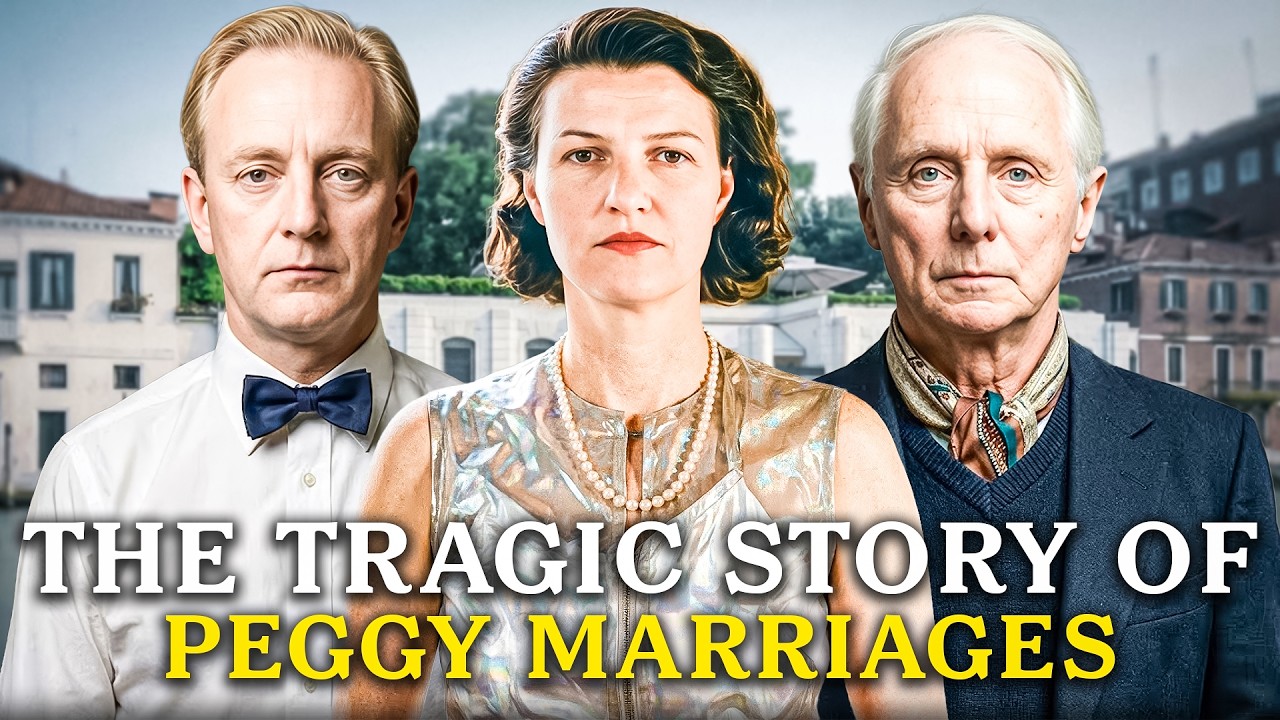
The Guggenheim fortune came from mining and smelting silver, copper, and lead, and the family name was synonymous with enormous wealth. But money did not protect her from tragedy. Her father, Benjamin Guggenheim, was a charming spender who frequently disappeared for long stretches. He was not a devoted family man, traveling constantly and openly keeping company with other women.
On April 14th, 1912, he boarded the RMS Titanic in Southampton, England, heading back to New York with his valet and a French singer he had been seeing. When the ship struck the iceberg, Benjamin reportedly changed out of his life jacket into formal evening clothes, saying he intended to die like a gentleman. He went down with the ship at age 46. Peggy was only 13.
His death triggered a financial unraveling the family worked hard to conceal. Benjamin had not managed his share of the Guggenheim wealth carefully. By the time his estate was settled, it was far smaller than expected. Peggy’s inheritance, held in trust, eventually amounted to several hundred thousand dollars, substantial by ordinary standards but a fraction of what her more business-minded relatives controlled.
The gap between being a Guggenheim and being treated as a lesser one followed her for decades. Her mother, Florette, was described by those who knew her as difficult, unstable, and deeply unhappy after her husband’s death. She clung to her daughters, Peggy and her two sisters, in ways that were smothering rather than comforting. The household became anxious, erratic, and frequently miserable, surrounded by money and grief.
Peggy grew up deeply self-conscious, particularly about her nose, which she considered her most unfortunate feature. She had it surgically altered as a young woman, though the result disappointed her and she claimed it made things worse. What she had, even then, was curiosity. She read voraciously and understood by her late teens that the world she was born into was not the world she wanted.
In 1919, at age 21, she came into a portion of her inheritance and left for Europe, first London, then Paris. She did not look back. Paris in the early 1920s was unlike anywhere else. The First World War had ended less than two years earlier, and the city was caught between grief and euphoria.
Artists, writers, and intellectuals gathered there, drawn by cheap rents and creative freedom. Gertrude Stein held her famous salon, James Joyce was finishing Ulysses, and Picasso, Brancusi, and Cocteau worked and argued through the night. Peggy walked straight into the middle of it. She was not yet a collector or patron.
She was a young American woman with money, a sharp eye, and a desperate desire to be taken seriously. She made friends quickly and fell in love with the work and the people around her. Her social currency was different in Paris than in New York. In the Guggenheim circle, money and lineage organized everything.
Among the artists of Montparnasse, what mattered was what you thought and how seriously you took the enterprise of making something. Peggy’s money was useful, but it did not earn her a place at the table. She had to earn that another way. In that world, she met Laurence Vail, the man who would become her first husband.
Vail was exactly the kind of man who made sensible people nervous. Born in America but raised in France, he was tall, handsome, and moved through Paris with easy confidence. He was a writer and painter, though better known for his personality than any body of work. His friends called him the King of Bohemia.
He was also, by multiple accounts, given to violent rages when he drank, which was often. Peggy was immediately captivated. He was everything her upbringing had trained her to avoid, unstable, extravagant, contemptuous of convention, and uninterested in domestic respectability. To her, those were features, not flaws.
They married in 1922, when she was 23. The marriage lasted eight years and contained more incident than most people experience in a lifetime. Early on, there was genuine warmth. They traveled constantly through France, Italy, and England, living in rented villas and cheap hotels, socializing with artists and writers.
Peggy later described the early years as genuinely happy, even joyful. They had two children, a son Sindbad in 1923 and a daughter Pegeen in 1925. But the marriage was cracking from the beginning. Vail’s rages were regular, not occasional.
When he drank, he became aggressive, humiliating, and sometimes physically violent. Peggy described incidents ranging from public screaming matches to situations where she feared for her safety. He threw things, grabbed her, and on multiple occasions attacked her in front of other people, including once in front of their children. The social world they moved in was not inclined to intervene.
This was Paris in the 1920s, among a crowd that prided itself on being above bourgeois concerns. Violence was treated as a private matter, and friends looked away. Part of what kept her there was the life surrounding the marriage. They summered on the French Riviera, where Gerald and Sara Murphy held court on the Cap d’Antibes.
F. Scott Fitzgerald was a recurring presence, as were Ernest Hemingway and Dos Passos. Peggy and Laurence were fixtures of one of the most celebrated social scenes of the century. During these years, Peggy also began developing her eye for art.
She looked constantly, in galleries, studios, and collectors’ homes. She formed opinions and learned to trust them, even against consensus. It was slow work happening invisibly alongside the drama of her marriage. In her memoir, written years later, she wrestled with why she stayed.
She talked about loving him, believing he would change, the children, and the fear of being alone. She admitted to pride, unwillingness to admit a mistake, and a conviction she could fix what was wrong. She could not. The end of the marriage accelerated with the arrival of someone new.
By the mid-1920s, Peggy had affairs of her own, partly in response to Vail’s infidelities. In 1928, she fell into a relationship with the English writer John Holmes, and it was with him that she found the clarity to leave. The divorce was finalized in 1930. It was not clean.
Vail fought over the children, and custody arrangements were emotionally brutal, though Peggy retained primary custody. He later married the writer Kay Boyle, with whom Peggy had a complicated and hostile relationship for decades. Even after everything, she and Vail maintained an uneasy connection for the sake of the children. The marriage taught Peggy she could endure far more than most people.
It also confirmed she was drawn to difficult men, brilliant and damaged, incapable of the steady affection she privately craved. Between her two marriages, Peggy spent years in England and Europe with John Holmes, the man she considered the great intellectual love of her life. Holmes was a writer of extraordinary promise who produced almost nothing. He was magnetic in conversation and utterly paralyzed when it came to putting words on paper.
Peggy adored him, organizing her life around him and suppressing her own ambitions for his sake. She later admitted she was more purely and helplessly in love with him than at any other point in her life. In January 1934, Holmes died unexpectedly during a minor surgical procedure. He was 37.
The anesthetic was mishandled, and he never recovered. Peggy was devastated, describing the loss as not just grief but disorientation. She eventually pulled herself forward through work. In 1938, she opened a gallery in London called Guggenheim Jeune, a wink at the famous Parisian gallery Bernheim-Jeune.
It was her first serious venture as patron and dealer, and it was where she developed the confidence that later made her one of the most important collectors of the century. The gallery ran for little more than a year before she closed it to pursue a museum. The project was interrupted by the outbreak of the Second World War. What followed was one of the most extraordinary periods of her life.
As France fell in 1940, Peggy kept buying art, claiming she bought a piece a day during the occupation. The prices were low, and she bought Leger, Dali, Ernst, Brancusi, Giacometti, and Miro, work later valued in the hundreds of millions. She had to fight to get it out of the country, packing canvases with personal belongings and shipping it to New York under the customs declaration household goods. In that chaos, she also made a decision about her personal life.
She married Max Ernst. Ernst was, by 1940, one of the most important artists alive. A founding figure of Dada and a central presence in surrealism, his paintings were hallucinatory and precise. He was born in Germany and, when Germany invaded France, he was in immediate danger as a German national whose work had been condemned as degenerate.
He had already been interned twice by French authorities in the early months of the war. Peggy had known him slightly for years. When she encountered him again in 1940 in desperate wartime Paris, she began buying his work and then became romantically involved with him. She was 41.
He was 49. Ernst was involved with another woman, the surrealist painter Leonora Carrington, who had suffered a severe mental breakdown while stranded in Spain. Peggy stepped in, using her American citizenship and money to arrange visas and passage out of Europe for a group of artists and intellectuals, Ernst among them. The logistics were nightmarish, and the stakes were life and death.
Peggy navigated it with determination and personal financial support. They arrived in New York in July 1941. On December 30th of that year, five months after arriving, they were married. Almost no one who knew either of them thought it was a good idea.
The marriage was troubled from the start. Ernst had not stopped loving Carrington, and when she eventually made her own way to New York, the situation became quietly agonizing for Peggy. More immediately disruptive was the arrival of Dorothea Tanning, an American surrealist painter who met Ernst at a party in 1942, barely a year into the marriage. He was immediately and obviously taken with her, making little effort to conceal the deepening connection.
Peggy’s response was complex. She was angry, and she expressed it in characteristic fashion, not by retreating but by escalating. She continued to run her gallery, which had opened in New York in October 1942 under the name Art of This Century. The gallery was a sensation, housed in a space designed by Frederick Kiesler with curved walls, rope-hung canvases, and theatrical lighting.
It became one of the most important venues in New York, supporting artists including Jackson Pollock, Robert Motherwell, and Mark Rothko. The Pollock relationship deserves special mention. Peggy was introduced to his work by the artist and critic Howard Putzel. Pollock was not an easy sell, his paintings were large, violent, and unlike anything being made in New York.
Several European surrealists were skeptical. Peggy trusted her instincts and commissioned Pollock to paint a mural for her townhouse, a canvas roughly 8 feet high and nearly 20 feet wide. Pollock reportedly stared at the blank canvas for months and then, the night before the deadline, painted the entire mural in one extended session. The result was a work of startling power.
Peggy showed it, championed it, and gave Pollock the institutional support that allowed him to keep working. Ernst, meanwhile, was barely present in the work making Peggy’s reputation. The marriage ended in 1943, less than two years after it began, when they separated. The divorce was finalized in 1946.
Ernst married Tanning that same year, and they remained together for the rest of his life. Peggy did not disappear. She continued the gallery and collecting, and in 1947 decided to leave New York for Europe. She settled in Venice in the Palazzo Venier dei Leoni on the Grand Canal, which she purchased and made her permanent home, exhibition space, and legacy.
She never married again. Peggy Guggenheim was not naive, and she was not, in any straightforward sense, a victim. She made choices with her eyes open. The marriage to Vail cost her years of physical and emotional safety.
The children, Sindbad and Pegeen, were affected in real and lasting ways. Sindbad lived a largely quiet life out of his mother’s orbit. Pegeen became a painter of genuine talent but struggled with depression and emotional fragility throughout her adult life. In 1967, Pegeen died in Paris at 41.
The circumstances suggested she had taken her own life, though details were never made fully public. Peggy, who was in Venice at the time, never recovered from it. The marriage to Ernst cost Peggy her dignity in the grinding way that comes from being publicly, obviously second best. She had helped him escape Europe, brought him to safety, and married him.
He turned almost immediately toward someone else with little guilt and no discretion. What kept Peggy from being defined by these losses was work. Art of This Century was her answer to everything the marriages had taken from her. It was hers, funded by her money, driven by her eye.
When she championed Jackson Pollock, giving him a contract and his first solo exhibition in 1943, she acted on her own judgment against the skepticism of almost everyone. She was right, and the world eventually caught up. In the last decades of her life, Peggy became a monument. She lived in the Palazzo Venier dei Leoni from 1949 until her death, opening the garden and ground floor to the public each summer.
Her collection drew visitors from around the world. She was impossible to miss in Venice, small, frequently barefoot, always in large sunglasses, often with a small dog tucked under her arm. She wrote a memoir, first published in 1946 under a deliberately provocative title, later revised and republished as Confessions of an Art Addict and more fully as Out of This Century. The book was frank to a degree that shocked readers.
She wrote about her marriages and lovers with specificity that made former companions furious. She did not cast herself as a saint or a villain. The central tension of her life came through clearly, a woman who had everything the world said you needed, money, fame, friends, artistic achievement, and who had also been repeatedly and sometimes devastatingly alone. The marriages had not given her what she wanted.
What she wanted, when she let herself admit it, was to be loved with the same intensity and steadiness she was capable of giving. Vail had been too angry. Holmes had died. Ernst had been emotionally elsewhere from almost the beginning.
The others, companions rather than partners. Asked late in life how many lovers she had had, she reportedly gave a large number and added, with dry humor, that she couldn’t be entirely sure of the count. It became a famous anecdote, proof of her liberation. Read differently, it was a woman describing a search that never quite ended.
She continued adding to the collection into her 70s and lobbied for years to ensure its preservation, arranging for it to pass to the Solomon R. Guggenheim Foundation after her death. She died on December 23rd, 1979, in Camposampiero, Italy, following a stroke. She was 81.
Her ashes were buried in the garden of the Palazzo Venier dei Leoni alongside the graves of her dogs. The palazzo and collection are now the Peggy Guggenheim Collection, one of the most visited museums in Italy. Both men she married were artists, charismatic and difficult and magnetic. Both required her to subordinate some part of herself, her safety with Vail, her dignity with Ernst.
Both marriages ended badly in ways that were painful and public. Yet Vail introduced her to the world she would spend the rest of her life in. He was the door through which she walked into bohemian Paris and the art world that shaped her taste and ambitions. Ernst was part of her collection before he was her husband, and the eye that recognized his work was the same eye that recognized Pollock.
The Paris art world of the 1920s and 1930s, for all its radicalism, had a traditional relationship with the women inside it. They were patrons, models, muses, lovers, but rarely celebrated figures in their own right. Peggy occupied all of those roles and chafed against them. What she became, a collector, curator, and institution in the deepest sense, was something she largely had to invent as she went.
The woman buried in the garden of the palazzo, surrounded by the art she had spent a lifetime gathering, was not defined by what happened to her in those marriages. She had, despite everything, defined herself.