JACK RUBY USED TO BABYSIT THE GIRL WHO WOULD BECOME KIM DARBY IN A DALLAS NIGHTCLUB
Decades before he shot Lee Harvey Oswald on live television, Jack Ruby once looked after a sleeping child in the back of his Dallas nightclub. That child grew up to become Kim Darby, the young actress who starred opposite John Wayne in the 1969 classic “True Grit. ” The unlikely connection between a nightclub owner and a Hollywood starlet is one of the strangest footnotes in American pop culture history. Darby was born Debra Zerby on July 8, 1947, in Los Angeles.
Her father, John Zerby, came from a family of vaudeville performers, and her grandfather was a head dancer in a revue. Her mother, Inga Wer, was a Hungarian-born performer from Budapest, sister to the Wer Brothers, three European clowns known for dazzling nightclub acts and appearances on the Ed Sullivan Show. Her parents danced together as the Zerby Dancers, performing in supper clubs and Las Vegas showrooms during the 1940s and 1950s. Her parents divorced when she was about two years old, and in an unusual decision for the time, the courts granted custody to her father.
Because he was a traveling performer, her grandparents largely raised her. She made her stage debut at age three, when a comedian called her up in a Las Vegas showroom and introduced her as the show’s manager. She stayed in the act until she started school. Her father chose her stage name, Derby Zerby, thinking it would make a great show business name.
The name became a burden once she reached school age, and her classmates mocked her relentlessly. She later said she chose the name Kim after the prettiest girl in her school, then changed Derby to Darby because of its similarity. Thus Kim Darby was born. She studied dance with her father and with Niko Charisse, but acting ultimately captured her attention.
At 14, she joined the Tony Barr acting workshop at Desilu, the studio built by Lucille Ball and Desi Arnaz. Barr was impressed by her emotional openness and moved her from the youth class to the adults class. She soon began booking small television roles, appearing in series like “Dr. Kildare,” “The Fugitive,” “Bonanza,” and “The Man from U.
N. C. L. E.
” In 1966, she played the lead in “Miri,” an early episode of “Star Trek,” portraying a girl on the verge of womanhood on a planet where a plague wiped out all adults. THE ROLE THAT CHANGED EVERYTHING
The role that would define her career came from an unlikely source: a television screen. Producer Hal B. Wallis was watching an episode of the Ben Gazzara series “Run for Your Life” when he spotted Darby and decided she was his Mattie Ross.
Wallis had purchased the film rights to Charles Portis’s novel “True Grit,” outbidding John Wayne himself, who had wanted the rights so badly he put up $300,000 of his own money. Wayne was set to play Rooster Cogburn, the fat, drunken, one-eyed federal marshal hired by a 14-year-old Arkansas girl to track down her father’s killer. The role of Mattie was highly coveted. Wayne wanted his daughter Aissa, but Wallis and director Henry Hathaway refused.
Mia Farrow accepted the role, then withdrew after Robert Mitchum convinced her to back out with frightening stories about Hathaway’s temper. Tuesday Weld turned it down. Wayne asked Karen Carpenter to audition. Elvis Presley was considered for the role of Texas Ranger LaBoeuf until Colonel Tom Parker demanded Elvis get the lead instead of Wayne.
Darby did not want the part. She turned it down three times. She was 21 years old, married to actor James Stacy, and a new mother about to become a single mother. In 1968, she married Stacy, whose real name was Maurice William Elias, a handsome television actor who had survived a previous Hollywood marriage to actress Connie Stevens.
She gave birth to their daughter, Heather, and the couple quickly separated. She later told critic Roger Ebert that she accepted the role for partly artistic and partly practical reasons. She began filming two weeks after giving birth. She told Ebert that Wallis kept insisting, and she finally accepted not only because the role was wonderful, but for personal reasons, because she had to think about supporting her family.
FILMING WITH JOHN WAYNE
Filming in Colorado as a single mother of a 21-year-old playing a 14-year-old was not easy. Hathaway attacked her on the first day. She said she was taken completely by surprise, got up, and went back to her dressing room. Eventually they reached an agreement on her terms.
She recalled telling him she would do anything he wanted, just never to yell at her again. She was not the only one Hathaway clashed with. Robert Duvall, who played outlaw Ned Pepper, developed such hostility toward him that his summary of the production was a study in omission. Duvall said Wayne was a wonderful man, but Hathaway was a subject he would not discuss.
Dennis Hopper was also in the film, and the set was full of conflict between old lions and ambitious young people who could not stand each other. With Wayne, there was barely any conversation. The Duke was 59 and dying of lung cancer, uninterested in the young actress the producer had hired over his objections. They hardly spoke off-camera.
His verdict on her varied. At times he called her the worst actress he ever worked with. At other times he spoke more kindly, and his opinion seemed to shift depending on circumstances. Darby spent years making sharp comments to journalists, then retreated from them in later decades.
She said she sometimes told people she hated Wayne and hated Henry, but admitted she never hated John. She said she never knew him and they never spoke. It was less a feud than a mutual misunderstanding between a middle-aged conservative icon and a 22-year-old whose entire generation opposed his war. She said she knew her peers did not like him, but she did not know he was a legend at the time, though she later recognized he was a great figure.
She believed she only found the real Mattie in the final scenes, which were the last ones filmed. She said she only acted well in the cabin scenes because she was no longer worried about her baby and her ex-husband. But on screen, her Mattie is full of grit and daring, a small person with enormous willpower who corrects killers’ grammar and haggles with a horse trader. Wayne himself acknowledged that his most tender scene, when Rooster sits by the campfire and confides his failed attempts at marriage and fatherhood, was the best acting he ever did.
Much of that success depended on Kim Darby listening. THE HOLLYWOOD MACHINE
“True Grit” premiered in the summer of 1969 and went straight to the top of the American box office. The Academy gave Wayne the only Oscar of his career. Darby received a BAFTA nomination for Most Promising Newcomer, and everyone agreed a star had been born.
Everyone assumed the industry would open up for her. But the very thing that made her suddenly in demand also made her difficult to categorize. She did not look or sound like the polished ingénues the studios were producing. She seemed like a real girl, with a slightly flat nose, simple beauty, a monotone voice, and a habit of thinking before speaking.
She was an early prototype of the more natural, unadorned women who would fill the 1970s. The problem with being new, of course, is that no one knows yet who you are. Once the novelty wore off, the machine that had recruited her could not decide whether she was a leading lady or a supporting actress, innocent or neurotic. So it simply stopped deciding.
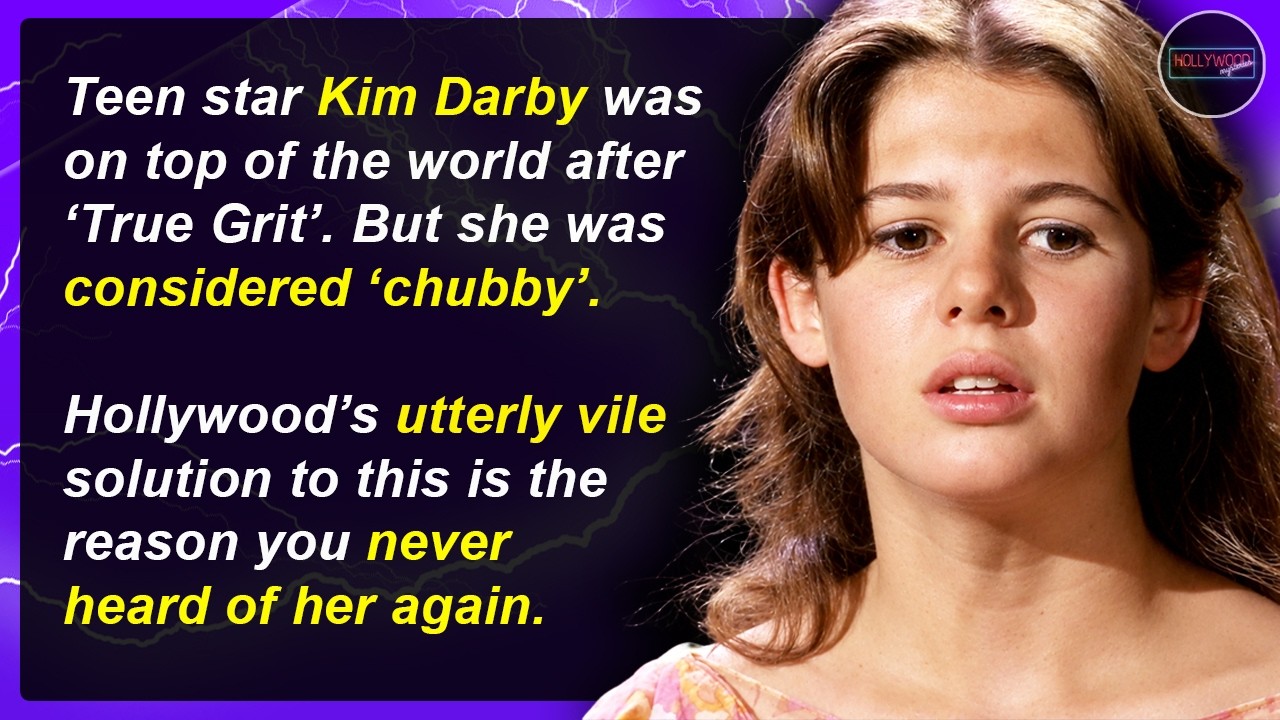
She was still carrying baby weight during “True Grit,” and Hollywood decided she needed to be transformed into a movie star. Her agents and managers expected it. One way she achieved it was becoming dangerously thin. The unhealthy method was amphetamines.
What began as a diet turned into an addiction and eating disorder lasting 16 years. At its worst, the girl who had outmatched John Wayne dropped to a dangerously low weight. She continued appearing on television as America’s girl next door while starving behind the scenes. She later told an interviewer in 2011 she had been drug-free for 35 years, saying she was very lucky she survived it all.
The drug that was supposed to give her a movie star body actually destroyed the career it was meant to revive. The same year as “True Grit,” she made “Generation,” a counterculture comedy about a father dealing with his pregnant daughter’s plan for a home birth, earning a Golden Globe nomination. Her co-star was Pete Duel, a handsome young actor who committed suicide within two years. In 1970, she made “Norwood,” an inconsistent film assembled to turn Glen Campbell into a movie star, playing another abandoned pregnant girl.
That same year, she appeared in “The Strawberry Statement” as the college student who tempts Bruce Davison into campus radicalism. She was everywhere, but none of it worked. A PATTERN OF MISSED OPPORTUNITIES
In 1971, her luck turned in a way that had nothing to do with her. She was cast opposite Elliott Gould in a modest Warner Bros.
production called “A Glimpse of a Tiger. ” Gould, then at the height of his short-lived stardom, was behaving so strangely on set that the studio fired him and shut down production entirely. The disaster briefly made him uninsurable and permanently damaged his career. Warner Bros.
handed the project to Peter Bogdanovich, who rebuilt it into the hit comedy “What’s Up, Doc? ” Darby was attached to a film that not only collapsed but was quickly remade without her as a hugely successful film for someone else. It became a recurring pattern. That same year, Robert Aldrich’s “The Grissom Gang” was released, a dark and sweaty Depression-era thriller in which she played Barbara Blandish, a spoiled heiress kidnapped by a family of stupid sadists.
One of them, played by Scott Wilson, develops a sick and possessive love for her. The film was brutal, ugly, and masterfully made, and it flopped so badly it barely recovered a fifth of its budget. In a final Hollywood joke, a supporting role went to Connie Stevens, the first wife of James Stacy, meaning Darby shared the shooting schedule with her ex-husband’s ex-wife. The film has admirers now, though it had almost none then.
While her film career struggled, she made something that would endure. In 1973, she starred in “Don’t Be Afraid of the Dark,” an ABC television movie about a young wife named Sally who inherits a gloomy old mansion and is slowly stalked by a colony of whispering creatures that want to drag her into the darkness. The film is only 74 minutes long and was made on a tiny budget, but it is genuinely and permanently terrifying. One child it terrified was a young boy in Guadalajara named Guillermo del Toro, who grew up to direct “Pan’s Labyrinth” and in 2010 produced a lavish remake as an homage.
Del Toro said he thought the original was the scariest film on earth and that it had been precious to him for a very long time. Darby’s Sally transforms from competent and energetic to full hysteria as the house consumes her. The film aired only once, on a Wednesday night in October 1973, then lived for decades through reruns and poor-quality tapes that 1970s children passed around like contraband. Television kept faith in her long after cinema abandoned her.
In 1976, she played the mentally disturbed Virginia Calderwood in “Rich Man, Poor Man,” the massive adaptation of Irwin Shaw’s novel that largely established the American miniseries, earning an Emmy nomination. She was always skilled at playing damaged women, the girl with the fixed smile, the wife or daughter whose bad day is about to collapse. During the 1970s, she worked almost without interruption in television movies, playing Calamity Jane one season, a female outlaw in the Pretty Boy Floyd story the next, and in “Enola Gay,” the wife of the pilot who dropped the atomic bomb on Hiroshima. It was steady work that took her everywhere except the top.
TURBULENT PERSONAL LIFE
If her career was a series of missed opportunities, her personal life was a series of brief encounters. After her divorce from Stacy, she married actor James Westmoreland in February 1970, a man she had known only three weeks. The marriage lasted 47 days. One movie magazine extracted a title from it: “The Marriage That Was.
” Her third marriage was stranger. She married William Tennant, known as Bill, one of the most prominent Hollywood agents and executives of the early 1970s, the man who made deals for films like “Easy Rider” and “Rosemary’s Baby,” who later ran production during the era of “Taxi Driver” and “Close Encounters of the Third Kind. ”
But Bill Tennant carried a horrific secret few of his clients could have imagined. He was Roman Polanski’s agent and close friend.
On the morning of August 9, 1969, Tennant was called to Polanski’s home at 10050 Cielo Drive. It was Tennant who identified the mutilated body of Polanski’s pregnant wife, actress Sharon Tate. It was Tennant who phoned Polanski in London to tell him. He said there had been a catastrophe at his home.
Sharon was dead, along with Voytek, Jay, and Abigail. So the little girl who had been cared for by the man who shot Oswald grew up to marry the man who found Sharon Tate’s body. Kim Darby had a near-supernatural talent for standing just outside the darkest events of her decade. Tennant’s end was long and tragic in itself.
Cocaine destroyed his marriages, then his money, then his home. The golden boy of 1970s Hollywood spent years in abject poverty before his death in 2012. Darby rarely spoke about any of it. One interviewer later noted she had suffered a series of dysfunctional, often tragic relationships with talented young actors.
THE FATE OF HER DAUGHTER’S FATHER
Then there was the fate of the man who fathered her only child. It happened far from her, but cast a shadow over everything around her. On September 27, 1973, James Stacy took his girlfriend for a motorcycle ride through the Hollywood Hills. A drunk driver hit them head-on.
His girlfriend, a young woman named Claire Cox, was killed instantly. Stacy lost his left leg and left arm. He later said he felt his mind separating from his body and thought everything was over. It was not.
Stacy won a landmark lawsuit against the bar that had over-served the driver, returned to acting with the help of friend Kirk Douglas, who wrote him a role in the western “The Guns of Will Sonnett,” and earned Emmy nominations for roles playing broken and wounded characters. Two decades later, the story took its final dark turn. In 1995, Stacy was accused of molesting an 11-year-old girl he had invited to swim at his home. He fled to Hawaii, threw himself off a cliff in a suicide attempt, survived, was extradited, and in 1996 was sentenced to six years in prison.
He died in 2016. This was the father of Heather Elias, the child Kim Darby left in Los Angeles to play Mattie Ross, another terrible event in a series of terrible events that always seemed to happen around her while she stayed out of the frame. By the late 1970s, the woman everyone had predicted would be a star was, in the cold terminology of the film industry, difficult to cast. She had a specialty by then, and she hated it.
At some point she was recategorized as a suffering character, and every offer that came her way was for what she called the miserable girl role. So she stopped. For nearly three years, she did not even read scripts. She raised Heather and sat with herself.
When Roger Ebert met her again in 1978 to promote the Henry Winkler film “The One and Only,” she sat on a hotel couch eating cottage cheese and spoke with an honesty Ebert found heartbreaking. She said she wanted to improve herself, that she was tired of stereotyped female roles. She told him she would never play a victim again, noting that people always called her for miserable roles, which was funny because she had been tougher than John Wayne in “True Grit. ” When Ebert said he would have preferred her in “The Goodbye Girl,” she replied as a working single mother, not as a burned-out star.
She said raising a daughter alone was a big responsibility, and added quietly that she knew a little something about raising a child alone. When asked which actor she would most like to work with, she named Woody Allen, explaining she found weakness in a man attractive and that false masculinity faded quickly. A COMEBACK AND RECONCILIATION
The comeback came in comedy. In 1985, a 24-year-old writer-director named Savage Steve Holland cast her as the mother in “Better Off Dead,” a dark teen comedy about a lovesick boy, played by a young John Cusack, whose repeated suicide attempts keep failing in darkly comic ways.
Darby played Mrs. Meyer, a crazed smiling housewife completely oblivious to her son’s despair, serving heavy meals and wrapping Christmas dinners. In the film’s most quoted scene, she presents an entirely French menu with a strange accent: “We’ve got french fries, french dressing… ” She said she loved it because she was not required to cry.
After a career spent being forced to cry on demand, she finally got to be intentionally funny, and a new generation embraced the film with cult passion. Years later, at a pre-screening Q&A, she stood and listened to an entire theater recite her dialogue word for word, comparing it to a “Rocky Horror” experience. She settled happily into her comedic niche. In 1987, she played a biology professor in “Teen Wolf Too” opposite young Jason Bateman.
In 1995, she played the adoptive mother of Laurie Strode in “Halloween: The Curse of Michael Myers,” closing a strange circle by joining the horror machine she had helped invent with “Don’t Be Afraid of the Dark. ” In 1999, she gave one of her last truly affecting performances in “The X-Files,” playing a broken woman who confesses to killing her missing son. The episode dealt with the unbearable weight of losing a child, and Darby performed it with a steadiness that stopped the entire episode. By that time, she had reinvented herself again.
In 1990, she began teaching acting throughout Los Angeles. From 1992 to 2009, she taught in UCLA Extension’s continuing education program, where her classes became a prerequisite for all film students in the entertainment studies program. A generation of ambitious young directors absorbed the basics of screen acting from the original Mattie Ross, often without realizing who she was. It suited the woman who had hidden behind the image of a fragile girl all along.
She said people underestimated her, but she was very stubborn and did what she had to do to accomplish anything. She insisted she was not a weak girl or a victim. When the Coen brothers remade “True Grit” in 2010 with 13-year-old Hailee Steinfeld, Darby was impressed. She called the new film a masterpiece and warmly congratulated the girl who had inherited her role, along with the Oscar attention that had eluded Darby.
She seemed to have made peace with being the first Mattie, though not the famous one. Kim Darby spent her life one step away from the immense events swirling around her: cared for by a killer, married to a man who found a murdered young star, mother of a child fathered by a man the world would come to hate, nominated for stardom that kept passing to other women while she fought a private war with her own body that nearly killed her. She was rarely in the center of the frame, but again and again, she was the figure at the edge of the image you could not look away from.