Gunfire ripped through the narrow kitchen corridor of the Ambassador Hotel just after midnight. A woman’s scream cut through the chaos as bodies scattered, chairs toppled, and a rack of dishes crashed to the tiled floor. While most people fled in the opposite direction, one man moved straight toward the sound. Roosevelt Grier was 6-foot-5 and weighed nearly 300 pounds.
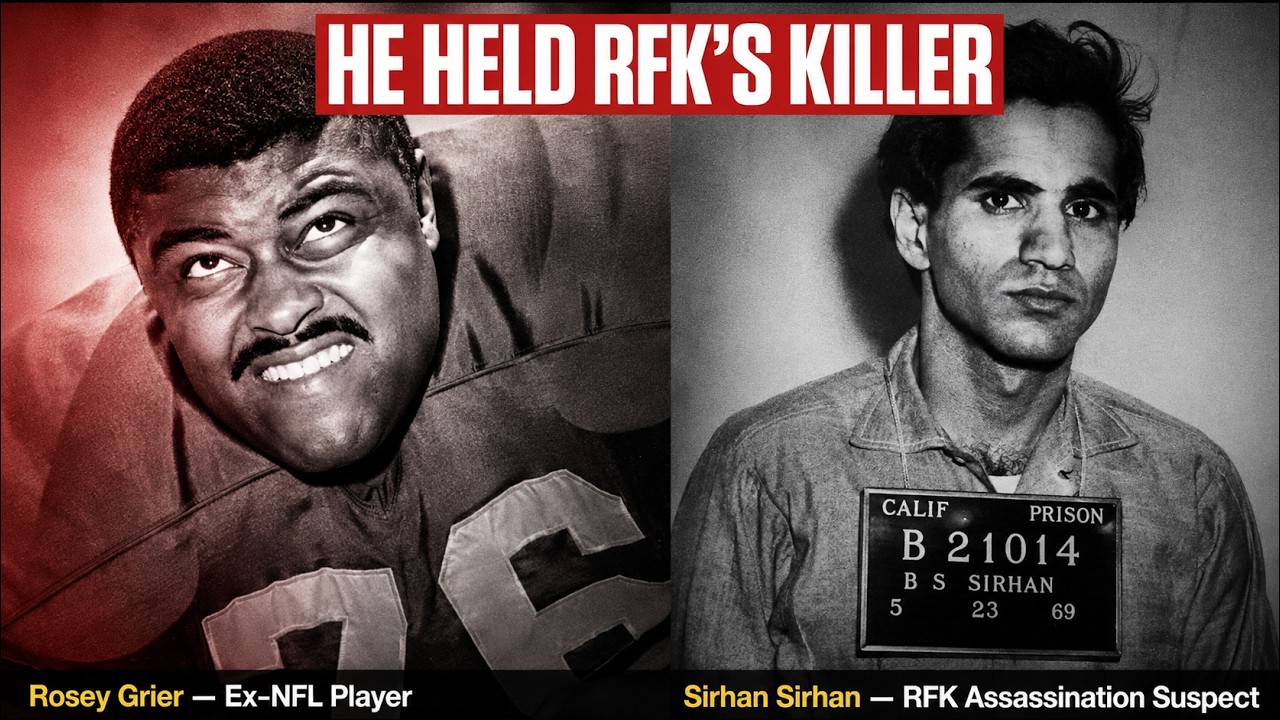
He had spent 13 seasons in professional football as a dominant defensive lineman, part of the Los Angeles Rams’ fearsome front four known as the “Fearsome Foursome” alongside Merlin Olsen, Deacon Jones, and Lamar Lundy. By the mid-1960s, his string of Pro Bowl seasons made him one of the most recognizable faces in football. He retired in 1967. The game had finally taken its physical toll.
After leaving football, Grier surprised those who knew him only as an athlete by moving into acting and music. A man of his size taught himself needlework, sitting openly with embroidery between takes on film sets, publicly rejecting the idea that his build required him to be menacing at all times. In the spring of 1968, Robert F. Kennedy announced his campaign for president.
Something about the candidate affected Grier in a way politics never had before. “This man meant so much to me,” he said decades later. “He was my hero. ” Grier was particularly moved by how Kennedy handled the news of Martin Luther King Jr.
‘s assassination in Indianapolis weeks earlier, choosing to announce the killing personally to a stunned crowd instead of taking the safer option of silence. Grier volunteered informally to help the campaign however he was needed. He ended up serving as an unofficial bodyguard alongside Olympic decathlon champion Rafer Johnson, another close Kennedy friend who had left his broadcasting career to help. On the night of June 4, 1968, at a campaign rally inside the Ambassador Hotel, Kennedy singled out Grier from the platform, joking to the cheering crowd that his friend would “take care of anybody who didn’t vote for me.
” The room laughed. No one there knew how soon those words would take on real meaning. The 1968 campaign was unlike anything American politics had seen. The country was still raw from King’s assassination.
Vietnam was tearing the Democratic Party apart. President Johnson had already announced he would not seek reelection. Kennedy, more than any other candidate that year, drew physical crowds that pressed in on him, reaching out to touch his sleeves and hands. He repeatedly refused to place any physical barrier between himself and voters, even as it alarmed those around him.
There was no Secret Service protection for candidates in 1968. Kennedy’s protection consisted of former FBI agent William Barry, plus Johnson and Grier, two athletes with no formal security training beyond their size, reflexes, and loyalty. For weeks before the California primary, that meant motorcades through San Francisco, Riverside, Long Beach, and San Diego, with Johnson and Grier taking turns escorting Kennedy or riding in the support car, absorbing the push of crowds with their bodies. On June 4, Kennedy narrowly won the California primary, a result that put him within genuine reach of the Democratic nomination.
Just after midnight, he took the stage in the hotel’s Embassy Room, thanked the crowd, and prepared to head to a press conference on the other side of the building. The most direct route ran through the hotel’s kitchen pantry. Grier, technically off duty that night, had come to celebrate with his friend. He was given one task: stay close to Ethel Kennedy, who was pregnant, while crowds surged around them.
As Kennedy was led off the stage into the kitchen corridor, a 24-year-old drifter named Sirhan Sirhan was already waiting there, a rolled-up campaign poster hiding a . 22 caliber pistol. Sirhan stepped forward as Kennedy passed, close enough to touch him, and opened fire. Kennedy fell to the ground, hit by three bullets in seconds, while a fourth tore through his jacket without striking him.
Sirhan kept firing, hitting five bystanders in the panic before anyone could reach him. Paul Schrade, William Weisel, Ira Goldstein, Elizabeth Evans, and Irwin Stroll. None were the intended target. They were simply standing in a crowded corridor at the wrong moment.
A radio reporter following the Kennedy entourage that night, with his tape recorder still running, captured the chaos in real time. He yelled into his microphone for Rafer Johnson to take the gun, to grab the shooter’s thumb and break it if necessary. William Barry lunged. Rafer Johnson lunged.
Grier, who heard what he later described under oath as “sounds more like firecrackers than gunshots,” moved toward the noise with the only instinct 13 NFL seasons had trained into him. You stop a man by attacking his legs. Grier grabbed Sirhan and held him against a steam table while the smaller man thrashed to break free. Writer George Plimpton, who was also in the pantry that night, struggled to wrench the pistol from Sirhan’s grip, finding himself at one point staring down the loaded barrel, a wrong wrist movement away from a second tragedy in the same 30 seconds.
Plimpton couldn’t quite do it. Grier reached out, took the pistol himself, and put it in his pocket to get it away from everyone, including the crowd now surging into the narrow corridor behind him. Then came the part almost no one outside that kitchen fully understood. As word spread through the crowd that Sirhan was the shooter, men began shoving toward him, grabbing at his legs, trying to pull him from Grier’s grasp to get their hands on him.
Someone screamed to break his thumb. Others threw punches over the shoulders of the men in front of them, indifferent to who they might actually hit. Grier, who had just watched his political hero shot three feet away, made a decision in that moment that surprised even those standing beside him. Instead of stepping back and letting the crowd take Sirhan, Grier threw his body over the shooter, using the size and strength that had made him a professional football player to physically protect the man who had just killed his friend, absorbing blows meant for someone else.
“I didn’t want any more violence,” he later said of his decision. This was a man who had watched, two months earlier, the country come apart after King’s assassination. He had been drawn to Kennedy precisely because of how Kennedy handled grief and anger without resorting to more of either. In the same place where his friend was dying, Grier chose, within seconds, without time to think and without anyone ordering him, not to let that spiral claim a second life that night.
What happened to the gun itself was never fully agreed upon, even by the men who were there. In Grier’s own account, which he repeated consistently across decades of interviews, he put the weapon in his pocket after taking it from Sirhan’s hand and only handed it over when Rafer Johnson asked for it moments later once things calmed. Other eyewitness testimony from the time, including FBI interview reports conducted in the days after the shooting, described Johnson as more directly involved in wrenching the gun away in the first place, with some saying Johnson’s hands were on the weapon before Grier’s closed over them. The radio tape from that night captured screams for Johnson first, urgently, as the man who got the gun, which some writers later took as evidence for Johnson’s account, while others interpreted it simply as the person closest to the recorder at that particular moment.
Neither man ever publicly disputed the other’s version or tried to diminish what the other did that night. A restraint unusual for two public figures who could have plausibly spent decades arguing over who deserved more credit. What is certain is this: two men completely unfamiliar with police work, without any training for such a moment, were the only thing standing between Sirhan Sirhan and a corridor full of people who wanted him dead. History has never needed to determine whose hand closed over the gun first to know that both mattered.
By the time police took Sirhan into custody, Grier was sitting on the pantry floor, sobbing. The mortally wounded Kennedy had already been loaded into an ambulance. Grier later described sitting there crying until a voice interrupted, asking whether he still had the gun, and he handed it over. Kennedy died the next day, less than 25 hours after taking the stage to celebrate a primary victory that was supposed to carry him to the presidency.
In the months and years that followed, Grier said he cried nearly every night, replaying the details of that evening over and over, wondering whether things might have gone differently if Kennedy had walked toward him instead of away. An unanswerable question he carried privately for the rest of his life. He continued writing and singing about grief in a song called “People Make the World,” becoming, almost unintentionally, one of the clearest examples in American public life that it was acceptable for a physically imposing man to grieve openly, to cry in public and call it strength rather than weakness. After being ordained as a minister later in life, he summarized that night simply: “It was a tragedy for the world, because everyone in that room was trying to build something better, and then evil broke out anyway, indifferent to how much good intention stood in its way.
”
The man who spent his entire football career being paid to hit people as hard as the rules allowed spent the worst night of his life doing the opposite, standing between an enraged crowd and the one person in that corridor everyone wanted destroyed. He never had the chance to save his friend. Instead, he made sure that saving was the one thing still within his control.