The legend of Major Richard Winters, the unflappable commander of Easy Company, has been etched into the annals of military history, largely thanks to Stephen Ambrose’s seminal book and the acclaimed HBO miniseries Band of Brothers. Yet, the most enduring and controversial enigma to emerge from that brotherhood is not the story of a battle won, but the whispered allegation of a war crime committed by one of their own: Captain Ronald Speirs. For decades, the question of whether Speirs executed unarmed German prisoners has haunted historians, veterans, and fans of the series alike.
Now, newly surfaced audio from an interview conducted in the early 2000s reveals Major Winters’s startling personal conclusion on the matter, a conclusion that suggests the rumors were not just battlefield gossip, but a grim reality.
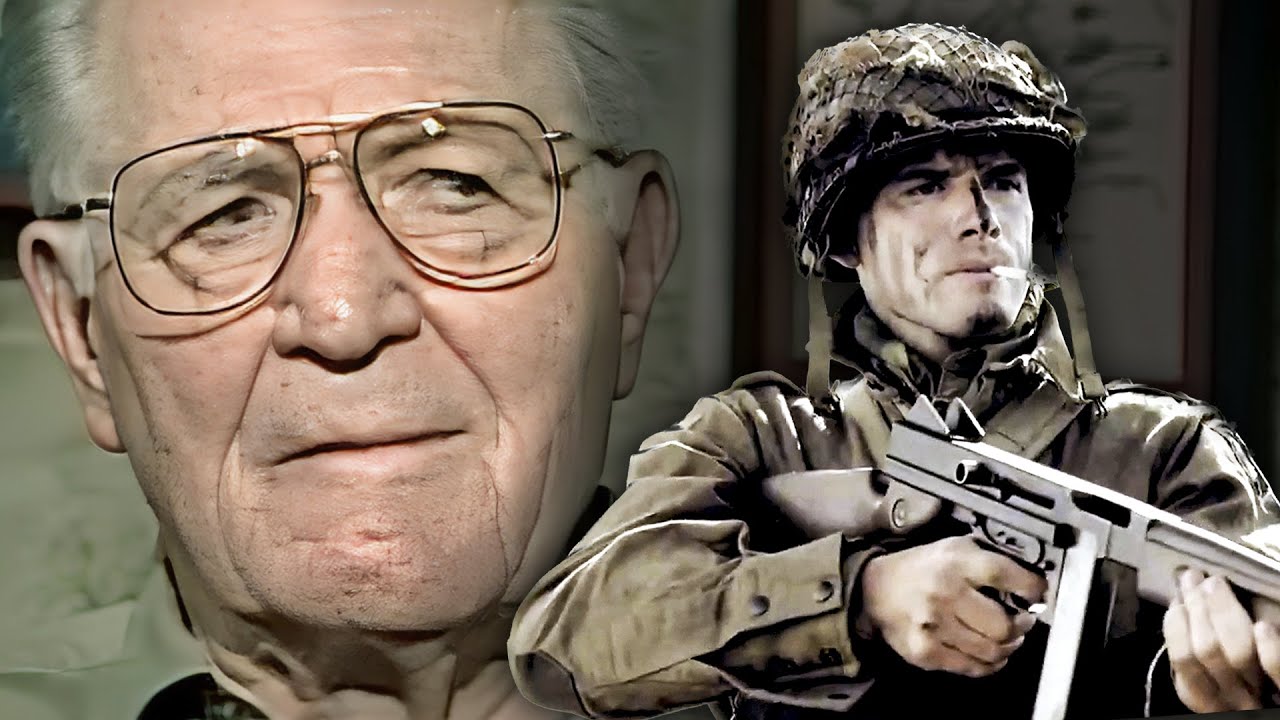 The revelation comes from a conversation between Winters and former Pennsylvania State Representative John D. Payne, a dialogue that has circulated among historians but has now been thrust back into the spotlight as the definitive answer to the most asked question about the enigmatic officer. In the recording, Winters recounts the frantic phone call he received from author Stephen Ambrose, who was facing a legal crisis with his publisher, Simon & Schuster.
The publisher’s legal department, terrified of potential lawsuits, had flagged several passages in the Band of Brothers manuscript, specifically the incendiary claims that Speirs had shot prisoners of war, a direct violation of the Geneva Conventions and the accepted rules of warfare.
Winters, ever the pragmatist and protector of his men, took it upon himself to resolve the impasse. He contacted Speirs directly, a man he had personally promoted to company commander and with whom he shared a deep, unspoken bond forged in the crucible of Normandy, Holland, and Bastogne. The transcript of the interview captures Winters’s voice, calm and matter-of-fact, as he recounts the exchange.
“I said, ‘Sparky, you know these stories have been going around for years and everybody says it, nobody saw it directly. I’m going to ask you, are they true?'” Winters recalled.
The response was immediate and chilling. “He said, ‘Oh yeah, yeah, they’re true, Dick.'”
According to Winters, Speirs offered to put the admission in writing to assuage the publisher’s fears, a letter that now sits in the historical record, a silent testament to a confession that has long been the subject of fierce debate. “That letter is in his files,” Winters stated. “There’s never been a problem with Simon & Schuster…
 because it’s a true story.” This admission from Winters, a man renowned for his integrity and moral compass, fundamentally shifts the narrative. It confirms that the rumors, which were depicted as exaggerated and distorted in the miniseries, were rooted in a brutal truth that Speirs himself never denied.
However, the context surrounding these confessions is far more complex than the simple act of murder. The most famous allegation, the shooting of twenty prisoners on D-Day after offering them cigarettes, remains unverified and is widely considered to be an embellishment. Yet, a more credible, first-hand account exists, one that paints a picture of a chaotic war where the rules of engagement were often bent by the sheer impossibility of the situation.
Private First Class Art DiMarzio, a 19-year-old paratrooper from Ohio, provided the only known eyewitness testimony regarding Speirs killing prisoners. DiMarzio recalled landing with Speirs and Sergeant Corrington on the night of June 6, 1944, and encountering three German soldiers walking down a road.
A brief, violent physical struggle ensued before the three Americans overpowered the stunned Germans. With no rear elements to escort the prisoners and the immediate threat of German counter-attacks, Speirs made a calculated, cold-blooded decision. “We’re going to have to take them out; we can’t take them with us,” he ordered, instructing his two subordinates to each shoot a prisoner while he dispatched the third.
Hours later, near the Marmion farm, the same scenario played out again. DiMarzio witnessed Speirs, without hesitation, shoot four unarmed German soldiers he encountered on the road to Uvillé. It was this second incident, a summary execution without the veneer of a firefight, that ignited the rumors that would follow Speirs for the rest of his life.
 The actions, while horrific by peacetime standards, must be viewed through the lens of the Normandy invasion’s sheer chaos. The 101st Airborne Division was scattered across the Cotentin Peninsula, their equipment lost, their units shattered. They were operating deep behind enemy lines with no way to hold, feed, or transport prisoners.
General Maxwell Taylor, the division commander, had explicitly instructed his paratroopers that taking prisoners would handicap their ability to carry out their primary mission. The order was a tacit endorsement of a “take no prisoners” policy, a reality that was not unique to Easy Company. American soldiers, having seen their comrades executed and hung from trees, were in no mood for mercy.
The Germans, under Hitler’s Commando Order, were equally ruthless, having been ordered to shoot all Allied special forces on sight.
In this context, Speirs’s actions, while extreme, were a pragmatic, albeit brutal, response to an untenable tactical situation. He was not a psychopath reveling in bloodshed; he was a combat leader making split-second decisions to ensure the survival of his men and the success of his mission. This is further evidenced by the other major allegation leveled against him: the shooting of one of his own sergeants.
The Band of Brothers series depicts this as a cold-blooded murder of a drunk who refused to go on patrol. The reality, confirmed by eyewitness DiMarzio, was a justifiable shooting in self-defense. The sergeant, intoxicated and refusing to obey a direct order to hold his position, raised his rifle and pointed it at Speirs, forcing the lieutenant to fire in self-defense.
 Captain Gross, Speirs’s commanding officer, investigated the incident and deemed it a justifiable homicide, a decision that was never pursued due to Gross’s death in combat the following day.
The legend of Ronald Speirs, the man his men called “Killer,” was built on a foundation of fear and respect. He was a natural-born leader, a man of immense physical courage who earned a Silver Star in Holland and a Bronze Star in Normandy, along with two Purple Hearts. Winters himself described him as “one of the best combat officers in the battalion,” a man who welcomed the reputation of being merciless because it served a purpose.
It instilled a level of discipline and fear in his own men that was unmatched, ensuring they would follow him into the jaws of hell without hesitation. The rumors, whether true or exaggerated, were a tool he wielded as effectively as his Thompson submachine gun.
The confirmation from Winters, however, forces a reevaluation of the man and the war itself. It strips away the romanticism of the “Greatest Generation” and exposes the moral compromises that were necessary for victory. In the brutal calculus of war, Speirs made a choice that many others made but few were willing to admit.
His willingness to confess to Winters, and to put it in writing, suggests a man who was at peace with his decisions, a man who understood that the war he was fighting was not one of black and white, but of endless shades of grey. The stories of the twenty prisoners and the cigarettes are likely apocryphal, a mythologized version of the two incidents DiMarzio witnessed, but they served their purpose in creating the legend of a man who was feared by his enemies and respected by his allies.
The legacy of Ronald Speirs remains a complex and uncomfortable one. He was a hero who saved countless American lives through his aggressive leadership, yet he was also a man who, by his own admission, executed prisoners of war. Major Winters, the moral compass of Easy Company, chose to stand by him, understanding that the war demanded a certain kind of ruthlessness.
In his interview, Winters did not condemn Speirs; he simply stated the facts as he knew them. The confirmation that the rumors were true does not diminish the bond of brotherhood; it complicates it, forcing us to acknowledge that the men who liberated Europe were not saints, but soldiers, capable of both extraordinary valor and extraordinary violence. The letter from Speirs, now a part of the historical record, serves as a permanent reminder that the true history of war is often far darker and more complicated than the stories we tell ourselves.