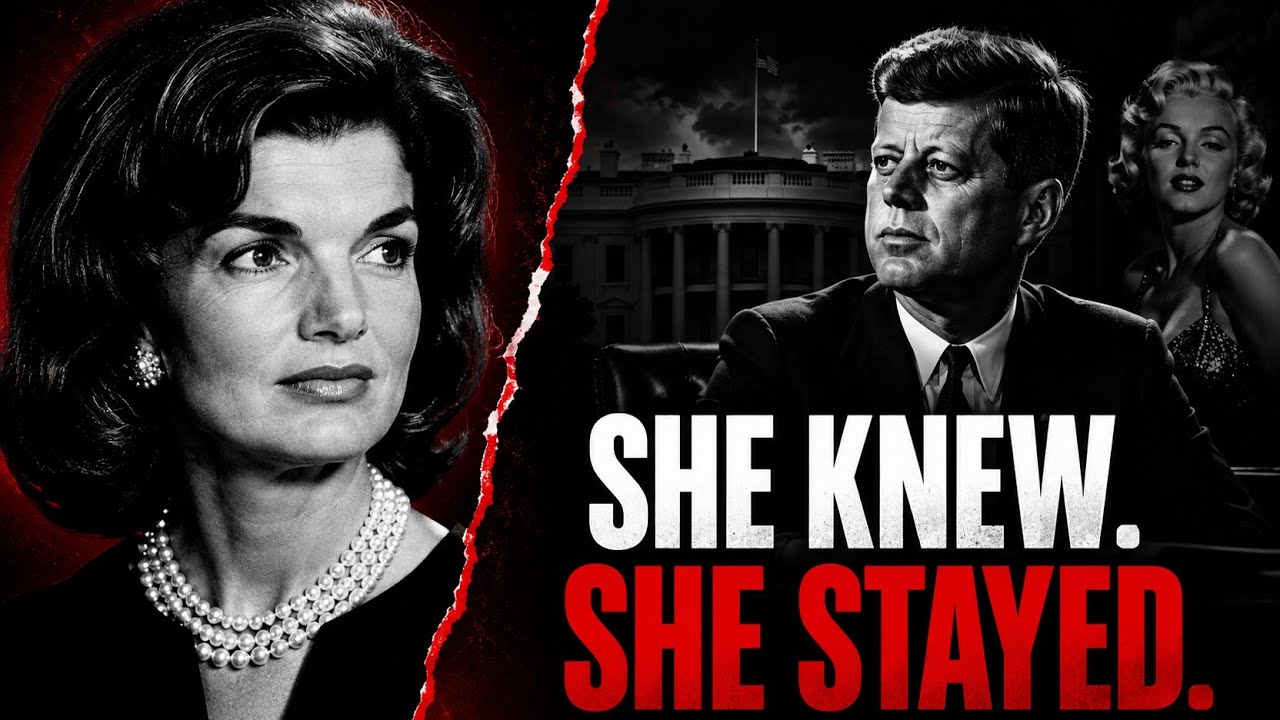
On May 19, 1962, Marilyn Monroe stepped onto the stage at Madison Square Garden and sang “Happy Birthday” to President John F. Kennedy. Fifteen thousand people watched. The First Lady was not among them.
Jackie Kennedy had chosen a horse show in Virginia instead. For sixty years, that choice has been told as humiliation—a wife hiding from her own embarrassment. But it was not humiliation. It was scheduling. She was not hiding from the story. She was declining to appear in it.
That raises harder questions. How much did she know? Which woman actually frightened her? And why would a forgotten 1957 genealogy book threaten the marriage more than any mistress ever could?
On September 12, 1953, at St. Mary’s Church in Newport, Rhode Island, Archbishop Richard Cushing said the nuptial mass. A papal blessing from Pope Pius XII was read aloud. Roughly 800 people filled the church. The bride was 24. The groom was a 36-year-old senator whose father had already decided he would be president.
On paper, this was the most public, most sacramentally sealed marriage in American political life. On paper is where it gets interesting.
In 1957, a genealogist named Louis Blauvelt published a family history noting, in an entry on a divorced woman named Durie Malcolm, that her third husband had been John F. Kennedy, son of Joseph P. Kennedy. No qualification. Recorded as fact. Blauvelt died in 1959, so no one could ask him where it came from.
By 1961, photostats were circulating among people who wanted it to be true. By 1962, the president’s own lawyer, Clark Clifford, was quietly running it down. The Kennedys called it an error. But Durie Malcolm was real, and Jack Kennedy had dated her in the 1940s. If a prior marriage existed, then Newport, the archbishop, the blessing—all of it—was invalid. No license, no certificate, no record of that marriage has ever surfaced.
Hold that page. It matters more than the vows did because the woman in that church wasn’t a decorative object assembled by a famous family. She had a life first.
Vassar, then a year at the Sorbonne she called the happiest of her life, a degree from George Washington University in 1951. That year she won Vogue’s Prix de Paris, beating out a thousand applicants for six months in New York and six months in Paris. She turned it down. Her mother worried it would leave her unmarriageable. So she declined the thing she’d just beaten a thousand women to win
She could compete. She could win. And she could be talked out of collecting. Instead, she became the inquiring camera girl at the Washington Times-Herald, earning 42.50 a week hauling a camera around the capital, asking strangers questions for print. She interviewed Richard Nixon. She interviewed a young senator she’d met at a dinner party. She had a byline, a paycheck, briefly a profession
She also had a father, Blackjack Bouvier—charming, broke, drinking, serially unfaithful. Her mother divorced him in 1940 and remarried into money that was never Jackie’s. In a Catholic world where divorce still carried real cost, she’d already watched what an unfaithful man does to a wife and what divorce does to a woman’s standing. She’d already broken one engagement herself to a safe, respectable broker largely over money. This was not a naive girl swept up. This was a woman who married a man she had already in writing compared to her father
That comparison isn’t inference. For fourteen years she corresponded with Father Joseph Leonard, an elderly priest she’d met in Dublin—someone safely distant with no stake in the Kennedy machine. The letters surfaced in 2014. In them, before the wedding, she wonders whether she’s in love with Jack or with the idea of him and compares him to her father. A man who loves the chase and is bored by the conquest. She married him anyway, having already written down the exact mechanism by which the marriage would hurt her. Knowledge was never the variable in this story. It was the starting condition
So look at what she traded. Her stepfather’s money was never hers. Her own income ended the year she married. Within months, the byline was gone. No announcement. It simply stopped existing
The marriage’s first demand was nursing. Kennedy’s back was a catastrophe. A 1954 spinal fusion, a coma, last rites, a second surgery in 1955, months flat on his back with an open wound being packed and dressed. Jackie was 25. She changed the dressings, fed him, read to him, and worked on the book that became Profiles in Courage. It won the Pulitzer Prize in 1957, giving him the moral credential that made him a national figure. Ted Sorensen did much of the actual drafting, but Jackie took dictation and pulled research in that sickroom. She helped build the object that built him
August 1956 answers part of what she got back, brutally. Pregnant again after an earlier miscarriage, she began hemorrhaging at Hammersmith Farm and was rushed into an emergency cesarean. The baby, a girl, was stillborn. Her husband was in the Mediterranean on a chartered yacht. He did not come home immediately. It took pressure from friends before he flew back. She woke from surgery having lost a full-term child and he was on a boat. She said nothing publicly
Within a year she was pregnant again, and Caroline was born in November 1957. This is where the rumor enters that Joseph Kennedy Senior offered her a million dollars not to divorce his son. No document, no witness has ever confirmed it. What’s actually interesting isn’t whether it happened—it’s that America needed it to have happened. The public couldn’t process a woman staying after that boat unless someone had paid her to
By the White House, the pattern had staff. Two young aides were known around the West Wing by joke nicknames Fiddle and Faddle. In 2012, one former intern, Mimi Beardsley Alford, published a memoir describing an affair that began days after she arrived at nineteen, continuing eighteen months with aides arranging the logistics. That’s not a secret. That’s a system
Did Jackie know? She knew. And the proof is the sentence she said out loud. Touring the White House with a French journalist, she gestured toward one of the young women on staff and remarked in French that this was supposedly the one sleeping with her husband. She wasn’t hiding it from someone she considered sophisticated enough to hear it. She chose a language that kept it deniable to everyone else in the room. That is not a woman kept in the dark. That’s a woman deciding exactly how much truth to release and in which language
So why stay if she knew before the wedding and knew inside the White House, too? Because most of it she seems to have filed as weather—unpleasant, constant, not a threat to anything she actually held
One relationship wasn’t weather. Mary Pinchot Meyer was a Vassar-educated painter with a Georgetown studio, the ex-wife of a CIA officer and the sister of Tony Bradlee, whose husband Ben Bradlee was one of Jack’s closest friends. She wasn’t staff. She was a peer inside the social world at the level of friendship. By 1962, she and the president were involved

In October 1964, eleven months after Dallas, Mary Meyer was shot twice at close range on a Georgetown towpath. A man was tried and acquitted. The case has never been solved to anyone’s satisfaction. Afterward, her family searched for her private diary. So did James Angleton, the CIA’s counterintelligence chief. By most accounts, the diary eventually reached Angleton and was destroyed in the 1970s. Every version of the story agrees on this much: a record of an affair with the president passed into American counterintelligence and came out as ashes
And through all of it, Jackie never competed on their ground. No confrontation, no ultimatum ever documented. She competed where none of them could follow. In 1961, she created the White House Fine Arts Committee and the position of curator, pushed through legislation making the mansion’s furnishings inalienable national property, and founded the White House Historical Association. She was twenty-nine, rewriting the legal status of the president’s house. Her televised tour of it in 1962 drew 56 million viewers and won a special Emmy
That June in Paris, crowds lost their composure over her. Her husband joked at a press conference that he was the man who accompanied Jacqueline Kennedy to Paris. A joke and an accurate description of the balance of power. She had found the one asset mistresses couldn’t touch, and he couldn’t generate alone: legitimacy. He supplied the motion. She supplied the frame
Each easy explanation for why she stayed is partly true. None is sufficient. Religion was real, but her own mother had divorced and rebuilt a life. Jackie herself remarried a divorced man in 1968 and absorbed the consequences. Money was heavier—a genuine cage in 1956—but by 1962, she had real independent leverage of her own. The children were central, but the marriage’s terms were set before Caroline was even born
Politics is where it gets concrete. Kennedy won in 1960 by roughly 100,000 votes as the first Catholic president. A divorce wouldn’t have been a personal embarrassment. It would have ended a five-sibling family enterprise. The machine needed a wife. But a requirement runs both ways. If they needed her that badly, she wasn’t the dependent. She was a shareholder
In 1963, for the only time, the ledger visibly moved. Carrying into her thirty-fifth week, she delivered a son, Patrick, by cesarean in August. He lived thirty-nine hours. This time, Jack was there. Witnesses described him weeping, holding the small coffin. Everyone close to them said the marriage changed after that. They were seen holding hands in public for the first time
Then, that October, grieving and exhausted, she boarded Aristotle Onassis’ yacht in the Aegean—a divorced foreign tycoon under federal indictment, a politically damaging trip fourteen months before an election. He didn’t stop her. And when she came home, she agreed to go to Texas. A public cost absorbed on both sides, returned in kind
November 22nd, 1963. Dallas. Pink Chanel-style suit, chosen because he’d asked her to look well for the trip. What she did in the next seven hours is the argument of this whole story. She climbed onto the back of the moving car. On the plane home, she refused repeatedly to change her clothes. Lady Bird Johnson recalled urging her and being turned down. The line that’s come down: let them see what they have done
She stood beside Lyndon Johnson at his swearing in with her husband’s blood still on her stockings. That photograph exists because she decided it would. Then she planned the funeral. Not consulted. Planned. Within hours she had aides pulling material on Lincoln’s 1865 burial. The East Room draped the same way, the catafalque rebuilt, lying in state under the Capitol dome, the riderless horse with boots reversed in the stirrups. That horse was named Black Jack—her own father’s nickname—walking behind her husband’s coffin
She insisted on walking eight blocks in public, on foot, over the objections of security. She asked for an eternal flame, never used before for an American president, and lit it herself. He held the office for 1,036 days. She authored how it would be remembered in seventy-two hours. She chose Arlington over the family plot in Massachusetts, walking the hillside herself to pick the spot. National ground, not Kennedy ground

Days later, in a private ceremony, she had her two other children’s bodies moved and reburied beside him. She assembled her family in the ground in the order she chose, on the hill she selected, under the flame she lit
Five days after the assassination, she summoned journalist Theodore White to Hyannis Port and told him that she and Jack used to listen to the Camelot recording at night, and that his favorite lines were about one brief shining moment. White phoned the piece in from the kitchen, while by his own account, she edited over his shoulder, pushing to keep that word in. A thirty-four-year-old widow performed the single most successful act of image making in twentieth-century American politics five days after Dallas
She outlived the story. In 1968, she married Onassis—a decision that cost her public affection, but bought her money that was finally hers and security for her children. After he died in 1975, she took a job as an editor, first at Viking, then at Doubleday, working four days a week for roughly nineteen years. The byline that vanished in 1953 returned in a Manhattan office building four decades later. It kept until she died
She died on May 19th, 1994—thirty-two years to the day after the garden gala. They buried her at Arlington beside Jack and Patrick and the daughter with no name under the flame she lit herself. Seventeen years later, her sealed 1964 oral history interviews were released. One line was quoted everywhere: that she got all her political opinions from her husband, offered as proof she’d secretly been a docile political wife
Hear it again with everything you now know. This is the woman who spoke French across a White House room to announce she knew who was sleeping with her husband, who refused to change out of a bloodstained suit so the country would have to look, who rebuilt Lincoln’s catafalque overnight and moved two children’s graves and edited her husband’s legend into American memory while he was still lying in the next room. That interview wasn’t a confession. It was the last brick in a structure she’d been building since November 1963
And the genealogy page was never substantiated. No license, no certificate has ever surfaced, and Durie Malcolm denied it for the rest of her life. But look at what the Kennedys did the moment it appeared. They put the president’s own lawyer on it because the one accusation that genuinely frightened that family was never adultery. It was illegitimacy. Not that the marriage was unhappy, but that it wasn’t real
Which is the answer. Why didn’t Jackie Kennedy leave? Strictly, she never refused to because no evidence suggests anyone ever formally offered her the choice. No filing, no separation agreement exists. For sixty years, outsiders have filled that silence with the same four explanations: Catholic, broke, small children, paid off. All partly true. None of them explains the French sentence or the yacht or Arlington instead of Brookline
What she refused was displacement. She would not be moved out of the position she held—a position whose terms she had read before Newport in her own handwriting to a priest in Dublin. He would love the chase and be bored by the conquest. She married the chase anyway and took the permanent things: the name, the house, the children, the graves, the story. He got the motion. She got everything that doesn’t move
Go back to Madison Square Garden. Marilyn on the stage, fifteen thousand people, an empty chair where the wife should be. For sixty years, that’s been read as a woman hiding from her own humiliation. She was in Virginia on a horse on a date she would die on thirty-two years later. She wasn’t hiding. She had simply declined to appear in someone else’s scene because she already knew exactly which scenes she intended to direct
There’s a hillside in Arlington where her name sits beside his with two children she buried twice under a flame she lit herself. She chose that place. He’s just in it