Two children of Denmark’s King Christian VII ended their lives with legacies so different that they seem to belong to different families. One modernized the kingdom, ruled effectively for decades, and died with no surviving descendants. The other, whose birth was clouded by scandal and doubts about her paternity, became the ancestor of royal houses across Europe that continue to the present day. Frederick was born on 28 January 1768 to Christian VII and Queen Caroline Matilda of Great Britain.
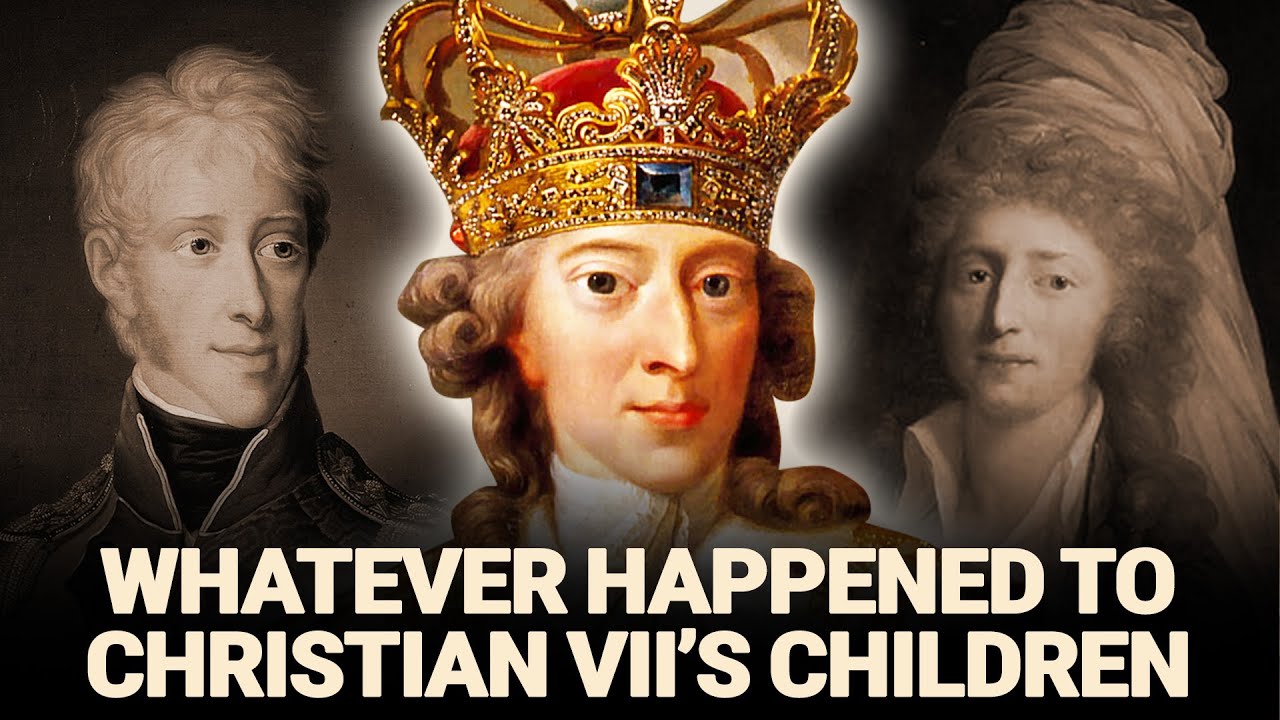
From his earliest years, his life was shaped by his father’s mental illness, which historians believe made Christian increasingly erratic and unable to govern. Into this vacuum stepped the king’s physician, Johann Friedrich Struensee, who rose to become the de facto ruler of Denmark while conducting a scandalous affair with the queen. In 1772, when Frederick was four, a conservative coup toppled Struensee’s government. The physician was executed, and Caroline Matilda was exiled from Denmark, never to see her children again.
She died in Celle in 1775, when Frederick was only seven. The loss of his mother and the instability around his father forced Frederick to grow up quickly, prepared by court officials who recognized that Denmark needed a competent heir. By 1784, at age sixteen, Frederick became regent as his father’s condition made effective governance impossible. His regency marked the beginning of a reform agenda that defined his legacy.
In 1788, he abolished the stavnsbånd, a form of serfdom that had bound peasants to the land for centuries. The reform freed rural Danes and drove agricultural modernization, reflecting Frederick’s commitment to Enlightenment principles and his understanding that Denmark needed to change to compete with other European powers. In 1790, Frederick married Marie Sophie of Hesse-Kassel, cementing an important alliance. Between 1790 and 1810, she bore him eight children, but only two daughters, Caroline and Vilhelmine Marie, survived to adulthood.
Under the succession laws of the time, daughters could not inherit the Danish throne. Both surviving daughters remained unmarried and childless, ending Frederick’s direct line. Frederick’s reign coincided with the Napoleonic Wars, which proved the defining challenge of his rule. His attempts to maintain Danish neutrality became untenable after a British fleet attacked Copenhagen in 1807, effectively forcing Denmark into alliance with Napoleon.
When Napoleon’s empire collapsed in 1814, Denmark faced the punitive Treaty of Kiel, the most devastating provision of which was the cession of Norway to Sweden, ending a union that had lasted more than 400 years. Frederick had little choice but to accept the terms, as Denmark lacked the military power to resist the victorious allies. Frederick officially became king in 1808 following his father’s death, though he had been the effective ruler for nearly a quarter century. His formal reign focused on rebuilding Denmark after the war.
He promoted education, supported agricultural improvements, and worked to modernize the economy, overseeing the establishment of new schools, improvements to infrastructure, and a gradual shift toward industrial development. He also had to manage the diplomatic tensions created by the loss of Norway, as many Norwegians continued to look to Denmark with nostalgia. Frederick’s relationship with his father was complex, shaped by Christian VII’s mental illness. From his earliest years, Frederick understood that his father was incapable of normal paternal relationships or effective governance.
This absence of a strong paternal figure meant Frederick’s political education came primarily from ministers and advisers rather than royal tradition. In some ways, this made him more open to reform and new ideas, as he was not bound by the conservative instincts of a more traditional upbringing. Despite this, Frederick never attempted to formally depose his father, reflecting both his character and his understanding that the monarchy’s legitimacy depended on proper succession protocols. Frederick VI died on 3 December 1839, having reigned for over 50 years when counting his regency.
His death marked the end of the direct male line of the House of Oldenburg in Denmark, as he left no male heirs. Under the succession laws governing Denmark, the throne passed to his cousin, Christian VIII, beginning a new branch of the royal family. Caroline died in 1881 and Vilhelmine Marie in 1891, both leaving no descendants. Frederick’s reforms had a lasting impact on Danish society, but from a dynastic perspective, his reign represents a dead end.
Princess Louise Auguste was born on 7 July 1771, and from the moment of her birth she was surrounded by controversy. Officially, she was the daughter of King Christian VII and Queen Caroline Matilda, making her Frederick’s younger sister and a legitimate princess. However, the circumstances of her conception raised questions about her paternity that would follow her throughout her life. The controversy centered on Caroline Matilda’s affair with Struensee, who had arrived in Denmark in 1768 and quickly gained influence over the mentally unstable king.
By 1770, he had effectively become the ruler of Denmark, implementing radical reforms while conducting a secret affair with the queen. Louise Auguste was conceived during the height of Struensee’s power. While official records list Christian VII as her father, many at court suspected Struensee was her biological parent, a suspicion strengthened by the timing of her conception and her physical appearance, which some claimed resembled the physician more than the king. The question of Louise Auguste’s paternity became politically explosive when the conservative faction began planning its coup.
When Louise Auguste was barely eight months old, the coup took place. Struensee was arrested and executed, and Caroline Matilda was exiled. The new government chose to maintain the fiction of Louise Auguste’s legitimacy, recognizing that publicly questioning her paternity would create even greater scandal and instability. Louise Auguste was raised at the Danish court alongside her brother Frederick, sharing the experience of losing their mother and growing up in the shadow of their father’s illness.
She received an education appropriate to her rank and was treated as a legitimate princess, maintaining her place in the line of succession. This decision proved politically wise, as it avoided creating additional instability in an already troubled royal family. In 1786, when Louise Auguste was fifteen, arrangements were made for her marriage to Frederick Christian II, Duke of Augustenburg. The marriage was politically significant, as the Augustenburg line had claims to the duchies of Schleswig and Holstein, territories that were personal possessions of the Danish crown but not formally part of Denmark proper.
The marriage strengthened ties with the Augustenburg family and provided Louise Auguste with an appropriate royal marriage while removing her from the direct succession line. The union appears to have been personally successful, and the wedding ceremony was celebrated with great pomp in Copenhagen, signaling that Louise Auguste was recognized as a full member of the royal family. Louise Auguste established herself as one of the leading figures in Danish high society, earning the nickname Venus of Denmark for her beauty, intelligence, and charm. She became known for her patronage of the arts and maintained close ties with her brother Frederick, frequently returning to Copenhagen for important events.
In 1794, she was present during the great fire that destroyed Christiansborg Palace, and her composure during the crisis enhanced her reputation for grace under pressure. Louise Auguste’s marriage placed her at the center of the Schleswig-Holstein question, one of the most complex political issues in 19th-century European diplomacy. The duchies had been ruled by the Danish crown for centuries but were not incorporated into Denmark proper and had their own laws and customs. The Augustenburg family had historical claims that competed with those of the Danish crown.
Louise Auguste’s marriage was partly intended to resolve these competing claims, but it actually created new complications for future generations. The issue would eventually contribute to major European conflicts, including the wars of 1848–1851 and 1864, and ultimately to the unification of Germany under Prussian leadership. Louise Auguste and Frederick Christian had several children of enormous dynastic significance. Their eldest daughter, Caroline Amalie, was born in 1796 and later became queen of Denmark through her marriage to King Christian VIII, Louise Auguste’s nephew.
Their son, Christian August II, inherited the Augustenburg titles and continued the family’s claims to Schleswig-Holstein, playing a significant role in the political upheavals of the 1840s and 1850s. Most significantly, Louise Auguste’s daughter Louise Charlotte married Wilhelm of Hesse-Kassel and became the mother of Louise of Hesse-Kassel. This Louise married Christian IX of Denmark, becoming known as the mother-in-law of Europe and ensuring that Louise Auguste’s bloodline spread throughout European royalty. Through this line, Louise Auguste became the ancestor of numerous European royal houses, including the modern Danish royal family, the former royal families of Norway and Greece, and connections to the British, Russian, and German imperial families.
The irony is striking. While her brother Frederick VI, the legitimate heir and effective ruler, left no surviving descendants, Louise Auguste, whose legitimacy was questioned, became the progenitor of multiple royal lines that continue to this day. Louise Auguste’s relationship with her father was complicated by both his mental illness and the questions surrounding her paternity. Christian VII was rarely capable of normal paternal relationships, but Louise Auguste was always treated as his legitimate daughter in official contexts.
Her name appeared in royal genealogies, she received the precedence due a princess, and she was included in state occasions and family portraits. The question of whether Christian VII was her biological father remained unresolved throughout her life. Louise Auguste never publicly addressed the speculation, maintaining the dignity expected of a royal princess. Louise Auguste lived until 1843, dying at the age of 72 after a long and eventful life.
She had witnessed the French Revolution, the Napoleonic Wars, and the beginnings of the democratic movements that would reshape Europe. Her later years were marked by pride in her children’s achievements, particularly her daughter Caroline Amalie’s marriage to Christian VIII, and concern for the political upheavals affecting the duchies. Her funeral was attended by representatives of royal families across Europe, acknowledging her significant position in the complex web of dynastic relationships. Louise Auguste’s great-grandchildren included King Frederick VIII of Denmark, Queen Alexandra of the United Kingdom, Empress Maria Feodorovna of Russia, and King George I of Greece.
Through these marriages, her bloodline spread throughout European royalty. The contrasting fates of Frederick VI and Louise Auguste illustrate one of history’s most striking examples of how dynastic fortune can diverge within a single generation. Both children of the troubled King Christian VII, they faced similar challenges in their upbringing: an absent mother, an incapacitated father, and the instability of Danish politics in the late 18th century. Frederick VI devoted his life to serving Denmark, modernizing the kingdom and providing stable leadership during some of the most turbulent decades in European history.
Yet his line died out completely. Louise Auguste, by contrast, began life under a cloud of scandal and suspicion but, through strategic marriage and the successful placement of her children, became the founder of multiple royal lines that continue to this day. Today, many members of European royal families trace their ancestry back to Princess Louise Auguste. The current Danish royal family, the former Norwegian royal family, and numerous other European noble lines all descend from the princess whose legitimacy was once questioned.
Frederick VI, despite his greater historical importance as a ruler, has no living descendants to carry on his legacy. This paradox highlights one of the fundamental uncertainties of dynastic politics: competence in rule and success in dynasty building do not always coincide. Whether Louise Auguste’s biological father was Christian VII or Struensee mattered less than her ability to navigate the complex world of European royal politics and position her children advantageously.
Her story suggests that character and strategic thinking may matter more than the circumstances of one’s birth.