Ten days before *The Twilight Zone* premiered, Rod Serling sat across from Mike Wallace and seemed to surrender the very thing that had made him famous. Wallace pressed him on whether the new half-hour fantasy series meant he had given up writing about the urgent problems of American life. Serling did not resist the premise. If “important” meant dramatizing current social issues directly, he said, then yes, these new stories were strictly for entertainment.
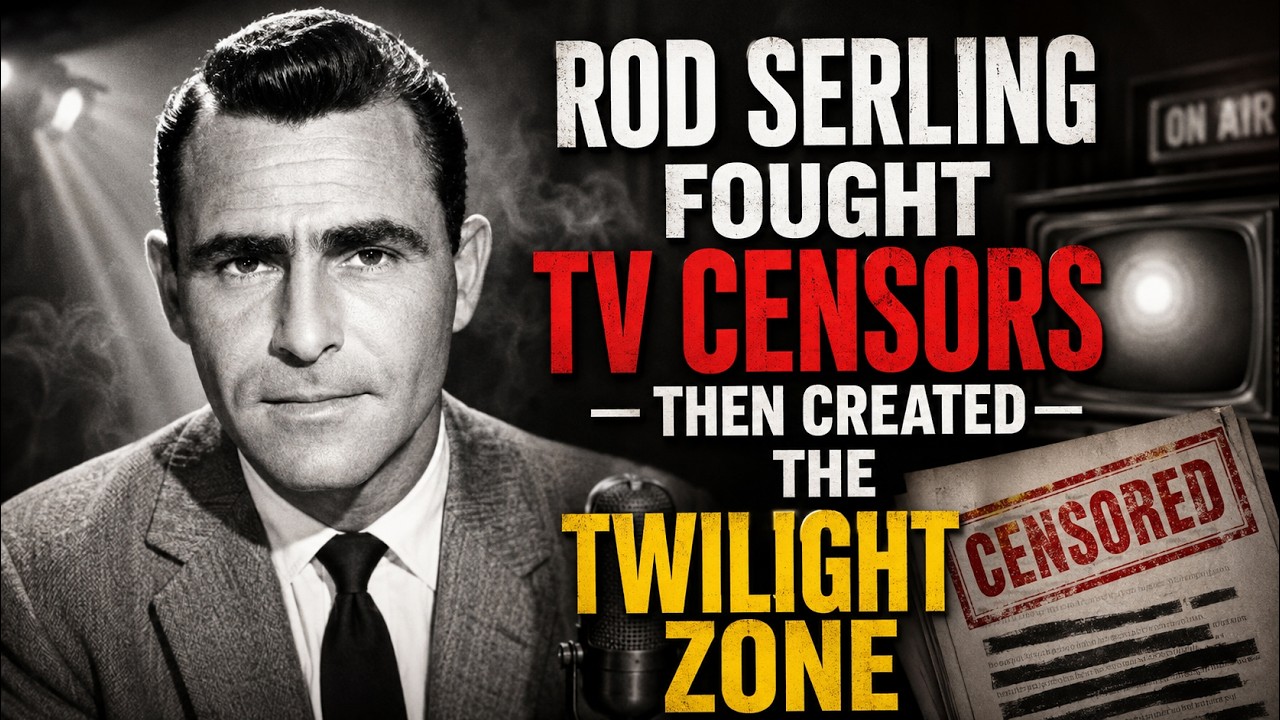
It was a startling answer from a writer already known for fighting sponsors, networks, and advertising agencies over what television was allowed to say. Only a few years earlier, he had watched a drama inspired by racial violence lose much of its sharpest meaning through revision after revision. Now, 10 days before the public entered his strange new universe, he appeared to be promising that the program would cause no such trouble. But Serling was not walking away from the argument.
He was changing the ground on which he would fight it. Rodman Edward Serling entered the world on Christmas Day 1924 in Syracuse, New York. His family soon made Binghamton the center of his childhood, and Binghamton would remain more than a place on a map. It became the remembered America to which his imagination kept returning: streets, parks, summer evenings, familiar storefronts, and the dangerous sweetness of believing that the past might still be waiting where one left it.
His older brother, Robert, remembered a boy fed on fantasy, science fiction, horror, movies, and pulp magazines. The two brothers did not simply watch stories; they replayed them. Bicycles became airplanes. Neighborhood games became westerns.
That gift for transformation later became one of Serling’s most recognizable strengths. A suburban house could conceal an apocalypse. A small town could become a laboratory of prejudice. There was another side to the boy.
He was competitive, restless, quick to test himself physically. He graduated from Binghamton Central High School during the Second World War and entered the United States Army almost immediately. Poor eyesight closed off his hope of becoming an aerial gunner, so he pursued the paratroopers instead, despite standing only about 5’4″ tall. He was assigned to the 511th Parachute Infantry Regiment of the 11th Airborne Division.
Training demanded endurance, and Serling also boxed. His brother later recalled that he won nearly all of his bouts in basic training. Boxing gave him a vocabulary for pride, punishment, aging, and the terrible moment when a body can no longer do what identity demands of it. War gave him something darker: memories of fear, absurdity, sudden death, moral confusion, and men whose lives ended without the clean, dramatic logic that stories usually provide.
The division went to the Pacific. When comedian Jack Benny visited the regiment in New Guinea, Serling helped with a skit and took a small part in it. The piece was broadcast on armed forces radio. Even in uniform, before he had chosen writing as a profession, the microphone had begun to offer another kind of battlefield.
Then came the Philippines. On Leyte, the regiment fought through difficult terrain and sustained combat. Serling served in a demolition platoon. One event later entered his own war writing with almost unbearable absurdity.
His friend Melvin Levy was killed not by enemy fire, but by a falling crate during an American food drop. The grotesque accident had the kind of cruel reversal that would later seem almost Serling-esque, except that here there was no author arranging the irony. Serling was wounded during his service and later received a Purple Heart and a Bronze Star. Decades later, a fictionalized work he had begun as a young college student, *First Squad, First Platoon*, would reveal how soon he was trying to put experience into words.
The work remained largely unknown for most of his life. When it was finally published many decades later, it carried five vignettes dedicated to fallen comrades. It mattered because it showed a young veteran already trying to preserve the physical reality of war before memory could become ceremony. His daughter Anne later read letters he had written from training camp.
They sounded to her like the letters of a boy who did not yet know what waited on the other side of training. He asked home for ordinary things: gum, candy, underwear. His daughters also remembered the war remaining present in family life. Anne has spoken of hearing about nightmares in which enemy soldiers were coming at him.
Jody described memories that woke him at night. Yet Anne has argued against flattening Serling into the tortured artist stereotype. She remembers a father who could be funny, silly, affectionate, and fully engaged with his family. Serling came home with decorations, injuries, memories, and a future that was not yet obvious.
He used the GI Bill to attend Antioch College in Yellow Springs, Ohio. At first, according to his daughter’s recollection, he considered physical education, but language and literature drew him more strongly. Campus radio gave him a place where ideas could immediately become voices. Antioch also brought Carol Kramer into his life.
She was a freshman when she met the returning veteran. They married on the last day of July in 1948. Carol would become much more than a spouse standing outside the work. She became his trusted reader, editor, and critic, someone who encountered scripts while they were still changeable.
Long before executives weighed the commercial risks of his ideas, there was often a private exchange at home in which Carol read the pages and told him what she thought. At Antioch, Serling haunted the radio workshop. In 1949, a radio script earned second prize in a national competition connected with the *Dr. Christian* program.
He also sold scripts to *Grand Central Station*. After college, he and Carol moved to Cincinnati, where Serling took a staff job at radio station WLW. He wrote documentaries and commercial material while continuing to aim beyond the assignment in front of him. Broadcasting consumed material.
Serling learned to produce under pressure, and he learned that the apparatus around writing—time slots, sponsors, schedules, executives—was not separate from the art. It was the weather in which the art had to survive. By the early 1950s, Rod and Carol made a consequential decision. He would try to write full-time, and they moved to Westport, Connecticut, close enough to New York to pursue the center of live television.
It was a family gamble before it was a legend. Serling wrote anyway. The early television years were a long apprenticeship disguised by hindsight. By the time *Patterns* broke through, he had already written dozens upon dozens of television scripts.
He wrote for anthology programs that defined the so-called golden age of television: *Kraft Television Theater*, *Studio One*, *Hallmark Hall of Fame*, and others. Broadcast in 1955, *Patterns* placed corporate ambition inside offices rather than battlefields. A younger executive is brought into a company where an older man is being pushed aside. Power operates through meetings, expectations, calculations, and quiet tests of loyalty.
The response changed his career. *Patterns* brought widespread critical attention and his first Emmy recognition as a writer. The next year, *Playhouse 90* broadcast *Requiem for a Heavyweight*. In it, an aging boxer named Mountain McClintock has reached the end of the only life he knows.
His body has absorbed too much punishment. The men around him must decide whether they will help him preserve what remains of himself or turn his decline into one final source of money. Serling had boxed. He had been a soldier.
He knew what institutions could ask from a body and how quickly they could move on when that body was no longer useful. *Requiem* brought Serling a special Peabody honor for television writing, the first special Peabody award for television writing in the history of those citations at the time. And that was when the central problem of his television life became impossible to ignore. The medium he believed could become an art form was also a sales machine.
In the 1950s, much of American television drama depended on sponsors. Advertising agencies and corporate representatives could influence what appeared beneath those names. The most famous example began in the shadow of the murder of Emmett Till, the black teenager killed in Mississippi in 1955. Serling wanted to write about the kind of hatred and communal complicity the case had exposed.
His first effort, which became *Noon on Doomsday*, encountered resistance before it reached the screen. Serling later described repeated meetings and layers of review. References that might identify the story too closely with the South were removed. The setting shifted.
The victim’s identity changed. The result, in Serling’s own judgment, had been stripped of much of the force that made him want to write it. The censorship story became cleaner in retelling than the surviving record allows. Later accounts, including Serling’s own recollections, did not always keep the stage and television versions of the material perfectly separate.
Some details commonly repeated as one tidy sequence were probably conflated across different drafts and forms. The conflict with sponsors and network caution was real. The exact path of every alteration is less tidy than legend prefers. Serling tried again for *Playhouse 90*.
He developed *A Town Has Turned to Dust*, another drama shaped by the subject of lynching and communal prejudice. It too was transformed. The story moved away from a direct contemporary rendering of racial violence and into a western setting. Yet more of the underlying accusation survived.
That displacement pointed toward a solution. If a network recoiled from a drama that said “this is happening here now to people you recognize,” perhaps a story could reach the same moral nerve by changing the surface. The argument could enter the room wearing a mask. It is tempting to describe *The Twilight Zone* as the single brilliant trick by which Serling defeated censorship.
The truth is more complicated. He did not escape the commercial system, and he did not turn every fantasy story into a coded editorial. He also cared about suspense, surprise, humor, craft, atmosphere, and the simple pleasure of a story that worked. The remarkable part was that entertainment and moral pressure did not have to cancel each other out.
Before the series existed, Serling had already tested science fiction as a television form. A script called *The Time Element* eventually appeared on *Westinghouse Desilu Playhouse* after CBS initially passed on the larger series concept. Audience response and favorable attention helped revive network interest. CBS then ordered another pilot, and the project that became *The Twilight Zone* moved toward production.
This time, Serling wanted more control, and he fought hard to obtain and maintain creative authority over the series. The early arrangement gave Serling and CBS equal ownership. On the second day of October in 1959, *The Twilight Zone* premiered. The show announced a territory between the familiar and the impossible.
Serling’s opening narrations gave that territory a voice. Behind that composure was a punishing work schedule. In his interview with Mike Wallace recorded 10 days before the premiere, Serling said he was working 12 to 14 hours a day, 7 days a week. Then Wallace returned to the question of seriousness.
The new half-hour show, Serling said, would not probe current social problems as his longer dramas had done. It was here that he used the phrase “strictly for entertainment. ” Wallace pushed. Had he abandoned important writing for television?
Serling agreed, if “important” meant dramatizing current social issues directly. What followed makes it impossible to read literally as the end of Serling’s social concerns. *The Twilight Zone* repeatedly examined prejudice, authoritarianism, war, conformity, greed, fear, loneliness, and the dangerous human hunger to belong to the crowd. *The Monsters Are Due on Maple Street* is one of the clearest examples.
Strange events disturb an ordinary neighborhood. Suspicion spreads faster than evidence. Neighbors begin identifying one another as threats. The science fiction premise is not an escape from civic life.
It is a pressure chamber for it. Other episodes worked differently. *Walking Distance* followed a weary adult who finds his way back to the town of his childhood and discovers that the past cannot simply be reclaimed. The setting drew on Serling’s memory of Binghamton, including Recreation Park.
*The Purple Testament* returned more directly to war, set among American soldiers in the Philippines. It centers on an officer who becomes able to perceive which men are marked for death. The series could also be playful, sentimental, macabre, comic, or simply ingenious. Serling invited writers he respected, including Richard Matheson and Charles Beaumont, and the anthology format allowed radically different tones from week to week.
He wrote at extraordinary volume. Across the series’ five seasons, *The Twilight Zone* produced 156 episodes, and Serling wrote 92 of them. He also served as executive producer and host. His family remembered it from the other side.
Anne recalled a father who could be present at home playing basketball or joking, and then suddenly acquire a distant look because part of him had gone back into a story. Serling’s method eventually made such divided attention practical. Archival work at UCLA has preserved evidence of his extensive use of dictation. Rather than compose only by typing at a desk, he could speak material into recording equipment for later transcription.
The technique suited the voice-driven quality of his writing and the pace at which television demanded pages. The success of *The Twilight Zone* did not free him from insecurity. The ratings were respectable rather than overwhelming, and the series was cancelled and revived more than once. Each season existed inside the same commercial uncertainty Serling had been trying to manage from the beginning.
He also became the thing a writer does not always expect to become: recognizable. Before *The Twilight Zone*, most viewers did not need to know the face of the person who wrote a teleplay. Serling’s hosting changed that relationship. A man who had fought for the authority of the writer became one of television’s first truly famous writers in the public sense.
The writer had become a character. *The Twilight Zone* was never a one-man production. Serling chose other writers whose imaginations could expand the series beyond his own habits. What Serling fought for was not the right to do every job.
It was the authority to protect the kind of program he believed they were all making. The format itself was not fixed. The first seasons used half-hour episodes. For one season, the network expanded the show to an hour.
Serling received two Emmy awards for his writing on *The Twilight Zone* during its original run. The instability kept Serling close to the practical side of authorship. His art did not emerge after those constraints disappeared. It emerged through them.
After several seasons of renewals, cancellations, format changes, and constant production, Serling eventually stopped fighting to keep it alive. The final original episode aired on the 19th of June in 1964. Serling did not stop writing socially engaged material when *The Twilight Zone* ended. He wrote the screenplay for *Seven Days in May*, the political thriller about an attempted military coup against an American president.
Released in 1964, it placed questions of civilian authority, military power, and political fear inside contemporary American institutions. He also worked in motion pictures. Among those projects was *Planet of the Apes*. Serling developed major versions of the screenplay adaptation, and the finished film ultimately carried screenwriting credit for both Rod Serling and Michael Wilson.
Yet Serling’s career outside *The Twilight Zone* never settled into a single triumphant second act. He tried a western series called *The Loner*. The series lasted only a short time. There were disappointments, arguments, compromises, and projects that did not control the room the way his earlier dramas had.
There was also a widening public role. By the middle of the 1960s, he was no longer simply a successful television writer. He had become a spokesman for what television might be. He served as president of the National Academy of Television Arts and Sciences during 1965 and 1966.
His complaint was not nostalgia for some pure golden age. What frustrated him was the gap between what television could do and what commercial caution often encouraged it to do. His own career, however, also demonstrates that Serling was not standing outside the system issuing judgments from a clean moral platform. He did commercials.
He narrated documentaries. He accepted work that used his now famous voice as a recognizable commodity. That is not hypocrisy so much as the ordinary condition of a working artist in mass media. Purity was never really available.
One answer came in public speaking. In December of 1968, Serling appeared at Moorpark College in California. A loyalty oath had been presented as a condition connected with his appearance and payment. He refused to sign it and waived his speaking fee.
He said he did not need to prove his loyalty through a signature demanded in advance. From there, his speech moved into the Vietnam War, social inequity, the divide between generations, democracy, and the danger of reducing citizenship to ritual declarations while ignoring human responsibility. By refusing the oath, he gave up the fee. The principle was small enough to be practical and real enough to cost him something.
At home, another form of continuity remained. Carol had been beside the work before *Patterns*, before the Peabody, before *The Twilight Zone*. She read scripts before submission, criticized them, discussed them, and shared the practical consequences of a career built on risk. Serling’s daughters provide another angle on the same man.
At home, Anne remembered humor and play. She has specifically resisted the idea that he was simply a dark, tortured man. She knew he wrote at a punishing pace, but she did not remember him as absent every day. He might play basketball after she came home from school.
Then his expression would change, and she would realize that for a few minutes he was writing somewhere inside his head. From 1967 through the last years of his life, Serling taught as a guest professor at Ithaca College. The college remembers him not as a distant celebrity lending his name to a course, but as a working teacher who screened material, discussed student scripts, offered feedback, appeared occasionally in student films, and invited students to the family home on Cayuga Lake. Former students remembered the seriousness of that attention.
Serling treated teaching as real work. His later television work tested another more painful form of return. *Night Gallery*, an anthology of supernatural and macabre stories, put Serling back before the audience as a host and writer. Serling had no production role on *Night Gallery* comparable to the authority he had exercised over *The Twilight Zone*.
He wrote material and hosted, but he did not control the series in the same way. The audience saw Rod Serling standing before strange paintings and introducing unsettling tales. The production structure gave him less. Television itself was changing.
The live anthology world in which Serling had learned his craft was largely gone. He could remain famous inside television while feeling increasingly separated from the conditions that had produced his defining work. Nostalgia, the force he had treated so carefully in *Walking Distance*, was beginning to gather around his own career. He did not answer by retiring into the past.
He kept teaching. He kept writing. He kept accepting narration and commercial work. He kept speaking publicly.
He remained inside the imperfect system he criticized because that system was also where his craft, livelihood, audience, and professional identity existed. By the beginning of the 1970s, *The Twilight Zone* was acquiring a powerful second life in reruns. That created a peculiar split. Serling was still a working man with new scripts, classes, speeches, narration jobs, family obligations, and bills to answer, while the younger version of him in a dark suit was already becoming fixed in cultural memory.
One Rod Serling aged, the other did not. In the spring of 1975, his body began imposing limits that deadlines never had. Serling was hospitalized after what was diagnosed as a mild heart attack. He was later readmitted and in late June underwent open heart surgery at Strong Memorial Hospital in Rochester.
The operation lasted about 10 hours. He apparently suffered another mild heart attack during the procedure. Two days later, on the 28th of June in 1975, Rod Serling died. He was 50 years old.
The night before the surgery, his daughter Anne saw him for the last time. Decades later, she remembered that he told her he loved her. He had been warned that after surgery he might be confused and fail to recognize family members. Anne remembered his answer.
He told them not to worry. He would know who they were. Carol was left not only with grief but with work in its most practical form. Manuscripts, recordings, contracts, correspondence, awards, rights, unfinished business, and requests from people who wanted to use the name Rod Serling did not organize themselves into a legacy.
For nearly three decades, she had watched that name change meaning. After his death, Carol became one of the people responsible for preventing that public image from swallowing the work that had produced it. Over time, major bodies of Serling material reached institutions including Ithaca College and UCLA, where private working documents could become part of public history. Those archives complicated the smooth silhouette left by television.
A finished episode makes writing look inevitable. The papers restore uncertainty. UCLA’s collection included personal dictation work, later made hundreds of those recordings accessible again. What had once been an ordinary method of labor became evidence of how he composed.
Another archival recovery reached even farther back. *First Squad, First Platoon*, the war writing Serling had worked on around his Antioch years, resurfaced from archival papers and was published long after his death. Binghamton preserved another kind of evidence. Recreation Park with the carousel that helped feed the emotional landscape of *Walking Distance* remained part of the city long after the boy who knew it was gone.
During the centennial year of Serling’s birth, a statue of him was dedicated there, close to the neighborhood that had shaped his remembered hometown. The risk is that reverence can make the work seem safer than it was. A program repeatedly vulnerable to scheduling and cancellation becomes an institution. A writer fighting revisions becomes a symbol of absolute authorship.
A complicated battle with sponsors becomes a single legend in which courage always knows exactly where the enemy is. The documents tell a better story. Serling did not possess a secret code that made institutions powerless. He learned to work through constraints without pretending they had disappeared.
Sometimes he won. Sometimes he compromised. Sometimes a project failed. Sometimes the form itself carried an argument farther than a direct statement could have traveled.
Serling changed forms throughout his career. *Patterns* used the corporation. *Requiem for a Heavyweight* used a boxer’s failing body. *Noon on Doomsday* and *A Town Has Turned to Dust* exposed the vulnerability of direct topical drama.
*The Twilight Zone* used impossible premises. *Seven Days in May* returned to recognizable political institutions. *The Loner* moved into the western. *Planet of the Apes* carried social implications through speculative cinema.
Moorpark required no fictional mask at all. The changing forms were evidence that he kept asking what a particular room would allow a writer to do. Sometimes the room was a sponsor-supported network broadcast. Sometimes it was a film set.
Sometimes it was a college auditorium. Sometimes it was a classroom. Sometimes it was the family house with Carol reading a draft before anyone else. In 2026, more than half a century after his death, that process returned to public attention in another form.
A documentary titled *Serling* received its world premiere at South by Southwest. Its announced approach was a first-person journey built largely from Serling’s own words, including previously unheard recordings and personal dictation. Anne and Jody were among its executive producers. Serling understood something mass media often forgets.
An audience can enjoy a story and still be asked to recognize itself inside the machinery of that story. There is no contradiction in laughter existing beside warning or wonder beside accusation. In one reflection on how he hoped to be remembered, Serling reduced the wish to something strikingly modest: a writer. The word matters because it returns attention from prophecy to labor.
A writer chooses the form. A writer hears the sentence. A writer accepts a cut or fights it. A writer discovers that a brilliant idea can fail in production and that an ordinary assignment can contain something alive.
For Serling, a great deal survived. Enough for a neighborhood panic written in the early television age to remain recognizable whenever fear outruns evidence. Enough for a tired man walking toward childhood to speak differently to viewers who first encounter him young and then return decades later carrying losses of their own. Enough for an aging boxer’s humiliation to remain painful after the world that produced live *Playhouse 90* broadcasts has disappeared.
Enough for the voice in a dark suit to remain familiar even to people born long after the cigarettes, sponsors, and network schedules around it changed. Today in Binghamton’s Recreation Park, the old carousel still turns in season. Near it stands a statue of the writer. The carousel moves in circles, but the riders do not remain the same.
A child climbs on. Music begins. The horses rise and fall. Then the ride ends, and the child steps down older by a few minutes into a world that has continued moving.
The value of *The Twilight Zone* is not that television should become 1959 again. The value lies in what its best stories still demand from the present: attention, doubt, judgment, empathy, and the willingness to notice when fear is doing the thinking. The writer who once seemed to promise Mike Wallace that he was leaving important subjects behind did not become less serious when he entered fantasy. He became harder to summarize.
That was the better outcome, because the real Rod Serling was never only the host at the edge of another dimension. He was the Binghamton boy replaying stories in the street. The paratrooper who discovered that death could arrive without dramatic justice. The young husband whose pages passed through Carol’s hands.
The live television writer who became famous by putting human dignity under pressure. The dramatist who discovered that institutions could alter a story one reasonable revision at a time. The producer who found temporary authority in an anthology of impossible situations. The public figure who refused a loyalty oath when he could speak without metaphor.
The teacher who listened to unfinished writers. The father his daughters remembered as darker in public than he was at home. He died at 50 before the cultural afterlife of his most famous work had fully revealed what it would become. The reruns continued.
The archives opened. The recordings returned. The war pages resurfaced. Students remembered.
Carol preserved. Anne and Jody added family voices to the public record. New audiences arrived, and the old question kept following the work: What happens when an entertaining story asks us to look at ourselves before we realize that is what it is doing? Serling never owned the answer.
He only kept riding toward it. The horses circle. The music repeats. The town is not the town it was, and the boy is not waiting there.
But the story still arrives.