For ten days in May 1969, American paratroopers made eleven assaults on an unnamed hill in Vietnam’s remote A Shau Valley, advancing into machine-gun fire, concealed bunkers, and even their own errant airstrikes. The mountain cost so many lives that survivors gave it a new name, scrawled on a ration can lid and nailed to a tree: Hamburger Hill, because, as they put it, the hill ground men into hamburger. What happened there would set it apart from every other bloody battle in that war. The Americans won, seized the summit, and inflicted far heavier casualties than they suffered.
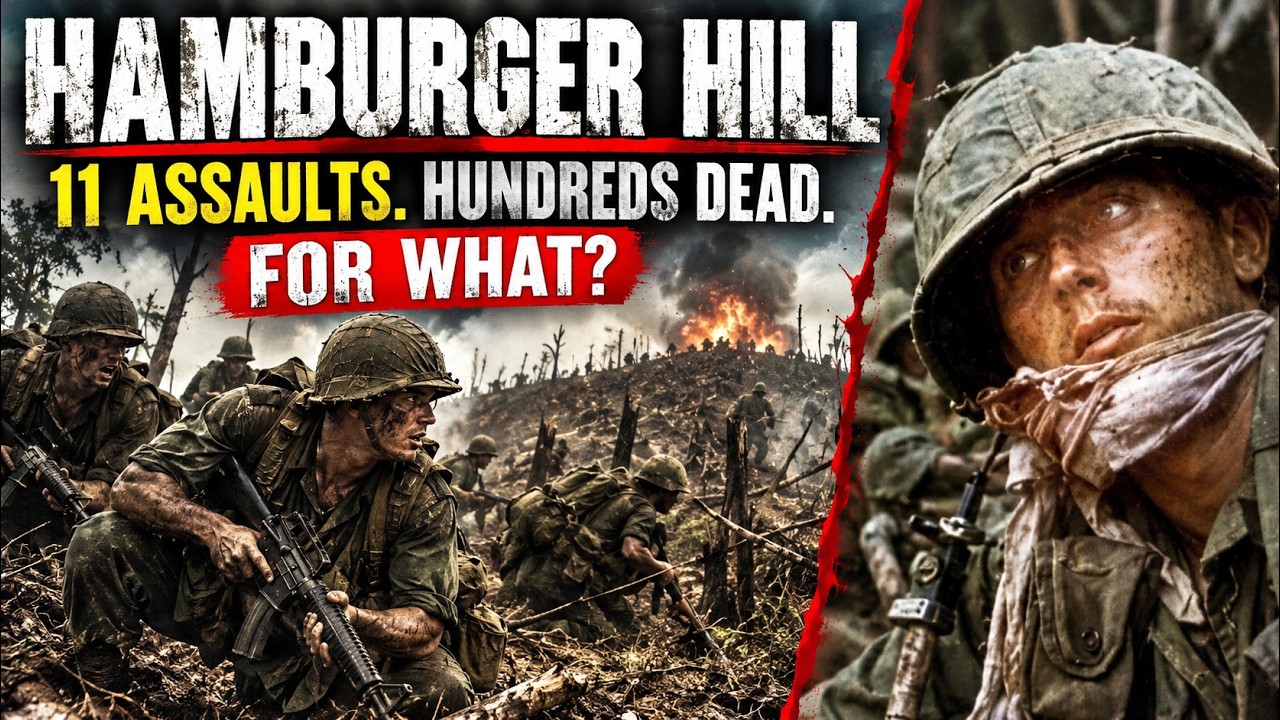
Then, two weeks later, they simply withdrew and abandoned the ground. The enemy moved straight back in. When the American public learned what had taken place, they did not see a victory. They saw a senseless slaughter, and the backlash helped turn the country against the war itself.
The hill in question was Hill 937, or Dong Ap Bia to locals, a ridge in the rugged Annamite Mountains along the border between South Vietnam and Laos. The A Shau Valley had long been a key infiltration corridor, a major artery for North Vietnamese troops and supplies moving south through the Ho Chi Minh trail. U. S.
forces had repeatedly entered the valley at heavy cost to disrupt enemy control there. In the spring of 1969, the mission was Operation Apache Snow, part of a campaign to destroy North Vietnamese bases in the valley. Hill 937 itself held little strategic value: it overlooked no vital road and guarded no significant position. But U.
S. intelligence believed a seasoned enemy force was dug in on it, the 29th Regiment of the North Vietnamese Army, a unit nicknamed “Pride of Ho Chi Minh” and made up of veterans of the brutal Battle of Hue during the Tet Offensive the previous year. That was the principal reason the hill mattered. The enemy was there.
In a war of attrition, where success was measured not by territory seized but by enemy dead, that was supposed to be reason enough. The Americans did not plan to isolate the hill and crush it from a distance. They were determined to climb it and hunt the enemy face to face. Leading the mission was Lieutenant Colonel Weldon Honeycutt, known as “Blackjack,” commander of the 3rd Battalion, 187th Infantry, the “Rakkasans,” one of the army’s proudest airborne units.
Before dawn on May 10, artillery pounded the landing zones and 65 helicopters carried the battalion into the jungle below the mountain, troops spilling out of Huey helicopters into the trees. At first, it was quiet. The terrain was brutal, steep slopes, tangled trees, and thick bamboo that swallowed the men, but they found only empty shelters and scattered, weak fire. Honeycutt concluded the enemy had withdrawn across the border into Laos, as the North Vietnamese often did, and ordered his companies to push toward the summit.
Late in the afternoon of that first day, however, a reconnaissance platoon found communication wire running through the jungle, a command line, and followed it straight into the heart of the storm. From expertly camouflaged fighting positions, the 29th Regiment opened fire with rifles and machine guns, dropping Americans at close range. The lead soldier fell. Another man’s weapon was knocked from his hands by a rocket.
The enemy had not withdrawn at all. They were entrenched and waiting, and they had just announced the defense of Hill 937. What Honeycutt and his men did not yet realize was that this was no fighter’s ambush. It was a fortress built into the mountain.
Over weeks, the North Vietnamese had turned the slopes of Hill 937 into a defensive masterpiece, invisible from the air. From above, the hill looked like a solid carpet of green jungle canopy. Beneath that canopy sat a layered system of trenches and bunkers built of timber and packed earth, dug deep, connected by tunnels, and so fully camouflaged that a soldier could stand within three meters of a machine-gun position without seeing it. The bunkers were arranged in tiers along the slope so their fields of fire overlapped and interlocked, covering every approach.
Some were positioned to fire on attackers from the rear after they had passed. This kind of fixed, fortified defense was rarely faced by American paratroopers, who were trained for fast, mobile, air-assault warfare. It also carried a terrible advantage inherent in the shape of the land itself. The Americans had to attack uphill, exposed, through dense jungle that forced them into narrow kill zones, against an enemy that held the high ground, hid in dirt and timber, and could see them coming.
Over the next ten days, the 3rd Battalion would climb into that meat grinder again and again, and the enemy would not be the only thing killing them. On the morning of May 11, the second day, the battle produced its first horrors, and they came from their own side. As the companies advanced, two American Cobra gunships, sent to support the attack, misidentified the battalion command post as an enemy position and fired rockets directly into it. American rockets hitting American soldiers.
Men were killed, dozens wounded, and moments later, as survivors staggered in shock, North Vietnamese mortar rounds fired from across the Laotian border rained down on the same wounded men. This was not an isolated tragedy. Over the course of the battle, there were five separate incidents in which American aircraft attacked their own troops on that hill, killing seven Americans and wounding more than fifty. Four involved Cobra gunships, one of which fired from more than a kilometer off target.
The napalm, bombs, and rockets meant to save them became just one more thing that could kill them at any moment. Honeycutt could have pulled back after that opening catastrophe, but he did not. He ordered the advance to continue, and a bloody pattern set in for more than a week: bombard the hill with artillery, airstrikes, and napalm; send infantry up the slope; watch the bunkers that were supposed to be destroyed come back to life as the Americans approached; take casualties; fall back; repeat the next day. Day after day, it continued in the mud and heavy monsoon rain.
On May 12, an attack stalled in a clearing, the bunkers intact despite everything thrown at them. On May 13, a platoon came under sniper fire from North Vietnamese soldiers who had tied themselves to trees so they would not fall when hit, forcing the Americans to use their machine guns to kill them. The rain was so heavy it cut visibility to a few dozen meters, soaking the men and jamming their rifles with mud at the worst moments. Every day, the bombardment reshaped the slope, trees blackened, earth churned, and every day the infantry climbed hoping the defenses had been shattered this time, and every day fire erupted again from bunkers that had survived underground.
By mid-battle, Honeycutt’s battalion had taken severe losses, some companies at 50 percent casualties, and higher command considered withdrawing the exhausted unit entirely. But Honeycutt and his men refused. They had started this and wanted to finish it. They would not let another unit take their hill.
Whatever one thinks of the decision to keep climbing, the men doing the climbing were not forced up against their will. Many of them wanted to be there, wanted to finish what had cost so many of their friends so much. On May 16, a civilian climbed that hill and asked that exact question out loud, and nothing was the same afterward. Jay Sharbutt, an Associated Press correspondent, learned a vicious battle was raging on Hill 937 and did what journalists do: he went there, interviewed the American general running the operation, and asked directly the question the entire country was about to ask.
Why use infantry, sending men up that slope to die, instead of using firepower on a hill with no strategic value? The question, published and broadcast, ignited a firestorm. Suddenly, the American people, exhausted and already divided by years of a war that seemed endless and pointless, found themselves reading about young men being fed, day after day, into a frontal assault on an unnamed hill that even the army admitted held no real strategic importance. The name did the rest.
Hamburger Hill. It was perfect and horrifying, and it spread everywhere. Then came the image that turned anger into grief. On June 27, 1969, Life magazine published an issue featuring the faces of 241 American soldiers killed in Vietnam in a single week.
Rows upon rows of young men staring out from the page. In fact, only a small number of those 241 had died at Hamburger Hill, but America did not understand it that way. To a grieving and angry public, those 241 faces became the symbol of Hamburger Hill, the human cost of a futile battle, all those young men sacrificed for a hill. The battle merged with that issue in the national consciousness and produced something no previous battle in the war had: a widespread, bipartisan feeling that this was simply senseless.
While the firestorm raged at home, the men were still on the hill, and they had to finish the job. By May 18, American command assembled everything it had for a massive assault. Artillery pounded from multiple bases, more than 270 airstrikes, and nearly a million pounds of bombs and 150,000 pounds of napalm fell on that hill. The summit turned into a smoky lunar landscape of shattered trees and scorched earth.
When the infantry climbed through it, some came closer than ever, within a few dozen meters of the crest. Then, from bunker openings that had survived even that inferno, machine guns and rockets opened fire again, driving them back. The defenses had not been destroyed, only reshaped. Finally, on May 20, the eleventh day, the Americans amassed overwhelming strength from every direction at once.
Honeycutt’s 3rd Battalion attacked alongside fresh battalions, the 1st Battalion of the 506th coming from the south, the 2nd Battalion of the 501st and South Vietnamese forces pushing from the southeast, converging on the summit from multiple axes. They climbed through the smoking, churned earth using bomb craters and fallen trees for cover, and this time, finally, they broke through the last line of defense and reached the top. American and South Vietnamese flags were raised over Hill 937. After 11 days and 11 assaults, the hill was theirs.
This is where the tragedy completes itself. The men were airlifted off the hill for rest, and as they left, they passed that makeshift sign a soldier had nailed to a tree, a piece of a military ration can with two words written on it: “Hamburger Hill. ” Beneath it, in some accounts, three more words: “Was it worth it? ” Over those eleven days, at least 70 Americans had been killed and more than 370 wounded taking that hill.
Their companies suffered devastating losses. Young men came down that slope prematurely gray, carrying things they would never let go of. Then, only two weeks later, American command made the decision that turned the costly victory at Hamburger Hill into a national scandal. They abandoned it.
The hill had no strategic value. That had always been true. So there was no reason to keep a garrison on it and bleed for it. The Americans simply left.
Within weeks, the North Vietnamese returned to Hill 937 and reclaimed the very ground that had cost more than 400 American casualties. Every man who fell on that slope fell for a piece of ground his own army handed back to the enemy without a fight. The consequences reached the highest levels, which is why the Battle of Hamburger Hill matters more than almost any other battle in the war. In the Senate, Edward Kennedy denounced the assault as senseless and irresponsible, a symbol of a war that had lost its purpose.
Public anger was enormous, bipartisan, and produced tangible change. It altered U. S. military policy.
Army command, shaken by the storm, issued new directives placing real limits on such bloody frontal assaults against heavily fortified positions. Commanders were now expected to rely on firepower and maneuver to avoid throwing infantry into another meaningless battle on another unknown hill. It was not just tactics. A few weeks after the battle, on June 8, 1969, President Richard Nixon met with South Vietnam’s president and announced the policy of “Vietnamization,” a plan to gradually withdraw U.
S. troops and hand the fighting over to the South Vietnamese. By the end of August of that year, the first U. S.
forces officially began coming home. Historians will rightly say that Vietnamization was already in preparation, that American public opinion had been shifting for a long time, and that Hamburger Hill alone did not end the war. That is true. But it is also true that Hamburger Hill became a glaring, unbearable symbol of everything wrong with how the war was being fought, and it came at the moment America was ready to stop.
It gave the growing withdrawal movement a rallying cry and a face. It was the battle that made the country say, “Enough. ”
That is the strange, sad legacy of Hill 937. Militarily, the soldiers who fought there did everything asked of them and more.
They climbed a steep slope 11 times against a fortified, experienced enemy. They endured fire from their own forces that rained down on them again and again. They took the hill through endurance and determination, and inflicted enemy losses far exceeding their own. By every measure, they won.
And it did not matter, because the hill was never the point, and everyone, soldiers, journalists, the public, the Senate, knew it. The men who fought there deserved a better fate than to become a symbol of futility, but that is what an unnamed hill, a ration-carton sign, and a magazine full of young faces made of them. They fought with no less courage than any American soldier in that entire war, for a piece of ground their own commanders admitted meant nothing, and then returned it to the enemy. The soldier who wrote those two words on a torn ration carton and nailed it to a tree was not writing military history.
He was asking a question, the simplest and hardest question a fighter can ask: Was it worth it? He asked it for himself and for the friends he had buried on that slope. Within weeks, a grieving nation adopted his question and turned it toward the entire war, and found no answer that satisfied it.
That is how an unnamed, worthless hill became one of the most important battles of the Vietnam War, not because of the ground gained, but because of the question asked on the way down.