On September 29, 2010, Tony Curtis died at his home in Henderson, Nevada. The 85-year-old actor, long battling chronic obstructive pulmonary disease, was surrounded by his paintings and personal belongings in the bedroom he loved, his wife Jill at his side. Cardiac arrest ended the life of a man who had spent decades constructing the image the world would remember. Six days later, at Palm Mortuary and Cemetery in Green Valley, Nevada, Curtis was laid to rest with a Stetson hat on his chest, an Armani scarf around his neck, driving gloves on his hands, an iPhone loaded with his favorite music, and a copy of the novel *Anthony Adverse* beside him.
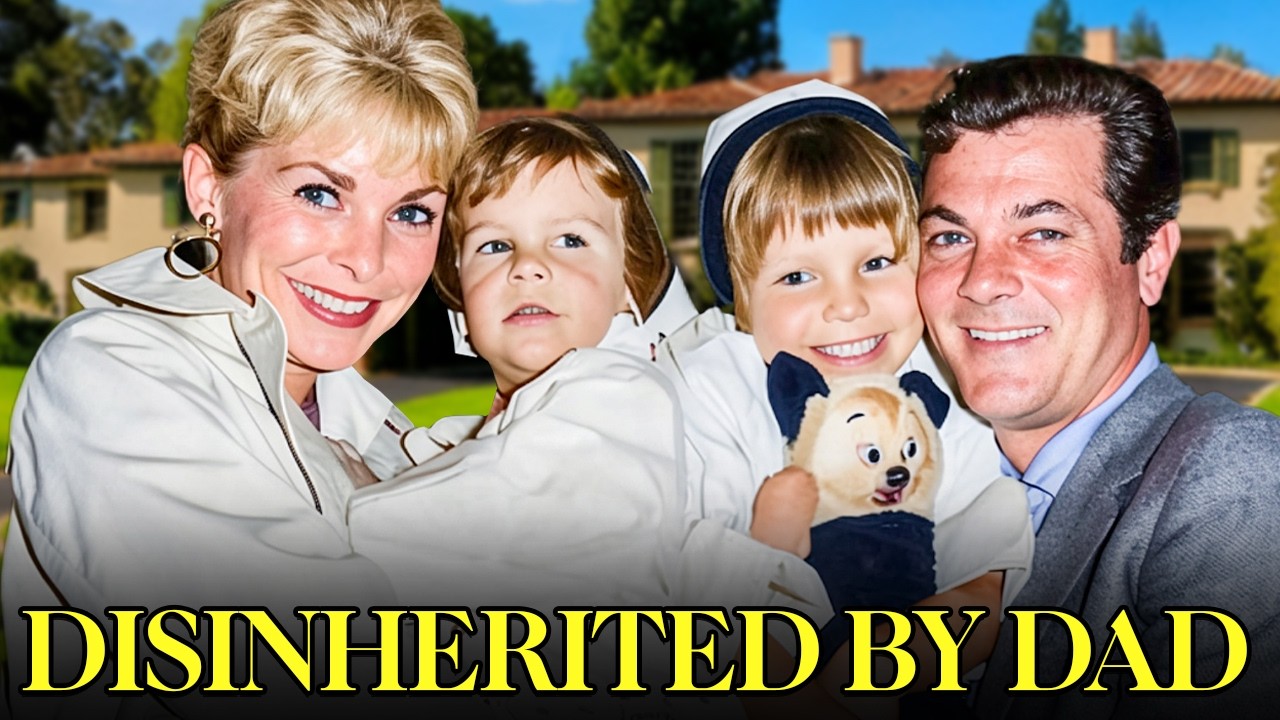
His daughters, Jamie Lee Curtis and Kelly Curtis, stood among the mourners, composed and grieving. They did not yet know what was coming. Five months before his death, Curtis had signed a will. The document named all five of his surviving children, acknowledged them, and then stated in language a probate court would later uphold that he intentionally chose to leave them nothing.
The estate went to Jill. His children received the experience of seeing their own names inside a legal instrument designed to exclude them. To understand how a family arrives at such a document requires looking far beyond the funeral. It requires returning to who Tony Curtis and Janet Leigh actually were before Hollywood made them into a fantasy.
Tony Curtis was born Bernard Schwartz on June 3, 1925, in the Bronx. His parents, Emanuel and Helen Schwartz, were Hungarian Jewish immigrants living in cramped apartments in a neighborhood shaped by poverty. Emanuel worked as a tailor with unsteady income. Helen would later be diagnosed with schizophrenia, leaving her sons to navigate a mother whose presence could shift from warmth to confusion to violence without warning.
Robert, Bernard’s younger brother, was killed by a truck in childhood. The loss was never fully processed. At times when home became unmanageable, Bernard and his brother Julius were placed in an orphanage, not because they were orphans, but because there was not enough food or stability to keep them safe. What Bernard Schwartz learned was permanent: survival meant charm, speed, and making himself impossible to look away from.
He served in the Navy during World War II, studied acting under the GI Bill at the New School in New York, and headed west. He changed his name, his accent, and everything about his surface, because the surface was the only thing that had ever gotten him anywhere. Janet Leigh came from the opposite direction. Born Janette Helen Morrison on July 6, 1927, in Merced, California, she grew up in a working-class household shaped by scarcity but disciplined in presentation.
Bright and studious, she learned early that prettiness and composure were currency. Her entry into Hollywood came through Norma Shearer, who noticed a photograph of the young woman at a ski lodge in Northern California, where her parents worked the front desk. Within months, she had a studio contract and a new name. If Tony was improvisation and appetite, Janet was presentation and control.
What she wanted was a protected life, work she could take seriously, and a marriage that would hold. When they met in 1950 at a party at Jerry Lewis’s home, the chemistry was immediate. Tony was magnetic and reckless. Janet was luminous and composed.
She represented entry into the world he had been building himself to reach. He represented vitality and danger to a woman whose public image was built on composure. They mistook the intensity of attraction for compatibility. They eloped on June 4, 1951, in Greenwich, Connecticut, despite resistance from both studios and objections from Janet’s family.
Jerry Lewis served as best man. The press covered the marriage as a love story too powerful to be contained by corporate logic. But inside the ceremony was an asymmetry: Tony was marrying up into the world he wanted, and Janet was marrying a man whose energy thrilled her precisely because it was unlike the order she had built. Kelly Lee Curtis was born on June 17, 1956, in Santa Monica.
Jamie Lee Curtis was born on November 22, 1958, also in Santa Monica. By the time Jamie arrived, the family had the full architecture of the fantasy: a famous father, a famous mother, two daughters, a beautiful house, and the Hollywood promise that glamour could protect children the way it protected careers. That promise was a lie that took years to reveal itself. In the mid-to-late 1950s, Tony and Janet were as close to Hollywood royalty as a couple could get.
Their joint films, *Houdini* in 1953 and *The Vikings* in 1958, fused their screen chemistry with their public marriage. The studios wanted it, the magazines wanted it, and both needed it. Tony because being seen as half of a golden couple proved the Bronx kid had made it, and Janet because the marriage, as long as it looked right, was the stable structure she wanted. The house in Beverly Hills was Janet’s domain, managed with exacting control.
Every room was curated, as if the house itself were an argument for the family’s legitimacy. Jamie would later describe growing up in a home where order was not comfort but enforcement, where immaculate rooms felt less like a place to live and more like a set prepared for photographers. Janet corrected Tony’s behavior at parties, how to hold a glass, which fork to use. Tony, who had spent his childhood in rooms where nothing was controlled, experienced that effort not as love but as judgment.
He was the Jewish kid from the Bronx in rooms full of people who had never worried about rent, and every correction reminded him of the distance between who he was and what this world required. Tony earned an Academy Award nomination for *The Defiant Ones* in 1958, opposite Sidney Poitier. Then came *Some Like It Hot* in 1959, opposite Marilyn Monroe and Jack Lemmon, which cemented him as a global star. Janet was doing her own strongest work.
In 1960, Alfred Hitchcock cast her as Marion Crane in *Psycho*, a role of guilt, fear, and violent exposure at a moment when her marriage was deteriorating behind closed doors. In June of 1961, the Curtises threw a tenth anniversary party that became one of the most talked-about social events of the Hollywood season. They built a dance floor over the swimming pool, hired a full orchestra, and hosted roughly 250 guests from the film industry’s most powerful circles. By multiple later accounts, the couple celebrating a decade of marriage were not happy when the guests went home.
By late 1961, the private reality had become unmanageable. Janet’s father came seeking money, landing in a household already strung with tension. At the International Red Cross Ball in Monte Carlo, hosted by Princess Grace, Janet broke. Accounts describe her retreating from the ballroom, overwhelmed, unable to maintain the composure that had been her armor for a decade.
Shortly after that night, Tony called with news that her father had died by suicide. The controlled, beautiful life Janet had spent her adult years constructing could not absorb it. She moved toward collapse. Tony moved toward escape, his established pattern.
The family left for Argentina, where Tony was filming *Taras Bulba*, carrying grief and resentment and two small daughters across an ocean. It was there, on that set, that Tony fell in love with a teenage co-star named Christine Kaufmann. Christine Kaufmann was 17 years old, some sources say 18. A man in his mid-thirties on location with his wife and two small daughters was falling for a girl young enough to be mistaken for one of the crew’s children.
She represented what Janet could not: the uncomplicated admiration of someone who did not know him well enough to be disappointed. The affair effectively ended the marriage. Tony and Janet divorced in 1962. Janet married stockbroker Robert Brandt that same year, not as a rebound but as a deliberate turn toward the steady, private, emotionally reliable life she had wanted all along.
Tony married Kaufmann in 1963. Jamie would later say that Robert Brandt raised her from the age of three. Brandt became the man who showed up, who drove the girls to school and provided the unglamorous continuity children need more than a famous last name. Janet’s second marriage lasted more than four decades until her death in 2004.
Tony married six times in total. Kelly and Jamie both moved toward acting. Jamie got famous fast. Her fame was always in part a conversation with the family she came from.
In early interviews, she said she did not know her father very well. After his death, she said it more directly: he was not interested in being a father. The distance between Tony and his daughters had been the reality for decades. Kelly’s path was quieter.
She acted, assisted Jamie on projects, and moved in and out of the industry without weaponizing the family legend. She was the older sister who remembered more and said less, old enough to see the original marriage up close, the first witness to a family photograph that had stopped matching reality. Tony had more children. Two daughters, Alexandra and Allegra, with Christine Kaufmann during the 1960s.
Two sons, Nicholas and Benjamin, with his third wife, Leslie Allen, in the 1970s. The pattern of partial presence continued across all of them. He was capable of warmth and dazzling attention but not consistency. And then came the tragedy that proved the family’s damage had become lethal.
Nicholas Curtis, Tony’s youngest son with Leslie Allen, died in 1994 at age 23. The cause was a heroin overdose. UPI reported that two men were charged with supplying the heroin that killed him. Later reporting noted Nicholas had been sober for a period before relapsing.
Tony would later call the loss of Nicholas the great sadness of his life. Tony’s own life in the decades after the first marriage followed a public and evasive trajectory. He battled alcohol and cocaine addiction in ways that damaged his career. His film career declined through the 1970s and 1980s.
He had severe health problems that accumulated with age. He kept marrying six times in total. By the early 2000s, he was living in Henderson, Nevada, with Jill Vandenberg, his sixth wife, decades younger than he was. He painted, wrote memoirs, and rescued horses.
A 2002 profile in *The New Yorker* captured him as an aging man from the Bronx who had never stopped running from the apartment where his mother lost her mind and his brother died in the street. On September 29, 2010, at approximately 9:25 in the evening, Tony Curtis died. His wife Jill was with him. She would later say he died peacefully in the bedroom he loved after they had decided together to bring him home from the hospital.
In July of that year, he had been hospitalized after an asthma attack during a book signing. Jamie Lee Curtis issued a public statement that was graceful and composed. The funeral followed on October 4th at Palm Mortuary and Cemetery in Green Valley, near Las Vegas. Jamie Lee Curtis and Kelly Curtis attended.
So did Jill, friends, fans, and former co-stars. Then the will became public. The document had been signed and notarized on May 5, 2010, nearly five months before Tony died, and filed in Clark County, Nevada on October 12, just eight days after the funeral. The Associated Press, following an Inside Edition report, published the details on March 7, 2011.
The document was not ambiguous. Tony Curtis had acknowledged his five surviving children by name. He had then stated that he intentionally chose not to provide for any of them. The estate, worth tens of millions of dollars depending on the estimate, went to Jill.
The wound of the will was not financial. Tony’s children were not people who needed an inheritance to survive. The wound was existential. Tony did not forget his children.
He named them. He listed them. And then he wrote in effect that his final wish was for them to receive nothing. The immediate aftermath tracked predictable lines.
Kelly Curtis contested the will and sought Jill’s removal as executive. The challenge was denied. Other children, including Allegra, spoke from a position closer to shock than surprise, questioning whether the decision sounded like Tony at all. Jill maintained that Tony had been very specific in his wishes.
Janet Leigh had died on October 3, 2004, at age 77 in Beverly Hills, the cause vasculitis. She died with Robert Brandt and her daughters Kelly and Jamie beside her. That presence stands in sharpest contrast to what happened six years later, when the children discovered they had been written out of their father’s final document. Jamie Lee Curtis carried the family story forward in the most public way.
She had been open about her addiction to painkillers, which began after a routine cosmetic procedure. She had been open about how her parents’ serial marriages shaped her understanding of love and commitment. In a 2026 interview with *60 Minutes*, recorded when she was 67, she spoke about her parents with clarity. She said she had surpassed them in emotional freedom, and that her marriage to Christopher Guest, which had lasted more than 40 years, was not luck but a daily, deliberate refusal to repeat the pattern she had inherited.
Kelly’s path through the aftermath was quieter, and it ended sooner than anyone expected. Kelly Lee Curtis died on May 30, 2026, at age 69. Jamie described her publicly as her first friend and lifelong confidant. Kelly was the one who had been old enough to remember the marriage before it ended, the first witness to a family story that would eventually become public property.
The other surviving children moved through the decades in ways reflecting their own relationships to the Curtis name. Alexandra Curtis kept the lowest public profile of any of the children. Allegra Curtis remained more public, working as an actress primarily in German-language media, and was among those who expressed shock when the will became public. Benjamin Curtis settled in Maine, managed a bar, and spoke in occasional interviews about how seriously he took being a present father to his own children, consciously doing what his father had not done.
The cultural afterlife of the Curtis-Leigh story has unfolded through memoirs, retrospective profiles, and literary re-examination. Janet Leigh’s *There Really Was a Hollywood* appeared in the 1980s. In 2023, Lawrence Leamer’s *Hitchcock’s Blondes* revived the marriage as a psychologically rich Hollywood story, bringing the private details back into public conversation. There was also a 2008 documentary, *The Jill and Tony Curtis Story*, which centered Tony’s late life with Jill and gave almost no meaningful space to the daughters’ long estrangement.
Jill moved forward after Tony’s death. Public records and the Shiloh Horse Rescue website show that Jill Curtis Weber, along with Todd Weber and Sally Vandenberg, relocated the horse rescue operation from Nevada to South Dakota in 2019. The rescue work became the most stable and publicly sympathetic thread of her post-Tony life. Jamie Lee Curtis remains married to Christopher Guest.
She has two adult children. She is sober. She won an Academy Award. The damage in this family was never resolved.
It was survived, which is a different thing. Tony Curtis and Janet Leigh gave their daughters a legend before they gave them a stable truth, and for the rest of their lives, those daughters lived in the space between the two. When Tony Curtis finally put his last wishes into legal language, he did not create the wound.
He gave it a file number.