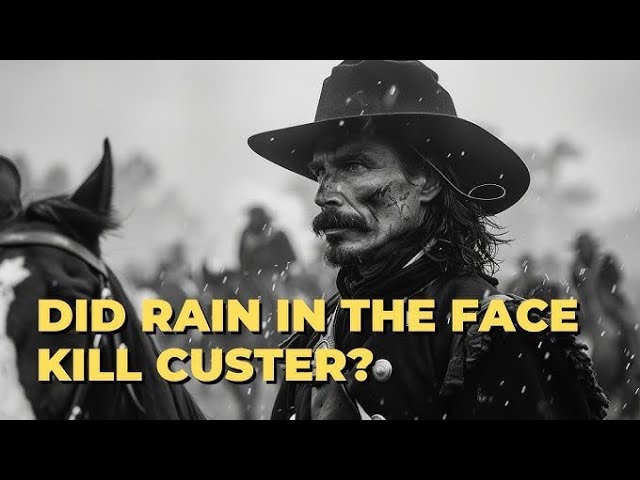
Rain in the Face, the famed Hunkpapa Lakota warrior and leader, played a significant role in the 1876 Battle of the Little Bighorn, where Lieutenant Colonel George Armstrong Custer and the Seventh Cavalry suffered a crushing defeat. Renowned for his ferocity and bravery, Rain in the Face carried a bitter personal hatred toward Custer, whom he believed responsible for the killing of his brother and sister during an earlier confrontation. Some accounts claim he took part directly in the attack on Custer’s detachment and may even have struck the fatal blow. Historians continue to dispute that claim, leaving the precise circumstances of Custer’s death unresolved.
Following the battle, Rain in the Face eventually surrendered to U. S. forces and spent years in confinement. After his release, he became an outspoken advocate for Native American rights and later performed in Wild West shows, recounting his experiences as a warrior.
In his later years, when pressed about his past, Rain agreed to tell his side of the story—and went further than anyone expected. He began recounting his personal memories of the battle, breaking decades of silence. For years, military officers and government officials had tried to extract the truth from him through persuasion, bribery, and threats. Nothing had succeeded.
His reputation as Custer’s killer had grown so powerful that poet Henry Wadsworth Longfellow even preserved it in verse. Rain said that two winters before the great battle, Gall and Sitting Bull camped at Standing Rock, where their people stood united against the government. He described life in the warrior camp as rich and joyful, filled with dances, horse races, shooting contests, and games. Buffalo and deer were plentiful, and the herds of ponies seemed endless.
One night, a girl challenged him to ride to Fort Lincoln and kill a white man. He warned her it meant death—soldiers were everywhere, and scouts were watching. She laughed and mocked him, saying a true warrior does not fear and that she would find a Sundance dancer with real courage instead. The insult decided everything.
He returned to his lodge, painted his face black, and prepared his weapons. Under cover of darkness, he rode 45 miles north toward Fort Lincoln. For two days, he watched and waited for his chance. He could have killed a white woman or a laborer, but he wanted a soldier’s buttons to prove himself.
At dawn, he saw a traitor and a horse doctor walking toward a spring. Custer and his men were riding nearby, barely a hundred yards away. Rain charged, shot the traitor, and smashed the doctor’s skull with his war club, finishing the work with arrows. As he cut away the buttons, Custer heard the gunshot and turned his men toward him.
There was no time to take scalps. Rain leapt onto his pony and taunted them, daring them to follow. They chased him as far as the Cannonball River. That winter, Rain went to the Standing Rock agency store but was denied rations because he had rejected the treaty.
The one-armed storekeeper was there, along with soldiers who attacked him from behind, overwhelmed him, threw him into a wagon, and held him down all the way to the guardhouse at Fort Lincoln. He was given no respect as a chief—only chains, an empty cell, and a single thin blanket. All winter long, the wind screamed through the cracks in the walls, and the cold fueled his hunger for revenge. One day, Custer allowed him outside, and the soldiers urged him to flee.
Rain understood the scheme: they wanted him to run so they could shoot him in the back. He stared straight at Custer and swore that if he ever gained his freedom, he would cut out his heart. Chained to a white prisoner, he escaped one night, but by morning his companion was recaptured. Rain disappeared into the wild country, knowing the pursuit would never truly end.
When he rejoined Sitting Bull’s camp, even they feared what might happen if they protected him. Rain sent Custer a warning: a buffalo hide painted with a dripping heart, a reminder that his vow still lived. When they met again, he fulfilled that promise. Much of what Rain told matched the army’s own records, including the killings of the sutler and Dr.
Hunninger. When shown a drawing of Custer’s charge, Rain burst into laughter and called it false. The soldiers didn’t swing sabers, he said—they fought with rifles and pistols, dismounting every fourth man to hold the horses’ reins. His own men tied themselves to their ponies, naked to the waist and painted for war, circling like a storm.
The picture showed them with bows, but they carried deadlier tools. When the soldiers’ rifles jammed, cartridges stuck inside the chambers, Rain said he saw dozens of rounds lying on the ground, never fired. When their weapons failed, the warriors smashed their skulls with war clubs, no harder than slaughtering sheep. Some pleaded for mercy.
None was given. He described the Little Bighorn village as curving along the river like a drawn bowstring, with too many lodges to count, thousands of warriors. Sitting Bull climbed a hill and made powerful medicine, returning with a sacred bundle and shouting that soldiers were coming but would be destroyed. The following morning, scouts brought warnings, and Sitting Bull ordered empty lodges set up as decoys.
Then he left to pray and did not return until the fighting ended. Gall took command, Crazy Horse led the Cheyenne, and Goose led the Arikara. Rain said they knew the soldiers’ horses were exhausted, and the scouts took the bait, believing the warriors weak and few. When the soldiers split their forces, the warriors rejoiced.
Gall swept upstream to strike their flank. Custer’s detachment came over the bluffs, and the young men sealed off their rear. Their charge collapsed under fire. Trapped, the soldiers dismounted in clusters, every fourth man holding the horses.
The warriors tightened around them like a noose. Officers shouted orders, but in the dust and smoke, all uniforms looked the same. Rain said he never saw Custer fall. The battle burned with fury and revenge.
The warriors shot down the men guarding the horses, then sent the terrified animals running by waving blankets. Rain said he had already sung his war song and breathed in the bitter smoke of gunpowder. His thoughts vanished, replaced by pure battle madness. When he seized the flag, his pony collapsed beneath him.
He slashed the straps loose, leapt to the ground, and crushed the flag bearer’s skull with his war club. Running back through the chaos with the banner in his hands, he felt triumph surge through him. Then he saw Custer. The memory of his blood oath burned fiercely.
He fought like a man beyond reason, bodies falling as he cut his way toward him. When their eyes met, Rain laughed at the terror on his face. Custer’s lips moved in prayer or begging, but the roar of gunfire swallowed his words. One shot from Rain’s revolver struck his chest and ended the debt.
Rain leapt down, cut out his still-beating heart, and bit into it savagely. Taking his scalp felt unnecessary. His vow had been honored. As he withdrew, the women finished off the wounded, gathering spoils—boot leather, fingers for rings—and searched in vain for Custer’s scalp.
His short hair and lack of a distinguishing uniform hid him among the dead. That night, the victory celebration began with feasting and scalp dances. Sitting Bull claimed the triumph, saying his medicine made the warriors brave. Gall answered sharply, saying they fought the battle while he made magic.
Their rivalry divided the camp. Some followed one chief, some the other, and many followed neither. When scouts warned of approaching artillery, the camp moved north across the border. Rain stayed there until Sitting Bull’s return allowed him to come home.
When pressed about whether he had killed Custer, his reply was simple: no one knows. The battle was confusion, and men fought without sight. Asked why Custer had not been scalped like the others, Rain said with contempt that bravery does not protect a man from scalping. The women searched, and he must have been buried beneath the bodies.
When asked about Curly, the Crow scout who claimed he escaped the fight, Rain’s scorn was unmistakable. Curly lies, he said. His horse failed and he ran—a coward, not a warrior. Now nearly 60 winters old, Rain stood as the last surviving chief of the Little Bighorn.
He scratched his name in English letters, though their meaning escaped him. His bravery was unquestioned, though his morality followed the ancient warrior code. When he gave his word, he never broke it, though gaining that promise demanded endless patience.
This rare firsthand testimony sheds new light on that fateful June day in 1876—not a polished legend, but the raw truth spoken by the last man alive who could tell it.