By the mid-1950s, the Theodore Hamm Brewing Company of St. Paul, Minnesota, had become the fifth-largest brewery in the United States. It was a remarkable rise for a brand that began with a butcher, a saloon, and a defaulted loan, and it was powered by clean artesian water, a memorable jingle, and a cartoon bear that every American kid could sing along to before learning to read. The reason the brewery eventually disappeared had nothing to do with the quality of its beer.
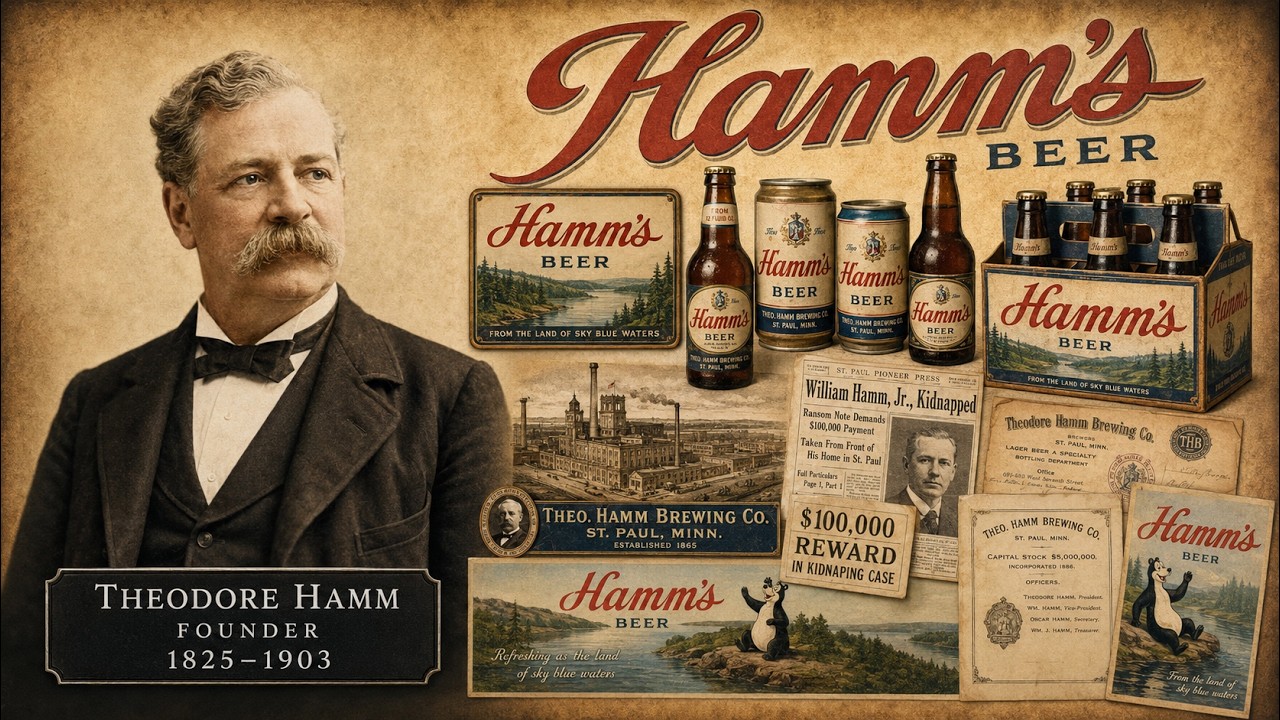
It had everything to do with a question no one asked out loud: who actually owned the name once the family that built it no longer did? The bear survived, but the brewery did not, and the real story of Hamm’s is a story about how many times the water and the name changed hands until there was almost nothing left of St. Paul in either one. The story began in St.
Paul in 1856. Theodore Hamm was born in 1825 in Herbalheim, in the Grand Duchy of Baden, the third of ten children in a household with little room for anything. At 28, he left Germany as hundreds of thousands of young German men were doing that decade, arriving in Buffalo, New York, in 1854, where he found work behind a butcher’s counter. He moved on to Chicago, married a woman named Louise Bholz, and in 1856 the couple moved again, this time to the frontier town of St.
Paul, Minnesota. Shortly after arriving, Theodore Hamm opened a saloon on the corner of Third and Robert Streets. Louise ran the kitchen side, serving full meals alongside the beer and turning the saloon into something closer to a beer garden. Her instincts helped build the business’s first foundation.
A few miles away, in a wooded ravine known as Swede Hollow, a man named Andrew Keller had built a brewery directly on top of natural artesian wells, with clean, cold water flowing from the sandstone bluffs above Phalen Creek. Keller called it the Pittsburgh Brewery. When Keller wanted to expand and needed money, he turned to a regular customer, the saloon keeper Theodore Hamm, and asked for a loan. Hamm agreed, with the loan secured against the deed to the brewery itself.
The expansion costs ran ahead of what the brewery could sell, and the debt grew faster than the beer moved. In 1864, with the loan in default, ownership of the brewery, the wells, the buildings, and the equipment passed to the man who had only meant to be a lender. Theodore Hamm did not set out to become a brewer. He became one because another man’s math failed.
He renamed the operation the Excelsior Brewery. In his first year, he ran the business with five employees and produced 500 barrels of beer. The location mattered more than anyone realized at the time. St.
Paul’s east side was filling with German immigrant workers who wanted beer the way they had it back home, and who lived close enough to walk to a brewery built over clean artesian water no one else in the area controlled. Hamm hired a master brewer named Christopher Fig to handle the technical side of the operation. Fig did not just brew the beer; he started a dynasty. His son William and later his grandson William II served as Hamm’s master brewers in turn, three generations shaping the taste of the beer across more than half a century without their names ever appearing on the label.
Not everyone who touched the brewery in those early years stayed loyal to it. A man named Jacob Schmidt, who had known Theodore Hamm back in Baden, worked as an early brew master and then left to start his own competing brewery just down the road in St. Paul. Hamm did not just survive the competition; he grew past it.
Within 20 years, the Excelsior Brewery had become the second-largest brewery in Minnesota. The output outgrew the original buildings, so Hamm brought in an architect, August Meritson, to design a much larger, ornate complex that opened to the public in September 1894. In 1896, the company was formally incorporated as the Theodore Hamm Brewing Company. Theodore Hamm died in 1903 at the age of 78.
He never saw the national brand his name would become. What he left behind was not a beer recipe or a marketing slogan. It was a brewery built on a spring of clean water that nobody else in the valley controlled, acquired almost by accident through a debt gone bad. His son William and grandson William Jr.
inherited the operation. Under William’s leadership, the brewery became the largest in Minnesota and a name recognized beyond it. By 1912, the plant was producing 2,000 barrels of beer a day. By 1919, on the eve of a threat no brewery could outproduce its way past, Minnesota’s brewing industry had grown to roughly 60 operating breweries, with Hamm’s among the largest.
Barrel counts had climbed from 500 to 5,000 to 40,000 to 2,000 a day, and the workforce had grown from five men to hundreds. Then came Prohibition. The 18th Amendment banned the manufacture, sale, and transport of alcohol nationwide, and Minnesota moved ahead of the federal deadline, falling into compliance in the summer of 1919, months before national Prohibition officially began. Most breweries did not survive.
Of the 60 operating in Minnesota in 1919, only six were still standing when Prohibition was finally repealed in 1933. Hamm’s was one of them. The Ham family survived by keeping the east side facility open and turning it toward anything that was not beer: near beer, industrial alcohol, soft drinks, syrups, ice, even cigars and canned sardines. It was survival, keeping the boilers running and the workforce employed for 13 years so that when the law changed again, there would still be a brewery standing.
When Prohibition ended on April 7, 1933, a whistle sounded outside the Hamm’s plant at one minute past midnight, and a crowd gathered outside the gates roared and leaned on their car horns. By 6 a. m. , less than six hours later, the brewery had shipped 100,000 cases of beer.
Hamm’s had come out of Prohibition as one of only six breweries left standing in the state. That visibility came at a price. On June 15, 1933, just ten weeks after the midnight whistle, William Hamm Jr. , the brewery’s president, left his office to walk to lunch.
A man stepped toward him, reached out as if to shake his hand, and steered him to the curb. Before Hamm understood what was happening, he was shoved into a waiting car. The men driving it belonged to the Barker-Karpis Gang, a crew that had spent years robbing banks across the Midwest and had just decided kidnapping paid better. They drove him across the state line into Wisconsin, forced him to sign four ransom notes, then moved him again to a hideout outside Chicago.
That night, the Ham family received a phone call. A ransom note reached the brewery’s manager with a demand for $100,000, a sum worth well over $2 million today. The family paid it. On June 19, four days after he was taken, William Hamm Jr.
was released unharmed. No one was arrested that summer, but the case did not end there. Investigators studying the ransom notes turned to a forensic technique that had never before been used successfully in an American criminal case: lifting latent fingerprints directly off paper. It worked.
The prints matched members of the Barker-Karpis Gang, and the method used to catch William Hamm’s kidnappers became a standard tool in American law enforcement. By the mid-1940s, the beer industry had changed shape. National brewers with national advertising budgets were pushing into markets that regional breweries like Hamm’s had always taken for granted. In 1945, Hamm’s made a decision that would define the brand for the next three decades.
It hired Campbell Mithun, a Minneapolis advertising agency, to create a national identity. What Campbell Mithun built was not just a slogan; it was a piece of folklore. The agency crafted a jingle built around the phrase “from the land of sky blue waters,” tying Hamm’s permanently to an image of Minnesota’s 10,000 lakes, cold and clean and untouched. It was not technically true that Hamm’s water came from a lake.
It came from artesian wells sunk into sandstone bluffs, but the jingle did not need to be literal. It needed to be memorable, and it was. In 1953, that identity got a face. Campbell Mithun introduced an animated bear, clumsy and cheerful, forever stumbling through the woods or losing at some backyard sport to a raccoon or a beaver.
He was not selling sophistication or status. He was selling the idea that Hamm’s belonged to the outdoors, to campfires and fishing trips and neighborhood ball games. In 1951, a man named William C. Fig Jr.
became president of the Theodore Hamm Brewing Company. He was not a member of the Ham family, but his own family had been part of the company since the beginning. His grandfather had been the first master brewer Theodore Hamm ever hired, and three generations of Figs had shaped the beer before one of them finally sat in the president’s chair. Under Fig, the company stopped thinking like a regional survivor and started thinking like a national contender.
Between 1946 and 1954, the St. Paul plant expanded to 20 acres and 1,300 workers. Fig’s real ambition was not a bigger plant in St. Paul; it was breweries everywhere else.
In 1953, Hamm’s went on a buying spree, purchasing the Rainier Brewery in San Francisco, the Acme Brewery in Los Angeles, Gunther in Baltimore, and the Gulf Brewing Company in Houston. In a single year, a brewery that had spent nearly a century rooted in one river valley now had production running on both coasts and deep into Texas. The math behind it was simple. Beer is heavy, and shipping it long distances eats the profit margin.
The fix was to brew Hamm’s beer closer to wherever it was being sold. For a while, it worked exactly as designed. By the middle of the 1950s, Hamm’s had climbed to become the fifth-largest brewery in the United States. But not every piece of that 1953 expansion held.
The Baltimore and Houston breweries never became what San Francisco and Los Angeles became. Both were shut down not long after Hamm’s acquired them. Two out of four new breweries had not worked, but nobody was counting that as a warning. Fifth-largest in the nation has a way of drowning out smaller numbers.
Through the 1950s and into the 1960s, Hamm’s became an advertising partner to professional sports teams across Minnesota and the broader Midwest. A 1965 promotional poster celebrated that year’s Minnesota Twins season. The beer’s name sat next to the team, two symbols of the same city wrapped into one image. By the early 1960s, the bear and the jingle had traveled further than Hamm’s marketing budget could have paid for on its own.
In 1962, a portion of the Hamm’s jingle turned up sung on screen by Moe Howard, Larry Fine, and Joe DeRita, the Three Stooges, in their feature film “The Three Stooges in Orbit. ” A regional beer’s advertising tune had become recognizable enough that a national comedy act could reference it and expect audiences to get the joke. In 1965, the Theodore Hamm Brewing Company turned 100 years old. It should have been a celebration.
Instead, it was an ending. The family that had run Hamm’s since a butcher’s saloon on Third and Robert Street, through a defaulted loan, through Prohibition, through a kidnapping, through five breweries and a bear that half the country could sing along to, decided at the exact moment the company hit its centennial to get out of the beer business. The Ham family sold the brewery to Heublein, a food and beverage conglomerate based in Connecticut, a company that had never brewed a barrel of beer in its life. It was not a hostile takeover and not a scandal.
It was a family deciding that a hundred years was enough, and that the beer business, now a national arms race between conglomerates with advertising budgets no single family fortune could match, was better left to someone else. That sale set a pattern the brand would follow for the next three decades. In 1965, the people who had built Hamm’s sold it to a company that had nothing to do with beer. In 1971, that company sold it again, this time to a group of Hamm’s own distributors.
In 1975, the distributors sold it once more, to Olympia Brewing, a Washington State company with its own regional identity and, somewhat awkwardly, a second regional beer brand under its roof. Olympia did not hold on to Hamm’s for long. In 1983, Pabst Brewing purchased Olympia outright, and Hamm’s came along as part of the package, a brand acquired almost as an afterthought inside a much larger deal about a completely different beer. Pabst did not want two flagship operations competing for the same shelf space.
So Pabst made a trade. It handed the St. Paul Brewery, the same site Theodore Hamm had taken over in 1864, the same artisanal wells, the same buildings August Meritson had designed in 1894, to the Stroh Brewing Company in exchange for a brewery Stroh owned in Tampa, Florida. One hundred nineteen years of continuous operation on one piece of land changed hands through what amounted to a corporate swap, one factory for another.
Stroh kept the St. Paul plant running for over a decade after the trade. But Hamm’s production itself was gradually shifted away, moved to a plant in Milwaukee, hundreds of miles from the water its own jingle claimed to be named for. Even the illusion of proximity was gone.
In 1997, Stroh shut the St. Paul plant down. There was no ceremony and no press conference, no gathering outside the gates the way there had been in 1933 when a crowd cheered at midnight because the beer was finally legal again. This time the doors simply closed and stayed closed.
A brewery that had operated continuously on that site for 137 years went quiet in a single year. Stroh took what equipment it wanted and left the rest. The property was sold to a real estate investor. The investor sold the southern half, including the original 19th-century brew house August Meritson had designed, to the city of St.
Paul. The city left those buildings standing and let them decay. Over the years that followed, sections were vandalized and sections were demolished outright. What survived did so by accident.
In 1999, two years after the St. Paul plant went quiet, Pabst transferred the Hamm’s trademark to Miller Brewing. Miller kept marketing it not as a flagship or a comeback story, but as a low-priced regional beer. That is still roughly where it sits today.
Molson Coors, which now owns what used to be Miller’s brand portfolio, produces Hamm’s Premium and Hamm’s Golden Draft, cheap and unpretentious, sold mostly in the upper Midwest to people who grew up drinking it or whose parents did. It would be technically wrong to say Hamm’s disappeared. It did not. It shrank.
A brand that was once the fifth-largest brewer in the entire United States, with plants on both coasts and a bear every American kid could recognize, is now a budget option on a shelf in Minnesota and Wisconsin. Miller’s own marketing has taken to calling Hamm’s most loyal drinkers “Hampions,” a half-joking nod to the fact that somebody is still choosing this beer on purpose. The bear never left the can. He is still on the label, and among collectors of old advertising memorabilia, Hamm’s material is some of the most actively sought after in the entire category.
There is an entire community built around it, including the Hamm’s Beer Club, a fan-run group still tracking the brand’s history and still trading memorabilia. The building itself has started to change too. In 2014, a portion of the old brewery complex was bought and slowly restored. Today, a modern craft operation called St.
Paul Brewing runs out of three of the original 19th-century Hamm’s buildings, with beer being brewed again on the same ground. And in November 2025, the St. Paul City Council voted to designate the historic Hamm’s Brewery site a heritage preservation district, a formal legal acknowledgment that the city intends to keep what is left of it standing. None of that came from Molson Coors or Miller or Pabst or any of the five companies that passed Hamm’s between them like a factory traded for a factory.
It came from a city, from collectors, and from a small group of people still calling themselves Hampions, deciding on their own that this particular piece of the past was worth keeping. The real story of Hamm’s was never about bad beer or a brand America simply grew tired of. It is the story of who owned the water and who owned the name, and how many times both of those things changed hands before there was nothing left of St. Paul in either one.
Each decision on its own was a rational response to an industry that had turned into a capital arms race, where advertising budgets and national distribution networks mattered more than the quality of what was actually in the can. Hamm’s beer, by every account, never got worse. What changed was the size of the company it had to compete against. Molson Coors owns the Hamm’s name today, but it does not own the reason people in St.
Paul still call themselves Hampions. The plant that made the beer closed in 1997, and the water it was named after was never really a lake at all. Still, 160 years after a butcher from Herbalheim, Germany, took over a small brewery because another man’s debt went bad, someone somewhere in Minnesota is opening a can tonight without knowing any of it.