Among the most infamous figures of World War II were the leaders of the Einsatzgruppen, the mobile killing units that followed the German army into the Soviet Union. In the years after the war, several of these men were sentenced to death for their roles in the murder of over a million civilians. Their trials and executions remain a significant chapter in the history of postwar justice.
The Einsatzgruppen were essentially mobile death squads. When Germany invaded the Soviet Union in June 1941, four main killing groups, designated A, B, C, and D, followed the advancing German forces eastward. These units belonged to the SS security police and the Security Service, known as the SD. They were further divided into smaller commandos called Einsatzkommandos.
Initially, these units were tasked with dealing with enemies of the new German occupation, such as partisans. However, their mission quickly shifted to the mass murder of civilians. The Einsatzgruppen, along with police and auxiliary groups, would round up civilians, march them to execution sites, force them to surrender their belongings and clothing, and then shoot them into prepared pits that became mass graves. Entire communities were wiped out within hours. At Babi Yar, for example, German SS and police units killed approximately 34,000 people in just two days.
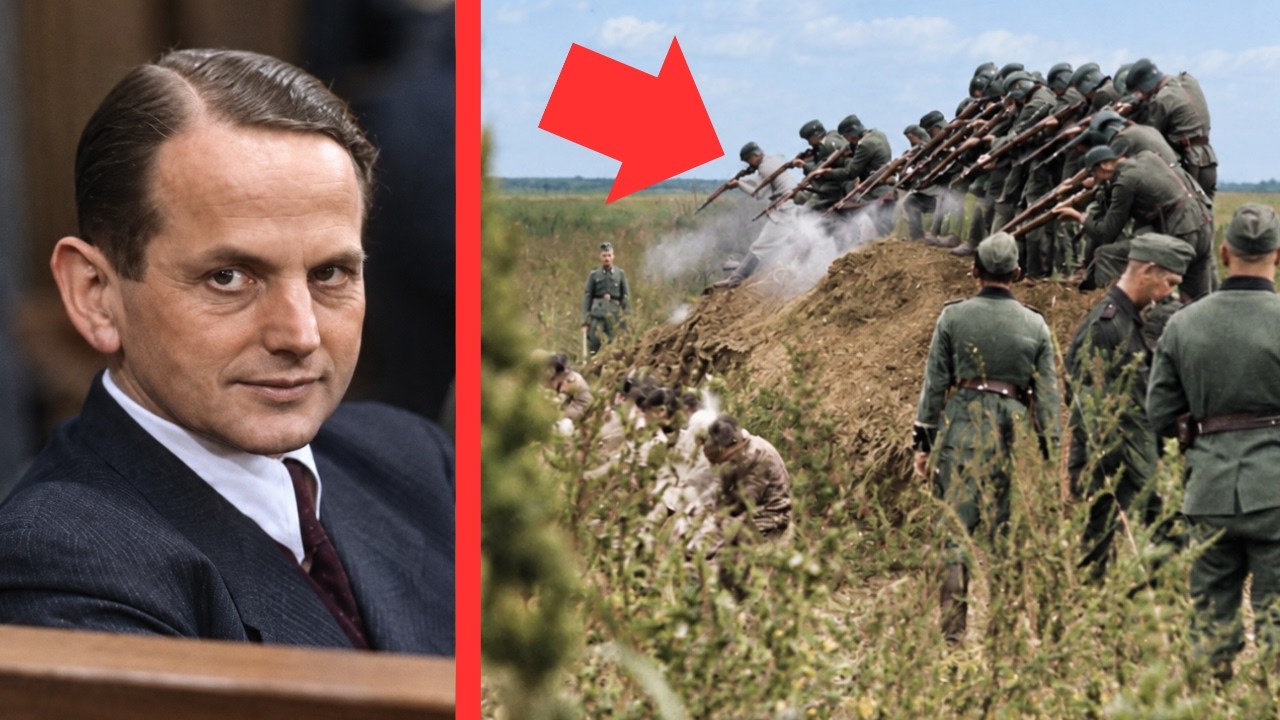
The men who led these operations were different from the military leaders tried at the end of the war. The Einsatzgruppen commanders were not soldiers who had fought for Germany; they were administrators of organizations whose deliberate operations included the mass killing of civilians. The scale of the killings was exceptional, and at the end of the war, the Einsatzgruppen trial was held to bring the men responsible for the deaths of at least 723,000 people to justice. The prosecution claimed there were more than a million victims, and today it is believed that at least 1.5 million people were killed by these death squads in the East.
Much of the evidence against the Einsatzgruppen came from the Germans themselves. The groups kept detailed reports, recording the killings and the number of victims. These documents also included information about the categories of victims and the locations of their graves. This documentary evidence made it very difficult for senior leaders to claim they were unaware of what their units were doing.
One of the clearest examples of an Einsatzgruppen general who deserved death was Otto Ohlendorf, commander of Einsatzgruppe D. His forces operated in southern Ukraine, the Crimean Peninsula, and the Caucasus region. He became a key figure in the postwar trial because he personally witnessed many of the killings. In his own words, he stated that his group had slaughtered about 90,000 people, mostly civilians, during his time in command. Ohlendorf did not deny the killings, but he tried to justify his actions by claiming he was following orders from his superiors, such as SS chief Heinrich Himmler. The court rejected the idea that superior orders could make mass murder legal.

The victims of the Einsatzgruppen were not ordinary battlefield casualties or soldiers. This was a crucial point in the trials. The defendants could not claim their victims were enemy combatants. The victims included women, children, and the elderly, all of whom were unarmed. Communities were gathered through deceptive means before being led to their deaths. In some cases, victims were shot while lying on top of the bodies of those who had been killed before them.
In the trials, the prosecution did not need to prove that the Einsatzgruppen leaders personally pulled the trigger. They had to prove that the leaders ordered and participated in an organized system of massacres. A commander who passed down orders, organized the killings, provided personnel, received reports, and oversaw the organization responsible for the massacres could be held criminally responsible without firing a shot himself.
In the Einsatzgruppen trial, 24 high-ranking officers were initially indicted, and 22 were tried. The charges related to crimes against humanity, including the killing and persecution of civilian populations, and war crimes involving killings in occupied territories. There was also a need to prove their membership in criminal organizations such as the SD, the SS, and the Gestapo. All 22 defendants were tried on at least one charge.

One man in the dock was particularly notorious. Paul Blobel commanded a unit involved in the Babi Yar massacre and was also assigned responsibility for Action 1005, a plan to destroy evidence of Nazi crimes. Prisoners were forced to dig up mass graves, extract the decomposing bodies, and burn the remains. The prisoners involved in this work were routinely killed themselves so they could never testify about the original crimes. Blobel was among those sentenced to death.
After the death sentences were confirmed, the men were to be executed by hanging. This method reflected their status as criminals. They were not executed as enemy soldiers captured in battle. Instead, they were arrested, charged, represented by defense lawyers, tried before a military court, convicted, and sentenced. Hanging became the primary method used by the Western Allies for condemned Nazi war criminals. The symbolism was important: execution after criminal conviction treated the condemned as convicted criminals, not as soldiers who had simply lost the war.
However, the 14 death sentences handed down in the Einsatzgruppen trial did not all result in executions. On April 10, 1948, the court issued 14 death sentences, two life sentences, and five prison terms ranging from 10 to 20 years. After the trials, politics had a significant impact. The Cold War was intensifying, and West Germany was becoming important to the Western Allies. Pressure grew to reconsider the death sentences against German war criminals. As a result, several death sentences were commuted to prison terms, and only four of the senior Einsatzgruppen leaders were actually executed.
Those four were Otto Ohlendorf, Paul Blobel, Erich Naumann, commander of Einsatzgruppe B, and Werner Braune, commander of Sonderkommando 11b. They were the last people hanged at Landsberg Prison. Their executions were carried out in June 1951, shortly before the prison was handed back to German authorities.
So why were these four men ultimately executed? The most important reason was their involvement in organizing the mass murder of hundreds of thousands of innocent people. The Allies did not treat the Einsatzgruppen leaders as high-ranking German officers. They were men who gathered entire communities and killed them, and the leaders played an active role in that process. The prosecution also possessed a vast amount of evidence, including German operational reports, captured documents, witness testimony, statements from perpetrators, and even confessions.
The Einsatzgruppen trial demonstrated that issuing an order, organizing a massacre, or leading the organization that carried it out could be just as responsible as the men who actually pulled the trigger. The four Einsatzgruppen generals went to the gallows not simply because they were members of the SS or because Germany lost the war. They were executed after fair proceedings convicted them of crimes against humanity and war crimes, which ultimately meant the slaughter of millions of people.