A researcher investigating a vanished Virginia community has uncovered claims that a Good Friday ritual practiced there was not an act of worship but a binding agreement with something beyond human understanding. The account centers on an 1897 incident in a remote valley settlement that reportedly stopped appearing in official records after that year. The settlement, called Shepherd’s Hollow, had about 230 residents in the late 19th century. According to the researcher, the town had no church.
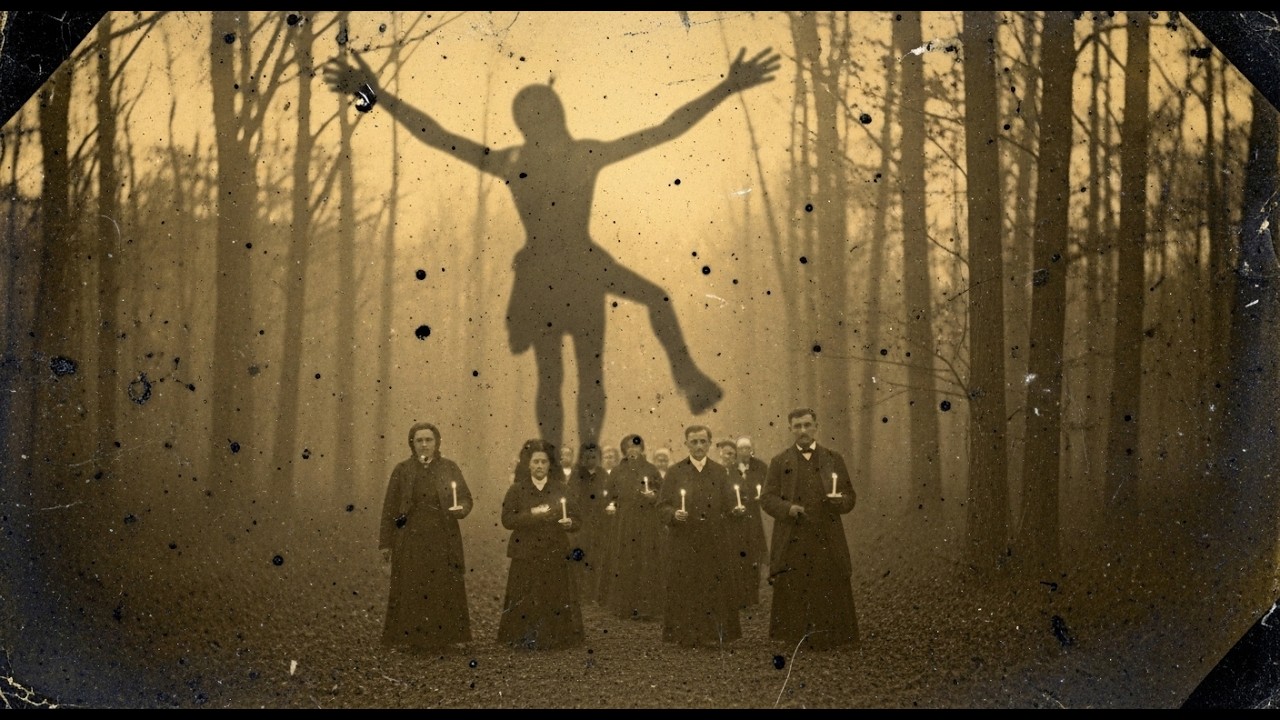
Its inhabitants, a mix of German and Scots-Irish settlers, practiced a form of Christianity that had evolved in isolation for generations, incorporating older folk observances that had drifted far from mainstream doctrine. Shepherd’s Hollow sat in a narrow valley accessible only by a single dirt road through dense forest. The town was self-sufficient and suspicious of outsiders, and its unusual religious practices remained largely unknown to the outside world. In March 1897, a traveling tinker and knife grinder named Cyprian Voss arrived in the settlement.
Voss, a 38-year-old German immigrant, offered his services and was given hospitality by the local general store family. Over the following weeks, he sharpened tools for nearly every household and asked careful questions about the community’s customs and history. According to his journals, which were later deposited in a university archive, Voss had spent nearly a decade searching for isolated communities that preserved older practices. He said his grandmother, who died by drowning after being accused of witchcraft in Germany, had taught him about a way of observing Good Friday that did not mourn Christ’s death but celebrated what she called “the opening.
”
Voss noted several unusual details about Shepherd’s Hollow’s customs. Households maintained banked embers supposedly descended from a fire lit by the first settlers. Wooden human figures were placed at crossroads. No fire was allowed to go completely out.
And the community maintained an annual Good Friday procession that every resident was expected to complete. The route was ancient, allegedly laid out by the first settlers. It passed seven landmarks in the forest. The procession always began at exactly 3:00 in the afternoon, the hour traditionally associated with Christ’s death, and lasted until sunset.
According to Voss, residents could not explain why the ritual was performed, only that it had to be done correctly. He learned that the ritual supposedly provided protection for another year. When he asked protection from what, the community’s eldest member, Heinrich Müller, replied, “From whatever’s waiting. ”
On the day before the procession, the town grew silent.
Residents stopped speaking above a whisper, maintained their fires, and gathered in their homes without conversation. Voss retrieved items from his collection that he said had been passed down from his grandmother, including a mirror with symbols etched into its frame and a notebook of instructions. According to Voss’s account, the entire population of the hollow assembled at the crossroads on Good Friday and began walking the route in silence. He reported that the procession matched breathing rhythms, that carvings at the first landmark depicted a crucified human figure with distorted proportions, and that symbols at other points along the route matched those in his grandmother’s notebook.
The procession passed the seven landmarks, a lightning-struck oak, a spring with iron-red water, a bare clearing, a stone formation resembling a kneeling figure, a ring of birch trees, a gorge where two ridges met, and a hollow stump. At the birch ring, Voss reported hearing Müller recite an invocation in an archaic German dialect, a request to be permitted to remain in their own town. At the final landmark, the hollow stump, Müller placed a wooden cross inside it. The crowd knelt.
According to Voss, the cross began to glow, and a shadow appeared that did not match the movement inside the stump. Using his grandmother’s mirror, Voss claimed he saw an opening in reality through which entities on the other side were observing the kneeling people. He reported a moment of direct contact that gave him sudden understanding. He concluded that the procession was not worship but maintenance, a payment renewed annually by people who had forgotten the original meaning.
The settlement’s ancestors, he believed, had made a bargain with something that existed beyond normal human perception, receiving protection in exchange for an annual opening. Voss claimed he grabbed the cross and pulled until the stump split. Real light poured out, the shadow convulsed, and the threads connecting the entities to the kneeling people snapped. The residents woke from their trance and turned on him in fury, understanding that he had broken their ritual and violated their protection.
He fled through the forest with the cross, chased by the townspeople, and did not stop until he reached a town 15 miles away. His warning was not believed. He left the next morning and never returned, traveling west. Voss kept a detailed journal of the events.
His handwriting deteriorated over time, and his final entry, dated six months after his flight, consists of a single sentence: “They’re still following the threads. ”
A death certificate for a man matching his description records his death in San Francisco in 1898 from “sudden heart failure. ” An examining physician noted unusual burn marks in a geometric pattern at the base of the skull, described as possibly symbolic in nature. The cross Voss reportedly carried was never found among his possessions.
The researcher who found the journal also searched for Shepherd’s Hollow. Scattered references exist, a census record from 1890 listing roughly 230 residents in the area, a surveyor’s note from 1875 mentioning a suspicious valley with German speakers, and a single baptismal record from 1888. Nothing after 1897. The town simply stops appearing in records, with no notation of abandonment or destruction.
The researcher attempted to locate the physical site using map coordinates, but reported encountering an unexplained mental barrier on the approach road. On foot, the researcher experienced severe headaches and visual distortions, and reported seeing a shadow between the trees shaped like a human figure with proportions matching those Voss described. The attempt was abandoned. The researcher concluded that the people of Shepherd’s Hollow had not been killed or driven away but had been taken through the opening after the ritual was broken.
According to this account, the town was removed from human perception while still existing somewhere between here and there. The story remains unverified, with no mainstream historical documentation confirming Voss’s account. The identity and motives of the researcher, and the location of the original journal, have not been independently confirmed. The events described have not been corroborated by any published historical account in the intervening decades.
Whether anything remains of Shepherd’s Hollow, and whether the Good Friday procession continues in some form, cannot be determined from the available documentation.