In late September 1941, German forces and their auxiliaries carried out one of the largest single-site mass killings of World War II at a ravine called Babi Yar, just outside Kiev, Ukraine. Over two days, SS units, German police, and local collaborators massacred 33,785 Jewish men, women, and children.
The massacre came after months of catastrophic losses for the Soviet Union. Despite warnings from Western powers about a German troop buildup along its western border, the Soviet leadership failed to prepare. When Germany launched Operation Barbarossa on June 22, 1941, the invasion achieved almost complete tactical surprise. Much of the Soviet Air Force was destroyed on the ground, and millions of Soviet soldiers were encircled and cut off from supplies, leaving many with little choice but to surrender.
As the German army advanced, SS and police units followed closely behind. Among the first to arrive were the Einsatzgruppen, the Nazi mobile death squads tasked with shooting Jews, Communists, and others deemed dangerous to long-term German rule. German forces entered Kiev on September 19, 1941. Shortly afterward, two major explosions destroyed the German headquarters and killed a large number of German soldiers and officials. The blasts were caused by mines left by retreating Soviet forces, but the Germans used the sabotage as a pretext to murder the Jews still remaining in the city.
Before the invasion, about 160,000 Jews lived in Kiev, roughly 20 percent of the city’s population. After the start of the war, approximately 100,000 fled or were already serving in the Soviet military. By the time the Germans occupied Kiev, about 60,000 Jews remained, mostly women, children, the elderly, the ill, and those unable or unwilling to flee.
On September 28, the Jews of Kiev were ordered to assemble the next morning for resettlement. German authorities expected only about 5,000 to 6,000 people to show up. Instead, more than 30,000 arrived, many still believing they were being relocated. They were marched to Babi Yar, a ravine located just outside the city. There, they were forced to undress and enter the ravine in small groups, where members of Sonderkommando 4a shot them.
A truck driver named Hofer later testified about what he witnessed. Victims were beaten if they hesitated. They were forced to give up their luggage, coats, shoes, and underwear, with separate piles for each article of clothing. Once undressed, they were led into the ravine, which was about 150 meters long, 30 meters wide, and roughly 15 meters deep. At the bottom, SS members forced them to lie down on top of Jews who had already been shot. The corpses were stacked in layers. A police marksman then shot each victim in the neck with a submachine gun, walking across the bodies to reach the next person.
In the evening, the Germans undermined the wall of the ravine and buried the victims under thick layers of earth. The money, valuables, underwear, and clothing of the murdered were turned over to local ethnic Germans and the Nazi administration. Wounded victims were buried alive along with the rest of the bodies. Reports sent to SS headquarters in Berlin recorded 33,785 Jews killed during the two-day massacre.
At least 29 survivors are known. One of them, Dina Pronicheva, was ordered to march to the ravine and forced to undress before being shot. In her postwar testimony, she described seeing groups of men, women, elderly people, and children forced to take off their clothes and led to an open pit where submachine gunners shot them. She heard terrible cries and quiet children’s voices calling for their mothers. She survived by throwing herself into the ditch just before being shot, landing on a pile of corpses, and playing dead. Later that night, she crawled out of the mass grave.
Babi Yar remained a killing site for two years after the September 1941 massacre. Germans stationed in Kiev murdered tens of thousands more people there, including patients from a local psychiatric hospital, Romani and Sinti people, Soviet prisoners of war, and non-Jewish civilians. In total, an estimated 100,000 people were murdered at Babi Yar under German occupation.
In the summer of 1943, with the Red Army approaching Kiev, the Germans attempted to conceal the mass murders. They forced about 300 prisoners from the nearby Syrets concentration camp to dig up the mass graves and burn the remains of the victims. Most of the prisoners involved in the cover-up were then murdered, but a handful escaped and later testified about the crimes.

During the massacre, most local residents remained passive. Some were indifferent, some were content to see the Jews removed, and a few directly participated in the persecution. But there were also those who risked their lives to help. Yente Paya and her six-year-old son survived by disobeying the order to go to the meeting point. They went to people they knew, the Chaplinski family, who hid them until Kiev was liberated on November 6, 1943. After the war, the rescued Jews and their rescuers remained close friends.
Justice caught up with some of the perpetrators in January 1946. Fifteen members of the German police were tried in Kiev for crimes committed at Babi Yar and other atrocities. The trial, known as the Kiev Nuremberg, took place from January 17 to 28, 1946. Fifteen Germans and Austrians were convicted of the murder and torture of civilians and prisoners of war.
On January 24, Dina Pronicheva took the witness stand. Her testimony was recorded on film for a Soviet Ukrainian newsreel. She described how victims were beaten and attacked by dogs, how some begged for mercy while others silently undressed and walked to the ditch, and how some went insane. She heard the rattle of a machine gun from the ravine.
Twelve of the fifteen accused were sentenced to death. Among them was Paul Scheer, a lieutenant general of police who had served as head of the security police in the Kiev and Zhytomyr regions. Scheer, the highest-ranking Nazi defendant in the trial, was accused of carrying out punitive operations in which villagers were burned out and displaced people were shot.
Another defendant sentenced to death was SS-Obersturmbannführer Georg Heinisch, a former district commissar who gave orders to shoot 3,000 children in October 1942. He was also found guilty of shooting 14,000 people during the occupation and sending 1,100 people to Germany. Under his orders, schools were closed and schoolchildren were sent to earthworks.

Karl Burckhardt, another lieutenant general of police, was convicted of carrying out the mass extermination of Soviet civilians under the guise of fighting partisans. Hans Hansen, a member of the SS Viking Division, was found guilty of participating in shootings in the Lviv region, including civilians, women, the elderly, and children. During the trial, he admitted that his unit made four roundups in Lviv within two days, rounding up up to 800 Jewish people who were taken east of the city and shot. Hansen personally shot approximately 120 people.
The other defendants sentenced to death were Fritz Beinhoff, Walter Hoyer, Emil Yot, Emil Vly, Meyer, Eard Hanson, Hans Thun, Geyer, Tren, and Oskar Valer. Three other defendants received prison sentences: two were sentenced to 15 years and one to 20 years of hard labor.
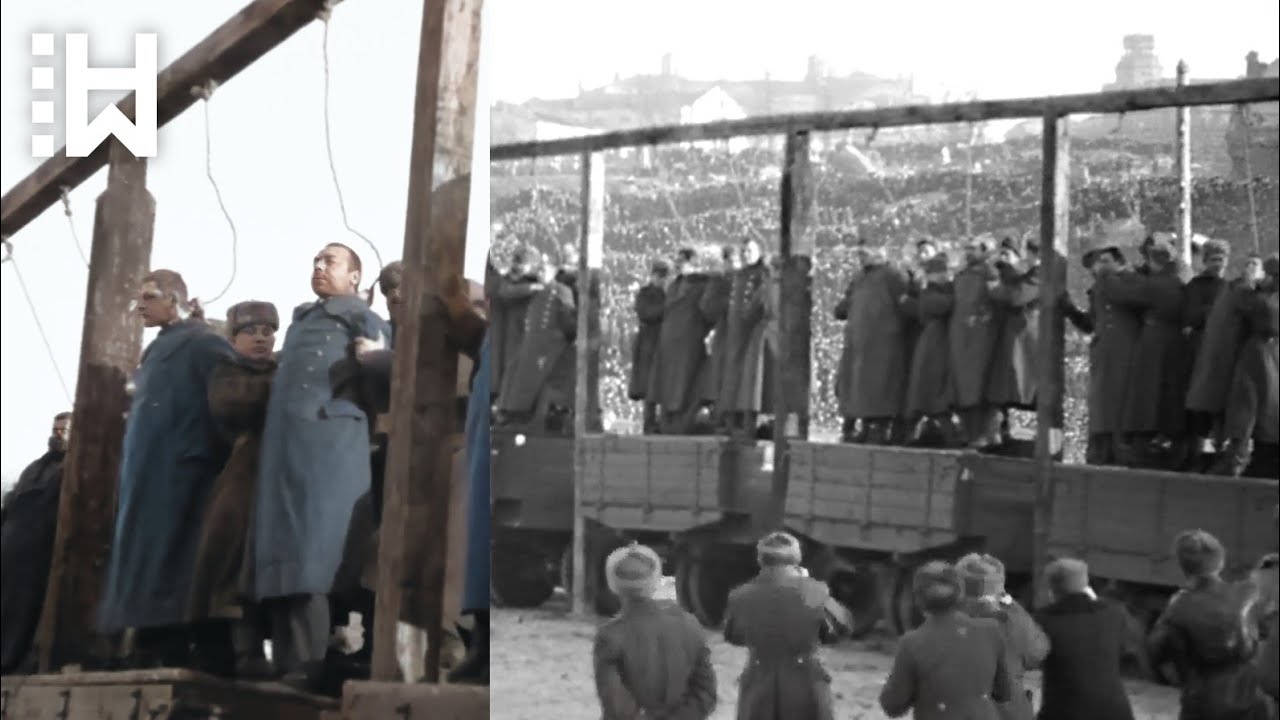
The execution was held publicly in Kiev’s Kalinin Square on January 29, 1946. About 200,000 people gathered in what is today Independence Square to witness the hanging. Soviet officials brought the twelve men to the gallows on six trucks, with two convicts standing on the platform of each truck. After an official speech ended with the words “Comrade commandant, enforce the sentence,” the trucks moved forward, leaving the condemned Nazis hanging.
One rope snapped, and the condemned man, Lieutenant Colonel Geyer, fell. Though ancient tradition held that a man who survived a hanging should be given life, the crowd would not have understood. A spare rope was brought, and he was hanged a second time. The crowd cheered, and disabled people who had suffered under the Nazis used crutches to beat the corpses of the hanged. The bodies were taken down only in the evening and buried at a special site.
The hanging of January 29, 1946, was the last public execution in the history of Kiev. The twelve executed men paid for their crimes, but the vast majority of those responsible for the Babi Yar massacre were never tried. The victims, more than 100,000 innocent men, women, and children, are remembered for the horror they endured and the silence that surrounded it for so long.