On May 28th, 1971, Audie Murphy boarded a small private plane in Virginia despite heavy rain and dense fog. The weather kept getting worse, and witnesses later said the aircraft seemed to be flying in circles, but the pilot never reported any trouble. Then, in the terrible visibility, tragedy struck. The plane slammed into a mountainside fourteen miles northwest of Roanoke.
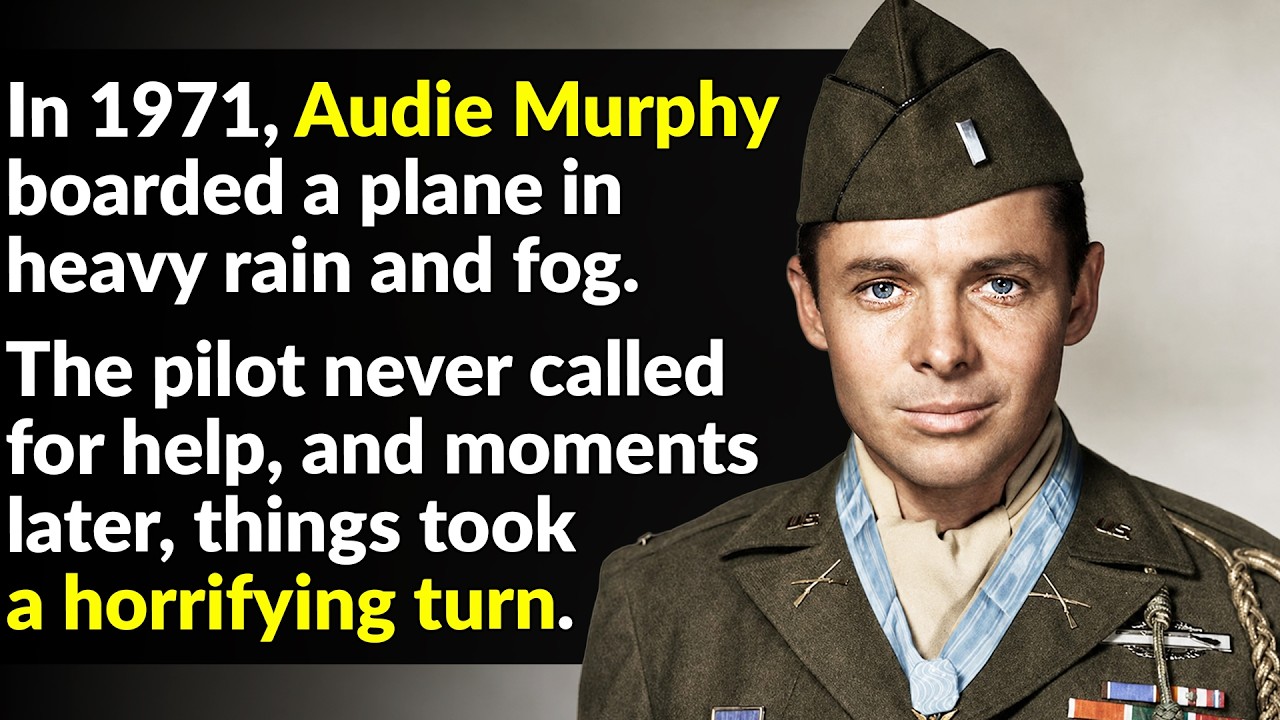
There were no survivors. Audie Murphy, the most decorated American soldier of World War II, a Hollywood star, and a man who had survived the worst of the war, was gone at forty-five years old. To the public, he had lived an all-American success story. Born into poverty in Texas, he had become a national hero, then a movie star, then a wealthy rancher.
But that public image hid a much darker private reality. The same war that made his name also haunted him for the rest of his life, and the final years before that fatal flight were marked by debt, addiction, and a desperate attempt to escape his own memories. Audie Murphy was born in Kingston, Texas, in 1925. His parents, Emmett and Josie, were sharecroppers, which meant they worked land owned by someone else and were constantly exploited and left struggling to get by.
He was the seventh of twelve children, and with that many mouths to feed, the family’s resources were stretched painfully thin. Growing up, Audie was a loner who suffered from dramatic mood swings and a short, explosive temper. As is often the case with troubled children, home life was the likely cause. Emmett wasn’t a candidate for father of the year.
Whenever things got tough, he would disappear for days, drifting in and out of Audie’s childhood before eventually abandoning the family for good. With Emmett gone, everyone old enough to help had to answer the call. Audie dropped out of school in the fifth grade to pick cotton. He also became skilled with a rifle, hunting small game to feed his family.
In 1941, when he was still a teenager, his mother Josie died from pneumonia made worse by endocarditis. The loss devastated the Murphy children. Finding himself an orphan at sixteen, Audie’s grief would stay with him for the rest of his life. Years later, he spoke about his mother in an interview, commenting on her beauty and her thoughtful but stoic nature.
Then he made a devastating admission. When she passed away, she took something of me with her. I’ve been searching for it ever since. Like many boys of his generation, the Japanese attack on Pearl Harbor in December 1941 had a profound effect on him.
He was eager to enlist and serve his country as the United States entered World War II. There was one problem, though. He was still too young. So he had his older sister help him forge documents, falsifying his age.
At first, the Army, Navy, and Marine Corps all turned him down because he was underweight. Eventually, he packed on enough pounds to be accepted into the army. He was deployed to Casablanca in February 1943. Despite his small frame, he immediately excelled, showing bravery and skill in battle.
He received a promotion to corporal and was assigned to the Allied invasion of Sicily, where again he met the moment. The army selected him for Operation Avalanche, a major push in the Allied invasion of the Italian mainland. While on a scouting mission along the Volturno River, Audie and two companions were ambushed by German forces. One of his men was shot, but Audie and his remaining comrade managed to take out five enemy soldiers with grenades and suppressive fire.
His bravery earned him a promotion to sergeant. His exploits eventually led to the liberation of Rome on June 4th, 1944, a turning point in the war. But deployment was hard on him for more than just the obvious reasons. His malnourished upbringing meant he was prone to illness, and he suffered multiple bouts of sickness during the campaign, including malaria.
Deployed next to assist in the Allied invasion of southern France, the young soldier proved himself again and again in remarkable displays of courage. In one incident, he advanced alone on a German-occupied building under direct fire, neutralized six enemies, wounded two more, and took eleven prisoners. In January 1945, he found himself in France’s Colmar Pocket, where his platoon came under heavy attack from German forces. After ordering his company to retreat, Audie was the only Allied soldier left.
Incredibly, he managed to single-handedly hold off a company of German attackers for an entire hour. He was wounded during the fight, but when reinforcements finally arrived, the nineteen-year-old led a counterattack against the Germans. It was an epic moment pulled straight from a movie. Indeed, Audie had something of a flare for the dramatic.
The US Army awarded him the Medal of Honor, the highest decoration given by the United States Armed Forces. By the time he returned home, he had received every US Army combat award for valor available to enlisted men who served in World War II. So heroic was his performance that even other countries recognized him. Though there has been some minor contention, most agree that Audie Murphy is the most highly decorated enlisted man in United States history.
But no heroism comes without cost. Audie racked up an astonishing total of 241 confirmed kills. Before he even set foot back on American soil, military higher-ups were making inquiries about sending him to West Point Academy. Audie never pursued that path.
Some believe the idea of studying for the entrance exam was beyond his capability and indeed his desire. Regardless, when he finally returned home, he received a hero’s welcome. He was showered with parades, banquets, and adoring speeches. The American people were eager to hear his story, and he eventually obliged.
With the help of collaborator David McClure, Audie began work on his memoirs, detailing his life and exploits in the European theater. In 1945, he was featured on the cover of Life magazine, depicted as the most decorated World War II fighter. That brought him to the attention of Hollywood actor and producer James Cagney, who saw potential in Audie’s story. For the next twenty years, Murphy embarked on a successful acting career.
Ten years into it, his memoirs were optioned for a motion picture adaptation, and the hunt was on for an actor to play the lead. There was, of course, an obvious candidate. Though reluctant at first, Audie eventually agreed to play himself in the 1955 autobiographical film To Hell and Back. Oddly enough, it wasn’t the kind of movie he usually led.
His storied career saw him feature in over forty films, the overwhelming majority of which were westerns. He met fellow Hollywood actress Wanda Hendrix in 1946, married her in 1949, and divorced her in 1951. He would marry for a second time later that year. While helping him write his memoirs, David McClure discovered that Audie had a talent for writing poetry.
McClure encouraged him to pursue it, and the accomplished veteran went on to make something of a side career as a songwriter. He wrote poetry as a creative outlet for his stress, penning pieces like The Crosses Grow on Anzio about his experiences overseas. For a time, he seemed to make positive strides in dealing with his turmoil. Audie now had wealth he could scarcely have imagined growing up near malnourished in Texas.
He invested in his hobbies and passions, purchasing two ranches in California and Arizona where he bred quarter horses. He entered the horse racing scene both as a rider and as a provider of horses for other jockeys, becoming a regular at the Del Mar racetrack. He seemed to have plenty of distractions, and given his mental state, those distractions were much needed. Since returning from the war, Audie had been plagued with regular bouts of depression and wrestled with constant insomnia.
His mental state only worsened as the years went on. At the time, his condition was called battle fatigue, but doctors today would diagnose him with a serious case of post-traumatic stress disorder. When he did manage to sleep, he suffered greatly from nightmares about the war. For years, he slept with a loaded pistol under his pillow, a sign of his deepening paranoia.
His first marriage hadn’t lasted long, and his struggles with PTSD likely played a role in its collapse. Years later, Wanda Hendrix claimed that Audie once held her at gunpoint in a bout of paranoid confusion and rage. But his PTSD manifested in less violent, though no less devastating, ways as well. One humanizing aspect of his suffering was the guilt he carried over the lives he had taken overseas.
Hendrix once witnessed her ex-husband tearing up while watching newsreel footage of German children orphaned by the conflict. Guilt is a heavy thing to live with, and Audie Murphy pursued the wrong kind of remedy. Between the guilt and the horrific nightmares, his insomnia eventually became too much. Seeking solace in substances, he developed a dependency on sleeping pills, using them daily, hoping for just one dreamless sleep.
Eventually recognizing that he had become dependent on sedatives, he took drastic measures. In the mid-1960s, he locked himself alone in a hotel room for a week to kick the habit. His efforts were successful, and he found healthier ways to deal with his pain. As the United States became mired in Korea and Vietnam, Audie watched the effects those conflicts had on the next generation of returning veterans.
He began speaking candidly about his own experience with shell shock and advocated for state support for returning soldiers. In his later years, though, he found himself in financial trouble. He had lost a lot of money gambling at the horse track, made some bad investments, and faced tax troubles with the IRS. Through it all, he remained steadfast in his values.
Because of his reputation as a movie star, companies often pursued him to appear in commercials. During his financial dire straits, they courted him to advertise cigarettes and alcohol. Audie was mindful of the poor example that would set for young people, and though he desperately needed the money, he refused to take part in commercials for products he didn’t endorse. It would be the last great stand the grieving war veteran would take.
Then came May 28th, 1971. Audie boarded that private plane in Virginia despite the awful weather. The pilot chose to continue anyway. Witnesses claimed the plane was flying in circles as conditions worsened, but no trouble was reported.
Then, amidst the terrible visibility, the plane crashed into a mountain. There were no survivors. After a thrilling and troubled life, Audie Murphy was gone at just forty-five years old. The state gave him one final salute.
He was interred with honors at Arlington National Cemetery, the graveyard outside Washington DC where some of America’s greatest heroes are buried. In true humble fashion, Audie had requested that his gravestone remain inconspicuous, no different from that of any other enlisted man. Over the years, thousands of visitors to Arlington have paid their respects to Audie Murphy, recognizing his colossal and heroic achievements. His gravesite remains the second most visited in Arlington, behind only that of John F.
Kennedy. It is a touching sign that despite all his troubles, the skinny young boy from Texas made a near presidential impact on his fellow countrymen.