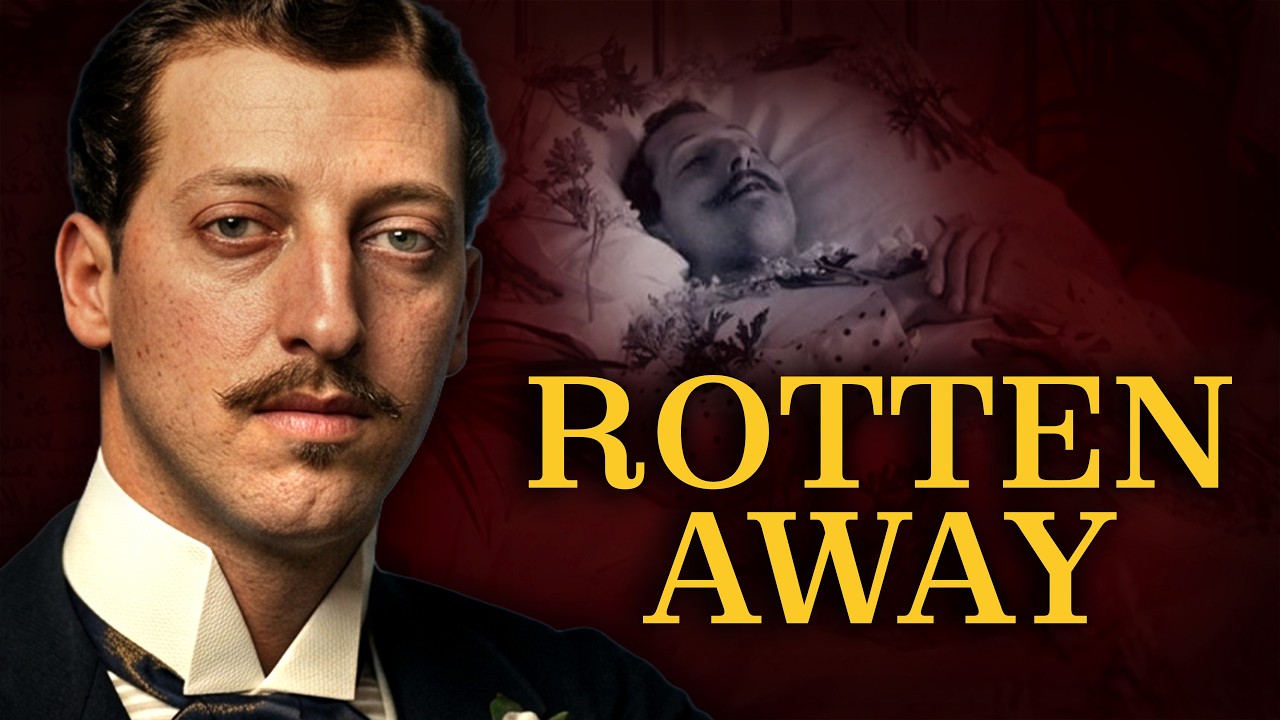
On the morning of January 14, 1892, Prince Albert Victor died in his bed at Sandringham House in Norfolk. He was the grandson of Queen Victoria and second in line to the British throne, behind only his father. Just six days earlier, he had turned 28.
The cause of death, confirmed by three attending physicians, appeared straightforward: pneumonia brought on by the influenza pandemic sweeping Europe. But in the century that followed, writers and conspiracy theorists buried that diagnosis under layers of sensational speculation. They accused him of a body ravaged by syphilis, of roaming the gaslit streets of Whitechapel as Jack the Ripper, and of hiding a life of dissipation behind the public face of a handsome royal son.
How did a quiet, gentle prince become one of the most defamed figures in British royal history? And what does the actual evidence say about the life and death of the man they called Eddy?
Prince Albert Victor Christian Edward entered the world two months earlier than expected. Born on January 8, 1864, at Frogmore House in Windsor, he arrived so prematurely that his survival through infancy remained uncertain. From his first breath, the child held an extraordinary position. As the eldest son of Albert Edward, Prince of Wales, and Princess Alexandra of Denmark, he was second in line to the throne of the most powerful empire on Earth.
Few newborns in Victorian England carried heavier expectations. The family called him Eddy. His younger brother, Prince George, the future King George V, arrived in June 1865, and the two boys grew up in remarkable closeness. Their early lives ran on parallel paths for most of the next two decades.
Their mother, Alexandra, showered both children with a warmth that contemporaries noticed and sometimes criticized as excessive. She clung to her boys and resisted any suggestion that they be separated for educational purposes. This protectiveness was rooted in genuine affection, but it would later complicate the question of how best to educate a boy who struggled in the classroom from the start.
Alexandra herself carried a burden she rarely acknowledged publicly: a partial and progressive hearing loss that worsened throughout her adult life. The condition ran in the family. Whether she recognized the same condition developing in her eldest son, and whether that recognition shaped her fierce protectiveness of him, the historical records do not say. But the question of what Eddy could and could not hear would become essential to understanding the boy's troubled education.
The court at Sandringham and Marlborough House operated under the Queen's heavy shadow. Victoria missed nothing, and she remained deep in grief decades after Prince Albert's death in 1861. She kept a firm grip on family affairs that went beyond protocol. Every decision about Eddy's upbringing was subject to her scrutiny, and she expected her grandchildren to meet strict intellectual and moral standards.
In 1871, when Eddy was seven, Queen Victoria appointed the Reverend John Neale Dalton as tutor to both princes. Dalton kept meticulous notes. As a serious clergyman, he observed that the elder prince's mind seemed abnormally dormant, noting the contrast with George, who showed energy and curiosity. Eddy floundered through lessons that should have taken an hour but stretched to fill an entire morning. Beyond Danish, his mother's native language, the boy struggled to master any subject with consistency.
This judgment, recorded in private correspondence and later discovered by historians, has haunted Eddy's reputation ever since. Generations of writers have repeated the phrase "abnormally dormant" as shorthand for a prince described as too stupid to rule. But the fuller picture appears far more nuanced than that single phrase suggests.
Sir Henry Ponsonby, Queen Victoria's private secretary, suspected that Eddy had inherited his mother's partial deafness, a condition Alexandra had downplayed throughout her life. If lessons reached him as muffled sounds rather than clear instruction, his distraction becomes something other than stupidity. He was a small boy struggling with a limitation he may not have fully understood himself.
Later historians continued this line of inquiry. Andrew Cook, in his 2006 writings, suggested that Eddy's academic difficulties were likely the result of his premature birth. A child born two months early in 1864, without modern neonatal care, faced developmental risks that Victorian medicine could not diagnose or treat. Cook argued that the prince may have suffered from a mild learning difficulty, possibly involving absence seizures. Those brief episodes of detachment from the surrounding environment could easily be mistaken by a Victorian clergyman for laziness or indifference.
None of this points to a young man incapable of living a normal life. It points instead to a boy whose particular needs fell outside the limited educational methods available to him, and whose tutor's honest assessment reflected the limitations of that era as much as the limitations of the pupil.
In 1877, both princes joined the naval training ship HMS Britannia. Dalton recommended that the boys remain together, reasoning that George's sharp intelligence might push Eddy forward, and the family agreed. Life aboard a warship meant entering a structured physical world quite unlike the drawing rooms of Sandringham. The ship's routines, strict schedules, navigation exercises, and enforced discipline provided a framework that may have suited Eddy better than the abstract academic demands of the schoolroom.
Their paths diverged in 1883. George continued his naval career with evident competence, while Eddy enrolled at Trinity College, Cambridge. This arrangement came with an unusual concession. Eddy would attend lectures and participate in university life, but he would be exempt from taking formal examinations. This exemption, designed to spare the prince the humiliation of poor academic performance, tells us much about the family's view of his abilities.
For Eddy, Cambridge functioned more as a finishing school than a rigorous academic institution, a place where he could absorb the atmosphere of intellectual life without being tested on it. Some historians see this as a kind gesture. Others see it as a missed opportunity, a decision that allowed Eddy to drift through another stage of his life without being properly challenged or supported.
By 1885, the question of what to do with a prince who could not excel in the classroom nor pursue a traditional naval career found its answer in the army. The 10th Hussars regiment awaited him. Eddy received a commission as an officer in this cavalry unit, known for aristocratic flair. The appointment suited his rank and social standing, if not necessarily his nature.
Contemporaries who met him during this period described a young man who could be charming in company and agreeable in manner, but who lacked the intellectual drive and personal ambition that the Victorian establishment expected of a future monarch. He performed his military duties without distinction or failure, participating in drills and the social rituals of army officers, and fulfilling the ceremonial obligations that accompanied his rank. But no one mistook him for a natural soldier.
The late 1880s brought a new and pressing question to royal planning. Who would Eddy marry? The stakes were high. His choice of bride carried political and dynastic weight far beyond personal preference. The ideal match would strengthen alliances and reassure the public that the monarchy's future rested in capable, respectable hands.
But no one in the family expected that Eddy, that passive and gentle young man, might actually fall in love. In 1890, he did exactly that. Princess Hélène d'Orléans, daughter of Philippe, Count of Paris, and the exiled claimant to the French throne, became the focus of his affection. By all accounts, the attachment between them was deep and mutual. Even Queen Victoria supported the marriage, a notable endorsement given her usual caution in royal marriage matters.
One obstacle stood in the way, and it proved insurmountable. Hélène practiced Roman Catholicism, and the Act of Settlement prohibited any member of the royal family from marrying a Catholic. Hélène volunteered to convert to Anglicanism, a gesture that proved the depth of her feelings, but the conversion required the approval of Pope Leo XIII, who refused to grant a dispensation. The religious and dynastic incompatibility shattered the relationship.
For Eddy, whose emotional life had rarely attracted the attention of royal planners preoccupied with his intellectual shortcomings, the loss was deeply painful. His grief was genuine. Contemporary accounts describe a young man truly heartbroken, not performing sorrow for the court but living it privately and persistently, withdrawing from the social calendar the family expected him to maintain.
Princess Mary of Teck, known in the family as May, emerged as the replacement. She was a princess of impeccable lineage, sharp practical intelligence, and a temperament that Eddy himself seemed to lack. The family approved of her enthusiastically. On December 3, 1891, at Luton Hoo in Bedfordshire, Eddy proposed and May accepted. Relief spread through royal circles, and a wedding date was set. But events were unfolding beyond the walls of Sandringham that no dynastic planning could have anticipated.
Before addressing the tragedy that ended Eddy's life, the scandal that preceded his death by about three years must be examined. It shaped much of his posthumous reputation and directly fueled the conspiracy theories that later surrounded his name. The year was 1889. In July, London police raided a property at 19 Cleveland Street and discovered a male brothel.
The discovery shocked the governing establishment. Victorian England criminalized homosexuality with harsh penalties. Imprisonment with hard labor, social ruin, and ostracism awaited any man publicly linked to such an establishment. Among those implicated was Lord Arthur Somerset, an official in the Prince of Wales's household and the closest to the royal family. Rumors spread quickly. Within weeks, foreign newspapers began circulating accusations that Prince Albert Victor himself had frequented 19 Cleveland Street.
Had the accusation been proven, it would have represented a catastrophe for the monarchy on a scale difficult to overstate. Homosexuality in Victorian Britain brought not only legal punishment but a kind of moral condemnation from which no public figure, however powerful, could recover.
But what evidence actually linked Eddy to the brothel? Upon close examination, his name never appeared in British press coverage of the scandal. Police files from the investigation contain no mention of the prince, no witness testimony, no visitor log, no intercepted letter placing him at 19 Cleveland Street or linking him to any of its clients. Modern historians have traced the rumors to a likely source: Arthur Newton, the lawyer representing Lord Arthur Somerset, who may have planted stories implicating the prince to divert police attention from his client.
Whether Eddy ever visited the brothel remains unresolved. Theo Aronson, in his 1994 writings, speculated that the prince may have been bisexual and, being highly suggestible, may have accompanied Somerset on one or more occasions. Although his argument rests on inference rather than documentary proof, Andrew Cook, whose 2006 biography formed the most careful modern examination of Eddy's life, reached the opposite conclusion. Cook found no primary evidence of involvement, considering Eddy a victim of what he called "guilt by association." Jane Ridley agreed in her 2012 biography of Edward VII.

Certainty from a distance of more than a century is impossible. But the evidence against the prince amounts to rumor, not fact.
To understand Prince Albert Victor's final days, one must first understand the disease that killed him. Influenza was the cause of death. Between 1889 and 1892, a devastating outbreak known as the Russian flu swept the world. The first cases were traced to St. Petersburg, and it struck with a ferocity that astonished the medical community. Two waves of the pandemic had already hit Britain by the winter of 1891. The country staggered, hospitals filled, and death tolls rose steadily as the disease moved through communities with a speed that defied the quarantine measures available to Victorian medicine.
Influenza itself, though miserable, rarely killed on its own. The danger lay in the pneumonia that followed, as damaged lungs succumbed to secondary bacterial infection that the body, exhausted by days of high fever and breathlessness, could not fight. Millions suffered the same grim progression from flu to pneumonia to death during the 1889–1892 pandemic. The young and the old alike. No social rank offered immunity.
In late December 1891, Eddy attended the funeral of Prince Victor of Hohenlohe-Langenburg, known in England as Count Gleichen, and caught a cold in the winter conditions. No one paid much attention. He returned to Sandringham for Christmas and New Year celebrations, and life at the house continued its usual rhythms of hunting parties, family dinners, and seasonal hospitality.
On January 8, 1892, his 28th birthday, Eddy went out shooting on the Sandringham estate despite feeling unwell. The cold Norfolk air and the physical exertion of a day spent tramping through frozen fields worsened his condition so severely that he could not attend his birthday dinner that evening. The decision to join the shoot, which seemed ordinary at the moment, would cost him his life.
He took to his bed, and the household summoned a doctor. Between January 9 and 13, Eddy's condition deteriorated with frightening speed as doctors diagnosed influenza and watched his lungs fill and his fever climb. Pneumonia began to consume him. The prince became delirious, his consciousness scattering while his body fought a battle he could not win.
Contemporary accounts describe his repeated calls for Hélène d'Orléans, not for his fiancée Princess May, who waited anxiously in the house, but for the woman he had loved and lost two years earlier. Whether this detail reflects genuine feeling distorted by fever, or whether it was added in the telling, cannot be known with certainty. But the image it paints, of a dying prince calling out for a love denied him by religious politics, has stuck in historical memory ever since.
Queen Victoria's diary for January 14 records the arrival of a telegram at Windsor reporting his collapse at 2 a.m., with breathing chiefly affected. Eddy's lungs could no longer keep him alive. He died at approximately 9:15 that morning, attended by three doctors: Dr. William Broadbent, Dr. Francis Laking, and Dr. Alan Reeve Manby. The official cause of death, recorded by the attending physicians, was pneumonia resulting from influenza, just six days after the onset of acute symptoms.
Grief settled over Sandringham immediately and completely. The Prince of Wales, Eddy's father, wrote to Queen Victoria in words stripped of all royal formality: "I would gladly have given my life for his." Princess Alexandra, who had clung to her two boys throughout their childhood, now faced the loss of her eldest son. Princess May, engaged to Eddy for barely six weeks, found herself mourning a fiancé she had scarcely known.
The funeral took place on January 20, 1892, at St. George's Chapel in Windsor Castle. Crowds gathered. Eddy's coffin joined the long procession of English monarchs already buried in that ancient stone chapel, and the ceremony drew condolences from across Europe, reflecting the web of family ties that bound the continent's royal houses together in grief as in marriage.
The national mourning, though sincere, was brief. Within months, public attention turned to other matters, and the prince who might have worn the crown receded to the margins of Victorian memory. It was a fate that would have surprised no one who knew how limited his public presence had been during his lifetime. Yet the decades that followed brought something stranger than oblivion: wild, sensational, and baseless stories that would eventually cling to Eddy's name with a persistence the real prince never showed in life.
For nearly 80 years after his death, Prince Albert Victor occupied a quiet corner of British royal history. No one questioned the official account. James Edmund Vincent's biography, commissioned by the Crown and published in 1893, painted a reverential portrait that concealed all controversy. The volume was so carefully edited that it mentioned neither Eddy's academic struggles nor the Cleveland Street rumors, presenting instead a prince who seemed noble, handsome, and beloved by all who knew him.
That image went unchallenged for generations. Not because historians fully believed it, but because no one cared enough about a dead prince to investigate. Eddy fell into that strange category of historical figures who inspire neither loyalty nor controversy, merely general indifference that nearly erases their memory.
Then in November 1970, a retired London surgeon named Dr. Thomas Stowell published an article in The Criminologist that shook the settled narrative with astonishing force, shattering 80 years of quiet indifference in a single issue of an obscure journal. Stowell claimed that an unidentified suspect, whom he called "Suspect S" but identified with evidence pointing unmistakably to Prince Albert Victor, had contracted syphilis during travels to the West Indies and later descended into the madness of late-stage neurosyphilis. This madness, Stowell argued, drove the prince to commit the Whitechapel murders of 1888. The disease itself, not influenza, caused his death in 1892.

Stowell claimed to have based his theory on private papers of Sir William Gull, a physician who had served the royal family, but no verifiable documents ever surfaced to support this claim. When the backlash came, Stowell retreated. Shortly before his death, he wrote a letter to The Times denying that "Suspect S" represented the prince. The denial convinced almost no one, given the precise biographical details woven into the original article. Details pointed so clearly at Prince Albert Victor that the denial amounted to no more than a belated legal precaution.
The fire he ignited proved impossible to extinguish. Within months of Stowell's article, the theory took on a life independent of its author, moving from a journal article into the broader culture of true crime obsession that marked the British publishing scene of the 1970s. The cultural forces that supported it had nothing to do with evidence. They rested entirely on the commercial power of sensational storytelling.
Stowell's article opened a door that other writers rushed through. In 1976, Stephen Knight published "Jack the Ripper: The Final Solution," weaving the Whitechapel murders into a conspiracy involving the Crown, the Freemasons, and a secret royal marriage to a Catholic commoner. Two years later, Frank Spiering went further, abandoning the elaborate conspiracy machinery and directly accusing Prince Albert Victor of being Jack the Ripper in his 1978 book "Prince Jack."
These books sold well, and the reasons went beyond mere morbid curiosity. The 1970s appetite for anti-establishment narratives, the persistent cultural suspicion of inherited privilege, and the enduring commercial appeal of an unsolved murder case combined to create a market in which the public found the royal suspect irresistible. The story sold itself. A serial killer from the royal family, a syphilitic madman roaming the East End in a top hat, while the palace conspired to cover up his crimes. It was an irresistible image.
But the theory collapses under scrutiny. The alibi evidence alone destroys it. Historians Theo Aronson and Andrew Cook documented that Prince Albert Victor had a confirmed, documented whereabouts during the dates of the 1888 Whitechapel murders. He was stationed in Scotland and Yorkshire, hundreds of miles from London, with court records, social engagements, and travel logs placing him far from the East End on every night in question. No amount of conspiracy theorizing can overcome the simple geographical impossibility of a man being in two places at once.
The syphilis claim fares no better under close medical examination. Stowell's theory required Eddy to have contracted the disease during a visit to the West Indies, then progressed to late-stage neurosyphilis within just a few years. This timeline makes the medical reality of syphilis progression implausible. Tertiary syphilis typically develops 10 to 30 years after initial infection. A patient suffering from neurosyphilis would show unmistakable symptoms: personality changes, physical deterioration, increasingly disturbed behavior visible to everyone. Eddy showed none of these.
In the months before his death, he attended public events, hunted at Sandringham, formally proposed to Princess Mary of Teck, and functioned, in short, as a healthy young man until the moment the Russian flu struck him down. The theory of his rotting body belongs to conspiracy theory, not medicine. It requires us to believe that three doctors attending his death lied about the cause, that the entire Sandringham household participated in a cover-up, and that a disease producing obvious and worsening symptoms somehow escaped the notice of everyone who knew the prince.
The entire theory collapses upon examination on medical and geographical grounds. No credible historian working today endorses this interpretation, and the documented evidence tells a far simpler story. A young man caught influenza during a pandemic, developed pneumonia, and died within a week.
The damage done to Eddy's reputation during the 1970s and 1980s proved difficult to repair. Myths rarely retreat quietly. The Ripperology industry, with its authors, publishers, television producers, and amateur investigators, had little incentive to abandon a suspect as interesting as a royal prince. Each new book drove another nail into Eddy's historical coffin, piling speculation upon speculation until the real man, with his quiet kindness and private struggles, disappeared entirely beneath the caricature.
By the 1990s, Prince Albert Victor occupied a strange dual existence in public consciousness. A figure most people knew nothing about, yet whose name, when it appeared, evoked immediate associations with serial murder and venereal disease. The caricature had replaced the man. Television documentaries recycled the accusations, while true crime bookshelves displayed his face alongside convicted killers.
Restoring the real Eddy, the premature baby, the deaf boy who struggled to hear his tutor, the young prince who called out for Hélène on his deathbed, required not new evidence alone but a completely different kind of attention. Careful historians provided the correction, though the process took decades to gain momentum. Theo Aronson's 1994 book "Prince Eddy and the Homosexual Underworld" addressed the Cleveland Street scandal directly, neither polishing the rumors nor accepting them uncritically. Aronson presented the evidence with scholarly integrity. His work allowed readers to weigh competing claims for themselves.
Andrew Cook's 2006 biography, "Prince Eddy: The King Britain Never Had," went further, forming the most comprehensive modern attempt to separate the documented life from the accumulated myths. Cook examined primary sources that Stowell and Knight never consulted, traced the archival records that contradicted their timelines, and reached a judgment based on documentary evidence rather than dramatic speculation. Eddy emerged as a gentle young man of limited intellect, entirely innocent of the monstrous crimes attributed to him decades after his death. Jane Ridley's 2012 biography of Edward VII reinforced this assessment.
What emerges from these modern studies is a portrait not of a monster or a fool, but of a young man born into circumstances that magnified his weaknesses and ignored his virtues. He never had a chance. His premature birth may have left him with a mild learning difficulty his era could not diagnose or manage, and his partial deafness compounded the problem. He fell in love with a woman he could not marry, and accepted an engagement to a woman he barely knew. All in service to a dynasty whose needs always came before his own.
Then at 28, he caught influenza and died. The conspiracy theories that followed tell us more about the fears and desires of later generations than they do about Prince Albert Victor himself. The accusations served other purposes. Eddy could not answer because the dead cannot defend their reputations. The commercial incentives of true crime publishing and the endlessly renewed fascination with Jack the Ripper found in him a convenient subject: a dead figure far too powerless to defend himself. The fact that no credible evidence supported any of the major accusations mattered little in a market where the dramatic appeal of the charges outweighed their truth.
There is a footnote to the story that carries its own quiet irony. Princess May did not remain in mourning forever. In 1893, she married Eddy's younger brother, Prince George. When George ascended the throne as George V in 1910, she became Queen Mary, consort to the king and grandmother to Queen Elizabeth II. Eddy's death reshaped the entire line of succession. The woman chosen to marry the prince who died became instead one of the defining figures of the British monarchy in the twentieth century.
Had Eddy's lungs held out through that bitter Norfolk winter, the entire course of the royal family, and perhaps the nation itself, might have taken a different path. History does not deal in counterfactuals. But the story still lingers. The crown that would have gone to Eddy went to George instead, and the quiet prince, abnormally dormant, faded into the silence of St. George's Chapel.